Northeast
Trump assassination attempt in Butler, Pennsylvania, has chilling ties to George Washington, first president

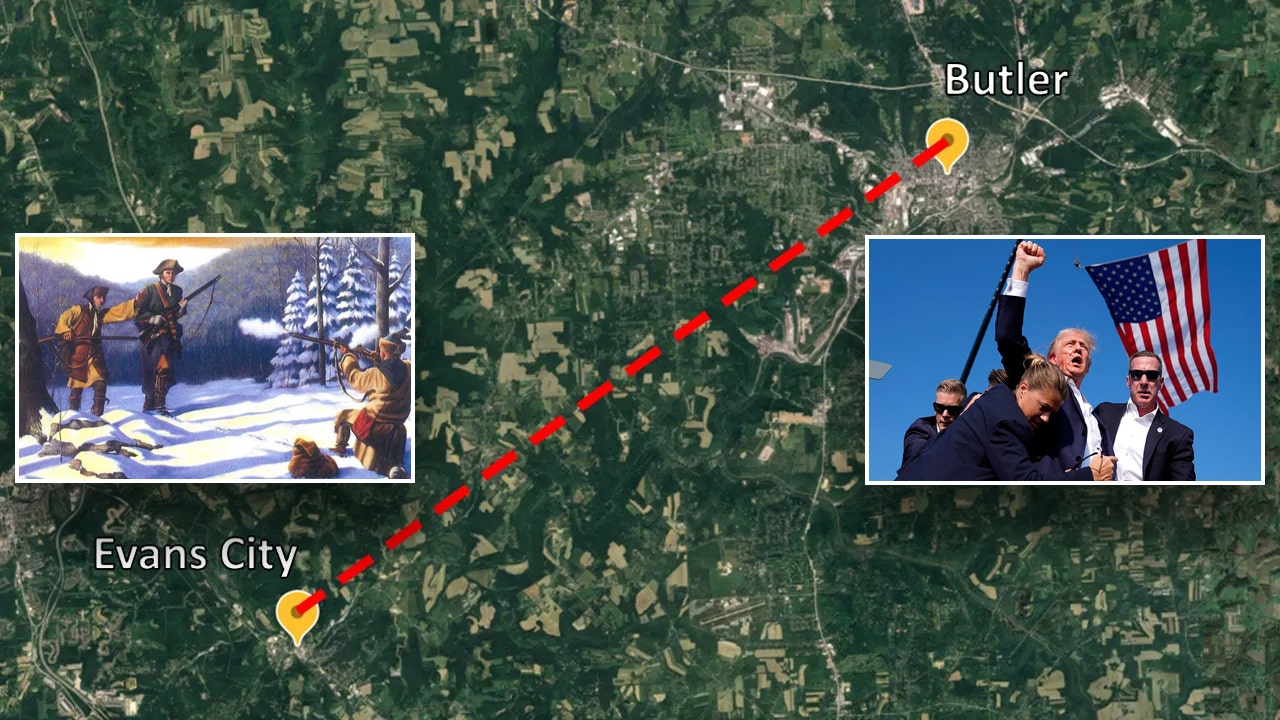
An important figure in American history once narrowly escaped with his life after an assassination attempt in western Pennsylvania – but it wasn’t former President Donald J. Trump.
George Washington, just 21 years old when it happened, was a major in the British Army.
The year was 1753.
TRUMP FLAG PHOTO JOINS PANTHEON OF IMAGES THAT CAPTURE AMERICAN RESOLVE, ERASE POLITICAL DIVIDES
The United States did not yet exist — and young Washington was traveling from Virginia to western Pennsylvania.
His goal? Preventing war.
A monument in Evans City, Pennsylvania, recounts the assassination attempt on George Washington’s life in Dec. 1753. (Derek Shook for Fox News Digital )
Washington “was on his way to go up to Fort Le Boeuf, which would be close to Erie,” Jack Cohen, president of Butler County Tourism and board member of the 1753 George Washington Trail, told Fox News Digital in a phone interview this week.
There, he would meet with French troops “to see if he could stop the French and Indian War,” Cohen said.
Washington had been tasked with delivering a letter from Virginia Gov. Robert Dinwiddie, requesting that the French leave the area.
FAITH LEADERS SHARE URGENT PRAYERS FOR FORMER PRESIDENT DONALD TRUMP AFTER PENNSYLVANIA RALLY SHOOTING
But the French balked at the thought of leaving the area — and a full-blown war would begin about six months after Washington visited Fort Le Boeuf.
Yet even before that, on Dec. 27, 1753, Washington and his guide, a surveyor named Christopher Gist, were following the Venango Indian Trail on their way back to Virginia when they stopped for the night at Connoquenessing Creek in Pennsylvania, Cohen relayed.
The attempt on Washington’s life is memorialized by artist Deac Mong in this 2007 painting called “The First Shot.” The painting is hanging in the Butler County Courthouse. (Deac Mong)
George Washington, shown in this portrait painting by Constable-Hamilton, 1794, went on to serve as president of the United States from 1789 to 1797. (Smith Collection/Gado/Getty Images)
There, the two befriended an “Indian guide” who said he would help them through the wilderness, he said.
As it turns out, the “Indian guide” was allied with the French troops — and was not pleased to see Washington.
The man “loaded his musket and shot at Washington and just missed him.”
The man “loaded his musket and shot at Washington and just missed him,” Cohen said of the chilling murder attempt.
TRUMP SHOOTING: ‘GOD’S HAND OF PROTECTION WAS ON HIM,’ SAYS REV FRANKLIN GRAHAM, OTHERS
“They were going to chase him down and Gist said, ‘Let him go.’ And so they let him go, and they went on their way the next morning.”
Nearly 300 years after the brazen attempt on Washington’s life, the event is chronicled by two markers in what is now Evans City, Pennsylvania – which is close to the Butler Farm Show location where Trump almost lost his life recently.
Evans City, where George Washington, founding father, was nearly killed, is about six miles away from the Butler Farm Show — where former President Donald Trump was nearly killed on July 13, 2024. (Deac Mong; Google Earth; AP Photo/Evan Vucci)
Washington’s would-be assassin, the markers note, was “less than 15 paces from him” when the gunman fired the shot.
Today, Cohen and the other board members are trying to get Washington’s historic route recognized by the National Parks Service as a National Historic Trail.
There are concerted efforts by many to get the route through Pennsylvania that Washington took in 1753 recognized as a National Historic Trail by the National Parks Service. Above, part of the trail. (Derek Shook for Fox News Digital )
“It should be a national trail knowing that George Washington could have been killed here,” he told Fox News Digital.
“That happened right here in Butler County.”
A general view of the trail on which George Washington, founding father, escaped an assassination attempt in present-day Evans City, Pennsylvania on Friday, July 26, 2024. The site of the shooting is about six miles from the Butler Farm Show — where Trump survived an assassination attempt. (Derek Shook for Fox News Digital )
In president-day Evans City, Pennsylvania, George Washington — later the first president of the United States — escaped an assassination attempt when he was 21 years old. The site of the shooting is approximately six miles from the Butler Farm Show. The above photo was taken on July 26, 2024. (Derek Shook for Fox News Digital )
On July 13, 2024 — more than 270 years after Washington escaped an assassination attempt, just six miles away from his campsite in Butler County — former President Trump, too, was spared death as a bullet grazed his right ear.
The similarities between the two events were not lost on Cohen.
Former President Donald Trump suffered a gunshot wound to his right ear from a would-be assassin in Butler, Pennsylvania, on July 13, 2024. (Alex Brandon)
The attempt on Washington’s life was “pretty much like what we just had,” he told Fox News Digital, referring to what happened to Trump.
For more Lifestyle articles, visit www.foxnews.com/lifestyle
“Isn’t that crazy?” said Cohen.
Read the full article from Here

Pennsylvania
Half of child deaths left unreviewed in Pa. since 2020 as counties struggle with ‘unfunded mandate’

Many Pennsylvania counties are failing to review the death of every child in their area, despite a 2008 state law that requires them to do so.
The problem, advocates and program participants say, is a lack of both state assistance in collecting data and time for volunteers to run the local panels.
Gov. Josh Shapiro wants the legislature to approve $2.5 million to improve this work, but it’s unclear if the request will be considered a priority this year.
The effort to study the deaths of Pennsylvania children dates back about two decades, when the state passed a law mandating counties host a local board of healthcare professionals, law enforcement officials, child protective service providers, and a coroner or medical examiner to review the deaths of every resident under the age of 21. The law was one of several initiatives spurred by the murder of Berks County toddler Maxwell Fisher in 1996.
Based on the information county boards gather, members are charged with creating strategies for local and state policymakers to prevent similar deaths.
But reports shared with Spotlight PA by the Pennsylvania Department of Health show that since 2020, roughly half of childhood deaths statewide have not been reviewed. Those lapses are especially prominent in rural counties, where local teams are more likely to falter or not exist.
Policymakers have known about the program’s issues for years.
A multiyear East Stroudsburg University evaluation of the program commissioned by the state Department of Health concluded in 2024 that the Child Death Review program is “an unfunded mandate.” It issued a long list of recommendations to rectify the program’s shortcomings, including creating regional teams for rural areas.
“Staffing turnovers and pandemic disruptions were detrimental to maintaining complete teams in many regions of Pennsylvania,” researchers wrote. “Some have since begun to rebuild while other teams have yet to meaningfully reengage in (Child Death Review).”
Still, lawmakers have failed to adopt legislation — or even introduce any, according to a search of the state General Assembly’s website — to address the issues facing the 2008 law.
The status quo could change this year.
Steven Shapiro, a pediatrician and longtime member of the Montgomery County review team, told Spotlight PA that he and fellow pediatrician Erich Batra, of Lebanon County’s review board, have been urging state officials to improve the “flawed” Child Death Review system. They want a coordinated effort to improve data collection and remove some burdens from counties’ responsibilities.
“If you just unpack how the child succumbed, then you begin to learn about how you can protect other children from enduring the same fate and parents enduring the same fate,” Shapiro said.
Shapiro’s son, Gov. Josh Shapiro, happens to be in a position to help get the program some state funding. Though the elder Shapiro said he does not “try to influence” policy when speaking with his son, some topics come up “over table talk at dinner sometimes.”
Earlier this year, for the first time, the governor proposed using a new $2.5 million from the state’s general fund to support the program. The Department of Health said in an emailed April statement that the money would be used to adopt some of the report’s recommendations. Those include adding health department staff to assist county teams with data collection and prevention strategies, creating a grant that counties could use to “enhance local CDR operations,” and expanding public education campaigns geared toward preventing child deaths.
The Department of Health’s statement did not specify how many positions would be added to improve the program’s organization.
Steven Shapiro said he and Batra are also working on a “cogent, complete and cost-effective” proposal to “redo” how the state is involved in Child Death Review data collection that would not require new legislation. He wouldn’t share details on how that new system might work, but said some funding from the state is essential.
Batra told Spotlight PA the $2.5 million in state funding the governor is proposing would be a good starting point. He envisions it helping counties with data collection and funding local prevention efforts, which can include things like adding signs at dangerous intersections, leading a smoke detector campaign in neighborhoods experiencing fires, or holding fundraisers for a local Cribs for Kids branch.
“A lot of the way Child Death Review works is what I call the intangibles,” Batra said. “It’s the community coming together and working together in a way that they might not always do on a day-to-day basis.”
But Cathleen Palm, founder of the Center for Children’s Justice and a longtime advocate for improving Child Death Review, told Spotlight PA she’s not convinced Gov. Shapiro’s funding pitch alone is a game-changer.
She said that if improving Child Death Review were truly a priority for policymakers, there would be more fanfare around the funding proposal from the Shapiro administration.
Palm also criticized lawmakers for their inaction on addressing issues within the program that have been known for years.
“Why do we create a law if we don’t want to follow it?” Palm said.
In a year where so many competing interests are fighting over a limited amount of state funds, Palm worries Shapiro’s proposal may go overlooked by lawmakers.
“Investing in improvements to the CDR process will further allow the Administration to expand public education and outreach, with a focus on preventable causes of child death,” Rosie Lapowsky, Gov. Shapiro’s spokesperson, said in a statement. “The Governor is hopeful the General Assembly shares that mission of protecting children and ensuring their safety.”
The annual proportion of reviewed child deaths plummeted during COVID-19 and has not fully rebounded, even though there has also been a reduction in the total number of deaths, according to annual reports from the Department of Health.
In the history of the review requirement, county boards have never succeeded in studying every death. The closest they got was in 2013 — statewide, about three-quarters of the 1,931 child deaths that happened that year were reviewed.
That rate dropped to an all-time low in 2019, when 43% of that year’s 1,907 child deaths were reviewed. The drop is often associated with the COVID-19 pandemic, because deaths tend to get reviewed many months after the fact.
The review rate climbed back to nearly 60% in 2023 (of 1,551 deaths), the most recent year for which data are available.
However, local teams across the state left more than 600 deaths unreviewed in 2023.
Unreviewed deaths stem directly from members being “stretched thin with resources” and being “pulled in so many different directions,” according to Christina Phillips, who organized the Child Death Review program from 2018 until her retirement earlier this year.
Phillips said she worked as a “one-person project” at the state level to coordinate with counties about which deaths to review. Part of the reason the Department of Health commissioned East Stroudsburg University to do its 2022-24 study of the program is because Phillips raised concerns, she told Spotlight PA.
Most of the people who serve on local review teams are volunteers who do this work alongside their regular paid positions. Phillips said many rural counties meet as little as once or twice a year.
What they need, she said, is help from state staff to request medical records, synthesize findings into data entry, and translate any patterns they find into prevention strategies.
Phillips said she was unsure why lawmakers have not tried to address advocates’ concerns, given they have received an annual report that highlights those problems for multiple years.
“Preventing kids from dying is never a partisan issue,” Phillips said. “Preventing kids from dying is possible if there are more resources for Child Death Review.”
East Stroudsburg University researchers sorted counties into categories: ones that already have strong review programs; ones that could improve in various ways; and ones that need to be redeveloped.
They identified 20 rural counties that should at least consider organizing under regional offices to maximize their resources, and 22 counties — 6 urban and 16 rural — that must regroup because although they experienced “sufficient deaths to justify a local team,” they saw inconsistent participation from members.
The 15 “strong” counties were a mix of urban and rural, from Philadelphia to a regional operation between Susquehanna and Wyoming Counties, according to researchers. They suggested that 10 other counties, including Allegheny, build on their current processes.
Many of the program’s issues stem from data collection. Researchers at East Stroudsburg found that facilitating data collection falls onto volunteer team chairs. In other states, like Maryland and Delaware, there are paid staff at the state level who coordinate data collection efforts prior to meetings, according to researchers.
Roy Hoffman, medical director of Philadelphia’s Fatality Review Program, told Spotlight PA that even for his team of roughly 15 city employees working on death review, data collection is “a pain” and “time-consuming.”
Philadelphia has operated its own death review group since the 1990s, Hoffman said, and saw few differences following the 2008 law.
“I can imagine for some of these smaller counties with coroners, with not having done this, this must be a big pull and hard to do,” Hoffman said.
The most recent state Child Death Review annual report, analyzing 2023 data, found that Black or African American children died at twice the rate of white children — a statistic in line with national trends.
Roughly 47% of the reviewed deaths in 2023 were caused by medical conditions, including prematurity. “External causes,” including bodily force or a weapon, accounted for about 45% of deaths that year.
Palm pointed to the Department of Health’s finding that roughly one-third of child deaths in 2023 were flagged by local teams as “preventable.”
“All of us as a society want to keep our kids alive and healthy and well,” Palm said. “In order to do that, we have to study the kids who died to figure out how we prevent the next child from dying.”
Palm wants the state to foster the same level of research toward preventing gun safety, motor vehicle crashes, drowning, accidental overdoses, and abuse or violence against kids as it and other institutions direct toward studying youth cancer rates.
Researchers at East Stroudsburg recommended that lawmakers amend current law to require a minimum number of quarterly meetings for each local team, boost training for local and state team members, mandate a specific timeframe for a death review to be completed, and require local teams to include representatives from school districts and “underrepresented community groups.”
They also urged lawmakers to reduce the age cap to trigger a mandated review, from 21 to 18, and to include an “enforcement provision” to encourage counties to participate in the program.
None of the researchers’ suggested changes to Child Death Review have been proposed in the General Assembly, according to a review of introduced bills on the legislature’s website.
The original bill establishing the program was sponsored by Republican state Sen. Lisa Baker. She told Spotlight PA in response to emailed questions that it’s likely time to reevaluate the system with input from state and local stakeholders to “address evolving needs.”
“Given children are potentially falling through the cracks, a closer examination and review of the program is certainly warranted,” Baker said.
Beth Rementer, a spokesperson for Democratic state House Majority Leader Matt Bradford, noted that the chamber passed Shapiro’s budget proposal in April, which included the $2.5 million for Child Death Review.
“We are open to discussions with the administration and stakeholders about improving the program to ensure all children are safe,” she said.
A spokesperson for Republican state Senate Majority Leader Joe Pittman did not respond to questions regarding potential changes this year to Child Death Review.
___
This story was originally published by Spotlight PA and distributed through a partnership with The Associated Press.


Video: Lincoln celebrates its softball championship win over Ponaganset
WATCH: Lincoln celebrates its softball championship win over Ponaganset
PROVIDENCE – The result was so obvious, everyone should have seen it coming.
That’s because Hailey Vigneau doesn’t lose big games.
The La Salle softball team might have been hammered by Chariho during their regular season matchups, but none of that mattered in the postseason. The state’s seen plenty of big-time pitchers, but none that have won like Vigneau. Saturday’s championship game against Chariho only added to her legacy, as she took care of things in the circle, Nikki Pallotta led the offense and the 5-2 win gave the Rams their fourth straight state title.
“We just know how hard we work,” Vigneau said. “We know we have each other. We know how supportive of each other we are. We just know that our team, in the end, will come out on top.”
Softball pitchers are supposed to strike fear with fastballs and sit batters down faster than they can get up to plate. You won’t find many teams that say they’re afraid of Vigneau, but you also won’t find any teams that have beaten her in a game that matters most.
The La Salle senior – who will pitch at Marist next spring – didn’t look bothered by the magnitude of the game she was pitching. If Chariho beat the Rams – which it had done twice this season – that meant an if-game where momentum would be on the Chargers side.
It seemed like a possibility, provided you ignored the fact that Vigneau has never lost a playoff game and wasn’t about to start in her senior season.
Vigneau made one mistake pitch that Adriana Jeannenot hit to outer space, a two-run blast that tied the game in the top of the fourth inning. She took the ball from the umpire, then retired the next batter to end the inning and get her offense on the field.
“I just have to focus on the next one. I can’t dwell on it,” said Vigneau, who gave up four hits and walked two while striking out eight. “Now I can reflect on it, fix what I know I messed up on.
“I didn’t even look. I didn’t turn my head.”
The bats went out and supported their ace. Pallotta had the go-ahead hit, a two-run double that scored Izzy Dong and Samantha Sell. While Pallotta and the Rams struggled to hit Jeannenot in clutch moments in the regular season, it was clear they figured something out.
“Their pitcher is really good and she shut us down in the first game,” said Pallotta, who went 3-for-4 with two RBI and three runs Saturday. “In the second game we started to pick up some hits, we started to learn a lot.
“We were lucky enough to play them twice, we got a lot of data off of that and so when we came into RIC … we had a lot of information and we used it.”
Armed with a 5-2 lead, Vigneau took care of things. The home run was a distant memory and when Alaina Valuk led off the fifth with a single, Vigneau barely noticed. She was in control and remained calm, right up until the final out was recorded, ending her career with a fourth straight title celebration.
“I just pitch one pitch at a time, no matter what the situation is in the game,” Vigneau said. “I can’t focus too much on the big win ahead, just one pitch at a time.”
Chariho was emotional after the loss and why wouldn’t it be? The Chargers entered the season with so much promise, finally got over the hump of beating La Salle and then did it twice in this spring.
But the two playoff losses – Saturday as well as the winners’ bracket final – showed that Chariho still has some work to do to in order to get that title the program wants. The loss will only help inspire the Chargers to keep chasing it next season.
“We had a phenomenal season. I’ve never been more proud of this team,” Jeannenot said. “… It definitely pushes us to go for even bigger things. This year our main thing was to beat La Salle, now I feel like we can have even bigger goals and we can have more success.”
This was supposed to be the year La Salle lost. The Rams graduated all that offensive talent, there’s no way they can overpower teams anymore.
Turns out La Salle didn’t need to. It had a secret weapon who shouldn’t have been so secret and closes her career as the most clutch pitcher Rhode Island has ever seen.
“Without her we probably wouldn’t be here at all,” Pallotta said. “She’s been the ace for the last four years and she always comes up when we need her and she shuts them down.”
“I just enjoyed my time with the girls. Whatever happens, happens, but we just work hard and have fun,” Vigneau said. “I couldn’t have imagined this whatsoever.”

BRATTLEBORO — Ever since the Latchis Theatre debuted the day after the Great New England Hurricane of 1938, its operators have aimed to take the town by storm with one splashy film premiere after another.
Consider “That Certain Age,” a now forgotten musical comedy “rushed from Hollywood by airplane” for the grand opening before its release anywhere else, the local newspaper reported at the time.
Or “The Wizard of Oz,” screened after a 1939 downtown parade that featured the horse-drawn carriage Judy Garland rode through Munchkinland.
Or “Gone with the Wind,” which arrived with the advertised claim, “Brattleboro will be the first town in the country of less than 10,000 population to see it.”
“A lot of the history of cinema has taken place right here,” Jon Potter, the Latchis’ current executive director, said in a recent interview. “We hearken back to a golden age, and part of the experience is a trip back in time.”
This summer, the Latchis is offering the latest sequels to “The Devil Wears Prada,” “Toy Story” and “Spider-Man.” Yet operators say 2026’s biggest draw so far is an Oscar-winning best picture — not the reigning “One Battle After Another,” but 1942’s “Casablanca,” which sold a near-capacity 400 tickets in a recent one-night-only return.
“Things are in a transformative moment,” Potter said. “Our movie audience is half of what it was before the Covid-19 pandemic, so we are doing more special events than ever of all shapes and sizes.”
The Latchis is set to host David Lubin, author of the new book “Ready for My Close-Up: The Making of Sunset Boulevard and the Dark Side of the Hollywood Dream,” as part of a June 14 showing of the 1950 film.
“Democracy Now!” host Amy Goodman will arrive June 19 with her new documentary “Steal This Story, Please!” as part of a program moderated by her brother, VTDigger podcast host David Goodman.
And the “Classics at the Latchis” series that has ranged from 1942’s “Now, Voyager” to 1983’s “Terms of Endearment” will continue June 21 with a Father’s Day presentation of 1973’s “Paper Moon.”
“There aren’t too many places that are a first-run movie theater and also an event space,” Potter said, “and that can be a challenge.”
 100vw, 926px”/><figcaption class=) A horse-drawn carriage that transported Judy Garland in “The Wizard of Oz” arrives outside Brattleboro’s historic Latchis Theatre in 1939. Photo courtesy of the Brattleboro Historical Society
A horse-drawn carriage that transported Judy Garland in “The Wizard of Oz” arrives outside Brattleboro’s historic Latchis Theatre in 1939. Photo courtesy of the Brattleboro Historical SocietyThe Latchis’ main auditorium can’t rely solely on films, as for every “Casablanca” is a current box-office bomb that detonates upon arrival. But the theater also can’t limit itself to live performances, since it’s the only cinema in a half-hour radius.
As a result, the Brattleboro landmark has a history of promising something for everyone.
The Art Deco picture palace opened in 1938 as a memorial to Greek immigrant-turned-impresario Demetrios Latsis. (An Ellis Island registrar misspelled that original surname, resulting in what’s now on the marquee.) The four-story building was billed as “a town within a town” for its cinema, 30-room boutique hotel, restaurant and sidewalk of shops.
The block provided entertainment and escape during the Depression and World War II, then saw audiences scatter with the arrival of Interstate 91 and the internet. The Latchis became a nonprofit organization in 2003, only to face $500,000 in flood damage from 2011’s Tropical Storm Irene and up to $1,000 in daily losses at the height of the 2020 pandemic.
To make ends meet, the Latchis now rents its main auditorium and three smaller screens for private events. It mixes in live stage shows: the Windham Philharmonic played there last week and a new production of the opera “Tristan und Isolde” is set for August. It’s also plugging into technology for simulcasts from New York’s Metropolitan Opera and London’s National Theatre.
Theater manager Luis Negron came up with “Casablanca” when brainstorming a film for Valentine’s Day.
“It’s not only about love,” he said, “but also people were so ready to see heroes winning.”
Even so, Negron was surprised when fans arrived with the lyrics to “La Marseillaise,” the French national anthem that’s heard in the movie.
“When it played, some people stood up and started singing,” he said. “And every time a Nazi appeared, they booed.”
“It turned a little bit into Rocky Horror,” confirmed Potter, referring to the 1975 cult picture show.
The Latchis isn’t sure how locals will respond when it screens 1951’s “A Streetcar Named Desire” in September. But with the latest “Star Wars” spinoff reporting a 70% drop in U.S. ticket sales from its first to second week, the Brattleboro theater is willing to try something different.
“We’re just opening the doors to what we can do here,” Potter said. “There are lots of reasons to stay home, so you have to give people a reason to come out.”
-

 North Dakota7 minutes ago
Mayville Fire and Rescue looking to open regional training facility
-

 Ohio10 minutes ago
At least 12 people shot at an Ohio festival
-

 Oklahoma15 minutes ago
Pedestrian killed in early morning crash on I-235 in Oklahoma City
-

 Oregon22 minutes ago
Texas Baseball Cruises Past Oregon, Moves One Win Away From Omaha
-

 Pennsylvania25 minutes ago
Half of child deaths left unreviewed in Pa. since 2020 as counties struggle with ‘unfunded mandate’
-

 Rhode Island30 minutes ago
How did La Salle win another state title? Having an ace up its sleeve.
-

 South-Carolina37 minutes ago
Countdown to kickoff prediction series: South Carolina gets off to fast start in 2026
-
South Dakota40 minutes ago
SD Lottery Powerball, Lotto America winning numbers for June 6, 2026

