Northeast
Third illegal immigrant captured after ICE facility breakout

NEWYou can now listen to Fox News articles!
FBI officials in Newark, New Jersey, have confirmed that three of four escaped illegal immigrant inmates have been detained.
The four inmates, whom the Department of Homeland Security (DHS) described as “public safety threats,” broke out of Delaney Hall, a privately run ICE detention facility, on the evening of June 12.
This week, the agency captured Franklin Norberto Bautista-Reyes, Joel Enrique Sandoval-Lopez and Joan Sebastian Castaneda-Lozada. Andres Felipe Pineda-Mogollon remains at large.
The three captured suspects, who were living in the United States illegally, are from Honduras, while Pineda-Mogollon was born in Colombia. The FBI is offering a reward of up to $25,000 for information leading to the arrest of Pineda Mogollon.
FBI CONFIRMS CAPTURE OF 2 OF 4 ILLEGAL IMMIGRANTS WHO ESCAPED FROM NEWARK ICE FACILITY
From left to right, Franklin Norberto Bautista-Reyes, Joel Enrique Sandoval-Lopez, Joan Sebastian Castaneda-Lozada and Andres Pineda-Mogollon. (DHS)
Authorities had previously offered a $10,000 reward for information leading to the escapees’ arrests.
Pineda-Mogollon entered the U.S. in 2023 and overstayed his tourist visa. He was arrested by the New York City Police Department on April 25 for larceny and again on May 21 by the Union, New Jersey, Police Department for residential burglary, conspiracy to commit residential burglary and possession of burglary tools.
The suspect’s last known address was in Newark, New Jersey, and he has ties to Queens, New York, the FBI said.
HOMELAND SECURITY REVEALS IDENTITIES OF THE 4 ‘PUBLIC SAFETY THREATS’ WHO ESCAPED NEWARK ICE FACILITY
Bautista-Reyes illegally entered the U.S. in 2021 under the Biden administration and was arrested by the Wayne Township, New Jersey, Police Department on May 3 for aggravated assault, attempt to cause bodily injury, terroristic threats and possession of a weapon for unlawful purposes.
Sandoval-Lopez illegally entered the U.S. as a minor in 2019 and was arrested by the Passaic Police Department in October for unlawful possession of a handgun and again on Feb. 15 for aggravated assault.
4 MIGRANTS ESCAPE FROM NEWARK ICE DETENTION FACILITY, DHS OFFICIAL CONFIRMS
Castaneda-Lozada entered the U.S. illegally in 2022 and was arrested by the Hammonton Police Department on May 15 for burglary, theft and conspiracy to commit burglary.
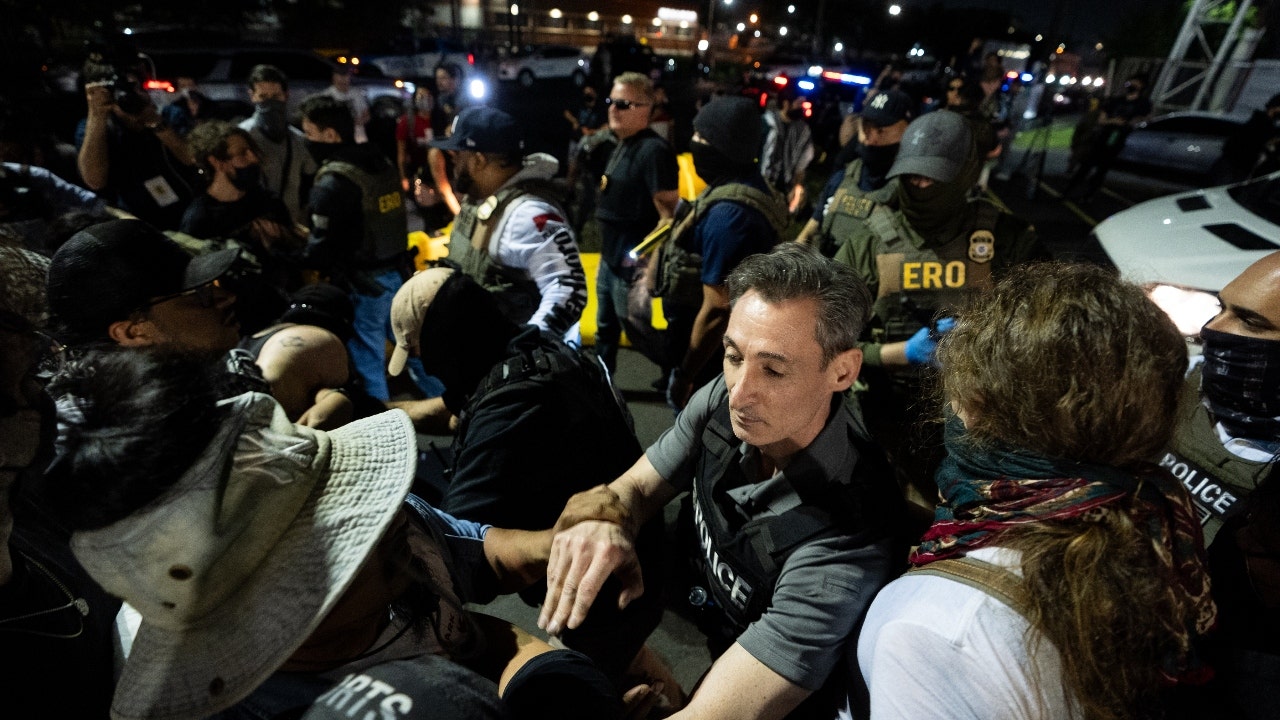
Demonstrators gathered to voice opposition to detention policies and call for accountability at Delaney Hall. (Lokman Vural Elibol/Anadolu)
Immigration attorney Mustafa Cetin told NJ.com that around 50 detainees at the private facility pushed down a dormitory wall after becoming agitated when meals were delayed.
“It’s about the food, and some of the detainees were getting aggressive, and it turned violent,” Cetin said.
BLUE STATE ICE FACILITY RAMPS UP SECURITY WITH NEW BARRICADES AMID CLASHES WITH PROTESTERS
Demonstrators gathered to voice opposition to detention policies and call for accountability at the facility. (Lokman Vural Elibol/Anadolu)
At approximately 9 p.m. on June 12, a group of protesters blocked an SUV from exiting an ancillary gate at Delaney Hall, forcing it to back into the facility.
DHS contested reporting that there had been widespread unrest at the facility, saying the private detention center “remains dedicated to providing high-quality services, including around-the-clock access to medical care, in-person and virtual legal and family visitation, general and legal library access, translation services, dietician-approved meals, religious and specialty diets, recreational amenities, and opportunities to practice their religious beliefs.”
Fox News’ Sandy Ibrahim, Peter Pinedo, Jasmine Baehr and Jennifer Johnson contributed to this report.
Read the full article from Here



Pittsburg, PA
ICE agents being deployed to Pittsburgh International Airport to assist with TSA operations

Immigration and Customs Enforcement agents are expected to arrive at Pittsburgh International Airport on Monday to assist with Transportation Security Administration operations.
A spokesperson for the Allegheny County Airport Authority said that ICE agents are expected to be deployed at Pittsburgh International on Monday. There’s no timeframe on when they’re expected to arrive.
The Airport Authority previously said it was aware of ICE agents being deployed at airports across the country and that it remains in close contact with federal partners at TSA as well as with local law enforcement and the Allegheny County Police Department.
“Safety and security are always the top priority at airports around the country,” the authority said. “We will continue to closely monitor the situation and stay in contact with our law enforcement partners. How federal agencies operate is not something that any airport, including ACAA controls. Any further questions about federal agencies’ operations should be directed to those agencies.”
President Trump said over the weekend that ICE agents will assist TSA agents at airports this week as delays and security staffing shortages continue to worsen amid a stalemate in Congress over how to fund the Department of Homeland Security.
Security wait times at Pittsburgh International have remained consistent in recent days and weeks with most wait times under 15 minutes.

A teen is suffering non-life-threatening injuries from a gunshot wound after a shooting in Hartford on Monday morning, police said.
Hartford Police Lt. Aaron Boisvert said officers were dispatched to the area of East Street around 6:45 a.m. When they arrived, they found a 14-year-old victim with a gunshot wound. The victim is being treated at a local hospital.
“It is not believed that the incident occurred on East Street,” Boisvert wrote in a press release.
Police do not know where the shooting occurred, according to Boisvert.
The Hartford Police Major Crimes and Crime Scene Divisions are investigating the incident.
The investigation is ongoing. Anyone with any information regarding the case is asked to call the Hartford Police tip line at 860-722-TIPS (8477).

The smell of sap and the taste of fresh syrup drew crowds to sugarhouses across Maine as the state celebrated the 43rd annual Maine Maple Sunday Weekend.
More than 100 sugarhouses statewide took part in this year’s event. At Balsam Ridge Christmas Tree Farm in Raymond, visitors got a firsthand look at how Maine sap is turned into maple syrup.
“So far we’ve had a great time, we have enjoyed all the maple treats,” said Doug Noe, a Portland resident.
Balsam Ridge Farm owner Dewey Lloy walked visitors through the process, explaining how sap moves through the evaporator. “Most of the evaporation is going to occur here in the back pan which is the evaporator pan and its going to come to the front pans which are syrup pans and now its becoming maple syrup at this point,” Lloy said.
Lloy said the farm plans to produce more than 300 gallons of syrup this year and expects more than a thousand visitors this weekend.
“It’s always nice to see the young and old and everybody that is just excited to get out and sample soon syrups and get stocked up on some syrup,” Lloy said.
Visitors sampled maple treats while listening to live music and exploring the Christmas tree farm.
Maine Maple Sunday weekend
“They always have great music and food and there’s always nice people to come see,” said Sam Menzel, an Oxford resident.
According to the Maine Maple Producers Association, Maine produces more than 575,000 gallons of maple syrup each year from more than 2 million maple tree taps across the state. As the state’s official sweetener, maple syrup remains a tradition that brings people back year after year.
“Its grown so much in the last years and its amazing to see how well their doing and i love to come support,” Menzel said.
Maine Maple Sunday festivities will continue across the state tomorrow.
For more information click here

Where to catch a Brewers shuttle to American Family Field for 2026 games

Federal immigration agents deployed to Atlanta airport during partial shutdown

ICE at US airports: No sign of agents at MSP

When the Spotlight Hits the Game, Black Artists Take Center Stage – Indianapolis Recorder

ICE agents being deployed to Pittsburgh International Airport to assist with TSA operations

Florida High School Football Rankings: Top 25 teams – Oct. 21

How old is Bo Nix? What to know about Oregon quarterback ahead of 2024 NFL Draft

Cleary's 21 help Le Moyne down Central Connecticut State 69-64 in OT

99th annual Pony Swim held in Virginia

Indiana Members Credit Union announced as new anchor tenant at Bottleworks District

Video: Plane Collides With Vehicle at LaGuardia Airport

As cattle herds shrink and beef prices rise, investors back AI cow collars

French elections: Paris stays left as far right makes mixed gains

ICE officers set to deploy to airports as delays mount, border czar Homan confirms

Video: ICE Agents Will Be Deployed to U.S. Airports, White House Confirms
-

 Detroit, MI4 days ago
Drummer Brian Pastoria, longtime Detroit music advocate, dies at 68
-

 Oklahoma1 week ago
Family rallies around Oklahoma father after head-on crash
-

 Georgia1 week ago
How ICE plans for a detention warehouse pushed a Georgia town to fight back | CNN Politics
-
 Science1 week ago
Federal EPA moves to roll back recent limits on ethylene oxide, a carcinogen
-

 Alaska1 week ago
Police looking for man considered ‘armed and dangerous’
-

 Movie Reviews4 days ago
‘Youth’ Twitter review: Ken Karunaas impresses audiences; Suraj Venjaramoodu adds charm; music wins praise | – The Times of India
-

 World1 week ago
Thousands march worldwide in solidarity with Palestine, Iran on al-Quds Day
-

 Texas3 days ago
How to buy Houston vs. Texas A&M 2026 March Madness tickets