Northeast
Third illegal immigrant captured after ICE facility breakout
NEWYou can now listen to Fox News articles!
FBI officials in Newark, New Jersey, have confirmed that three of four escaped illegal immigrant inmates have been detained.
The four inmates, whom the Department of Homeland Security (DHS) described as “public safety threats,” broke out of Delaney Hall, a privately run ICE detention facility, on the evening of June 12.
This week, the agency captured Franklin Norberto Bautista-Reyes, Joel Enrique Sandoval-Lopez and Joan Sebastian Castaneda-Lozada. Andres Felipe Pineda-Mogollon remains at large.
The three captured suspects, who were living in the United States illegally, are from Honduras, while Pineda-Mogollon was born in Colombia. The FBI is offering a reward of up to $25,000 for information leading to the arrest of Pineda Mogollon.
FBI CONFIRMS CAPTURE OF 2 OF 4 ILLEGAL IMMIGRANTS WHO ESCAPED FROM NEWARK ICE FACILITY
From left to right, Franklin Norberto Bautista-Reyes, Joel Enrique Sandoval-Lopez, Joan Sebastian Castaneda-Lozada and Andres Pineda-Mogollon. (DHS)
Authorities had previously offered a $10,000 reward for information leading to the escapees’ arrests.
Pineda-Mogollon entered the U.S. in 2023 and overstayed his tourist visa. He was arrested by the New York City Police Department on April 25 for larceny and again on May 21 by the Union, New Jersey, Police Department for residential burglary, conspiracy to commit residential burglary and possession of burglary tools.
The suspect’s last known address was in Newark, New Jersey, and he has ties to Queens, New York, the FBI said.
HOMELAND SECURITY REVEALS IDENTITIES OF THE 4 ‘PUBLIC SAFETY THREATS’ WHO ESCAPED NEWARK ICE FACILITY
Bautista-Reyes illegally entered the U.S. in 2021 under the Biden administration and was arrested by the Wayne Township, New Jersey, Police Department on May 3 for aggravated assault, attempt to cause bodily injury, terroristic threats and possession of a weapon for unlawful purposes.
Sandoval-Lopez illegally entered the U.S. as a minor in 2019 and was arrested by the Passaic Police Department in October for unlawful possession of a handgun and again on Feb. 15 for aggravated assault.
4 MIGRANTS ESCAPE FROM NEWARK ICE DETENTION FACILITY, DHS OFFICIAL CONFIRMS
Castaneda-Lozada entered the U.S. illegally in 2022 and was arrested by the Hammonton Police Department on May 15 for burglary, theft and conspiracy to commit burglary.
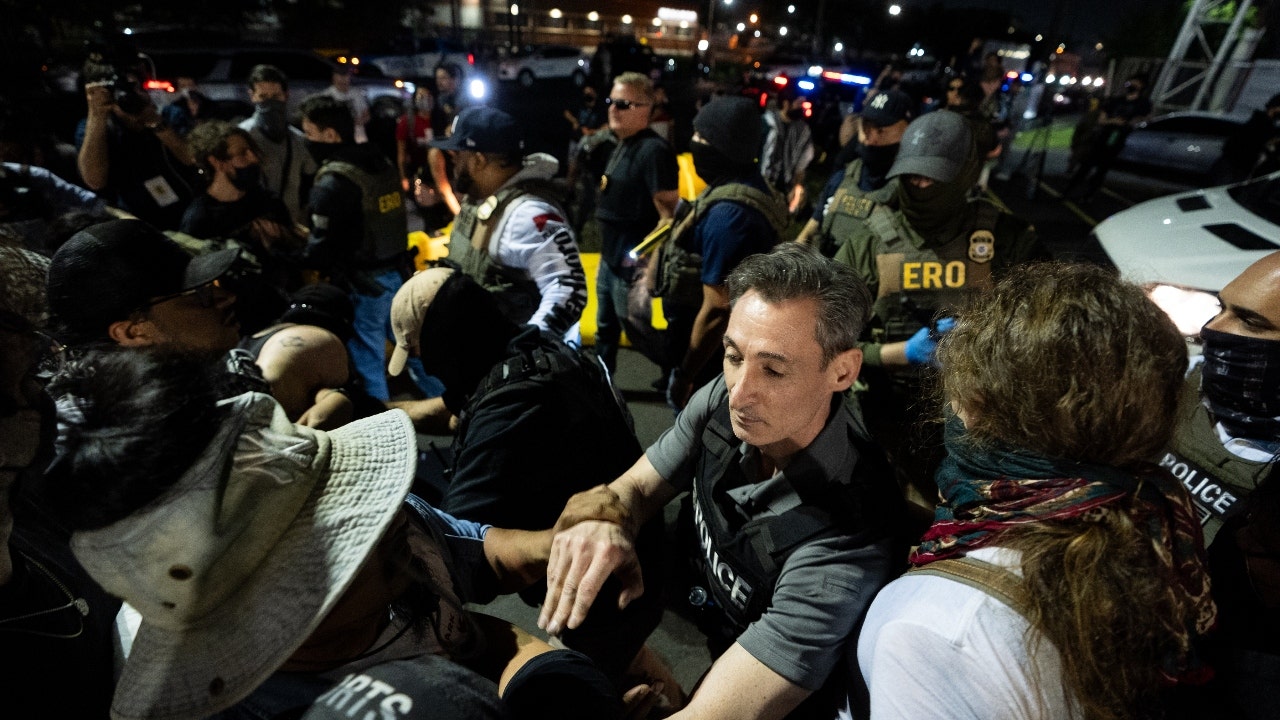
Demonstrators gathered to voice opposition to detention policies and call for accountability at Delaney Hall. (Lokman Vural Elibol/Anadolu)
Immigration attorney Mustafa Cetin told NJ.com that around 50 detainees at the private facility pushed down a dormitory wall after becoming agitated when meals were delayed.
“It’s about the food, and some of the detainees were getting aggressive, and it turned violent,” Cetin said.
BLUE STATE ICE FACILITY RAMPS UP SECURITY WITH NEW BARRICADES AMID CLASHES WITH PROTESTERS
Demonstrators gathered to voice opposition to detention policies and call for accountability at the facility. (Lokman Vural Elibol/Anadolu)
At approximately 9 p.m. on June 12, a group of protesters blocked an SUV from exiting an ancillary gate at Delaney Hall, forcing it to back into the facility.
DHS contested reporting that there had been widespread unrest at the facility, saying the private detention center “remains dedicated to providing high-quality services, including around-the-clock access to medical care, in-person and virtual legal and family visitation, general and legal library access, translation services, dietician-approved meals, religious and specialty diets, recreational amenities, and opportunities to practice their religious beliefs.”
Fox News’ Sandy Ibrahim, Peter Pinedo, Jasmine Baehr and Jennifer Johnson contributed to this report.
Read the full article from Here

Maine
18 jaw-dropping views from Katahdin to help you plan for warmer weather
Editor’s note: This story was originally published in September 2022.
When it comes to Maine hiking, summiting Katahdin is the ultimate achievement.
Maine’s tallest mountain stands at 5,269 feet, and there are a number of different trails hikers can take to get up and down Katahdin. And while some are harder than others, none are easy.
But the views are incredible.
Whether it’s the rugged terrain of the Knife Edge or the vast landscape of the 200,000 acres that compose Baxter State Park below, here’s a look at what it’s like to climb Katahdin.
Hunt Trail


Abol Trail


Chimney Pond Trail

Cathedral Trail


Saddle Trail


Northwest Basin Trail

Knife Edge


Tablelands


South Peak

Hamlin Peak

Massachusetts
Police shoot and kill man armed with knife in Lexington, DA says
Police shot and killed a man who officials say rushed officers with a knife during a call in Lexington, Massachusetts, on Saturday.
Middlesex County District Attorney Marian Ryan said the situation started around 1:40 p.m. when Lexington police received a 911 call from a resident of Mason Street reporting that his son had injured himself with a knife.
Officers from the Lexington Police Department and officers from the Northeastern Massachusetts Law Enforcement Council (NEMLEC), who were already in town for Patriots’ Day events, responded to the call.
Police were able to escort two other residents out of the home, initially leaving a 26-year-old man inside. According to Ryan, while officers were setting up outside, the man ran out of the home and approached officers with a large kitchen knife.
She added that police tried twice to use non-lethal force, but it was not effective in stopping him. The man was shot by a Wilmington police officer who is a member of NEMLEC. The man was pronounced dead on scene and the officer who fired that shot was taken to a local hospital as a precaution.
The man’s name has not been released.
Ryan said typically in a call like this where someone was described as harming themselves, officers would first try to separate anyone else to keep them out of danger, which was done, and then standard practice would be to try to wait outside.
“It would be their practice to just wait for the person to come out. In the terrible circumstances of today, he suddenly rushed the officers, still clutching the knife,” Ryan said.
The investigation is still in the preliminary stages and more information is expected in time. Ryan said her office will request a formal inquest from the court to review whether any criminal conduct has occurred, which is the standard process.
This happened around the same time as the annual Patriots’ Day Parade, and just hours after a reenactment of the Battle of Lexington, which drew large crowds to town.
This is a developing story. Check back for updates.
New Hampshire
New Hampshire grapples with nuclear waste storage – Valley News
In New Hampshire and across New England, nuclear energy is in the spotlight. But as plans for the region’s nuclear future are charted, some of the big questions that stirred New Hampshire in the 1980s remain unanswered.
Gov. Kelly Ayotte has called for New Hampshire to embrace new nuclear technology, while state legislators have introduced multiple bills to promote its development. Then, last week, Ayotte joined the rest of New England’s governors in a bipartisan joint statement calling for the region to pursue advanced nuclear technologies while championing its two existing nuclear power plants.
There are timeline and economic questions about the implementation of emerging nuclear technologies. But front-end logistics aside, some say there’s a bigger and enduring problem: How will we safely handle nuclear waste, in New Hampshire and nationwide?
The spent fuel that nuclear reactors spit out is hot and remains dangerously radioactive for thousands of years. The U.S. Nuclear Waste Policy Act of 1982 requires it be safeguarded and separate from nearby populations for at least 10,000 years. The law also requires the United States to come up with a national system to facilitate that at a centralized location, but no plan has yet emerged.
The matter is close at hand in New Hampshire, from the hilly west of the state, where a federal proposal for a deep nuclear waste storage site once threatened to displace residents, to the Seacoast, where spent fuel from the Seabrook Station power plant is generated and stored. To activists, just how we will handle the hazardous material is a hanging question that challenges the wisdom of embarking on a new nuclear era.
“There have been efforts over several decades here in New Hampshire to raise attention to this issue, but, obviously, we haven’t seen much real movement,” said Doug Bogen, executive director of the Seacoast Anti-Pollution League.
No stranger to nuclear waste
Three hundred or so million years ago, the long, fiery process that turned New Hampshire into the Granite State began. As magma seeped up into the crust from below and began to cool, seams of grainy, crystalline granite slowly formed.
The immense pockets of stone formed through this process are called plutons. When erosion washes away the sediments and soils around them, plutons can form mountains like the 3,155-foot Mount Cardigan. That peak is the crest of New Hampshire’s largest pluton: an approximately 60-mile long and 12-mile wide stretch of granite running through western New Hampshire.
In the 1980s, this swath of stone attracted an unexpected visitor: the United States Department of Energy, searching for a site to excavate a long-term storage facility for the nation’s nuclear waste.
Spent fuel remains radioactive for several million years, but its radioactivity decreases with time. The period of “greatest concern,” where levels of radiation are more dangerous to humans, lasts about 10,000 years, according to the International Atomic Energy Agency.
So, to keep the waste contained over that period, the U.S. government plans to rely on a combination of engineering and favorable geology, according to Scott Burnell, senior public affairs officer with the Nuclear Regulatory Commission. A long-term storage site is envisioned underground, because certain minerals can help shield radiation.
Granite is one such mineral. That’s what drew the department to western New Hampshire in the ’80s, Bogen recalled.
In 1986, the department announced that a 78-square-mile area on the pluton, centered around the town of Hillsborough, was one of a dozen sites across the country under consideration for a potential deep storage facility. Residents understood then that a number of surrounding towns would have been partially or entirely seized by the federal government through eminent domain to make way for the facility. Many were distraught.
“There weren’t any Yankees that were going to take that,” said Paul Gunter, a founding member of the anti-nuclear Clamshell Alliance.
The “Clams,” as well as the New Hampshire Radioactive Waste Information Network, which Gunter also co-founded; the Seacoast Anti-Pollution League; and other environmental groups, towns, and individuals mobilized quickly. In addition to organizing demonstrations, activists also circulated a warrant article opposing the generation and dumping of nuclear waste in New Hampshire. One hundred and thirty-seven towns ultimately voted to pass it, according to the New Hampshire Municipal Association.
Their opposition was multi-pronged, Gunter said. Organizers had health and safety concerns about the management of nuclear power and highly radioactive waste, including a lack of faith that the radiation would be safely isolated from human populations. They were also concerned about the proliferation of nuclear technology and the security risks that would come along with the transport of highly enriched nuclear fuel through their region. With some pacifist Quaker roots, the Clamshell Alliance also was, and remains, deeply opposed to nuclear weapons, Gunter said. They consider the matters of nuclear power and nuclear weapons inextricable.
News that New Hampshire was under consideration for a possible dump broke in January 1986. Later that year, the New Hampshire Legislature passed a law opposing the siting of such a dump in the state. When the Department of Energy dropped New Hampshire from its list, the storm seemed to have passed.
But while the Clams and others celebrated that, they continued to oppose the issue around which they had first come together: Seabrook Station nuclear power plant. At the time, then-Gov. John H. Sununu said he believed the two matters had to be considered separately. But Gunter said opposing the generation of nuclear waste went hand-in-hand with opposing its storage.
To this day, he said, the issues are often discussed separately, allowing the threat of nuclear waste to take a backseat in discussions and planning around nuclear energy.
New Hampshire’s high-level radioactive waste act was quietly repealed in 2011, and a subsequent attempt by the late former Rep. Renny Cushing to reintroduce legislation on the topic, opposing the siting of a high-level waste facility in New Hampshire, was defeated in 2020.
Where we are now
Hillsborough’s story has echoes elsewhere across the country. The most progress toward a potential deep storage site occurred at Nevada’s Yucca Mountain, where excavation took place, but the site was abandoned amid opposition from the state.
In broad strokes, a similar story has repeated in other instances where a site was proposed, Burnell said. But a spokesperson for the Department of Energy, the agency charged with finding a location, said their search continues nonetheless.
President Donald Trump’s administration has taken a new tack, framing the search for a waste facility along with potential new development as a search for a “nuclear lifecycle innovation campus.” The move comes as Trump has attempted to bolster the U.S. nuclear industry, calling for a surge in nuclear generation and development with multiple executive orders.
“The Nuclear Lifecycle Innovation Campuses Initiative is a new effort to modernize the nation’s full nuclear fuel cycle,” a spokesperson for the department’s Office of Nuclear Energy said in an email. That would involve a federal-state partnership with funding for a nuclear technology facility where many stages of the process could be colocated, they said, naming fuel fabrication, enrichment, reprocessing, and “disposition of waste” as some of what would occur at such a site.
The deadline for states to submit “statements of interest” for hosting sites was April 1, and the spokesperson said “dozens” of responses had been filed. But they declined to say whether New Hampshire was among those, and the New Hampshire Department of Energy did not immediately respond to the same question.
In the meantime
Spent fuel generated at Seabrook Station is initially stored in 40-plus-foot-deep pools of water for preliminary cooling, then moved to steel-and-concrete casks, according to Burnell and NextEra spokesperson Lindsay Robertson. The concrete casks remain on-site on a concrete pad, Burnell said. Until another plan is developed, this is the case for spent fuel generated at reactors across the nation.
The storage facilities in use at Seabrook were tested and built to government standards, intended to withstand “extreme weather,” Robertson said. She declined to say how much spent fuel was generated or stored at Seabrook Station.
Since coming online in 1990, Seabrook Station has generated a significant portion of New England’s power without generating much news. Yet Gunter said his concerns about the station and storage of its spent fuel have not been ameliorated with the passage of time.
“They’ve been affirmed,” he said.
Gunter has concerns about concrete degradation and wiring at Seabrook Station and other power plants nationwide. Regarding waste, Gunter and Bogen said they worry about sea level rise affecting the storage area; Seabrook Station is located adjacent to tidal marshland. And, lacking a national plan for more long-term storage of nuclear waste, they wonder what will happen to the material currently stored on a temporary basis at Seabrook if no such plan emerges.
Gunter said his concerns about nuclear waste are part and parcel to his overall opposition to nuclear power, including those generators already in use.
“The new reactors are still on paper. The real threat is really in the day-to-day operation of aging nuclear power plants that are way past their shelf life,” he said.
Nuclear power plants are expensive to construct, creating what Bogen called the “opportunity cost” of embracing them at the expense of other sources of power generation. He and Gunter see renewable energy, principally through offshore wind, as safer and faster to deploy, and were disappointed to see politicians renew their focus on nuclear energy.
“It is coming back in a rebranding, which this industry is very well versed in,” Gunter said. “… Nuclear waste is going to be a persistent hazard over geological spans of time, while the electricity is going to be a fleeting benefit.”
Bogen said he wanted to see more reinforcement of the waste stored at Seabrook in a model called hardened on-site storage. But in terms of dealing with future waste, he and Gunter believe the best solution would be to stop generating it altogether.
“If you find yourself in a hole,” Bogen said, “the first thing you do is stop digging.”
Conversely, the New Hampshire Department of Energy does not see the question of nuclear waste as a barrier to further development in the state, according to an email from department Legislative Liaison Megan Stone. The nuclear roadmap that Ayotte’s March executive order directed the department to craft would include consideration of the “nuclear lifecycle,” including storage and “disposition” of waste, Stone said.
Then, she alluded to the expectation that a federal plan would emerge. “Dry cask storage is a safe and effective method of storing spent nuclear fuel until it is collected by the federal government,” she said.
-
Maine3 minutes ago18 jaw-dropping views from Katahdin to help you plan for warmer weather
-
Maryland9 minutes agoMaryland Lottery Powerball, Pick 3 results for April 18, 2026
-
Michigan15 minutes agoQ&A: Jocelyn Benson on her tenure as Michigan’s secretary of state
-
Massachusetts21 minutes agoPolice shoot and kill man armed with knife in Lexington, DA says
-
Minnesota27 minutes agoBoldy, Eriksson Ek help Wild cruise past Stars in Game 1 of Western 1st Round | NHL.com
-
Mississippi33 minutes agoGeorge County High School senior killed in Highway 26 crash, MHP says
-
Missouri39 minutes ago
Missouri Lottery Powerball, Pick 3 winning numbers for April 18, 2026
-
Montana45 minutes ago
Montana Lottery Powerball, Lotto America results for April 18, 2026