Northeast
Secret Service, FBI respond to Trump rally video showing figure on roof minutes before gunfire

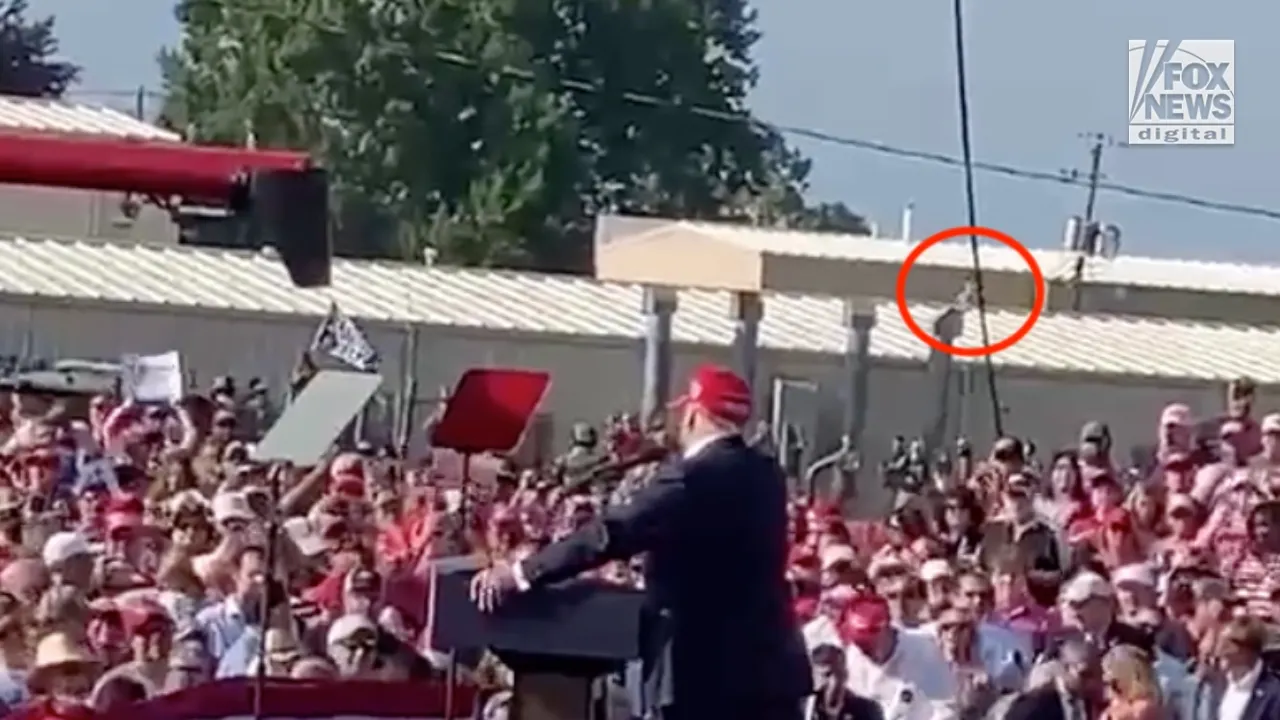
Video shows Trump shooting victim’s POV moments before gunfire
A new video from James Copenhaver, one of the victims critically wounded in a July 13 assassination attempt against former President Trump, shows a figure moving across a rooftop just minutes before gunfire rang out at Trump’s rally in Butler, PA.
The U.S. Secret Service and FBI on Thursday responded to a video recorded by James Copenhaver, one of the victims wounded in a July 13 assassination attempt against former President Trump, showing a figure moving across the roof of the building gunman Thomas Crooks shot from.
The video that Copenhaver shared exclusively with Fox News Digital was taken at 6:08 p.m. on July 13, minutes before Crooks fired at least eight gunshots at 6:11 before counter snipers killed him.
“The Secret Service is committed to better understanding what happened before, during, and after the assassination attempt of former President Trump to ensure that never happens again,” the agency told Fox News in a statement. “That includes complete cooperation with Congress, the FBI and other relevant investigations.”
The FBI told Fox News it is aware of the video but has no further comment.
TRUMP SHOOTING: TIMELINE OF ASSASSINATION ATTEMPT
Republican presidential candidate former President Donald Trump is surrounded by U.S. Secret Service agents at a campaign rally, Saturday, July 13, 2024, in Butler, Pa. (AP Photo/Evan Vucci)
Crooks killed 50-year-old Corey Comperatore — a father and volunteer fire chief — and critically wounded 74-year-old James Copenhaver and 57-year-old David Dutch in his attempt to assassinate the former president. Because Trump turned his head at the last second to look at a projection screen displaying immigration statistics, a bullet sliced Trump’s ear, but he was rushed out of the rally otherwise unscathed.
Law enforcement officials have been working to piece together a timeline of events since that evening to determine how and why Crooks was able to carry out the assassination attempt.
VIDEO FROM TRUMP ASSASSINATION ATTEMPT VICTIM’S POV SHOWS FIGURE MOVING ON ROOF MOMENTS BEFORE GUNFIRE
Republican presidential candidate former President Donald Trump is covered by U.S. Secret Service agents at a campaign rally, Saturday, July 13, 2024, in Butler, Pa. (AP Photo/Evan Vucci)
Republican Iowa Sen. Chuck Grassley’s office released text messages obtained through a public records request showing that law enforcement was aware of a suspicious person near the rally site approximately 90 minutes before gunfire began and took photos of Crooks around 4:36 p.m.
FBI officials told reporters during a press call on Monday that Crooks gained access to the roof of the AGR building by climbing HVAC equipment and piping. He then traversed multiple rooftops before he found his position on top of the AGR building, where he had a direct line of sight to the former president.
TRUMP ASSASSINATION ATTEMPT VICTIM JAMES COPENHAVER ‘SAD’ WITH STATE OF ‘POLITICAL DIVISION’ IN US
Pictures of Thomas Mathew Crooks taken by a sniper. (Sen. Ron Johnson’s Office)
Leading up to the shooting, on July 6, Crooks, of Bethel Park, Pennsylvania, researched how far Lee Harvey Oswald was from the late President John F. Kennedy when Oswald assassinated the former president in 1963.
On July 7, he traveled to the rally site and spent approximately 20 minutes in the area, according to Kevin Rojek, special agent in charge at the FBI’s Pittsburgh field office.
TRUMP ASSASSINATION ATTEMPT: FBI SAYS GUNMAN CLIMBED HVAC, TRAVERSED ROOFTOPS TO SHOOTING PERCH
A sniper spots Crooks looking at his phone and a range finder. At 5:38 p.m., the sniper then sends a message to the “Sniper Group” regarding the suspicious person, later identified as Crooks, according to Johnson’s office. (Sen. Chuck Grassley’s office)
On the day of the rally, Crooks parked his vehicle and flew a drone between about 3:50 p.m. and 4 p.m. about 200 yards from where the former president would be speaking on July 13. FBI Director Christopher Wray testified during a July 17 congressional hearing that Crooks had been at the rally site for about 70 minutes the morning of the assassination attempt.
Fox News’ CB Cotton and Seth Andrews contributed to this report.
Read the full article from Here



NewJerseyDevils.com is the official web site of the New Jersey Devils, a member team of the National Hockey League (“NHL”). NHL, the NHL Shield, the word mark and image of the Stanley Cup and NHL Conference logos are registered trademarks of the National Hockey League. All NHL logos and marks and NHL team logos and marks as well as all other proprietary materials depicted herein are the property of the NHL and the respective NHL teams and may not be reproduced without the prior written consent of NHL Enterprises, L.P. Copyright © 1999-2025 New Jersey Devils and the National Hockey League. All Rights Reserved.


Crews battle blaze on salvage barge in Delaware bay
Crews battled a blaze on a salvage barge in the Delaware Bay Tuesday morning. No injuries were reported. 3/10/26
Delaware, Pennsylvania, and federal agencies have been responding to a barge fire in the Delaware Bay.
The barge, which is carrying salvage metal, is being moved to shallow water so it can be secured, allowing on-scene responders to extinguish the fire and complete salvage operations, according to a March 10 statement from the Delaware Emergency Management Agency.
No injuries have been reported as of 1:15 p.m.
The Delaware Department of Natural Resources and Environmental Control (DNREC) is on scene to perform air monitoring, the statement said.
Responding agencies include the Wilmington Fire Department, Good Will, Leipsic Volunteer, Bowers and South Bowers fire companies. Also there are Delaware State Police, DNREC, New Castle County Office of Emergency Management, Kent County Department of Public Safety, the Delaware Emergency Management Agency and the U.S. Coast Guard Sector Delaware Bay.
The Philadelphia Fire Department was enroute.
This is a developing story. Check back with delawareonline.com for more information.
Send tips or story ideas to Esteban Parra at (302) 324-2299 or eparra@delawareonline.com.

Senate panel endorses reporting exemption for players on New Hampshire Fisher Cats

Chemistry Class | DEVILS NOW | New Jersey Devils

Tanya Tucker to perform at New Mexico State Fair

These 4 Western NC towns are among WorldAtlas favorites for 2026

Four area players land on North Dakota Division A all-state team

Florida High School Football Rankings: Top 25 teams – Oct. 21

How old is Bo Nix? What to know about Oregon quarterback ahead of 2024 NFL Draft

Cleary's 21 help Le Moyne down Central Connecticut State 69-64 in OT

99th annual Pony Swim held in Virginia

Indiana Members Credit Union announced as new anchor tenant at Bottleworks District

Map: 2.3-Magnitude Earthquake Reported North of New York City

Trump stirs GOP primary drama with visit to Massie’s Kentucky home turf

Israeli air strike targets building in south Lebanon

Ed Martin, outspoken Justice Department lawyer, is formally accused of ethical violations | CNN Politics

Trump reveals top issues GOP should focus on to secure midterms victory: ‘I’ve never been more confident’
-

 Wisconsin1 week ago
Setting sail on iceboats across a frozen lake in Wisconsin
-

 Massachusetts1 week ago
Massachusetts man awaits word from family in Iran after attacks
-

 Maryland1 week ago
AM showers Sunday in Maryland
-

 Pennsylvania5 days ago
Pa. man found guilty of raping teen girl who he took to Mexico
-

 Florida1 week ago
Florida man rescued after being stuck in shoulder-deep mud for days
-

 Sports6 days ago
Keith Olbermann under fire for calling Lou Holtz a ‘scumbag’ after legendary coach’s death
-

 Miami, FL6 days ago
City of Miami celebrates reopening of Flagler Street as part of beautification project
-

 Detroit, MI4 days ago
U.S. Postal Service could run out of money within a year