Northeast
Riley Gaines praises HS field hockey team's decision to forfeit, takes swipe at NCAA president

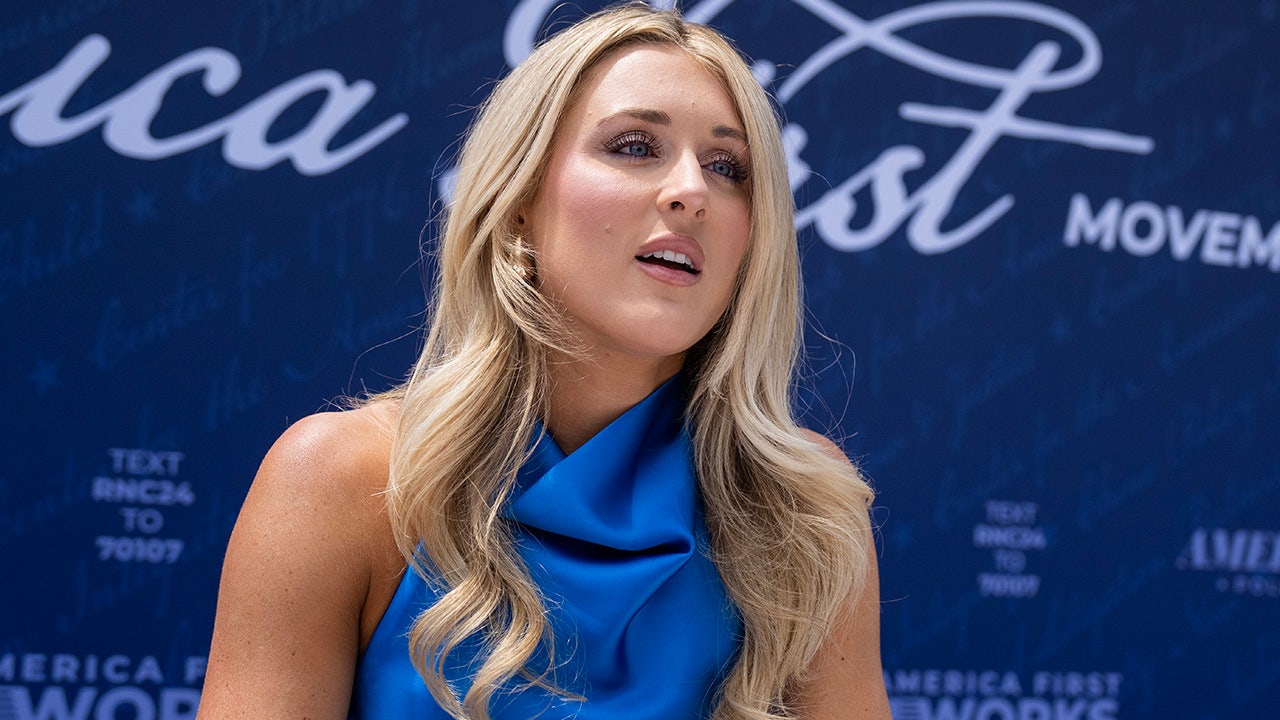
Riley Gaines praised a Massachusetts high school for deciding its girls field hockey team should forgo playing a team that had boys on it, and she also took a swipe at NCAA President Charlie Baker.
Gaines, the host of OutKick’s “Gaines for Girls” podcast and the director at the Riley Gaines Center at the Leadership Institute, appeared on “Don’t @ Me with Dan Dakich” to talk about Dighton-Rehoboth Regional High School’s decision to forfeit against Somerset Berkley.
Riley Gaines (Tom Williams/CQ-Roll Call via Getty Images)
“This is what leadership looks like. There was a team, it was last year, actually, it’s the high school – it’s called Dighton-Rehoboth field hockey,” Gaines said, mentioning last year’s incident. “They are playing another team, Swampscott. A boy is on that team. He slaps a shot, it hits one of the female players in the face. I mean, Dan, she lost all of her teeth. She had to go undergo facial reconstruction surgery to reconstruct her face, her smile.”
“The superintendent released a statement, and he said safety matters more than victory. And I thought that was just incredibly well put. He even went on to say, you know, we might not even get a playoff spot. We might not be able to compete in our league’s championship, and that’s OK because I’m doing my job of prioritizing and protecting my students, my athletes.”
HIGH SCHOOL FIELD HOCKEY CAPTAIN SPEAKS OUT AGAINST RULE ALLOWING BOYS ON GIRLS TEAMS AFTER HORRIFIC INJURY
Tuesday’s decision to forfeit, which came after coaches and team captains convened on the matter, came after a new policy that was put in place allowing players and/or coaches to opt out of any games or competitions against an opposing team that “includes a member of the opposite sex.”
“In accordance with School Committee Police JJIB – Interscholastic Athletics, whose updates were approved by the Dighton-Rehoboth Regional School Committee on June 25, 2024, the District has notified Somerset Berkley Regional High School that we will be forfeiting the Field Hockey contest scheduled for September 17,” the school district’s statement read.
“Our Field Hockey coaches and captains made this decision, and we notified our opponent accordingly,” the statement continued. “The District supports this decision as there are times where we have to place a higher value on safety than on victory. We understand this forfeit will impact our chances for a league championship and possibly playoff eligibility, but we remain hopeful that other schools consider following suit to achieve safety and promote fair competition for female athletes.”
Gaines said she wished Baker would follow suit.
NCAA President Charlie Baker (Michelle Pemberton/IndyStar/USA TODAY NETWORK)
“I wish the NCAA president, Charlie Baker,” Gaines said, “I wish they had half the gumption that this superintendent – I believe his name is Bill Runey – I wish they had half of the courage and the spine that Bill Runey possesses.”
Follow Fox News Digital’s sports coverage on X and subscribe to the Fox News Sports Huddle newsletter.
Read the full article from Here


This is a web edition of GBH Daily, a weekday newsletter bringing you local stories you can trust so you can stay informed without feeling overwhelmed.
Sign up here!
🥵Very hot, with highs around 97 degrees. Sunset is at 8:19 p.m.
GBH’s Dan Murphy captured Abby Evangelista and her corgi, Rocko, at Sail250 this weekend. “Rocko gets dressed up for lots of occasions … sometimes just to go to the store, and he does so great with meeting people,” Evangelista said. Keep reading for more photos from the tall ships.
A year ago today firefighters were extinguishing flames at the Gabriel House, an assisted living facility in Fall River. Ten people died in the fire, a tragedy for their loved ones and a scary moment for about 18,000 people who live in assisted living facilities across the state.
Now state officials have created new regulations for fire safety in assisted living facilities, going into effect later this month. Fire departments will inspect these facilities once a year, and facilities will need to submit emergency plans and train their workers on what to do in case of a fire.
GBH’s Craig LeMoult found that neither the new regulations nor state or federal fire codes address checking sprinkler systems. Some of the sprinklers at the Gabriel House weren’t working the night of the fire, including the ones in the room where it started.
“Had the sprinklers functioned properly, we’re not having this conversation right now. It is maybe a single fatality fire, but certainly not more than that,” Fall River fire chief Jeffrey Bacon told LeMoult. “The good news is that some of the sprinklers did function. And had they not, we would be here talking about 20, 30, 40 victims.” You can read the full story here.
Four Things to Know
1. Colleagues and friends are remembering Louisa Gag, a Boston transportation planner killed last week when a truck driver hit her as she rode her bike near the Roxbury Crossing MBTA stop. Gag grew up in Roslindale and worked for the city on expanding the BlueBikes bike-share program. Before that, she worked for the LivableStreets Alliance, co-authoring a plan to help cities stop traffic deaths. You can see her talk about her work in this 2019 video.
“In moments like these, there is a tendency to reduce the person to the way they died and to their activism,” said Stacy Thompson, a former executive director of LivableStreets. “While we may know Louisa as a deep champion of the city and a close advocate, she’s also a Boston Latin [School] kid. She’s also, like, the most infectious, hilarious person you’ve ever met. She’s also a daughter. It’s so important to us right now for her life to not be reduced to how she stopped living.”
2. More than 4,000 nurses are back at work at Brigham and Women’s Hospital. They went on a one-day strike last week, and hospital administrators kept them from returning to their jobs for another five days. The Massachusetts Nurses Association and Brigham management have been negotiating a contract for seven months, going back and forth over wages, health insurance premiums and staffing levels.
“It’s exciting, but also frightening,” said Christine Forgeron, a cardiac nurse at Brigham and Women’s Hospital. “I don’t know what to expect when we go back to our patients. What happens next, because we still don’t have a contract,is the most unsettling part.”
3. Michael Walsh, a Republican candidate for state attorney general, will be on the primary ballot in September despite what Superior Court Judge Jeffrey Karp called “substantial evidence in the record of voter fraud.” The case began when Adam Roof, executive director of the Massachusetts Democratic Party, submitted a complaint accusing a signature gatherer Walsh’s campaign hired of either falsifying or not meeting state requirements for 1,021 of the 10,677 signatures they submitted. Candidates for statewide office need 10,000 signatures to get onto the ballot.
Karp said that there was indeed evidence that the signatures came not from voters themselves but from a list of registered voters the state’s Republican party gave the signature gatherer. But the case fell on a technicality: state law required Roof, the Democratic party official, to submit his complaint by certified mail, and he did not do so. The state’s highest court still has to decide what will happen to Anne Manning Martin, a Republican candidate for lieutenant governor who used the same signature gatherer.
4. Residents of towns around the Quabbin Reservoir flooded into the Massachusetts Water Resources Authority meeting last week to ask for a better deal. The Quabbin supplies clean drinking water for dozens of cities and towns in the eastern part of the state. Right now, the state requires towns like Shrewsbury, Belchertown, Orange and Pelham to keep their development in check to keep the Quabbin clean. Though those towns get some money in return, local officials said it’s not enough to cover their costs.
“We are protecting this watershed by foregoing any type of economic development, which is a cornerstone of providing the basics of education [and] public safety,” said state Rep. Aaron Saunders, of Belchertown. “It’s time for a change, and not an incremental one.”
Tall ships sail into Boston
Dan Murphy / GBH News
Tomorrow is the last full day of Sail Boston, the city’s tall ships celebration. The ships will leave our harbor Thursday morning. GBH photographer Dan Murphy was there over the weekend to capture the Parade of Sail.

Dan Murphy / GBH News
The Esmeralda, a ship from Chile, sailed by Castle Island.
Dan Murphy / GBH News
Carolyn Gustine carried her son, Patrick, on her shoulders.
You can see the full photo essay here.
Dig deeper:
–Spectators line Cape Cod Canal to see tall ships make their way to Sail250 in Boston
–The World Cup transformed Greater Boston. Will it last?
–Department of Agricultural Resources celebrates Ice Cream Trail program
GBH Daily

It’s going to be another hot week in the Pittsburgh area with high temperatures back into the 90s.
Any Alert Days Ahead? I have us hitting 90 degrees starting on Tuesday through Friday, so that stretch of 4 days are First Alert Weather Days. A severe storm setup looks to be in place for Saturday, so we may also see a FAWD issued for Saturday.
Aware: So far this year, we have seen five 90° days. Tuesday may be our 6th of the year.
Heat index values today are expected to be in the mid-90s, near 100 degrees.
The hottest days of the week will be on Wednesday & Thursday. I have both days seeing highs at 92°.
Rain chances start to tick back up on Friday, late in the afternoon. I have Friday highs still hitting 90, with highs in just the mid-80s on Saturday and Sunday.
There still remains a concern for severe weather on Saturday, with all the ingredients in place. Right now, the chance looks low due to morning rain keeping instability numbers low.
Congress again considering making Daylight Saving Time year-round
I am not surprised that the U.S. Congress is taking up making Daylight Saving Time standard year-round again. The Sunshine Protection Act is the latest attempt by Congress to solve the issue of time and daylight. It’s a plan that you may not realize has been attempted before, and people disliked it so much that it didn’t even last a year.
Let’s start with a brief history of changes to the clock and what we will call Daylight Saving Time. Before World War 1, there was very little in the way of guidelines for states to follow when it came to time. WWI changed things, as the government dictated that Daylight Saving Time be in effect until the war was over in the hopes of conserving energy. Farmers were glad after the war to see the changes come to an end because the later sunrise in the winter meant less time to get out in the fields and get produce to market. Overall, the move to permanent DST was seen as unpopular.
The next big push for DST came during World War 2, and again, the reason for the change was the conservation of energy. Franklin Roosevelt, the president, called year-round DST ‘war-time.’ Once again, after the war, states were allowed to do their own thing. There remained no real federal policy on DST through 1966. That all changed in 1966 with the passing of the Uniform Time Act, signed into law by Lyndon Johnson. This put into effect a mix of daylight saving time and standard time, similar to what we have today; standard time lasted around 3 months longer than what we have today.
Our next energy crisis came in 1967 with the worldwide oil embargo by the Organization of Arab Petroleum Exporting Nations (OAPEC). Our Congress decided to try out a year-round DST across the country. They put the trial period beginning at the start of 1974 and going through the spring of 1975. What could go wrong, right? Well, everything. The public hated the changes, and even worse, nearly 10 kids were killed in early morning hours that first winter period due to low visibility. A program that was supposed to last just two winter seasons was cancelled before we even got to the second winter.
It appears to be a big push again to get Congress to push for permanent Daylight Saving Time hours. I hope they are considering the impact on everyone. For Pittsburgh, that would mean sunrise on some days in the winter around 9 a.m. Sunsets during that time would still be before 6 p.m. The issue is that during the wintertime, Pittsburgh only has around nine and a half hours of ‘daylight.’ We have to figure out the best way to align our clocks to that time. I think what we are doing right now is pretty close to perfect. What do you think?

Florida’s tallest flag pole raises new Stars and Stripes on Independence Day
Florida’s tallest free-standing American flagpole now stands 250 feet tall at Bernice Braden Park in Cape Coral
You might have seen Connecticut’s state flag in government buildings and schools and wondered what the meaning was behind its design.
Adopted by the General Assembly in 1897, the Flag of Connecticut features a navy blue background with a white shield. Three grapevines with purple grapes are on the shield and oak leaves and acorns can be found on the shield’s edge.
Below the shield is a banner which features the phrase “Qui Transtulit Sustinet” written in Latin. According to ConnecticutHistory.org, that phrase translates to “He who transplanted still sustains,” which honors the colonists who moved to the state from England.
Per Encyclopedia Britannica, the three grapevines have two competing interpretations: they represent either the three oldest settlements in the state (Hartford, Wethersfield and Windsor) or the three colonies that merged to form Connecticut (Connecticut Colony, Saybrook Colony and New Haven Colony).
Why is the Connecticut flag blue?
According to ConnecticutHistory.org, the blue comes from Connecticut’s Civil War military flags. During the Civil War, Connecticut regiments had flags featuring blue backgrounds. ConnecticutHistory.org reports that when the legislature adopted an official flag in 1897, they kept the color that military tradition had already established.
Origins of Connecticut’s state flag
Per ConnecticutHistory.org, Connecticut did not have an official state flag until 1897. The site reports that in 1895, the Anna Warner Bailey Chapter of the Daughters of the American Revolution in Groton pushed for an official flag to display in their new meeting room.
Governor Owen Vincent Coffin introduced a bill on May 29, 1895, which ConnecticutHistory.org says caused the legislature to subsequently form a committee. After several designs were submitted, the Connecticut General Assembly adopted the flag in 1897.
Connecticut’s coat of arms, which includes the shield, grapevines and banner featured on the state flag, was not formally standardized until 1931, according to USASymbol.com. The website also says color standards for the flag came in 1956, when the Secretary of the State’s office developed uniform specifications.
-

 World3 minutes ago
Frontières 2026: Lineup and Highlights from a Zombie Wedding to Thai Folk Horror Noir and a Half-Body Filipino Vampire
-
Politics15 minutes ago
Why Supreme Court Justices Are Asking for More Security
-

 Culture45 minutes ago
Do You Know These Greek Plays and Poems That Were Turned Into Movies?
-
 Lifestyle51 minutes ago
Why your favorite international artist might be reconsidering their next U.S. tour
-

 Technology1 hour ago
Nintendo’s Switch 2 bundle that includes a game is $50 off
-

 World1 hour ago
Inside Israel’s mission to train civilians to stop the next Oct 7-like terror attack
-

 Politics1 hour ago
Trump reveals who he’s eyeing to replace Lindsey Graham
-

 Health1 hour ago
Notable figures who died from the same heart condition linked to Lindsey Graham’s death

