Connect with us

Northeast

Reservations for election week getaway sell out in seconds as 'unplugged' travel spot offers steal of a deal

Published

on

Reservations for election week getaway sell out in seconds as 'unplugged' travel spot offers steal of a deal

Join Fox News for access to this content

Plus special access to select articles and other premium content with your account – free of charge.

By entering your email and pushing continue, you are agreeing to Fox News’ Terms of Use and Privacy Policy, which includes our Notice of Financial Incentive.

Please enter a valid email address.

Having trouble? Click here.

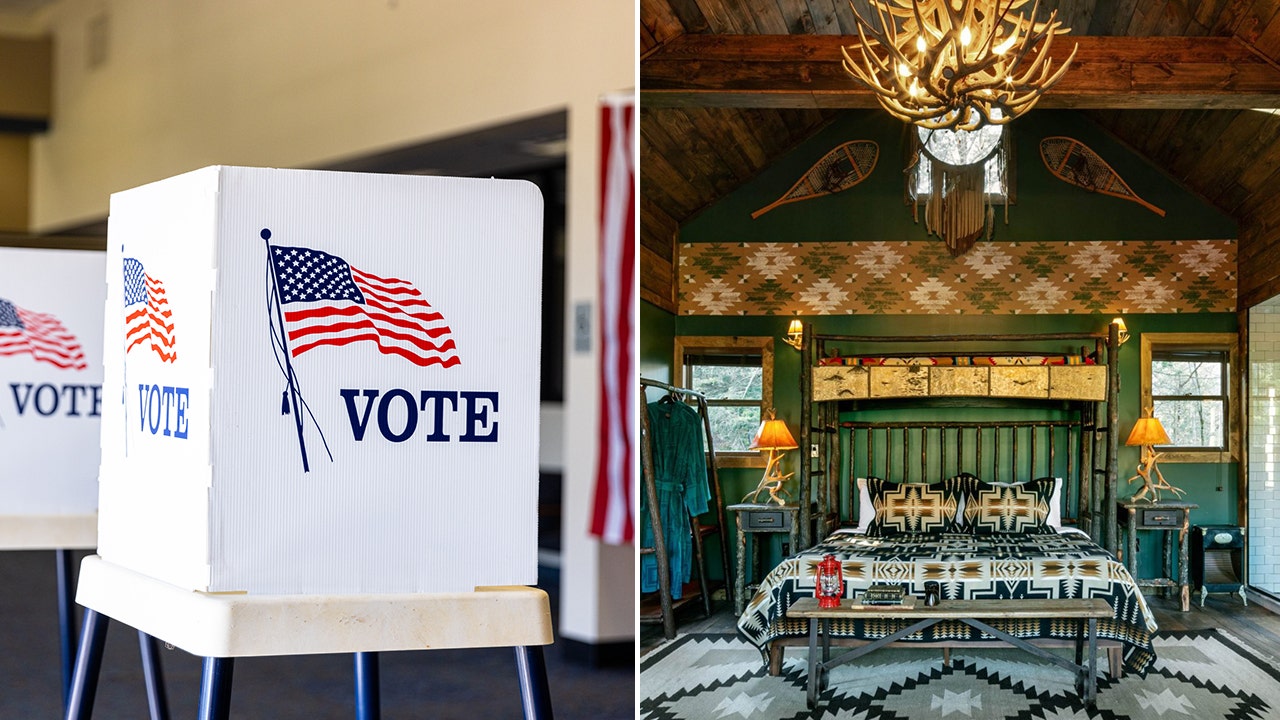
A cabin in the woods that was listed for bookings ahead of the 2024 presidential election sold out in seconds after a near-97% discount was offered to the public.

Urban Cowboy Lodge is a mountainous escape at the Big Indian Wilderness in Catskill Park in Claryville, New York, located roughly three hours north of New York City. 

Advertisement

In collaboration with Sensible Weather, a weather protection provider, Urban Cowboy Lodge announced a limited time “Presidential rate” for the typical $750/night stay the week of Nov. 1 through Nov 7.

RURAL TRAVEL DESTINATIONS WHERE YOU CAN UNPLUG AND HAVE FUN THIS SUMMER

Bookings opened for a pivotal time in America, guaranteeing an unplugged experience for the 2024 presidential election.

Urban Cowboy Lodge is located in Catskill Park in Claryville, New York. (Urban Cowboy Lodge)

For $24 per night, travelers will stay in a suite in the woods featuring luxury bathtubs, rain showers and saunas. Hiking and yoga are also offered.

Advertisement

Urban Cowboy Lodge will take the travelers’ phones upon check-in and replace them with a Polaroid camera in order for visitors to be completely removed from social media and any news surrounding the election results, per the company’s website. 

HOT TRAVEL TREND HAS PEOPLE SEEKING QUIET ESCAPE AND PERSONAL TRANSFORMATION

“After you cast your ballot (whether by mail, absentee, or early voting), you can trade in the anxiety of election week for the serenity of a mountain escape,” the website says. 

Urban Cowboy Lodge rooms typically go for $750/night on a regular week in Catskill Park in New York. (Urban Cowboy Lodge)

A recent study by U.S. News & World Report noted that one of the top five worries at bedtime for Americans is the 2024 presidential election. 

Advertisement

SOLO TRAVEL EXPERTS REVEAL BENEFITS OF TRAVELING ALONE IN 2024, HOT DESTINATIONS TO PUT ON YOUR BUCKET LIST

Dr. Chris Mosunic, chief clinical officer at Calm in San Francisco, told Fox News Digital it’s “no surprise” that the upcoming election is one of the top worries keeping Americans up at night.

“When it comes to getting a good night’s rest, especially in moments of heightened anxiety like the election, practicing healthy habits is crucial to winding down at night,” he said. 

The Urban Cowboy Lodge offers an unplugged experience for those with anxiety surrounding the 2024 presidential election. (Urban Cowboy Lodge)

Blair Staunton, vice president of marketing at Sensible Weather, a weather protection provider for the travel and hospitality industries that partners with Urban Cowboy Lodge, told Fox News Digital the rise of silent travel and anxiety levels surrounding the election helped this offer come to life. 

Advertisement

For more Lifestyle articles, visit www.foxnews.com/lifestyle.

“When we started noticing the rise in ‘silent travel’ – people seeking complete disconnection – and combined that with studies showing increasing anxiety levels surrounding the upcoming election, we knew we needed to offer something to ease as much stress as possible,” she said. 

She also said it’s notable the special sold out in seconds. 

A wilderness escape offered a $24/night special for the week of the 2024 Presidential election. It sold out in seconds. (iStock; Urban Cowboy Lodge)

Advertisement

“’The Election Escape’ was designed to tackle both election and weather worries, but the fact that it sold out in seconds truly underscores how much people need a break from it all,” she said.

Staunton said the success of the special package has the company looking at other ways “to help people disconnect and enjoy their vacations without the unpredictable.”

Read the full article from Here

Advertisement
Continue Reading
Click to comment

Leave a Reply

Your email address will not be published. Required fields are marked *

This site uses Akismet to reduce spam. Learn how your comment data is processed.

Boston, MA

Poor Clares’ monastery a case study in why Boston is short on housing – The Boston Globe

Published

on

Poor Clares’ monastery a case study in why Boston is short on housing – The Boston Globe


But the story of the Poor Clares’ monastery — or as it’s known on the books of the Boston Planning Department, 920 Centre Street — is, at least for now, a case study on how housing doesn’t get built in this city.

It’s a story about how one midsized project with everything going for it — a world-class architect, a brilliant landscape designer, and a developer willing to make one compromise after another to the size and layout of the plan — still can’t move the needle in the face of one powerful opponent.

Advertisement

Well, make that one powerful opponent who has the ear of City Hall.

Faced with dwindling numbers in their order (they were down to 10 in 2022) and a Vatican mandate to consolidate, the sisters decided to sell their 2.8-acre parcel and the aging monastery building to developer John Holland. The building, which they had occupied since 1934, was expensive to heat and in need of extensive repairs.

They relocated to Westwood in 2023, hoping to expand those quarters to accommodate another 10 nuns from around the country as soon as the sale of the Jamaica Plain property became final, contingent on the approval of its redevelopment.

They’re still waiting.

The former monastery is neighbor to the Arnold Arboretum, land owned by the city but under a renewable 1,000-year lease to Harvard University. And no question, the 281-acre parcel is a tree-filled treasure for researchers and picnickers alike. Just try getting near the place on Lilac Sunday.

Advertisement

But the Arboretum, or rather its director, William Friedman, a Harvard evolutionary biology professor, has emerged as a powerful foe.

“The development has been part of the city’s planning process for nearly five years and has undergone several revisions,” Sr. Mary Veronica McGuff, the order’s abbess, wrote in a letter to Mayor Michelle Wu in January and shared with the editorial board. “We are very disappointed to learn that the main obstacle is … the Arnold Arboretum.”

She revealed that the order had earlier offered to sell the property to the Arboretum, but was rebuffed.

“It’s upsetting that our progress is now being hindered by an institution that declined the opportunity to take stewardship of the land and is now making unreasonable demands for its redevelopment,” she said in the letter.

In fact, its market rate condo component, once slated to be five stories high, has been reduced to four stories. Those 38 senior rental units planned for the monastery building will include 25 affordable units.

Advertisement

Project architect David Hacin, winner of the Boston Preservation Alliance’s 2022 President’s Award for Excellence, is equally bewildered.

“I don’t understand how a project that is so good on so many levels is being held up for years, literally, over asks that seem, to me, completely unreasonable,” Hacin told Globe business reporter Catherine Carlock. “If we can’t build five-story buildings, how are we going to solve the housing crisis?”

How indeed.

The developers have done shadow studies, a sunlight analysis, and tree root studies to convince Arboretum officials that the planned housing would do no damage to the magnolia tree roots on the perimeter of Harvard’s grounds, which seem to be their main bone of contention.

The project’s landscape architect Mikyoung Kim has surely not acquired her international reputation for “ecological restoration” by murdering magnolia trees.

Advertisement

Friedman has met with Boston’s planning chief, Kairos Shen, but as of Thursday the sisters have not yet been granted a similar opportunity. Nor have they heard from either Wu or Shen (who was copied in on the Jan. 12 letter) since they made their appeal for help “in finding a solution that allows this project to move forward and for our community to finally settle into our new home.”

In a statement to the Globe editorial board, Wu said, “Large properties like 920 Centre Street are significant housing sites for Boston, and we are working actively with all parties to advance a plan that would deliver homes our city needs.”

For the past year, experts have been warning that the slumping number of building permits in Greater Boston — down 44 percent last year from four years ago — do not bode well for an increase in the future housing supply. That dearth in supply is driving up prices and rents.

And while the Wu administration is quick to blame President Trump’s tariffs and rising costs for the construction slump, it fails to look in the mirror. Enabling the kind of Not In My Back Yard obstructionism that is keeping a good project on the drawing boards for years will never get Boston the kind of housing it needs to keep pace with demand and allow this city to thrive.


Editorials represent the views of the Boston Globe Editorial Board. Follow us @GlobeOpinion.

Advertisement


Source link

Continue Reading

Pittsburg, PA

Plum Borough parents charged with supplying alcohol for underage drinking party

Published

on

Plum Borough parents charged with supplying alcohol for underage drinking party


Two parents are facing charges after police say more than 60 teenagers were drinking at a large party in their Plum Borough home.

According to court paperwork, Ian and Corrine Dryburgh have been charged with endangering the welfare of children, corruption of minors, and furnishing liquor to minors stemming from the incident that happened at a home in Plum Borough late last month.

Police said that officers went to the home after receiving a tip about a large party involving high school aged children.

Advertisement

When officers arrived at the home, they found numerous teenagers, empty beer cans and empty seltzer cans, and multiple bottles of vodka.

The parents told police that a birthday party for their 17-year-old daughter got out of hand and that some kids has been kicked out, but more came and they didn’t know what to do.

According to the criminal complaint, officers said they had been called to the home two previous times for similar reasons. 

Police said a total of 66 underage kids were at the home.

Court records show that both parents have been cited via summons and preliminary hearings are scheduled for mid-April. 

Advertisement


Source link

Advertisement
Continue Reading

Connecticut

Connecticut to receive $154 million for rural health

Published

on

Connecticut to receive 4 million for rural health


Connecticut is set to receive more than $154 million aimed at improving health care in rural communities.

The funding comes from the Centers for Medicare & Medicaid Services’ Rural Health Transformation Program, according to a community announcement.

The Connecticut Department of Social Services will lead the initiative, partnering with other state agencies to implement projects across four core areas: population health outcomes, workforce, data and technology, and care transformation and stability, according to the announcement.

Advertisement

The program will include several innovative projects, such as a mobile clinic pilot with four primary care and four dental vans, a health workforce pipeline through the Area Health Education Center and UConn Health Center, and community health navigators.

“Rural Connecticut has unique challenges, and its residents deserve the same access to high-quality care and support as anyone who lives anywhere else,” Lamont said. “This investment allows us to tackle those challenges head-on – from expanding mental health services and building a stronger health care workforce to modernizing our technology infrastructure and connecting residents to the services they need. This is about making sure every corner of Connecticut has the opportunity to thrive.”

The program was developed through extensive public engagement, including more than 250 written comments, meetings with health care providers, local government officials and community organizations, as well as in-person and virtual listening sessions held across the state, according to the announcement.

Andrea Barton Reeves, commissioner of the state Department of Social Services, highlighted the program’s long-term vision.

Advertisement

“This program reflects our commitment to building systems that work for rural residents over the long term,” she said in the release. “We are excited and grateful to CMS for this opportunity to make sure that our investments are coordinated, impactful, and built to last.”

The program aims to bring health care closer to rural residents while supporting the workforce that provides care, said Dr. Manisha Juthani, commissioner of the state Department of Public Health.

“Every person in rural Connecticut deserves good health care close to home, and the people who provide that care deserve real support too,” Juthani said. “This funding helps us bring care to where people are and build the healthcare workforce our communities need. When we invest in both, we give everyone a better chance at staying healthy.”

Additional information about the Rural Health Transformation Program, including opportunities for public engagement, will be made available as implementation proceeds.

For more information, visit the Connecticut Department of Social Services website at ct.gov/dss.

Advertisement

This story was created with the assistance of Artificial Intelligence (AI). Journalists were involved in every step of the information gathering, review, editing and publishing process. Learn more at cm.usatoday.com/ethical-conduct.


Source link

Continue Reading

Trending
