Pittsburg, PA
Swisshelm Park solar project radiates Pittsburgh’s energy future


Sun beats down on an old slag heap leftover from Pittsburgh’s industrial past in Swisshelm Park. Mountain bikers and hikers cut informal trails across parts of the mound that snake down to Nine Mile Run. But up at the top, a flat, barren expanse prepares for a transition into a 15-acre sea of solar panels.
Last week, the Urban Redevelopment Authority, which owns the property, announced it had received a $2 million grant from the EPA. It’s the last piece of a funding puzzle to clean up the site for solar. The URA had intended to develop housing there. But after struggles to clean up the toxic remains from its past life as part of a former steel manufacturing site and the challenges involved around building a required access road, the agency turned to the sun.
The URA saw an opportunity to “be a part of that transition to a cleaner energy future in the city of Pittsburgh,” according to Lilly Freedman, manager of development projects at the URA. “The site itself is really kind of perfect for solar,” Freedman said. “It’s a serendipity of sorts, because it is flat and cleared and south facing.”
Pittsburgh doesn’t have a reputation for sunshine. Clouds cover about half of Pittsburgh’s sky each year, according to data from the European Centre for Medium-Range Weather Forecasts. But solar energy isn’t that simple. As the impact of climate change accelerates, the race to decarbonize energy sources is on. The cost of solar technology has plummeted in the past decade and lucrative tax credits from the federal Inflation Reduction Act make solar an appealing investment.
Some local organizations have made the bet on solar. The University of Pittsburgh purchased all energy produced at a 20-megawatt solar site by the airport that provides 18% of the university’s power. And Pennsylvania Governor Josh Shapiro committed to using solar to power half of the government’s operations. But to catch up to the nation’s sunnier states, the region will have to blot out some persistent challenges, such as a long line to connect to the region’s power grid and a lack of storage solutions for dark hours.
“It’s pretty clear that we need to clean our energy sources,” said Aurora Sharrard, assistant vice chancellor for sustainability at the University of Pittsburgh. “Local solar power is one way to do that. With the financial incentives out there, both federally and at the state level right now, solar looks very attractive economically and environmentally.”
Here comes the sun
Solar technology works when the sun strikes a photovoltaic panel and the panel turns the sunlight into electricity. Homeowners put solar panels on their roof to capture the sunlight and power their homes and developers set up large, utility-scale solar arrays. Costs vary from about $900 a panel for a rooftop solar installation, to “tens of millions of dollars” for a 100-acre project, according to Tom Daniels, professor of city and regional planning at the Weitzman School of Design at the University of Pennsylvania.
The best indicator of a location’s solar potential is the measure of global horizontal irradiance (GHI), according to Max Zheng, professor of engineering and faculty director at Cornell Atkinson Center for Sustainability. This measures all the solar radiation — direct, diffuse, reflected — that a solar panel could receive. While Pittsburgh is a cloudy city, it is “on par” with several cities in the eastern U.S., such as Boston and Philadelphia, in terms of its solar potential from GHI, according to Zheng who looked at the average GHI between 2000 and 2020 from data from the European Centre for Medium-Range Weather Forecasts.
Bo Yuan and Max Zhang, Cornell University
/
ERA5 Reanalysis from the European Centre for Medium-Range Weather Forecasts (ECMWF)
As far as renewables go, solar is consistent. For wind power, windy locations vary widely within a region and most places with high wind speed on land have already been developed, according to Zheng. There’s also a threshold of wind speed necessary to generate wind power. There is no threshold for the sun to produce solar energy. And the amount of GHI is fairly consistent across a region, providing “many more opportunities to develop solar farms than wind farms,” Zheng said.
And it’s cheap. Solar has the lowest levelized cost of energy in most markets in the U.S., according to a 2023 report from the Energy Technologies Area at the Berkeley Lab. “The key advance is that the cost of solar technology has come way down in the last 15 years,” Daniels said. “So that solar is now the cheapest form of electricity. It’s cheaper than coal. It’s cheaper than natural gas. And it’s even cheaper than wind.”
Another part of solar’s bargain came from the federal Inflation Reduction Act, which offers a 30% tax credit for solar installations until 2032.
Taking a chance despite challenges
The biggest challenge for solar development in southwestern Pennsylvania is the long line to get on the grid. The local operator, PJM, has a years-long backlog of projects waiting to get connected; over 90% of these projects are for renewable energy sources, according to a PJM spokesperson.
Unlike California with fields of shipping container-sized batteries to store excess solar power for use at night or on cloudy days, Pennsylvania does not have any battery storage facilities. That could change if utility-scale projects in the state start to take off, according to Daniels.
The largest solar project is Western Pennsylvania is the BE Pine 66-megawatt utility-scale array in Beaver County. The net proceeds from the solar power goes to Dollar Energy Fund, a Pittsburgh nonprofit that helps people pay their utility bills. The project became operational last December and it’s projected to bring in $75 million over 35 years, according to Chad Quinn, CEO of Dollar Energy Fund.
On top of the slag heap in Swisshelm Park, construction starts next year. The URA is waiting to find someone to purchase the energy produced. They’re watching to see if a bill legalizing community solar programs — a sort of neighborhood co-op for solar energy — passes the Pennsylvania State Senate.
“People have a perception of Pittsburgh as being too cloudy for solar,” Freedman said. “And that’s really not true. I think that’s a big misconception. We’re really hoping to show with this project — a pilot for solar on public lands — that it is possible. This is a story, to us, not just of solar development. But Pittsburgh’s transition into a green, clean city, that is no longer environmentally harming our public land.”



Pittsburg, PA
‘It began right here in the Hill District’: Bill from Rep. Lee seeks national honor for Freedom House


Hear from the Buro Happold team on the engineering behind Pittsburgh International Airport’s new landside terminal.
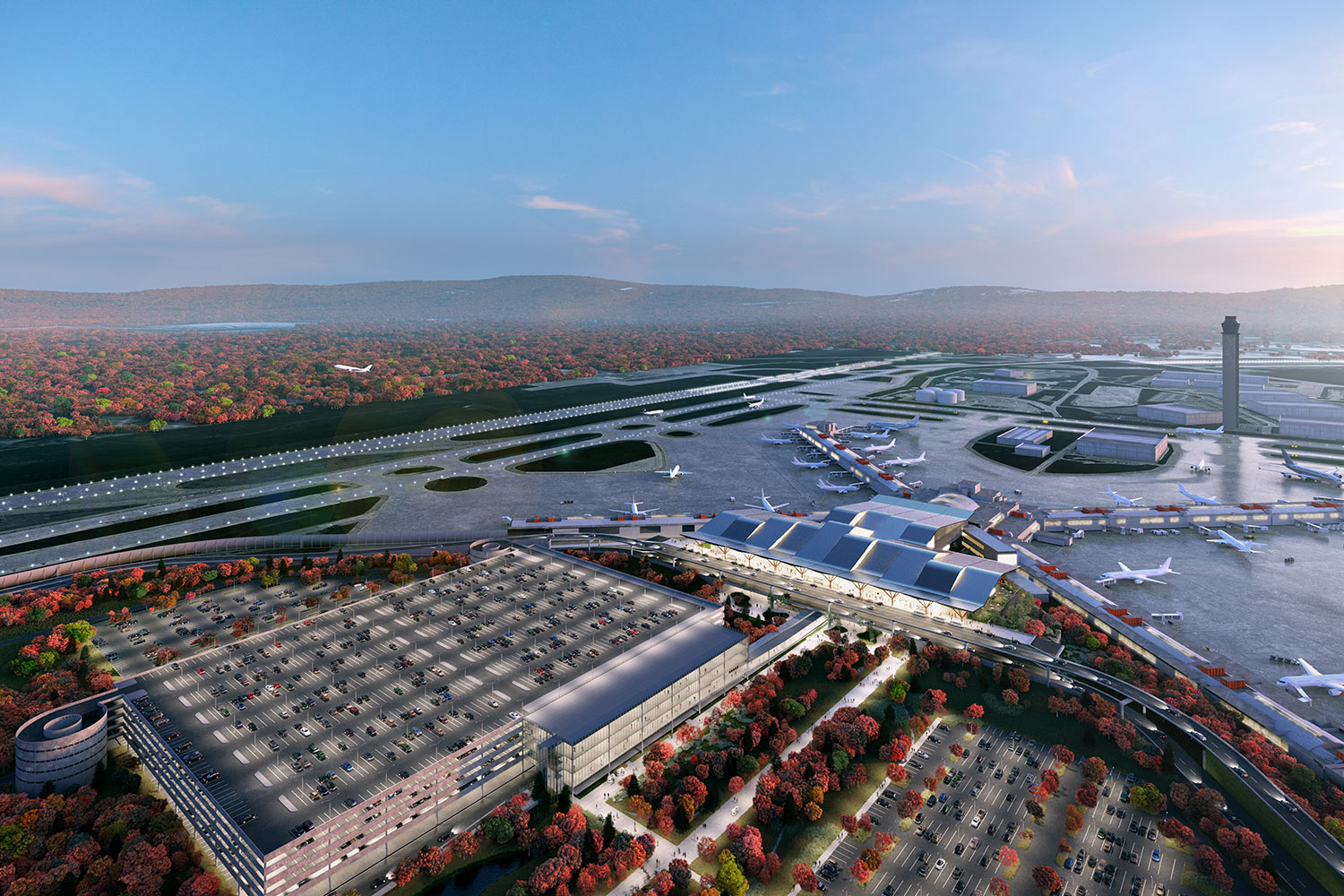
When Pittsburgh International Airport opened its new landside terminal in November 2025, it wasn’t just a ribbon‑cutting – it was a reset. The project replaced a 30‑year‑old layout designed for a hub airline that no longer exists, transforming the airport into a streamlined, Pittsburgh‑first operation built around the people who actually use it.
The Terminal Modernization Program (TMP) did more than link a new 800,000 ft² landside terminal directly to the existing concourses. It rethought a half‑mile disconnect between tickets and gates, retired the underground tram called the Automatic People Mover (APM), and re‑established clarity, comfort, and efficiency as the organizing principles of the passenger journey.
For Buro Happold, the challenge was both technical and cultural: engineer a right‑sized terminal that would feel effortless to travelers while quietly delivering resilience, efficiency, and long-term operability. In this Q&A, the team walks through the decisions behind the systems – from displacement ventilation to microgrid integration – and the choreography required to modernize an airport without ever shutting it down.
Meet the engineering team behind the new terminal
A building shaped by use, not nostalgia
The old Pittsburgh terminal felt stuck in the early 1990s: a mall‑like landside building, security, and then a tram ride to a distant airside concourse. It was a spatial diagram designed for connections, not for the 98% of travelers who now begin or end their journeys in Pittsburgh. The new plan positions the landside terminal directly against the airside concourses. “The split made a stressful trip more stressful,” said Joe Gaus, associate principal. “Now the sequence is straightforward: check in, central screening, and a short connector – no train, fewer unknowns.” The modernization project reversed the logic. Ticketing, screening, and arrivals were consolidated into a single hall linked directly to the gates, cutting time and uncertainty while opening up generous meet‑and‑greet spaces for a city that prefers to walk inside to welcome family and friends.
The architecture – led by Gensler and HDR, in association with luis vidal + architects – doesn’t hide its regional references: an undulating roof suggestive of rolling hills; columns branching like trees; fiber‑optic “stars” that glance off glass at night. What it does hide, by design, is the machinery of comfort. “You see the nature,” Gaus says, “and only when you look closer do you realize the technology is doing the work in the background.”

Integrating today with yesterday – while never closing
Modernizing a live airport is not a matter of swapping parts. The new terminal was built “separate ‑through‑construction,” as Yelena Nelson, senior mechanical engineer, describes it, to preserve operations until the moment of carefully sequenced tie‑in. That meant temporary routes, scaffolding, and wayfinding choreographies that changed as the building neared the old concourse. “The challenge wasn’t wiring old equipment to new,” Nelson says. “It was delivering next to a live airport without breaking its rhythm.”
Phasing became the delivery mechanism: one package for everything underground – utilities, stormwater, and the remnants of the train infrastructure – and another for everything above. The connector bridge formed a new passage aligning the security exit with the existing concourse. “LED walls, the bridge motif – it’s a reveal that feels like Pittsburgh,” says Mike Weleski, who led portions of the MEP and site integration. “All while the airport kept moving.”

Behind the scenes, the team wrote a white paper for the airport authority on its building management system. Do they double down on the incumbent platform or open the market to competition? Matt Hochberger, the project lead, explains the calculus: keep the operator workflows and alarm philosophies that staff know, but design the new terminal’s BMS to interoperate – not lock in. The owner chose open bid, preserving flexibility without sacrificing a seamless handoff to facilities. It’s the kind of decision passengers never feel, but operators make every day.
Power that protects operations
Pittsburgh International Airport is powered by a 23‑megawatt microgrid – a blend of on‑site natural gas generation and solar – capable of operating independently from the regional grid. The new terminal had to integrate seamlessly into that system. “We tied in at medium voltage with new 3.5 kV switchboards, then stepped down to 480V for the building,” says Jeremy Hall, associate electrical engineer. That strategy allowed the team to shrink the diesel generator to life‑safety loads – emergency lighting, egress, fire/life safety – and to rely on the microgrid’s redundancy for optional standby, cutting emissions and fuel risk.
Where the power system provides resilience, the controls framework ensures efficiency. The design incorporates daylight‑responsive dimming, occupancy and vacancy controls, and a full LED specification that cuts lighting power density to roughly 30 percent below ASHRAE code. The result is an automated, low‑waste operation that performs without demanding attention. It’s engineering that works in the background – constantly optimizing, rarely seen.
Comfort engineered into the background
If the project has a signature technical move, it’s displacement ventilation. In halls of this scale – soaring ceilings, long sightlines, and air volumes that would typically demand brute‑force conditioning – Buro Happold rethought the physics. Instead of pushing large quantities of air from high above, the team supplied conditioned air low and slow, allowing natural stratification to lift heat and contaminants clear of the occupied zone.
“The airflow isn’t felt – no drafts,” Hochberger says. “You’re calmer in the place people are usually most anxious: baggage claim.”

Those lofty ceilings, a defining architectural element of the new hall, were made possible precisely because the engineering retreated from them. By delivering air at the floor and letting the upper volume act as a quiet thermal buffer, the team avoided cluttering the roofline with the typical web of ducts, grilles, and mechanical hardware. The height could read as pure architecture – light, airy, unbroken.
Function followed form: diffusers are integrated into benches, walls, and carousel surrounds, preserving valuable floor‑to‑floor height and keeping the focus on the sweep of the roof instead of the machinery behind it. “We worked carefully with the design team to hide the big openings,” Nelson adds. The result is a space that feels open and intuitive, while the engineering works invisibly in the background to keep it comfortable at every scale.

Modeling as risk management
The integration platform for all of this was BIM. “We modeled space by space with exact elevations,” says Rachel Weaver, an electrical engineer who helped with BIM coordination. The point wasn’t just clash detection; it was construction intent. Electrical conduits and feeders were pre‑cut from the model to minimize waste. On the plumbing side, the team used Revit to thread storm piping through the undulating structure – a challenge made more urgent when the plumbing group proposed a stormwater reuse system that hadn’t been in the initial brief. “You have a roof this large,” Weleski says. “Why not capture and treat a portion for the landscape terraces and reduce domestic water demand?” The owner agreed.

A local project with global reach
The talent bench shifted as the program matured: early concept work drew on Buro Happold’s global aviation experience, then moved through New York and Pittsburgh for design and construction administration. What never shifted was proximity.
“We were on site weekly,” Gaus says. “Half the time it was faster to drive to the airport than to the office.” Problems that might have lingered on emails resolved in thirty‑minute hallway meetings or impromptu field walks with the contractor and architect.
Jeremy Snyder is direct about why that mattered: “It’s the airport’s building. They have to operate it. We moved efficiently and treated the owner as part of the team making decisions on design.”

What people will notice – and what they won’t
Travelers will recognize the ‘Pittsburgh-ness’ of the new hall immediately: the lift of the roofline, the light from all sides, the constellations overhead. They’ll also notice what’s missing. The tram is gone; the walk is shorter; the signage reads clearly. Much of what makes that possible is deliberately invisible – air delivered where people are; power and data routed where they need to be; sensors adjusting light to the day – so the building can do more with less.
For the engineers who lived with it for years, the pride is more granular. “We had to keep a complex campus breathing while we changed a lung,” Hochberger says, smiling at the metaphor. Weleski calls it a legacy project. “You don’t build a new airport here every decade,” he says. “I came to work on this. I can’t wait to fly out of it.”
In the end, the terminal modernization reflects the spirit of the city it serves: a clarity of purpose, an economy of means, and an insistence on doing the hardest work out of view so the experience feels effortless. It is, as the team repeatedly noted, an airport for Pittsburgh, by Pittsburgh – engineered to carry the region forward.

For us, the measure of success wasn’t just opening a new terminal – it was giving Pittsburgh an airport that feels effortless to use and resilient to operate. When engineering disappears into the experience, that’s when we know we’ve done our job.”
— Jeremy Snyder, US Aviation Director


Pleasant, spring-like weekend for Virginia, Maryland, DC ahead of active start to March

House explosion in Cleveland’s Slavic Village neighborhood catches neighboring houses on fire

A total lunar eclipse will turn the moon blood red on Tuesday

Alabama ‘Fully Aware’ of Losing Streak to Tennessee Ahead of Road Rematch

Over $150K worth of drugs seized from man in Juneau, police say

Florida High School Football Rankings: Top 25 teams – Oct. 21

Cleary's 21 help Le Moyne down Central Connecticut State 69-64 in OT

How old is Bo Nix? What to know about Oregon quarterback ahead of 2024 NFL Draft

99th annual Pony Swim held in Virginia

Indiana Members Credit Union announced as new anchor tenant at Bottleworks District

Where Iran’s ballistic missiles can reach — and how close they are to the US

Has India’s influence in Afghanistan grown under the Taliban?

Bill Clinton to testify before House committee investigating Epstein links

Read Judge Schiltz’s Order

Vulnerable House Dem lashes out at Trump’s ‘racist’ SOTU challenge: ‘That was uncomfortable’
-

 World2 days ago
Exclusive: DeepSeek withholds latest AI model from US chipmakers including Nvidia, sources say
-

 Massachusetts2 days ago
Mother and daughter injured in Taunton house explosion
-

 Montana1 week ago
2026 MHSA Montana Wrestling State Championship Brackets And Results – FloWrestling
-

 Oklahoma1 week ago
Wildfires rage in Oklahoma as thousands urged to evacuate a small city
-

 Louisiana5 days ago
Wildfire near Gum Swamp Road in Livingston Parish now under control; more than 200 acres burned
-

 Denver, CO2 days ago
10 acres charred, 5 injured in Thornton grass fire, evacuation orders lifted
-

 Technology6 days ago
YouTube TV billing scam emails are hitting inboxes
-

 Technology6 days ago
Stellantis is in a crisis of its own making