Pittsburg, PA
Sale of US Steel kicks up a political storm, but Pittsburgh isn't Steeltown USA anymore


PITTSBURGH — Generations of Pittsburgh residents have worked at steel mills, rooted for the Steelers or ridden the rollercoaster at Kennywood amusement park, giving them a bird’s eye view of the massive Edgar Thomson Works, the region’s last blast furnace.
Now, Steeltown USA’s most storied steel company, U.S. Steel, is on the cusp of being bought by Japanese steelmaker Nippon Steel Corp. in a deal that’s kicking up an election year political maelstrom across America’s industrial heartland.
The sale comes during a tide of renewed political support for rebuilding America’s manufacturing sector and in the middle of a presidential campaign in which the politically dynamic Pittsburgh region is a destination for President Joe Biden, former President Donald Trump and their surrogates.
The deal follows a long stretch of protectionist U.S. tariffs that analysts say has helped reinvigorate domestic steel. And it is eliciting complicated feelings in a region where steel is largely a thing of the past after people, particularly those 50 or older, watched mills shut down and their Rust Belt towns wither.
“The fear is that these jobs went away once, and the fear is that these jobs could go away again,” said Mike Mikus, a Pittsburgh-based Democratic campaign consultant whose grandfather lost his steel mill job 40 years ago.
U.S. Steel is no longer a major steelmaker in an industry dominated by the Chinese. But its workers still carry political heft in what some see as a larger symbolic fight to save what’s left of manufacturing in the United States.
With the United Steelworkers against the deal, Biden — a Democrat who has made his support for organized labor explicit and has won the union’s endorsement — has all but vowed to block U.S. Steel’s sale, saying in an April rally with steelworkers in Pittsburgh that the company “should remain totally American.”
Trump, a Republican who as president opposed union organizing efforts but describes himself as pro-worker, has said he would block it “instantaneously.”
Biden’s White House has indicated the secretive Committee on Foreign Investment in the United States will review the transaction for national security concerns. The committee can recommend that the president block a transaction, and federal law gives the president that power.
In the meantime, the Department of Justice is reviewing it for antitrust compliance, and the steelworkers union has filed a grievance over it.
In a rare flurry of bipartisan unity, the sale has drawn opposition from Democratic Sens. Bob Casey and John Fetterman of Pennsylvania and Sherrod Brown of Ohio and from Republican Sens. J.D. Vance of Ohio, Ted Cruz of Texas and Josh Hawley of Missouri, on both economic and national security grounds.
Nippon Steel has scheduled the deal to close later this year.
Once the world’s largest corporation, U.S. Steel was the world’s 27th-largest steelmaker in 2023, according to World Steel Association figures. It reported just under $900 million in net income on $16 billion in sales last year.
The deal includes all of U.S. Steel’s ore mining, coking, steelmaking and processing plants around the country, including the Edgar Thomson Works, which looms over the Monongahela River just south of Pittsburgh and still churns out steel slabs 150 years after it was built. U.S. Steel employs 3,000 people at its four major Pennsylvania plants, including the Edgar Thomson and the nation’s largest coke-making plant in nearby Clairton.
Nippon Steel — the world’s fourth-largest steelmaker in 2023, according to association figures — and U.S. Steel are now in the midst of a broad public relations effort to promote the sale.
Their ads are on social media, TV screens and billboards, as the companies promise to protect jobs, move Nippon Steel’s U.S. headquarters to Pittsburgh from Houston and invest in the badly aging Pittsburgh-area plants to make them cleaner and more efficient.
Flyers landing in Pittsburgh-area mailboxes tout the “future of American steel” and urge residents to contact their elected officials to support the companies’ “partnership.”
And, they say, “U.S. Steel remains U.S. Steel.”
Meanwhile, Pittsburgh is a changed place.
It is no longer a destination for new steel investment. Gone are the 20 or so miles (32 kilometers) of contiguous iron and steel mills from downtown Pittsburgh and up the Monongahela River that helped the U.S. industrialize and wage wars.
Now, Pittsburgh is seen as an “eds and meds” city in which universities and hospitals are the major employers.
Allegheny County, which surrounds Pittsburgh, just began growing again, after decades of population decline. Some city neighborhoods have emerged from a long period of struggle and are thriving, and a younger generation is attracted to the city’s growing high-tech industry.
Younger residents or transplants don’t necessarily want steelworkers to lose jobs, but they care about the environment, too. Local elections are increasingly elevating insurgent progressives who take a dim view of fossil fuels and heavy industries — such as U.S. Steel’s plants — that use them.
Edith Abeyta, an artist and California transplant who lives near Edgar Thomson Works, keeps an air monitor at her house to check daily for air quality.
For her, Edgar Thomson Works is a massive eyesore and a health threat.
“Not every place you go smells like rotten eggs or burning metal or you see big plumes of red smoke or black smoke or flares that are burning all night long,” Abeyta said. “Not everybody lives with that.”
Steelworkers have changed too.
The union still endorses Democrats, but rank-and-file blue-collar union members, like the steelworkers, are no longer viewed as a bedrock of the Democratic Party’s coalition, in part because of shrinking union numbers but also because there were defections to Republicans. In 2016, Trump became the first Republican to win Rust Belt states Michigan and Pennsylvania since 1988.
Christopher Briem, an economist at the University of Pittsburgh’s Center for Social and Urban Research, estimated there are 5,000 steel mill jobs in the region, a tiny percentage of the number of mill jobs when steelmaking there was at its peak. He puts the region’s competitive steelmaking peak in the 1920s, before technological advances rendered the region’s metallurgical coal unnecessary for steelmaking and gave rise to electric arc furnaces that don’t require coal.
And while Pittsburgh has recovered from the collapse of steel, some smaller neighboring towns haven’t.
“And that’s what got people so concerned, is the fact that we’ve been through this before and it changed the region and it devastated people’s lives,” said August Carlino, president and chief executive officer of the Rivers of Steel Heritage Corporation, based in Homestead.
Tony Buba, a filmmaker who lives near the Edgar Thomson plant and whose father worked for 44 years at a steel mill, sees a misplaced nostalgia around Pittsburgh’s steel industry.
Mill jobs were dangerous work that didn’t pay decent wages until shortly before steel’s collapse in the early 1980s, he said. “Sirens would go off when someone got hurt, and mother would start praying,” he said.
Regardless of who owns them, Buba expects that Pittsburgh’s steel plants will be gone in 30 or 40 years — and that political support will be fleeting.
“It’ll be interesting to see after the election,” Buba said, “how many people are opposed to the sale.”
___
Follow Marc Levy at twitter.com/timelywriter.
___
Follow the AP’s coverage of the 2024 election at https://apnews.com/hub/election-2024.



Pittsburg, PA
Pittsburgh’s air quality considered “unhealthy for everyone” on Friday due to wildfire smoke

The air quality will remain poor today. Officially, the air quality will be in the “very unhealthy” to “hazardous” range.
Friday’s forecast and air quality warnings
How hazardous are things? Wildfire smoke, like what we are dealing with today, really gives you a double whammy when it comes to impacting your health. The first is that you may notice when talking about air quality that we label it with a number, and then we put behind it PM2.5 or maybe 10.
The 2.5 is important because it is talking about the size of the particles that we are describing as parts per million. The unit for 2.5 is microns. 1 micron is the same as 0.00003937 inches or 0.001 mm. So 2.5 microns is around a fourth the width of a single wool fiber or around 1/7th the width of a human hair. It’s tiny and grating.
It’s small enough to get deep into your lungs but hard enough to irritate, like very fine sandpaper. For those with respiratory issues already in place, this increased irritation causes shortness of breath and frequent coughing spells. Not good.
The good news is that our air quality will rapidly improve overnight, with us returning to more normal air quality on Saturday morning. The bad news is that another plume of smoke is expected to roll in on Sunday, but that plume is not expected to be as bad as this current one.
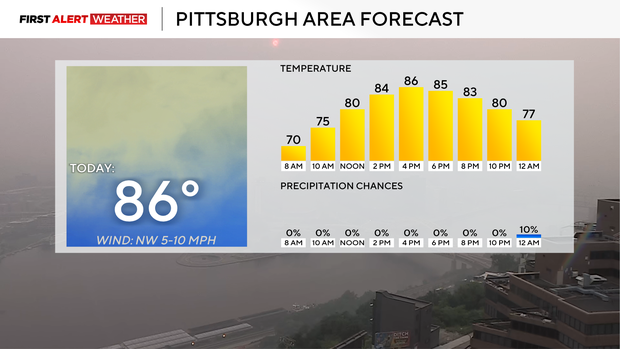
Getting to today’s forecast, it is going to be hot with highs in the mid-80s today. There will be a haze sitting over the city all day long. I have noon temperatures near 80 degrees with light winds of around 5 mph.
Kennywood and Sandcastle close due to air quality
Both Kennywood and Sandcastle announced on Friday morning that the parks will be closed due to the air quality alert issued by the Pa. Department of Environmental Protection.
According to both parks, patrons who purchased tickets for July 17 will be valid on one operating day throughout the rest of the season.

A Westmoreland County family wants to warn others after they said they found a large void beneath the garage in their house built by Ryan Homes.
“More than anything, we just want folks to know that there is potential that other homes could be built like this and just to be aware,” said homeowner Nicole Holderfield.
Beneath their seemingly normal front-facing two-car garage in the Altman Farms neighborhood in North Huntingdon is a lot of dead space that the Holderfield family just found out about. They said having a secret room is not as cool as it sounds when you realize the structural integrity of the 30-year-old home is at risk.
“I hate to say shocking, but it’s not something that we really wanted to be the first one on the street to find out,” Holderfield said.
Holderfield said there are leftover cinder blocks and even a Lowe’s bucket down there.
“You can actually stand all the way down here on this side, a lot of backfill, and then we did see it was weatherproofed on some of the walls,” Holderfield said.
This all started because Holderfield wanted to fix the growing number of large cracks popping up across her garage floor.
“We were starting the cosmetic fix, and our contractor was here. And with a sledgehammer, he wanted to see what he was working with, so he simply pounded down the sledgehammer,” Holderfield said.
The large void directly underneath the garage is not accessible from their finished basement. Only one wall appears to be weatherproofed, so the family believes moisture rusted away the single support column and the steel rebar attempting to carry the weight of the entire two-car garage.
“A couple different companies did stop by, and they were in awe of what they found. Even the North Huntingdon inspector came out, took a look, and it was not something he was familiar with seeing,” said Holderfield.
That inspector encouraged the family to hire a structural engineer. They did, and received a report that concluded the issue was the result of “poor workmanship and faulty construction,” Holderfield said.
The family’s homeowner’s insurance denied the claim, saying defects from faulty construction are excluded from coverage.
“Knowing that we were parking our cars in here up until we found this problem — we have children and animals, and knowing that a catastrophe could come, I think that’s our biggest concern,” Holderfield said.
That’s why the family called the builder, Ryan Homes, and alerted all of their neighbors with similar builds and floorplans.
“They really just took a look and took pictures. When we did speak to the one gentleman at Ryan Homes, he said this was 30 years ago, there were different laws back then,” Holderfield said.
KDKA Investigates reached out to Ryan Homes for comment to ask if building these dead spaces is still its practice. And if so, should other homeowners who live in Ryan Homes inspect further?
Ryan Homes said they do not comment on news stories.
In an update on Thursday, the Holderfields told KDKA Ryan Homes reached out and said it’s willing to work with them on this, share the cost of the fix, and manage the project to ensure it is fixed as they would expect.
The family feels that’s a valid attempt to make it right.
KDKA Investigates talked to a Cranberry homeowner who also lives in a Ryan Home built around the same time. She sent photos showing the wet tire marks where her car drove over and broke through the concrete last year. When the garage floor failed, she said it revealed a 9-foot void. She said it took four triaxle trucks of fill and $20,000 to fix.
Holderfield says that makes her wonder who else could find this.
“I would love people to be held accountable, but I also understand the laws and that we could potentially be out of the warranty period is what they say. I do wish we could have them stand behind their work or help us get this fixed,” Holderfield said.
More than anything, the Holderfield family says it wants people to know there is potential that other homes could be built like this and to be aware.
-

 Movie Reviews11 minutes ago
“The Odyssey” is Christopher Nolan’s Most Singular Film Yet (Movie Review)
-
World23 minutes ago
Iran War Updates: Bridges and Water Plants Hit as Strikes Stretch to 7th Straight Day
-
 Lifestyle1 hour ago
Spain could make World Cup history: The first to win men’s and women’s trophies back-to-back
-

 Technology1 hour ago
Taylor Farms pulls iceberg lettuce from the US market after cyclosporiasis outbreak
-

 World1 hour ago
Who is Andy Burnham? The Trump critic set to become the UK’s next prime minister
-

 Politics2 hours ago
Major appeals court declares New Jersey AR-15 ban unconstitutional in landmark Second Amendment ruling
-

 Health2 hours ago
First death reported in Upper East Side Legionnaires’ disease outbreak as cases rise to 67
-

 Sports2 hours ago
Raising Cane’s owner Todd Graves on how viral Tom Brady-Rob Gronkowski dunk tank came to be at Fanatics Fest

