Pittsburg, PA
Penguins Already Shifting Focus Past Season


It might be a tough pill to swallow for many, but it might be the right time for the Pittsburgh Penguins to tear things down as look to the future. The Penguins are 6-9-3 with no real signs of improving and have a number of key faces that could fetch large returns on the trade market.
The Penguins already opened the floodgate of trades by sending Lars Eller back to the Washington Capitals for a couple of draft picks. If more trades are on the horizon, what kind of solutions are president and general manager Kyle Dubas looking for?
When Dubas arrived in Pittsburgh, his focus was to find success right away in the final years of Sidney Crosby and Evgeni Malkin while restocking the shelves for the future. According to Daren Dregger on TSN’s Insider Trading, the focus may have completely turned to looking ahead.
“He knows what he’s dealing with,” Dreger said. “He’s got the Hall of Famers there. But he also recognizes that given his contract status, the length of his contract, this is going to be a complex project of work. He wants young NHL players are draft picks to build for a better future.”
The first sign of Dubas turning to the future was put on display when he didn’t get another player in return for Eller. Rather he scooped a couple of draft picks for 2025 and 2027 while promoting a young forward to fill the roster space.
Sam Poulin was that young player, who is arguably on his last chance with the Penguins. Poulin is 23 years old with just seven games of NHL experience under his belt over the last three seasons.
Behind Poulin is a slew of youngsters that have budding NHL talent or are among the organization’s top prospects. The Penguins aren’t completely throwing in the towel on the season, but they’re going to give their youth a chance.
If they help out and the Penguins turn things around, that’s great. If things keep going south, there won’t be too many disappointed by the results. Dubas and the Penguins are looking to the future, and they’ll likely be a team to watch as the trade deadline approaches.
Make sure you bookmark Breakaway OnSI for the latest news, exclusive interviews, recruiting coverage, and more!



Pittsburg, PA
‘It began right here in the Hill District’: Bill from Rep. Lee seeks national honor for Freedom House


Hear from the Buro Happold team on the engineering behind Pittsburgh International Airport’s new landside terminal.
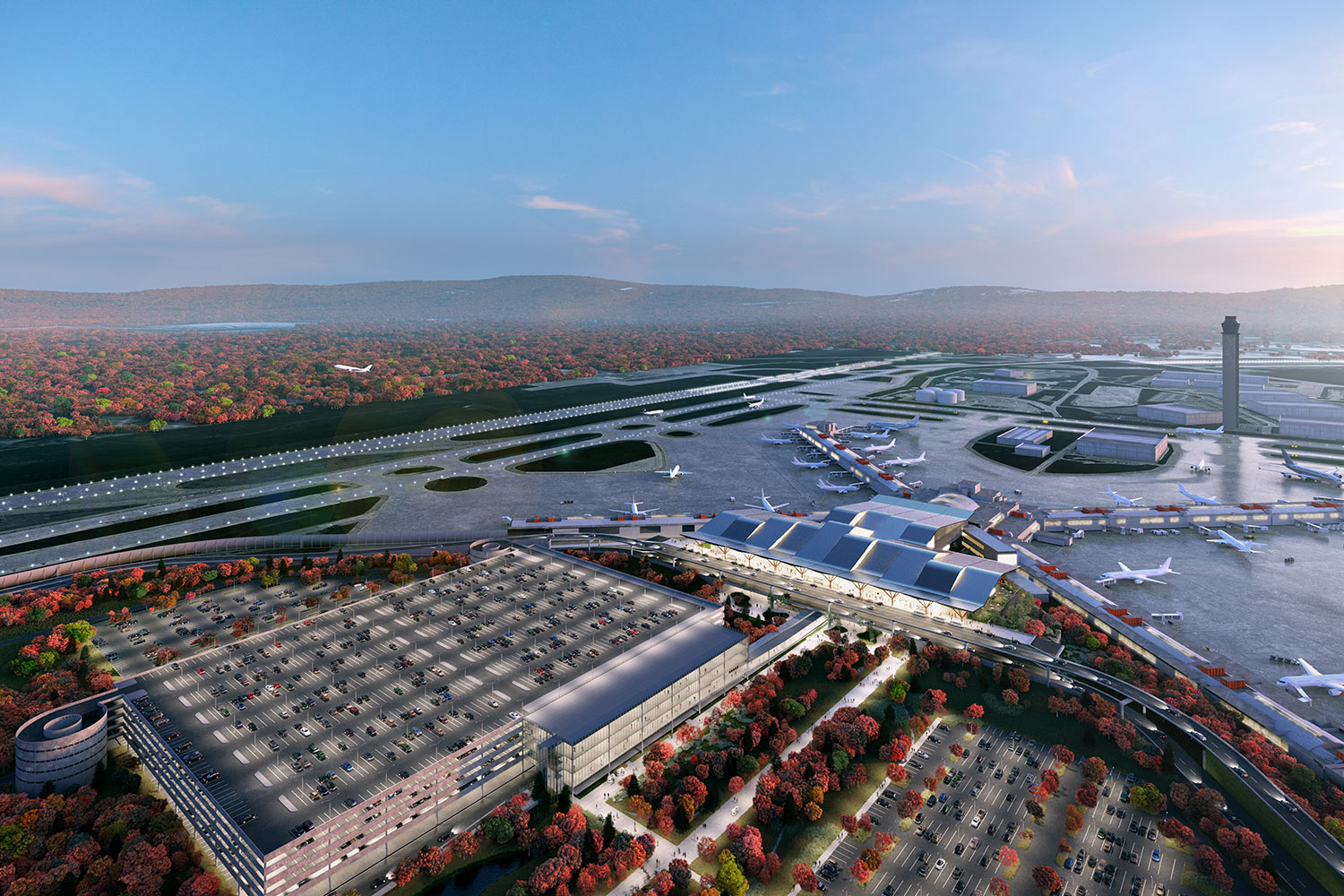
When Pittsburgh International Airport opened its new landside terminal in November 2025, it wasn’t just a ribbon‑cutting – it was a reset. The project replaced a 30‑year‑old layout designed for a hub airline that no longer exists, transforming the airport into a streamlined, Pittsburgh‑first operation built around the people who actually use it.
The Terminal Modernization Program (TMP) did more than link a new 800,000 ft² landside terminal directly to the existing concourses. It rethought a half‑mile disconnect between tickets and gates, retired the underground tram called the Automatic People Mover (APM), and re‑established clarity, comfort, and efficiency as the organizing principles of the passenger journey.
For Buro Happold, the challenge was both technical and cultural: engineer a right‑sized terminal that would feel effortless to travelers while quietly delivering resilience, efficiency, and long-term operability. In this Q&A, the team walks through the decisions behind the systems – from displacement ventilation to microgrid integration – and the choreography required to modernize an airport without ever shutting it down.
Meet the engineering team behind the new terminal
A building shaped by use, not nostalgia
The old Pittsburgh terminal felt stuck in the early 1990s: a mall‑like landside building, security, and then a tram ride to a distant airside concourse. It was a spatial diagram designed for connections, not for the 98% of travelers who now begin or end their journeys in Pittsburgh. The new plan positions the landside terminal directly against the airside concourses. “The split made a stressful trip more stressful,” said Joe Gaus, associate principal. “Now the sequence is straightforward: check in, central screening, and a short connector – no train, fewer unknowns.” The modernization project reversed the logic. Ticketing, screening, and arrivals were consolidated into a single hall linked directly to the gates, cutting time and uncertainty while opening up generous meet‑and‑greet spaces for a city that prefers to walk inside to welcome family and friends.
The architecture – led by Gensler and HDR, in association with luis vidal + architects – doesn’t hide its regional references: an undulating roof suggestive of rolling hills; columns branching like trees; fiber‑optic “stars” that glance off glass at night. What it does hide, by design, is the machinery of comfort. “You see the nature,” Gaus says, “and only when you look closer do you realize the technology is doing the work in the background.”

Integrating today with yesterday – while never closing
Modernizing a live airport is not a matter of swapping parts. The new terminal was built “separate ‑through‑construction,” as Yelena Nelson, senior mechanical engineer, describes it, to preserve operations until the moment of carefully sequenced tie‑in. That meant temporary routes, scaffolding, and wayfinding choreographies that changed as the building neared the old concourse. “The challenge wasn’t wiring old equipment to new,” Nelson says. “It was delivering next to a live airport without breaking its rhythm.”
Phasing became the delivery mechanism: one package for everything underground – utilities, stormwater, and the remnants of the train infrastructure – and another for everything above. The connector bridge formed a new passage aligning the security exit with the existing concourse. “LED walls, the bridge motif – it’s a reveal that feels like Pittsburgh,” says Mike Weleski, who led portions of the MEP and site integration. “All while the airport kept moving.”

Behind the scenes, the team wrote a white paper for the airport authority on its building management system. Do they double down on the incumbent platform or open the market to competition? Matt Hochberger, the project lead, explains the calculus: keep the operator workflows and alarm philosophies that staff know, but design the new terminal’s BMS to interoperate – not lock in. The owner chose open bid, preserving flexibility without sacrificing a seamless handoff to facilities. It’s the kind of decision passengers never feel, but operators make every day.
Power that protects operations
Pittsburgh International Airport is powered by a 23‑megawatt microgrid – a blend of on‑site natural gas generation and solar – capable of operating independently from the regional grid. The new terminal had to integrate seamlessly into that system. “We tied in at medium voltage with new 3.5 kV switchboards, then stepped down to 480V for the building,” says Jeremy Hall, associate electrical engineer. That strategy allowed the team to shrink the diesel generator to life‑safety loads – emergency lighting, egress, fire/life safety – and to rely on the microgrid’s redundancy for optional standby, cutting emissions and fuel risk.
Where the power system provides resilience, the controls framework ensures efficiency. The design incorporates daylight‑responsive dimming, occupancy and vacancy controls, and a full LED specification that cuts lighting power density to roughly 30 percent below ASHRAE code. The result is an automated, low‑waste operation that performs without demanding attention. It’s engineering that works in the background – constantly optimizing, rarely seen.
Comfort engineered into the background
If the project has a signature technical move, it’s displacement ventilation. In halls of this scale – soaring ceilings, long sightlines, and air volumes that would typically demand brute‑force conditioning – Buro Happold rethought the physics. Instead of pushing large quantities of air from high above, the team supplied conditioned air low and slow, allowing natural stratification to lift heat and contaminants clear of the occupied zone.
“The airflow isn’t felt – no drafts,” Hochberger says. “You’re calmer in the place people are usually most anxious: baggage claim.”

Those lofty ceilings, a defining architectural element of the new hall, were made possible precisely because the engineering retreated from them. By delivering air at the floor and letting the upper volume act as a quiet thermal buffer, the team avoided cluttering the roofline with the typical web of ducts, grilles, and mechanical hardware. The height could read as pure architecture – light, airy, unbroken.
Function followed form: diffusers are integrated into benches, walls, and carousel surrounds, preserving valuable floor‑to‑floor height and keeping the focus on the sweep of the roof instead of the machinery behind it. “We worked carefully with the design team to hide the big openings,” Nelson adds. The result is a space that feels open and intuitive, while the engineering works invisibly in the background to keep it comfortable at every scale.

Modeling as risk management
The integration platform for all of this was BIM. “We modeled space by space with exact elevations,” says Rachel Weaver, an electrical engineer who helped with BIM coordination. The point wasn’t just clash detection; it was construction intent. Electrical conduits and feeders were pre‑cut from the model to minimize waste. On the plumbing side, the team used Revit to thread storm piping through the undulating structure – a challenge made more urgent when the plumbing group proposed a stormwater reuse system that hadn’t been in the initial brief. “You have a roof this large,” Weleski says. “Why not capture and treat a portion for the landscape terraces and reduce domestic water demand?” The owner agreed.

A local project with global reach
The talent bench shifted as the program matured: early concept work drew on Buro Happold’s global aviation experience, then moved through New York and Pittsburgh for design and construction administration. What never shifted was proximity.
“We were on site weekly,” Gaus says. “Half the time it was faster to drive to the airport than to the office.” Problems that might have lingered on emails resolved in thirty‑minute hallway meetings or impromptu field walks with the contractor and architect.
Jeremy Snyder is direct about why that mattered: “It’s the airport’s building. They have to operate it. We moved efficiently and treated the owner as part of the team making decisions on design.”

What people will notice – and what they won’t
Travelers will recognize the ‘Pittsburgh-ness’ of the new hall immediately: the lift of the roofline, the light from all sides, the constellations overhead. They’ll also notice what’s missing. The tram is gone; the walk is shorter; the signage reads clearly. Much of what makes that possible is deliberately invisible – air delivered where people are; power and data routed where they need to be; sensors adjusting light to the day – so the building can do more with less.
For the engineers who lived with it for years, the pride is more granular. “We had to keep a complex campus breathing while we changed a lung,” Hochberger says, smiling at the metaphor. Weleski calls it a legacy project. “You don’t build a new airport here every decade,” he says. “I came to work on this. I can’t wait to fly out of it.”
In the end, the terminal modernization reflects the spirit of the city it serves: a clarity of purpose, an economy of means, and an insistence on doing the hardest work out of view so the experience feels effortless. It is, as the team repeatedly noted, an airport for Pittsburgh, by Pittsburgh – engineered to carry the region forward.

For us, the measure of success wasn’t just opening a new terminal – it was giving Pittsburgh an airport that feels effortless to use and resilient to operate. When engineering disappears into the experience, that’s when we know we’ve done our job.”
— Jeremy Snyder, US Aviation Director


Feeding South Dakota

Trump touted gas prices under $2.30. Tennessee gas prices say otherwise

North Texas middle school closes after a norovirus outbreak

Utah man dies of injuries sustained in avalanche in Big Cottonwood Canyon

Here are five places to ice skate in Vermont this winter

Florida High School Football Rankings: Top 25 teams – Oct. 21

Cleary's 21 help Le Moyne down Central Connecticut State 69-64 in OT

How old is Bo Nix? What to know about Oregon quarterback ahead of 2024 NFL Draft

99th annual Pony Swim held in Virginia

Indiana Members Credit Union announced as new anchor tenant at Bottleworks District

Where Iran’s ballistic missiles can reach — and how close they are to the US

Has India’s influence in Afghanistan grown under the Taliban?

Bill Clinton to testify before House committee investigating Epstein links

Read Judge Schiltz’s Order

Vulnerable House Dem lashes out at Trump’s ‘racist’ SOTU challenge: ‘That was uncomfortable’
-

 World2 days ago
Exclusive: DeepSeek withholds latest AI model from US chipmakers including Nvidia, sources say
-

 Massachusetts2 days ago
Mother and daughter injured in Taunton house explosion
-

 Montana1 week ago
2026 MHSA Montana Wrestling State Championship Brackets And Results – FloWrestling
-

 Oklahoma1 week ago
Wildfires rage in Oklahoma as thousands urged to evacuate a small city
-

 Louisiana4 days ago
Wildfire near Gum Swamp Road in Livingston Parish now under control; more than 200 acres burned
-

 Technology6 days ago
YouTube TV billing scam emails are hitting inboxes
-

 Denver, CO2 days ago
10 acres charred, 5 injured in Thornton grass fire, evacuation orders lifted
-

 Technology6 days ago
Stellantis is in a crisis of its own making