Northeast
Original Dunkin' Donuts a cherished culinary keepsake for Portuguese-American Carvalho clan

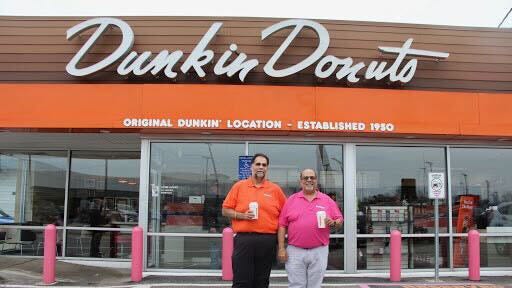
An immigrant family in Massachusetts keeps alive a beloved American culinary landmark.
Brothers Victor and Octavio Carvalho own the original Dunkin’ Donuts in Quincy, Massachusetts.
It’s a bucket-list destination and popular selfie-spot for coffee and donut fans from around the world.
ANCESTRY, GUINNESS RELEASE TROVE OF RECORDS TRACING HISTORY OF MILLIONS OF IRISH AMERICANS
“We feel a sense of pride and responsibility,” Victor Carvalho told Fox News Digital.
The Carvalho brothers are first-generation Portuguese-Americans — and the second generation of their family entrusted with the landmark.
Victor, left, and Octavio Carvalho are the owners of the original Dunkin’ location in Quincy, Massachusetts. Their parents, immigrants from Portugal, took over the location in 1979 from the Rosenberg familiy that founded this first Dunkin’ Donuts here in 1950. (Courtesy Carvalho family)
Dunkin’ Donuts was founded by Boston-area entrepreneur William Rosenberg on this spot in 1950.
Victor and Octavio’s parents, Jose and Maria, arrived from the Azores in 1966.
They bought the original Dunkin’ from the Rosenberg family in 1979; it’s been in the Carvalho family ever since.
MEET THE AMERICAN WHO INVENTED THE DONUT
“Dunkin’ means so much to our family because it changed our lives,” said Victor Carvalho, the first among five siblings born in the United States.
“My parents lived the American dream and were able to pass it down to us. It’s a passion for us now.”
A sign at a Dunkin’ in Trier, Germany, showing the original Dunkin’ location in Quincy, Massachusetts. (Kerry J. Byrne/Fox News Digital)
Dunkin’ now boasts over 13,000 locations in 40 nations around the world.
The original is something of a tourist attraction, drawing donut and coffee lovers from across the United States and from as far away as Saudi Arabia, said Carvalho.
‘CAKE BOSS’ BUDDY VALASTRO SOUNDS STARSTRUCK AS HE OPENS ON BROADWAY: ‘LIKE THE AMERICAN DREAM’
The original is also an international icon. Its picture is often displayed on the walls of Dunkin’ locations around the world as a tribute to its legacy.
Yet Dunkin’ remains a local brand in the eyes of people in Greater Boston and to the customers who are regulars at the original on Southern Artery (Route 3A).
The first Dunkin’ Donuts, founded in Quincy, Massachusetts, in 1950, remains a roadside attraction today that draws visitors from as far away as Saudi Arabia, said franchisee Victor Carvalho. (Dunkin’)
Dunkin’ Super Bowl ads in recent years have featured New England icons such as Ben Affleck, Matt Damon and Tom Brady — often affecting a Boston accent to drive home the local roots of the international brand.
SMALL FAMILY FARMS MAKE AMERICAN-GROWN ROASTED COFFEE THE WORLD’S BEST BREW
Massachusetts residents, meanwhile, remain deeply devoted to Dunkin’.
The state boasts 3,162 Dunkin’ locations, according to data site ScrapeHero.com.
That’s an amazing coffee-saturated 1 Dunkin’ for every 2,200 Bay State residents.
It’s easily the highest Dunkin’ density of any state in the Union.
New York has more locations (4,287), yet its total equals just 1 Dunkin’ for every 4,500 residents.
The original Dunkin’ is open 24 hours a day, seven days a week.
For more Lifestyle articles, visit www.foxnews.com/lifestyle.
Read the full article from Here

Boston, MA
Boston University OT Program Ranks Top in Its Class for Fifth Straight Year by U.S. News & World Report

Other graduate programs in Sargent College, School of Law, and School of Public Health also score high in rankings
Boston University’s Sargent College of Health & Rehabilitation Sciences retained U.S. News & World Report’s nod as the best occupational therapy program in the United States, while other BU schools boast programs that are among the top 10 in their fields. Photo by Above Summit for Boston University Photography.
University News
Other graduate programs in Sargent College, School of Law, and School of Public Health also score high in rankings
Boston University’s Sargent College of Health & Rehabilitation Sciences retained its nation-topping ranking for occupational therapy instruction in U.S. News & World Report’s 2026 evaluation of graduate school programs. It’s the fifth consecutive year that the program has claimed the first spot in the magazine’s rankings.
A half-dozen other BU programs cracked the top 10 in their respective disciplines:
- The School of Law’s health law program ranked second-best in the country.
- Sargent’s speech-language pathology program clocked in at sixth best.
- The School of Public Health had four programs in the top 10: epidemiology (seventh), biostatistics (eighth), public health (ninth), and social behavior (also ninth).
“Sargent has a long history of having top-ranked programs,” says Gloria Waters, BU provost, chief academic officer, and former dean of Sargent. “It is rewarding to see the occupational therapy program at the top of the rankings again. This recognition reflects the program’s faculty, support staff, and the college’s commitment to creating impactful educational experiences that translate into real-world outcomes.”
Of the high rankings for the other University programs, Waters says, “Faculty and staff are creating exceptional educational experiences across BU’s schools and colleges every day. Their efforts are not only reflected in national rankings like these, but in the quality of the students that go on to lead in their chosen fields.”
Faculty and staff are creating exceptional educational experiences across BU’s schools and colleges every day.
Depending on the discipline it is evaluating, U.S. News uses different assessment methodologies. For rankings of programs in sciences, social sciences, humanities, and health, the magazine relies on peer assessment surveys.
By contrast, for schools of business, education, engineering, law, medicine, and nursing, the rankings are based on two types of data, U.S. News says: “expert opinion about program excellence, and statistical indicators that measure the quality of a school’s academic productivity and postgraduate outcomes.” Last fall and early this year, the magazine sent schools the statistical surveys and sent peer assessments to academics and professionals in the fields being evaluated.
The peer assessments asked deans, program directors, and senior faculty to rank the academic quality of programs in their disciplines, from 5 (outstanding) to 1 (marginal). U.S. News buttressed those evaluations with surveys of professionals hiring or working with recent graduates in certain fields.
Explore Related Topics:

Pittsburgh Regional Transit will hold a public meeting on Tuesday to hear from riders on the proposed Bus Line Refresh. According to PRT, the Bus Line Refresh is an update to the bus network and is designed to improve reliability, frequency, seven-day service, and connectivity. “We have some new routes proposed, a North Hills to Oakland connection, a South Hills Oakland connection, that don’t exist today. We also are proposing to increase service on off-peak hours,” said Jake Stockman, a senior planner for PRT. “And then also wanting to make sure that throughout this process, we’re centering equity, to make sure that the communities where the service is needed the most aren’t being left behind.”The Bus Line Refresh is the second draft of the Bus Line Redesign, which Stockman said prompted more than 90 public engagement events and garnered more than 12,000 public comments. However, this time, the proposed updates will not be as drastic. “We’ve called it the ‘Refresh’ because we want the second draft to reflect that we’re reducing the volume of change so the system will look a little bit more familiar to our existing riders compared to what we previously presented in 1.0,” Stockman told Pittsburgh’s Action News 4 Reporter Jordan Cioppa. PRT staff will continue to gather public feedback on the new proposal through a number of ways, such as attending community meetings and popping up at bus stops. Stockman presented the plan to West End neighbors Monday night. “The increased frequency sounds great, later on Sunday night for people. There used to be service after midnight. Some people do work past 11 p.m.,” said John McNulty, a West End resident and PRT rider. Public comment started in March and will last through May. PRT will then host public hearings this summer before presenting a final plan to the PRT board in the fall. Stockman said the goal is to implement the changes in 2027. Riders are encouraged to attend the main public comment meeting on April 7 at the August Wilson Center from 5 to 7 p.m.
Pittsburgh Regional Transit will hold a public meeting on Tuesday to hear from riders on the proposed Bus Line Refresh.
According to PRT, the Bus Line Refresh is an update to the bus network and is designed to improve reliability, frequency, seven-day service, and connectivity.
“We have some new routes proposed, a North Hills to Oakland connection, a South Hills Oakland connection, that don’t exist today. We also are proposing to increase service on off-peak hours,” said Jake Stockman, a senior planner for PRT. “And then also wanting to make sure that throughout this process, we’re centering equity, to make sure that the communities where the service is needed the most aren’t being left behind.”
The Bus Line Refresh is the second draft of the Bus Line Redesign, which Stockman said prompted more than 90 public engagement events and garnered more than 12,000 public comments.
However, this time, the proposed updates will not be as drastic.
“We’ve called it the ‘Refresh’ because we want the second draft to reflect that we’re reducing the volume of change so the system will look a little bit more familiar to our existing riders compared to what we previously presented in 1.0,” Stockman told Pittsburgh’s Action News 4 Reporter Jordan Cioppa.
PRT staff will continue to gather public feedback on the new proposal through a number of ways, such as attending community meetings and popping up at bus stops. Stockman presented the plan to West End neighbors Monday night.
“The increased frequency sounds great, later on Sunday night for people. There used to be service after midnight. Some people do work past 11 p.m.,” said John McNulty, a West End resident and PRT rider.
Public comment started in March and will last through May. PRT will then host public hearings this summer before presenting a final plan to the PRT board in the fall.
Stockman said the goal is to implement the changes in 2027.
Riders are encouraged to attend the main public comment meeting on April 7 at the August Wilson Center from 5 to 7 p.m.

Leer en español
Walking into the ESPN Welcome Center in Bristol, Connecticut, you pass by an eye-catching red wall that loudly screams Latino. From floor to ceiling are anchor catchphrases — many in Spanish — like “En fuego,” “He’s livin’ la vida loca,’” and “Suave, suave, suavecito!”
Latinos are one of the fastest-growing populations of sports fans in the U.S. They currently make up 19% of the $160 billion sports industry, according to a 2025 study from Telemundo and McKinsey. The research projects Latino fans will contribute one-third of the economic growth in the industry in the next decade.
At ESPN, much of that growing sports audience is served by fellow Latinos, specifically Puerto Ricans. In fact, ESPN’s main headquarters is in Connecticut, the state with the highest proportion of Boricuas: 8%.
The universal language of sports
Sports has continued to be a mainstay for Latinos, regardless of their preferred language. Nielsen’s latest data shows viewership of popular sports for Latinos, like soccer, baseball and boxing, has only grown in recent years. For example, more than 12 million people tuned in to the 2024 Copa América Final. Of those fans, more than half identified as Latino.
Even leagues that have historically marketed toward an English-speaking audience have pivoted in modern times — from the predominantly white NHL’s bilingual marketing of the Florida Panthers to the NFL’s most recent choice for its Super Bowl Half Time performer: Bad Bunny. The Spanish-language concert brought in a record 4.2 billion viewers worldwide.
At ESPN, Spanish-language content became a pillar more than 20 years ago. In 2004, it launched ESPN Deportes, a separate outlet, offering ESPN’s coverage in Spanish. That required hiring an entirely new staff of anchors, reporters, producers and more to create independent content that included not only the native language, but also cultural context sought by Latino audiences.
Many of those Latinos recruited in the early days were pioneers from Puerto Rico’s sports media industry. It was a small circle at the time, where many of those who landed at ESPN had known — and sometimes even mentored — each other for years.
Ryan Caron King
/
Connecticut Public
José “Canelo” Álvarez Martínez
José “Canelo” Álvarez Martínez first rolled into ESPN 15 years ago — literally.
Álvarez Martínez skateboarded to work for his first eight months at ESPN, as part of its PA Trainee Program. The recent University of Puerto Rico graduate didn’t want to invest in a car in case he didn’t make the cut for a full time contract.
The lifelong athlete grew up in San Juan, eventually playing on the UPR Men’s Volleyball Team and the Puerto Rico Golf Junior National Team. He said love of sports runs in his family.
“It’s funny because I was watching a documentary on the Puerto Rico national team that was playing in the World Baseball Classic,” he said. “And they posted a picture of the first Puerto Rican national team in 1938, and I paused it. I was like, ‘That’s my grandpa on that team.’”
Álvarez Martínez watched ESPN with his “pops” every morning before school. Now, the 39-year-old is a father himself and a digital director of video and original storytelling for ESPN Global Team.
He is now up for two 2026 Emmys for features he worked on last year, but he is most proud of producing coverage of Puerto Rico’s first-ever gold medal at the 2016 Olympics in Rio de Janeiro.
“I think part of all of our success is understanding that we don’t have to fit in and that we can do something very special and unique as Latinos and Hispanics, and as Puerto Ricans,” he said.

Ryan Caron King
/
Connecticut Public
Michele LaFountain-Stokes
Michele LaFountain-Stokes is one of the first Latinas to ever anchor ESPNews in English.
With nearly three decades in sports media, the 57-year-old serves as general editor for ESPN Deportes Digital, shaping coverage in an industry where women were once barely part of the conversation.
“I knew that it was a male-dominated field, obviously, sports,” she said. “So that was the pressure for me, that I didn’t want to do a bad job … I always knew that I would be a role model.”
The San Juan native got her start through a two-summer internship at El Nuevo Día newspaper. After earning her master’s degree in communications from Boston University, she was introduced to ESPN by a colleague and — at first — she turned the opportunity down, since she didn’t know much about the technical side of TV.
Her career brought her to Mexico’s Univision and Telemundo then English-language networks in the U.S., before she returned to ESPN. One of her biggest challenges was deciding, live on air, how much or how little of an accent to use on Spanish surnames.
“I would read on the internet, ‘She mispronounces that name.’ That would get to me, and I would feel insecure,” she said. “Now, I’m older. I’m wiser. So, I feel more confident in myself.”
Recently, she was given the responsibility of women’s sports coverage. With the way they’re taking off, she says, “it’s almost like vindication.”

Ryan Caron King
/
Connecticut Public
Freddy Rolón Narváez
Freddy Rolón Narváez was born in New York to Puerto Rican parents. He grew up five blocks from Yankee Stadium in The Bronx and was always going to games.
“The Yankees were really, really bad, but that didn’t stop my dad from being super passionate,” he said, laughing. “I used to have a deal with my parents that if I finished my homework before 6 o’clock, I could go to the game.”
Back then, bleacher seats were less than $4 each, and that easy access spurned a lifelong love of sports for Rolón Narváez.
Now the head of global sports for ESPN, Rolón Narváez’s corner office at headquarters is filled with signed boxing gloves and baseball posters, including an image of Roberto Clemente.
He said that his father, who is from Salinas, is the main reason he is passionate about sports.
“My dad came to visit earlier last year, and he had a smile the entire time he was here,” he said. “It was just a nice moment to come full circle. Like, I’m not in sports if it wasn’t for my dad helping me have that passion.”
Rolón Narváez says his dad has “probably got ESPN branded clothes 365 days of the year” now.

Ryan Caron King
/
Connecticut Public
Marilyna Rodriguez
Marilyna Rodriguez, a Bayamón native, had a storied journalism career in Puerto Rico, working for legacy outlets like El Diario de Puerto Rico, El Mundo and El Vocero. Her husband, Hector Cruz, was also a journalist at the online version of El Nuevo Día.
Then, her husband got an interview with ESPN Deportes.
“I told him when he was coming, ‘Make sure you get a tour, because we’re never going there. Like, they’re not going to hire you,’” Rodriguez recalled, laughing. “I am what it’s called in HR, a trailing spouse.”
Rodriguez, 50, first took a temp role at ESPN and then found a way to stay, holding multiple positions until joining the diversity team in 2015.
“Connecticut is a great place, but it’s significantly different from being back on the island,” Rodriguez said. “I’m incredibly grateful for ESPN, for the community of Puerto Ricans that we have here. We have built a family away from home, which is an incredible experience.”
That family became all the more important when her husband, Cruz, passed from cancer in 2023. A few years later, she still goes to work each day with the couple’s decadeslong colleagues and friends — plus, their adult son, who works in statistics and information.

Ryan Caron King
/
Connecticut Public
Jaime Vega-Curry
Jaime Vega-Curry’s path into sports media started at just 12 years old on a bicycle, working as a newspaper delivery boy for his dad’s workplace, El Nuevo Día.
Over the years, he moved through different roles at the paper, working in inserts, at the front desk and, eventually, in the photo archive, where he met aspiring journalists like Michele LaFountain-Stokes.
His mind was on sports, a section he finally moved to and reported in for over a decade.
In September 2001, he was sent to New York City to cover Puerto Rican boxer Félix Trinidad’s match with Bernard Hopkins at Madison Square Garden, but the 9/11 terrorist attacks pulled him into hard news.
Eventually, Vega-Curry moved to California for his wife’s journalism career, and there they remained until a coffee meeting with a colleague at ESPN in LA.
“I always said that it will take for me a bulldozer to take me out of California. I love California,” Vega-Curry said. “And then the bulldozer was ESPN.”
Today, the 63-year-old is the deputy editor for ESPNdeportes.com, helping guide digital storytelling for the U.S. Latino audience.
“Be ready when the moment arrives,” Vega-Curry advises. “It may be anytime, anywhere. Be on the lookout for it.”

Ryan Caron King
/
Connecticut Public
Hiram Martínez
Hiram Martínez is originally from Puerto Rico’s mountainous interior in Utuado, but he has now called Connecticut home for 15 years.
Many know the senior editor for ESPNdeportes.com as “the father of the Puerto Rican sports journalists,” but he said he owes his sports media career to Jaime Vega-Curry.
“We went together to the University of Puerto Rico,” Martínez said in Spanish. “Senior year, I was in a precise moment of not knowing what I wanted to do, but I knew a lot about sports.”
Martínez read the entire issue of El Nuevo Día every day from the back to the front to make sure he didn’t miss any sports news. If you ask him who won the MLB World Series any year since 1970, he claims to know the answer.
Vega-Curry knew this about his childhood friend, which is why he called Martínez about an open position at El Nuevo Día.
“I ended up here thanks to people I knew from Puerto Rico and entered the industry thanks to people I’ve known since I was a kid, so I’ve always had those guardian angels,” Martínez said.
Martínez went on to work at all three of the major outlets on the island, as founding sports editor for Primera Hora, also a subsidiary — like El Nuevo Día — of GFR Media and, after 12 years, moved to El Vocero. In 2011, a friend living in the states got him an interview at ESPN.
The “father” title came from his years trying to pass that kindness forward — to aspiring sports journalists, like José “Canelo” Álvarez Martínez.
“One of the things I’m most proud of during my career is having helped so many people,” Martínez said. “I believe in giving opportunities to young journalists.”

NHL roundup: Zach Werenski says slumping Blue Jackets ‘still in it’

How to watch San Francisco Giants vs. Philadelphia Phillies

After deadly crash, loved one questions suspect’s actions at scene

Unlicensed contractor arrested after allegedly scamming Miami Catholic school out of $220,000

Boston University OT Program Ranks Top in Its Class for Fifth Straight Year by U.S. News & World Report

Florida High School Football Rankings: Top 25 teams – Oct. 21

How old is Bo Nix? What to know about Oregon quarterback ahead of 2024 NFL Draft

Cleary's 21 help Le Moyne down Central Connecticut State 69-64 in OT

99th annual Pony Swim held in Virginia

Indiana Members Credit Union announced as new anchor tenant at Bottleworks District

Map: Minor Earthquake Strikes Near San Diego

Trump claims he’d win as the president of Venezuela — just needs to ‘quickly’ learn Spanish

US Supreme Court clears path for Steve Bannon criminal case dismissal

Trump reiterates threats to bomb Iran’s power plants and bridges

Trump threatens Iranian infrastructure over Strait of Hormuz | BBC News
-

 Atlanta, GA2 days ago
1 teenage girl killed, another injured in shooting at Piedmont Park, police say
-

 South-Carolina1 week ago
South Carolina vs TCU predictions for Elite Eight game in March Madness
-

 Movie Reviews5 days ago
Vaazha 2 first half review: Hashir anchors a lively, chaos-filled teen tale
-

 Vermont1 week ago
Skier dies after fall at Sugarbush Resort
-

 Politics1 week ago
Trump’s Ballroom Design Has Barely Been Scrutinized
-

 Politics1 week ago
JD Vance says he was ‘obsessed’ with UFOs, believes aliens are actually ‘demons’
-
 Entertainment5 days ago
Inside Ye’s first comeback show at SoFi Stadium
-

 Atlanta, GA1 week ago
Fetishist ‘No Kings’ protester in mask drags ‘Trump’ and ‘JD Vance’ behind her wheelchair