


Get the latest Boston sports news
Receive updates on your favorite Boston teams, straight from our newsroom to your inbox.

NEWYou can now listen to Fox News articles!
The New Jersey State Police, the Division of Criminal Justice and Attorney General Matthew J. Platkin announced charges against 14 people for their roles in an alleged multimillion-dollar sports betting ring involving members of organized crime.
Joseph M. “Little Joe” Perna, 55, of Fairfield, N.J., is the alleged head of the illegal operation and has been identified as a member of the Lucchese crime family, according to a news release from the Office of the Attorney General.
Perna is being charged along with his sons, stepson, nephews and others with racketeering, conspiracy, money laundering and gambling offenses. Perna’s wife and ex-wife are also being charged independently of the scheme.
A bettor holds a betting slip at the betting window at the Westgate SuperBook sports book Aug. 4, 2025, in Las Vegas. (Aaron M. Sprecher/Getty Images)
“We may all think that the portrayal of organized crime we remember from movies and television shows and books no longer exists, but we are announcing charges today that allege it still does,” Platkin said in a statement.
“Despite the proliferation of legal betting of all kinds, gambling remains a mainstay of members and associates of organized crime. The locations and methods may have evolved, but illegal gambling — in this case, sports betting — remains a problem, and we will charge those who seek to profit from it.”
Division of Criminal Justice Director Theresa L. Hilton added, “Today we are alleging that a member and associates of the Lucchese crime family were running a sophisticated sports betting operation. … We are committed to rooting out these illegal operations and protecting the public from becoming their victims.”
Documents filed in the case allege that, in January 2024, members of the Port Investigations Unit of the State Police Port Security Section began investigating an illegal sports betting ring operating out of Essex and Bergen counties.
GUARDIANS’ EMMANUEL CLASE ARRESTED BY FBI AT JFK AIRPORT FOR ALLEGED ROLE IN GAMBLING SCHEME
The scheme allegedly enticed individuals to place bets, and proceeds were used to operate the enterprise and enrich its members. Some participants were allegedly student-athletes who operated sportsbooks.
Between 2022 and 2024, the gambling ring reportedly transferred an estimated $2 million in suspected gambling transactions.
The enterprise had “a nationwide web of bookmakers” who worked under Perna, a soldier in the Lucchese crime family.
Betting odds on a video board at the Westgate SuperBook sports book Aug. 4, 2025, in Las Vegas. (Aaron M. Sprecher/Getty Images)
“Perna acted as the ‘financier,’ who supported the operation,” the Office of the Attorney General said. “Perna’s son, Joseph R. Perna, 25, of Oakland, N.J., conducted the daily operations of the sportsbook, facilitating dozens of subordinate agents, including his brother, Anthony Perna, 23, of Oakland; his stepbrother, Frank Zito, 23, of Fairfield; and his cousins, Dominic Perna, 23, of Newark, N.J.; and Michael Cetta, 23, of North Haledon, N.J.”
There were additional co-defendants in the case, including one from North Kingstown, Rhode Island, and another from Gainesville, Florida. Others were from several northern New Jersey towns.
As for the women involved with “Little Joe” Perna, his current wife, Kim Zito, allegedly received several payments in November and December 2023 from known Frank Zito conspirators linked to illegal gambling.
Then, in April 2025, Perna’s ex-wife, Rosanna Magno, allegedly attempted to conceal gambling ledgers from police during an investigative stop.
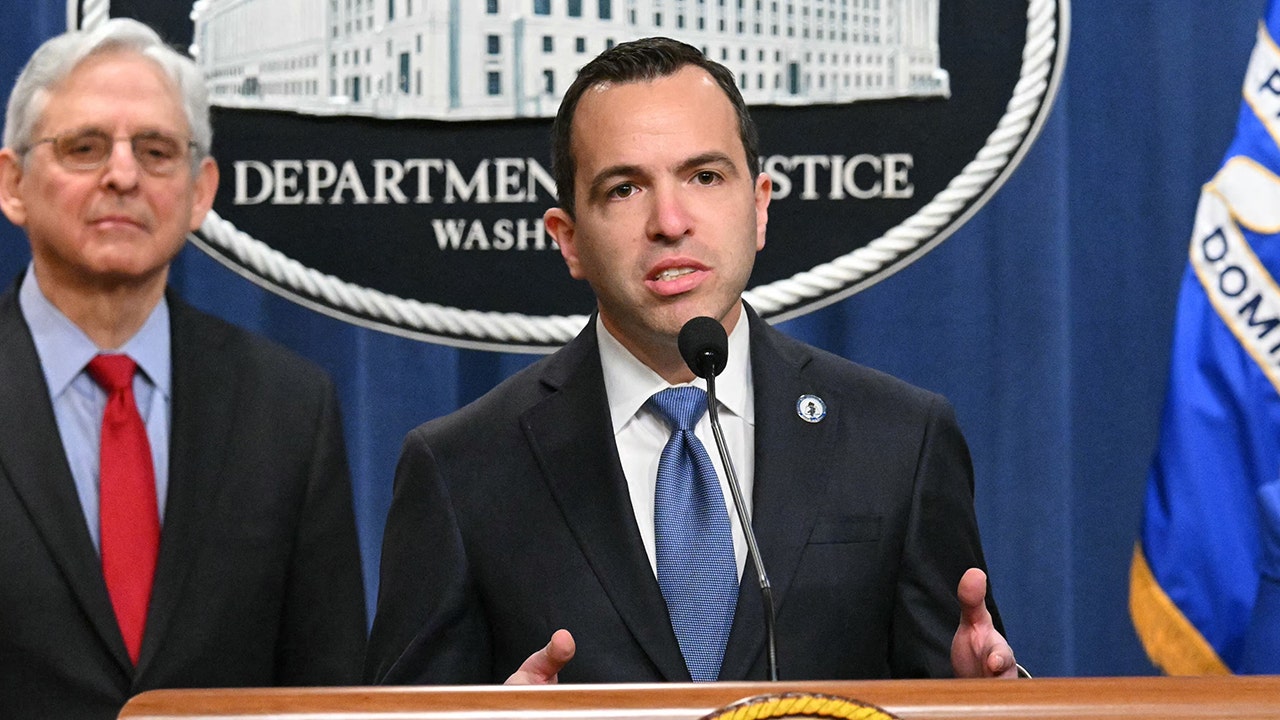
New Jersey Attorney General Matthew Platkin, with U.S. Attorney General Merrick Garland, left, speaks during a press conference announcing an antitrust lawsuit against Apple at the Justice Department in Washington, D.C., March 21, 2024. (Mandel Ngan/AFP)
CLICK HERE TO DOWNLOAD THE FOX NEWS APP
First-degree crimes in the case carry a prison sentence of 10 to 20 years and a fine of up to $200,000. First-degree money laundering carries a $500,000 fine. Second- to fourth-degree charges also carry prison time.
“The takedown of this organized illegal sports gambling ring underscores our unwavering commitment to dismantling criminal networks that profit from corruption and greed,” said Col. Patrick J. Callahan, superintendent of the New Jersey State Police.
“These racketeering operations exploit vulnerable individuals and communities, and today’s charges send a clear message: We will continue to protect victims and pursue justice wherever organized crime takes root.”
Follow Fox News Digital’s sports coverage on X and subscribe to the Fox News Sports Huddle newsletter.
Read the full article from Here


Boston Red Sox
Are the Boston Red Sox back?
They’re certainly on the right track.
Boston won its seventh consecutive game Friday night, 6-2, in its series opener against the New York Mets. The victory improved its record to 44-48, which moved the club even closer to .500 on the year.
On top of that, the win was the Red Sox’ 12th in their last 14 games.
Immediately after the final out was recorded, Boston found itself 1.5 games back of the American League’s third wild-card spot.
The win was even sweeter considering the team’s severe issues they experienced in attempting to reach Citi Field.
After they were supposed to have departed Chicago at 9:45 p.m. Eastern Time on Thursday night following their series sweep of the White Sox, the Red Sox’ team plane was grounded until 3 p.m. ET on Friday. Weather delays on Thursday kept them at their gate, and then mechanical problems on Friday prolonged their stay on the tarmac well into the afternoon.
Friday’s game with the Mets was originally scheduled to begin at 7:15 p.m., but was pushed back until 7:50 due to Boston not landing at LaGuardia Airport until shortly after 4:30 p.m.
Starting pitcher Sonny Gray did not travel to New York ahead of time, which some starters do to get settled before their outing.
Nevertheless, the Red Sox de facto ace continued his stretch of utterly dominant pitching.
Gray tossed six innings of one-run ball, struck out three, and walked one on 91 pitches (53 strikes). He added an 11th win to his personal record in what has been an excellent season for the veteran right-hander.
Boston’s bullpen was nails, too — Tyron Guerrero, Garrett Whitlock, and Greg Weissert finished the game off in the final three innings after Gray exited. Weissert allowed New York’s second and final run in the ninth on a solo home run, but that was all she wrote in the runs column.
Offensively, the Red Sox’ bats stayed hot in what has been an unprecedented turnaround by the entire team at the plate.
Masataka Yoshida got things going in the first inning with a two-run double, but Boston was quiet until the seventh when Anthony Seigler broke things open. He hit a two-run homer to extend the lead, his second of the year, and was fired up as he rounded the bases.
After the game, Apple TV’s Heidi Watney asked Seigler how he had so much energy following the travel issues the team encountered earlier in the day. He said the club simply knew they would have to persevere, and they did just that on the diamond.
“I think that’s just how we are. It’s this whole team. It doesn’t just start with one person. I think it’s just everybody in the locker room,” Seigler said. “We were dealt some adversity today, obviously. But it doesn’t matter. We knew we were gonna come out here and handle our business, and we did.”
He even said he felt like he could suit up for another game immediately after the win.
“I mean, I feel like we could go another nine (innings) if we needed to, honestly, with how we’re going,” Seigler said with a smile.
Seigler, who came to Boston in the Caleb Durbin trade in February, has been a total, albeit unlikely, spark plug since joining the team last month. Through 20 games, he’s slashing .292/.378/.477 with an .855 OPS, and has hit at the top of the order.
Wilyer Abreu joined in on the fun with a two-run shot of his own in the ninth to cap the Red Sox’ scoring. He finally got a hold of one after coming within feet of hitting a homer in the fifth inning.
Boston’s offensive surge couldn’t have come at a better time. The front office has yet to decide whether they will be buyers or sellers at next month’s trade deadline; the team’s hot streak could prevent chief baseball officer Craig Breslow from blowing the roster up entering the second half.
The Red Sox are still four games below .500, but capping off the first half of what was a tumultuous start to the season with a win streak and multiple series sweeps could be just what the doctor ordered with the dog days of summer looming.
“We’re just putting great at-bats together, the whole lineup from top to bottom,” Seigler said of what’s gone right lately. “Our starter, Sonny, all of them, they just speak for themselves. And then our bullpen does a great job coming in behind them.
“It’s just fun to be around everybody. We believe in each other. Everything’s contagious. We’re all bringing high energy every day.”

Receive updates on your favorite Boston teams, straight from our newsroom to your inbox.
Get everything you need to know to start your day, delivered right to your inbox every morning.

An oversized poster board tracks the deep cleaning happening across Pittsburgh’s Mount Washington neighborhood. All of the yellow highlights denote the streets already adopted.
“We got all the streets on Grandview [Avenue] and we’re still working on a few on Duquesne.”
It’s the brain of Helen Oldfield, who told KDKA-TV that her recent move from the West Coast left something to be desired at first.
“I was very depressed and shocked by the amount of dirt and litter everywhere,” said Oldfield, creator of the Adopt-A-Block program.
She started volunteering for the large cleanups along Grandview Avenue and loved seeing people rappel down the sides to collect the accumulated trash.
“It’s the iconic street in Pittsburgh. It needs to be clean and look nice, but what about the rest of Mount Washington? When people wandered back through the streets, it was just horrible; it was a mess,” Oldfield said.
It was from that idea that Oldfield’s Adopt-a-Block program was born. Now she’s more than 60 volunteers deep and trying not to just clean but shift attitudes.
“I think a lot of the mess that accumulates up here on Grandview, unfortunately, is due to groups of young people collecting in the evening and just hanging out,” she said. “And it’s a cool place to hang out, so why not? They come with their motorbikes, and they come with their fast cars, and they drink, and they eat fast food, and then they chuck it all over the edge. I don’t believe the trash is due to any local residents or any visitors or sightseers.”
Volunteers Barbara and Paul Franklin say this is part of their life now.
“We’ve been here about a year, and we moved back to Pittsburgh after being away for 37 years, and we noticed there’s just a lot of trash out there,” Paul Franklin said.
The couple is now donning yellow safety vests, using an embroidery hoop to keep the trash bags open, and using grabbers to snag cigarette butts, cans, and even gum wrappers.
“When we do McCardle Roadway on Sunday mornings, I feel really good about that,” Barbara Franklin said.
The volunteers keep on coming, snapping pictures of themselves getting their steps in and making a difference, block by block.
“There is still a long way to go, and we are getting there, and I feel the motivation going here,” said Oldfield.
The Franklins told KDKA-TV that it’s addicting, and now they notice trash everywhere. They hope people will see this story and spread it beyond Mt. Washington.
“We’re proud of this city, we’re proud of this neighborhood, and we want to show it in its best light, and we think we’re helping to do that,” said Paul Franklin.
Oldfield said she hopes to secure some funding to continue supplying her volunteers with much-needed gear. She’s currently receiving some money from the community organization Neighbors on the Mount to purchase the vests and grabbers.
She’s soon applying for grant money in the form of a Neighborhood Economic Development grant and told KDKA-TV that she hopes the city will consider her group for the funds to keep this going.

The second-year Golden State Valkyries keep clearing hurdles that have never been scaled in the history of the WNBA.
They did it again Friday night.
Across the country from Ballhalla, against an opponent with the league’s worst record, the Valkyries became the fastest WNBA expansion franchise to 40 victories.
They needed just 68 games over two seasons to hit the mark.
That was among the bullet points in their 79-64 victory over the Connecticut Sun, an outcome that extended Golden State’s franchise-record win streak to seven games, including the first four in a five-city trip that concludes Wednesday at Indiana.
The Valkyries overcame a rough start on a night in which their All-Star forward, Gabby Williams, was ruled out before tip-off because of a back injury that sidelined her in the fourth quarter of the team’s win in Toronto on Wednesday.
Connecticut, which fell to 5-18, stormed to a 9-2 lead in the opening minutes and maintained an advantage into the second quarter even though its leading scorer on the season, center Brittney Griner, missed her second consecutive game because of a quad strain.
But the Valkyries’ highly touted defense eventually put a grip on the home team, and Golden State grabbed its first lead, 24-23, when Kaila Charles drove for a layup.
The visitors led 30-25 at halftime.
Connecticut kept the margin within single digits for nearly all of the third quarter, but Veronica Burton closed the period with an up-and-under layup as time expired to give Golden State a 54-44 cushion heading into the final 10 minutes.
The Valkyries put the score out of reach when Charles and Burton made back-to-back 3-pointers to widen the lead to 60-44 with 7:19 to play.
Burton had a superb game against her former team, finishing with 17 points, six assists, three rebounds, two blocks and a steal. The Valkyries are undefeated this season when the point guard has at least six assists.
Golden State’s bench contributed 42 points, seven more than its league-high season average. Janelle Salaun led the reserves with 16 points, seven rebounds, and three steals. Laeticia Amihere added six points, five rebounds, three blocks and three assists. The Valkyries also got nine points from Tiffany Hayes and eight from Kaitlyn Chen.
Williams, meanwhile, gave the team a boost from the bench.
“Gabby is still going to contribute, and she still helped us,” Burton said. “She was one of the loudest people throughout the entire game. With that … it’s a next-man-up mentality. There is not necessarily any drop-off. We find different ways to win, and we just rely on every single person on this team.”
With the win, Golden State is the first to 17 victories this season, as the result on Friday improved its record to 17-7, tying the Valkyries with Las Vegas and Minnesota (both 16-6) for the league’s top mark.
How has Golden State done it?
It starts with “high-character” players the front office brought in, coach Natalie Nakase said, noting that everyone has accepted their roles, some more challenging than others.
“The best thing about our team is we have a selfless team that understands matchups,” Nakase said. “Having a deep bench was intentional. But it also comes with the humility that each player has to have that sometimes they can start, sometimes they’ll have a night, sometimes they might not start, sometimes they might not have a night.
“This is a very special group. I am not going to take this group for granted at all because they have meshed a lot better together than I anticipated.”
But even with far more highs than lows, the Valkyries are not a finished product in the eyes of their coach. Nakase noted the team’s slow starts in its previous two games, against Washington and Toronto, and stressed stronger consistency.
The Valkyries had another rough start on Friday.
Afterward, Nakase pointed to fatigue caused by an extended period on the road.
“We lost our vocalness in the first quarter, so I wasn’t really happy with that,” she said. “When you’re tired, the first thing that goes is the mind and they stop talking. We found pockets tonight of when we were very, very connected. But I need to see some rest. They deserve it. Four games in seven days and the emptying-the-tank mentality, I saw a lot of consistency there. But this game was really tough. Credit to Connecticut.”


Red Sox win 7th straight game just hours after landing in New York

One tree at a time: Denver nonprofit works to close shade gap as heat dome threatens neighborhoods


VIDEO: West Seattle Summer Fest 2026 day 1, evening report


The World’s Number One Wellness Retreat is Right in Our Backyard

Festivalgoers say Milwaukee’s summer events fill a gap in downtown entertainment


Atlanta mentoring program brings ‘Save Our Sons Tour’ to Jacksonville’s Duval Day


Minneapolis police highlight missing person found by drone as city weighs aerial tech program


Indiana Silver Alert issued for 14-year-old girl in Indianapolis

