Northeast
On this day in history, March 17, 1776, British troops flee Boston after dramatic 11-month siege by militia

British troops and loyalists fled Boston by ship for Canada in “disgrace” after nearly a decade of occupation that incited protest, bloodshed and then revolution, on this day in history, March 17, 1776.
“Surely it is the Lord’s doings and it is marvelous in our eyes,” patriot and future first lady Abigail Adams wrote of the incredible victory by the pugnacious little city over the mighty British crown.
The humiliating flight of King George III’s forces in the face of his disloyal subjects is still celebrated each year as Evacuation Day, a civic holiday, in Boston.
ON THIS DAY IN HISTORY, MARCH 16, 1802, UNITED STATES MILITARY ACADEMY ESTABLISHED AT WEST POINT
“It was a spectacle such as could only have been imagined until that morning,” David McCullough wrote in his “1776” epic of the most heroic year in American history.
“There were 120 ships departing with more than 11,000 people packed on board — 8,906 King’s troops, 667 women and 553 children, and in addition, waiting down the harbor, were 1,100 Loyalists.”
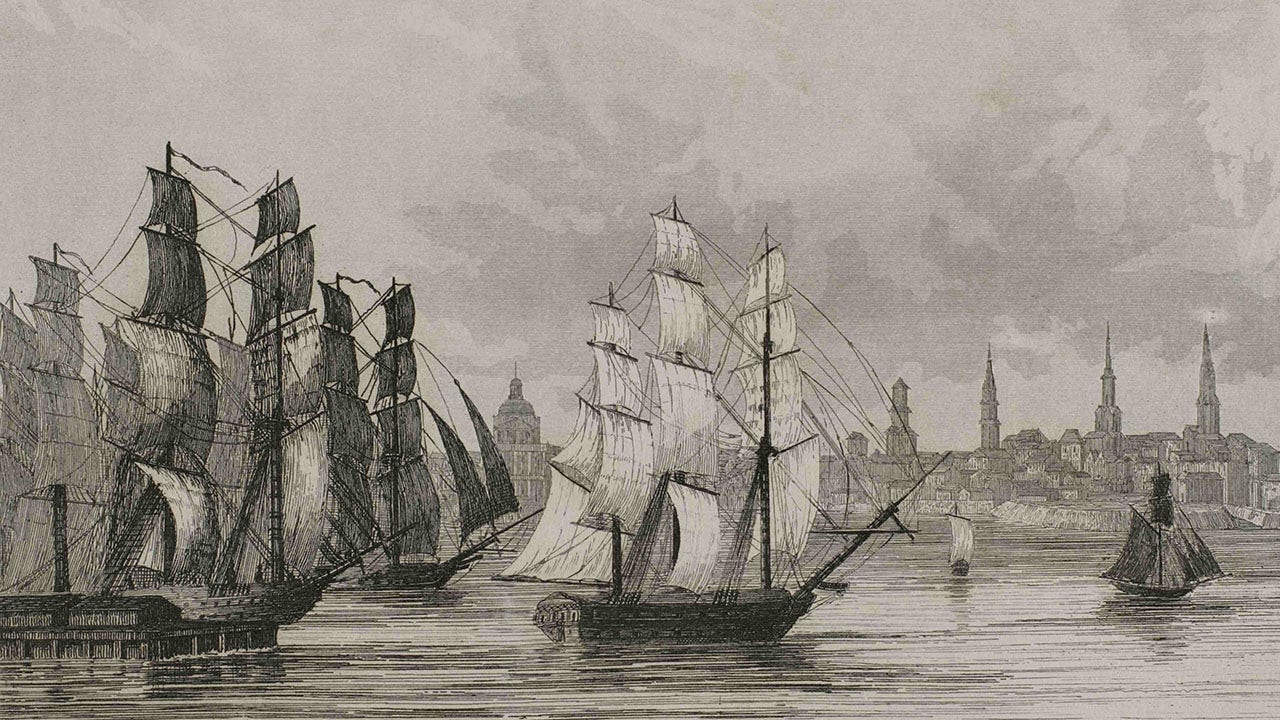
American Revolutionary War. Siege of Boston (April 19, 1775-March 17, 1776). Departure of the British fleet. On March 17, 1776, British forces were forced to evacuate the city of Boston following Gen. George Washington’s successful placement of fortifications and artillery on Dorchester Heights, which overlooks Boston from the south. Engraving by Petit. Panorama Universal. History of the United States of America, from 1st edition of Jean B.G. Roux de Rochelle’s Etats-Unis d’Amerique in 1837. Spanish edition, printed in Barcelona, 1850. (Prisma/Universal Images Group via Getty Images)
The Massachusetts Minutemen famously routed the Redcoats at the Battles of Lexington & Concord on April 19, 1775 — the “shot heard ’round the world” and the start of open hostilities between colony and crown — and chased them all the way back to Boston.
The Siege of Boston followed.
“Surely it is the Lord’s doings and it is marvelous in our eyes.” — Abigail Adams
Thousands of militiamen from around New England left their farms, descended on Boston and launched an 11-month siege of their own port city. It was an unplanned display of resolve that shocked the British.
The British took Breed’s Hill, north of Boston, in the Battle of Bunker Hill, in June 1775, but at shocking cost. They did not make an attempt on Dorchester Heights, south of Boston.
In a line, the Lexington Minutemen and a group of the Massachusetts Sons of American Revolution stand atop Dorchester Heights in Boston on March 17, 2022. The annual commemoration of Evacuation Day at Dorchester Heights in South Boston on Thursday, March 17, is hosted by the National Parks of Boston and South Boston Citizens Association. (David L. Ryan/The Boston Globe via Getty Images)
The Brits were trapped inside the city.
Gen. George Washington of Virginia arrived in Boston on July 3 to forge the militia — 16,000 men strong — into a legitimate fighting force.
“The siege of Boston from June 1775 to March 1776 marked Washington’s debut as commander in chief,” writes Smithsonian Magazine.
TEXAS MOM SUFFERS QUADRUPLE AMPUTATION, CREDITS HER FAITH AND A LITTLE DOG FOR PULLING HER THROUGH
“He met many of the men who would comprise his general staff for the duration.”
One of those men was Boston bookseller Henry Knox.
Col. Henry Knox, Washington’s chief of artillery, brings guns and mortars from Fort Ticonderoga to Boston. Hand-colored engraving by Van Ingen. (MPI/Getty Images)
“Knox impressed Washington with his energy, ingenuity, determination and knowledge of artillery,” writes MassMoments.org, a repository of Massachusetts history.
Knox proposed an audacious plan to end the stalemate: Trek more than 200 miles each way through a New England winter to Fort Ticonderoga, New York, and haul its bounty of artillery back to Boston.
“It was a spectacle such as could only have been imagined until that morning.” — David McCullough
“In less than two months’ time, Knox and his men moved 60 tons of artillery across lakes and rivers, through ice and snow to Boston,” writes MassMoments.org.
MEET THE AMERICAN WHO ROWED WASHINGTON ACROSS THE DELAWARE ON CHRISTMAS: SAILOR-SOLDIER JOHN GLOVER
It’s gone down in American lore as the Noble Train of Artillery. Villagers cheered as the expedition of American patriots passed through their towns.
Knox arrived without losing a single piece of equipment. Continental troops mounted the guns on Dorchester Heights under the cover of darkness the night of March 4 and 5 — six years to the day of the Boston Massacre.
Engraved portrait of former U.S. Secretary of War Henry Knox standing next to a cannon, circa 1780-1800. Engraved from the original by Chappel. (Kean Collection/Archive Photos/Getty Images)
“My God, these fellows have done more in one night than I could make my army do in three months,” British commander General William Howe reportedly exclaimed amid his shock at seeing the guns.
The British garrison, and the loyalists inside Boston, had been reduced to near starvation during the siege.
Howe realized his situation was hopeless. He shipped out March 17.
“The British were completely disgraced,” enthused the New York Constitutional Gazette.
“In less than two months’ time, Knox and his men moved 60 tons of artillery across lakes and rivers, through ice and snow to Boston.” — MassMoments.org.
“The first cheers from the American lines had been heard as early as nine that morning, when the men on Prospect Hill and Dorchester Heights saw clearly what was happening,” McCullough writes.
“In no time small boys came running across the Neck from Boston to deliver the news that the ‘lobsterbacks’ were gone at last.”
The American Revolution moved elsewhere: next to New York, New Jersey and Pennsylvania, and eventually southern colonies, before the British were finally defeated at Yorktown, Virginia, in 1781.
View of residences near Dorchester Heights Monument on April 2, 2015. (Patrick Whittemore/MediaNews Group/Boston Herald via Getty Images)
The American Revolution was over in Boston, the city where it began and where 11-year-old Bostonian Christopher Seider was the first colonist to give his life in the cause of independence in 1770.
Boston has not been occupied by a foreign soldier since.
The victory renewed faith in American independence across the colonies.
Spurred by leading Boston rebels John Hancock and John Adams, the Second Continental Congress declared independence four months later.
The same road into downtown Boston is known today as Washington Street.
Washington deferred the honor of marching into the newly liberated city on March 17 to the New England officer who led the colonial militia in its siege before his arrival.
“In the early afternoon the first troops from Roxbury crossed the Neck and marched into Boston,” writes McCullough. “Drums beating, flags flying and led by Artemus Ward on horseback.”
The general from Virginia soon followed.
The same road into downtown Boston is known today as Washington Street.
For more Lifestyle articles, visit www.foxnews.com/lifestyle.
Read the full article from Here



See the moment a husky shields child from bear
A husky jumped into action to protect a child as a bear charged at them through the yard in Connecticut.
If you’re looking for the best barbecue restaurant in the state, you may have to drive to the state’s capital.
Business Insider identified the most beloved barbecue spot in each state, including Connecticut.
“Our list includes barbecue destinations with historical or regional significance and devoted national or local followings,” Business Insider said. “Many of the spots or their pitmasters have won major accolades, and some have appeared on mainstream TV shows.”
Business Insider’s choice for the most iconic place for barbecue in Connecticut is a specific location of a chain restaurant that has multiple stores in the Constitution State.
Here’s what Business Insider had to say about Bear’s Smokehouse Barbecue, and why it might be worth the extra trip to Hartford, Connecticut.
Bear’s Smokehouse — Hartford, Connecticut
Business Insider said the Hartford location is the most iconic Bear’s Smokehouse in Connecticut. However, Bear’s has locations in Windsor, New Haven, South Windsor, and Storrs (although that one is in a University of Connecticut Student Union).
“Local outlet Hartford Courant named Bear’s Smokehouse the best ribs and best food truck in the state,” Business Insider said. “USA Today also named it one of the best restaurants in the country in 2026 (albeit, one of the North Carolina locations).”
Chain restaurant or not, this location’s menu appears to have all the goods that make a barbecue restaurant great: beef brisket, burnt ends, pulled pork, and turkey breast, all done up in a Kansas-City style of barbecue that would make Ted Lasso proud.
They also offer some innovative takes on hearty dishes like poutine with Bear Style Poutine, which comes with fries, spicy cheese curds, brisket gravy, and your choice of meat.
You can find Bear’s Smokehouse at 25 Front St, Hartford, Connecticut.
They open at 11 a.m. on weekdays and weekends but their closing hours vary depending on the day.
Rin Velasco is a trending reporter. She can be reached at rvelasco@usatodayco.com.

Ralph Benko served as a deputy general counsel in the Reagan White House and worked closely with the George W. Bush administration as a contractor in its domestic policy initiative to find and rescue human trafficking victims. He lives in Maryland.
“As Maine goes, so goes the nation” was, for about a century, a political maxim. Recently, the political junkies in the capital were obsessing about the Platner vs. Collins race.
Wrong race!
Understandable, for those card-carrying members of the Columnist Party. The U.S. Senate majority, a very big deal, may hinge on that race. And that race was spiced up by the salacious and unseemly stories about the winner of the Democratic primary.
With that said, hey, junkies? Platner vs. Collins always was the wrong race to put on the marquee of your political theater. The real bellwether race is the governor’s contest between Bobby Charles and Hannah Pingree.
The political dynamics that have emerged or are emerging is less Republican vs. Democrat and more establishment insiders (Hannah Pingree, former speaker of the Maine House, whose family name has been a prominent fixture in Maine politics for over 30 years) vs. popular insurgents (Bobby Charles, on his first electoral foray).
Charles is fashioning his affordability program via a classic center-right Republican free market platform. Pingree is fashioning her affordability solution via a classic center-left Democratic public works and pro-regulatory platform.
Full disclosure, as chairman of the 190,000-Facebook follower Capitalist League, I lean center-right. My own preferences revealed, there is more to this race than programmatic preferences.
The Charles vs. Pingree race is the perfect microcosm of the national political culture.
I was a lifelong Democrat until the sensible Democratic Party left me for left field. And there they go again. The progressive Mills-Pingree-Platner party ghosts the FDR/JFK/Bill Clinton Democrats.
Bobby Charles — who worked in the Reagan White House and later directly for Colin Powell — is a modern Reaganesque figure, aligning himself with the sensible Maine population, including independents and traditional Democrats, offering common-sense policies.
Charles is running on the Republican line. Yet he has the kind of “man of the people” values that FDR embodied and Middle America embodies.
Yes, there is a lot of crazy going on in the GOP now. Charles, however, embodies classical Republican radical pragmatism. He’s not an ideologue, and is exempt from the fanaticism that so plagues our politics today. Charles is neither a zealot nor a moderate. He’s simply … capable.
Meanwhile the Democrats now, wholesale, are nominating “democratic socialists.” Wait, what? History has repeatedly shown that socialism doesn’t work, locally or nationally.
The further left you move, the more it never works. Remember Jimmy Carter’s misery index? (That’s what forced me out of my once beloved Democratic Party.)
Insanity is doing the same thing and expecting different outcomes. Let’s do sane for a change.
Hannah Pingree presents as an honorable and capable public servant. That said, she will, if elected, be badly constrained by the romantic-but-dysfunctional emerging narrative of her party, now in thrall to its fanatical base, listing so far to portside that it is about to capsize the ship of state.
Maine is one of the states most guided by common sense. Its voters will embrace the candidate with a proven agenda for affordability and security rather than a member of the party who is admittedly charming but impractically romantic (Bernie, AOC, Zohran, etc).
While the nation scratched its head at Maine’s oddly out of sync “oyster farmer” there was, and is, a more meaningful race afoot. Many who have known Bobby Charles for decades and watched him serve his country unflinchingly think he, considered a dark horse, is the odds-on favorite to pull an upset and bring common sense and real management skills to Maine’s governance.
So, political junkies? Now that Platner vs. Collins has ended, please turn your attention to the true marquee Maine race, Charles vs. Pingree. For as Maine goes, so goes the nation.

Massachusetts’ recent smoky skies and hazy sunsets may look unusual, but experts say what we’re seeing is part of a growing pattern fueled by bigger and longer wildfire seasons.
The strange haze has lingered for two days — so far — thanks to a weather pattern bringing smoke straight from parts of Ontario, Canada, straight to New England.
NBC10 Boston NBC10 Boston
“A lot of the fires farther up north are burning longer and more intensely than they have previously, so that’s been a big change and may be why we’re seeing more of the smoke,” said James Urban, an associate professor in the Fire Protection Engineering Department at Massachusetts’ Worcester Polytechnic Institute.
It looks like Boston’s getting a break from the wildfire smoke that’s making the sky hazy enough that you can actually look at the sun, if briefly. But that break may not last. Plus, we’re looking at rain moving in this weekend.
He explained the nuances about how climate chance may play a role in what we’re seeing this summer.
“In general, drier conditions make things more flammable, but also, if you have a period before that of wet winter but not a lot of freezing, you may get a lot of plant growth, and then when it dries out in a drought, you get a lot of fuel that may ignite,” Urban said.
Why does smoke travel cross-country and change the color of the sky?
We went to a museum to find out more about what’s causing the unearthly images in the sky.
“With smoke, it’s driven into the air with the heat and then gets caught in the upper air current, so it travels over the mountains and comes straight across the country,” said Noreen Johnson Smith, president and CEO at Worcester’s EcoTarium.
Mass. or Mars? Photos of the eerie, rusty skies caused by Canadian wildfires
The way the sun looks has to do with how smoke scatters light.
“We’re seeing these bright orange and red suns because the blues aren’t able to reach our eyes at the moment,” said Murphy Florman, an educator at the museum.
How smoke affects air quality
An air quality alert for Massachusetts has been extended through all day on Thursday, with the Department of Environmental Protection saying in a statement, “elevated levels of fine particles [mean that] air quality statewide is expected to be unhealthy for sensitive groups.”
Massachusetts is under an air quality alert due to the Canadian wildfire smoke that’s made the skies dark and hazy and turned the sun into an “orange orb.” Here are the factors making the air hard to breathe for some and what medial professionals say about it.
Tufts Medical Center pulmonologist Dr. Sucharita Kher said that it’s important to be aware of the air quality where you live, especially if you’re going to be spending time outside. The conditions Massachusetts has been experiencing are especially harmful to those with heart or lung disease.
“The symptoms of that can be tightness in the chest, they can experience more wheezing, they can have more swelling in their airways leading them to cough more, produce more phlegm,” she said. “All of that ultimately leading to worsening symptoms of that underlying disease.”
Needham pharmacist Kevin Ryan said certain medications can help with symptoms, such as histamines like Claritin or Zyrtec, as is wearing an N-95 mask.
“If you feel like you’re doing fine outside, that’s great. If you if you don’t feel like you can breathe effectively, then limit your exposure,” he said.
Canadian wildfire, smoke map
-

 Alaska1 minute ago
ICE: Alaska state attorney arrested by immigration officials, held in Tacoma detention center
-

 Arizona7 minutes ago
Arizona Lottery Powerball, The Pick results for July 15, 2026
-

 Arkansas13 minutes ago
AGFC proposes WMA regulation | Arkansas Democrat Gazette
-

 California19 minutes ago
Becerra leads Hilton by wide margin in California governor’s race, new poll finds
-

 Colorado25 minutes ago
See where the new Colorado Connector train will stop
-

 Connecticut31 minutes ago
This Connecticut barbecue restaurant is ‘beloved’ for a reason.
-

 Delaware37 minutes ago
Delaware oversight commission debates authority to reject utility rate hikes
-

 Florida43 minutes ago
Florida preacher buys VT campus to build Christian college | Fox News Video

