


Sign up for the Today newsletter
Get everything you need to know to start your day, delivered right to your inbox every morning.

NEWYou can now listen to Fox News articles!
In the final stretch leading up to Election Day 2025, former President Barack Obama is everywhere.
From coast to coast, the former president is hoping to help push fellow Democrats over the finish line in the most high-profile and consequential ballot box showdowns this year as his party aims to rebound following last year’s election setbacks.
On Saturday, with just three days to go until Election Day, Obama will headline rallies in New Jersey and Virginia, the only two states holding elections for governor this year.
And last week he weighed in on another crucial ballot box showdown.
HEAD HERE FOR THE LATEST FOX NEWS REPORTING ON THE 2025 ELECTIONS
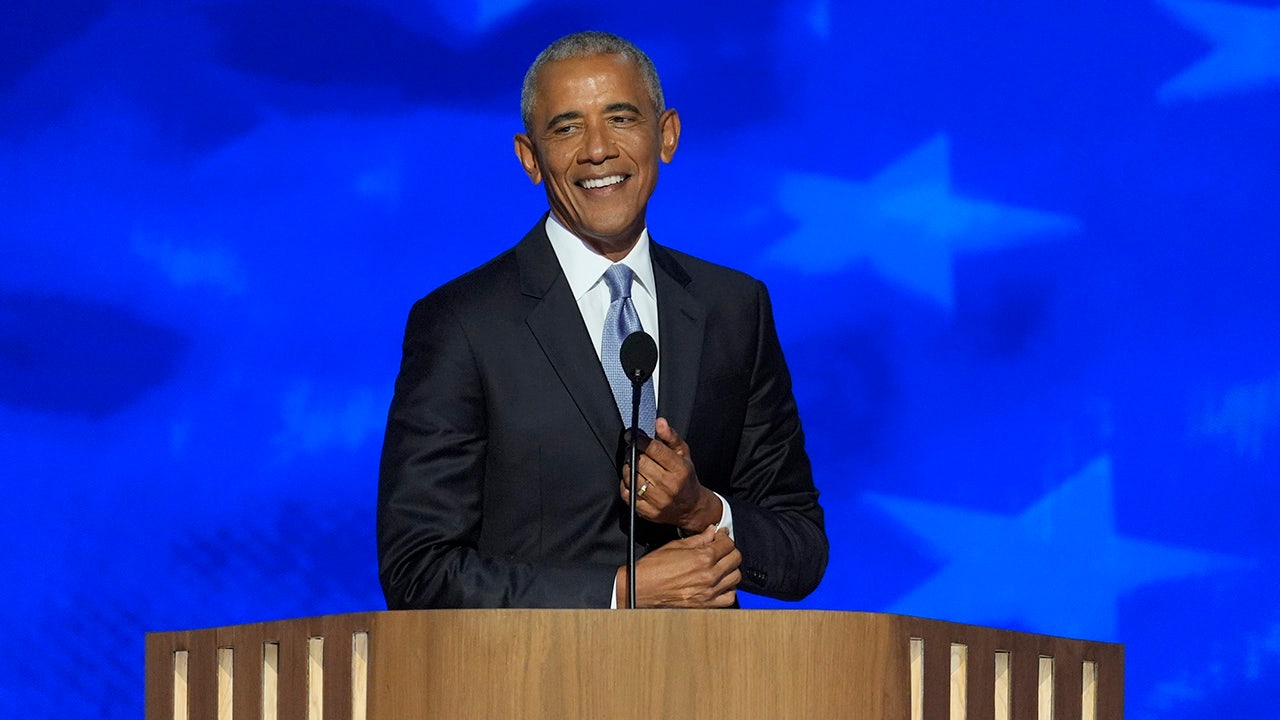
Former President Barack Obama speaking at the Democratic National Convention on Aug. 20, 2024, in Chicago. (J. Scott Applewhite/AP Photo)
“A lot of us do not believe that politicians should choose their voters, they believe the voters should choose who’s going to represent them. That’s the meaning of democracy,” the former two-term president said as he joined California Gov. Gavin Newsom on an organizing call for California’s Proposition 50.
California voters are deciding whether to pass the proposition, which will give congressional redistricting powers in the left-leaning state back to the Democrat-dominated legislature over the coming years.
The move would likely create up to five more blue-leaning U.S. House seats in the nation’s most populous state, and counter new maps drawn in GOP-dominated Texas, Missouri, and North Carolina that will likely create up to seven Republican-leaning districts.
FIVE KEY RACES TO WATCH ON ELECTION DAY 2025
It’s part of a broad effort by the GOP to pad its razor-thin House majority to keep control of the chamber in the midterms, when the party in power traditionally faces political headwinds and loses seats. Democrats need a pickup of just three seats to win back control of the House.
President Donald Trump and his political team are aiming to prevent what happened during his first term in the White House when Democrats reclaimed the House majority in the 2018 midterm elections.
Obama argued that the Trump-led effort by Republicans across the country is “brazen.”
“The problem that we are seeing right now is that our current president and his administration is explicitly saying that we want to change the rules of the game mid-stream in order to insulate ourselves from the people’s judgment,” the former president said as he joined Newsom.
Obama, who is appearing in “Yes on 50” TV ads, said that passing the proposition in California would give Democrats “a chance, at least, to create a level playing field in the upcoming midterm elections.”
BATTLE FOR GOVERNOR IN THIS CLOSELY WATCHED RACE MAY BE HEADED FOR A PHOTO FINISH
The former president is also appearing in ads in New Jersey for Democratic gubernatorial nominee Rep. Mikie Sherrill, who’s locked in a close contest with GOP rival Jack Ciattarelli in the race to succeed term-limited Democratic Gov. Phil Murphy, a Democrat.
And he’s starring in spots for former Rep. Abigail Spanberger, the Democratic gubernatorial nominee in Virginia, who’s facing off against Republican rival Lt. Gov. Winsome Earle-Sears in the showdown to succeed term-limited GOP Gov. Glenn Youngkin.
Former Rep. Abigail Spanberger, seen at an early voting rally on Sept. 19, 2025, in Henrico, Virginia, is the Democratic Party’s nominee in this year’s election for governor. (Chip Somodevilla/Getty Images)
For Democrats, who are aiming to escape the political wilderness after losing control of the White House and Senate majority and falling short in winning back the House last year, the 2025 ballot box showdowns are their first major shot at redemption, and they hope that Obama’s two-state swing will energize their base voters.
But for the former president, whose crowning domestic achievement — the Affordable Care Act, which is better known as Obamacare — is front-and-center in the current federal government shutdown and a top issue on the 2025 campaign trail, his return to the campaign trail is also about protecting his legacy.
“President Obama reminds us what we can accomplish when we leaders are unafraid to take on big challenges to deliver,” Sherrill said in a statement. “He led historic efforts to insure millions of Americans and lower healthcare costs.”
Rep. Mikie Sherrill, the Democratic nominee for governor in New Jersey, greets voters at a senior center in Elizabeth, N.J., on Oct. 29, 2025 (Paul Steinhauser/Fox News)
Obama is often referred to as the Democrats’ campaign closer as they point to his recurring role since leaving office nine years ago as the party’s most effective campaign trail communicator.
According to a Gallup poll conducted in January, Obama had a 59% favorable rating among Americans, higher than any other living former president. And among Democrats, his favorable rating stood at an astronomical 96%.
“He’s the best communicator of our generation. The pathway back lies largely in meeting people where they are, and President Obama showed in his two election victories that he can do that,” seasoned Democratic strategist Joe Caiazzo told Fox News Digital.
But Erin Maguire, a veteran Republican strategist and communicator who served in top communications positions for then-House GOP leader Kevin McCarthy, for Trump’s 2020 presidential campaign, and later led communications for Sen. Ted Cruz of Texas, disagrees.
“It shows what a vacuum of leadership there is in the Democrat Party that Obama has to be the closer here,” she emphasized.
Pointing to Trump’s come-from-behind 2016 White House victory, Maguire argued “there was a complete rejection of the Obama era when Donald Trump was elected to office. . . . For Democrats, this just shows what a monumental mess their whole party is that Obama has to be the strongest voice on any of these races.”
Read the full article from Here


Local News
A Boston man is facing charges after he allegedly lunged at a Burger King employee, punched a customer, and then resisted arrest at a nearby MBTA station in East Boston, authorities announced Monday afternoon.
Patrick Donovan, 59, was charged July 1 with one count of assault and battery causing injury on an over 60 or disabled person, assault and battery, disorderly conduct, resisting arrest, assault, and vandalism, Suffolk District Attorney Kevin Hayden’s office said in a press release.
The charges stem from an incident shortly before 10 p.m. on June 30, when Boston police responded to a disturbance call from Burger King at 1 Maverick Square, Hayden’s office said.
A Burger King employee told officers that, after ordering his food and receiving it, Donovan yelled that he no longer wanted it and smacked a napkin holder off the counter. He then allegedly lunged at an employee and grabbed her by the arm, prosecutors said.
Donovan subsequently shoved a customer from behind and allegedly punched him in the face three times while calling him racial slurs, the DA’s office said.
Emergency medical services evaluated the customer for “visible lacerations to the forehead,” but the victim declined additional treatment, authorities said.
Donovan fled the restaurant following the assaults, and officers tracked him to the nearby MBTA Maverick Station, prosecutors said.
“While officers tried to detain Donovan inside the station, he swung at them with a closed fist but did not make contact,” Hayden’s office said, noting that Donovan made racial slurs towards the officers. “Donovan was placed into custody after a brief struggle.”
During his arraignment in the East Boston division of the Boston Municipal Court, Donovan pleaded not guilty and was released on personal recognizance. Court records show he was also ordered to stay away from Maverick Square and Burger King.
He is scheduled to return to court Aug. 7 for a pre-trial hearing, prosecutors said.
Officers obtained security footage of both assaults. Authorities said the incident remains under investigation and could result in further charges.
“Our workers deserve to be safe in their workplaces and our consumers deserve to be safe in their shopping or dining places, without exception,” Hayden said in a statement. “Beyond that, none of our citizens or first responders should be subjected to racial slurs. These appalling words have no place in Suffolk County or anywhere else in our society.”
Attorney information for Donovan was not immediately available Monday afternoon.
Get everything you need to know to start your day, delivered right to your inbox every morning.


A hit HBO documentary series is looking to Connecticut for stories to feature in its second season.
The show “Neighbors” follows on-going neighbor disputes across the country. The goal of the show is to help neighbors reach a resolution, according to the show’s casting director and executive producer Harleigh Shaw.
“Each story we explore, we spend extensive time with neighbors on both sides to really understand the full context beyond the disputes,” Shaw said.
Producers wanted to share stories in the second season that were based in states that weren’t featured earlier this year in the first season, including Connecticut, Shaw said.
“A lot of the things that we’re most interested in are things that may seem small, but become a bigger issue between the neighbors,” Shaw said. “Anything from disagreements over gardening practices to property lines to noise to dock issues, if it’s a waterfront property. A whole myriad of things. We’re really open to anything.”
However, the show does avoid situations that are violent or dangerous.
Residents from Connecticut looking to participate should be open to third party conflict resolution, according to Shaw.
“Some of the ways that we did that were through mediation,” Shaw said. “That’s a huge one. But there are other things in terms of resources we’d be open to help the neighbors to like help work through the issues.”
Filming will take place throughout the summer and is expected to be completed by the end of September.
The show’s production team is located in New York City and Los Angeles.
“Connecticut has always been really interesting because it’s just a short trip away, and we’re just curious to explore the types of neighbor dynamics that are going on there,” Shaw said.
Connecticut residents who are interested in being on “Neighbors,” can apply at helloneighbortv.com and are encouraged to submit information about themselves as well as their neighbor dispute.
“The neighbor disputes are the entry point for this show, but we’re always also just very interested in inspiring amazing people doing cool stuff,” Shaw said.
“Neighbors” premiered in February and was quickly renewed. The show averages about 3 million viewers per episode.
The show features stories that make viewers laugh and cringe, according to HBO Programming’s Executive Vice President Nina Rosenstein.
“At a time when even the smallest disagreements can spiral out of control, ‘Neighbors’ feels both hilariously absurd and surprisingly relatable,” Rosenstein said. “What makes the show special isn’t just the stories and people they find, but the empathy and humanity they bring to each episode.”


Ritzy Pasadena hotel settles lawsuit for allegedly price gouging wildfire victims


Brother Nature at Night: Jack’s backyard & kayaking the Huron River


Hardin Fire in Napa County burns 55 acres near Pope Valley


Former Dallas ISD Superintendent Michael Hinojosa runs for Dallas Mayor


South Florida mother arrested for leaving daughter chained to fence, police say


Boston man charged after allegedly assaulting Burger King employee, punching customer

Denver Country Club caddie earns full-ride Evans Scholarship, becomes first in family to attend college


Seattle very much in running for another World Cup

