
Connect with us

Northeast

'No need to be afraid' of 'venomous flying spiders,' expert says

Published

on

'No need to be afraid' of 'venomous flying spiders,' expert says

Reports of “venomous flying spiders” poised to invade the United States may seem scary to some, but multiple spider experts told Fox News Digital this week that, while there’s cause for concern, there is no threat to humans or pets.

The Joro spider, an invasive species originally from Asia, was first officially sighted in the United States about 10 years ago, Dr. David Nelsen, a professor in the Biology and Allied Health Department at Southern Adventist University in Tennessee, said in a phone interview. 

Nelsen published a research paper on the spread of Joro spiders in 2023. 

FLORIDA OFFICERS ‘ARREST’ NUISANCE ALLIGATOR AT 104-YEAR-OLD WOMAN’S HOME

“I think that we should be worried, because it’s invasive, and they look like they’re having an effect on the ecosystem,” Nelsen said. 

Advertisement

Yet in terms of the safety of humans, pets and property, these spiders do not pose much, if any, of a threat at all, he said. 

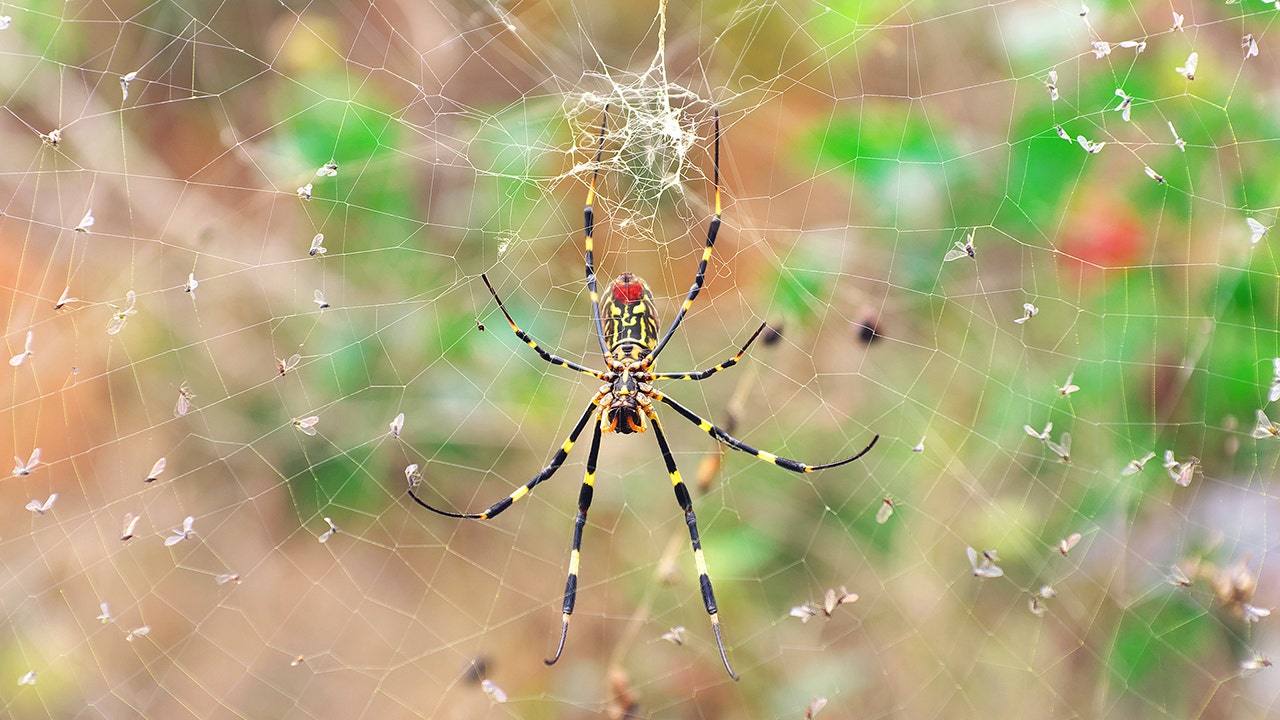
Joro spiders are native to Asia but have recently made their way to the United States, an expert told Fox News Digital.  (iStock)

“They’re more of a nuisance than anything,” Nelsen said. “They’re going to decorate your house with webs. They tend to like to aggregate together in these large communities. And that can bother people.”  

Their large size — their legs can grow up to 4 inches — can be unsettling for people who do not like spiders, he added. 

ELUSIVE AND ‘HIDEOUS’ FISH STUNS VIEWERS AFTER INSTAGRAM POST GOES VIRAL: ‘NEW FEAR UNLOCKED’

Advertisement

“But as far as venom is concerned, you’re not hearing reports from China and Korea about envenomations and risk,” Nelsen said. “They’re really not aggressive spiders.”

Joro spiders “look more scary than they actually are.”

Joro spiders “look more scary than they actually are,” Allan Bossel, operations expert at Florida-based Bed Bug Exterminator, told Fox News Digital. 

“They definitely are big, and they can catch all kinds of things in your yard, like flies and wasps, but also bees and butterflies,” said Bossel, who specializes in general insect control, according to the company’s website. 

While the Joro spiders, like the vast majority of spider species, have venom glands, that venom does not pose a danger to humans or pets, Bossel said.

Advertisement

Joro spiders have venom, but they do not pose a danger to humans or pets. (iStock)

“That venom is for their prey and doesn’t really harm people or pets,” he said. 

Joro spiders are “incredibly docile,” Dr. David R. Coyle, an assistant professor at Clemson University in South Carolina, told Fox News Digital in an email. He’s published research on Joro spiders. 

“I’ve handled dozens of them (and my kids have handled them) with absolutely zero ill effects,” he said. 

What’s more, it is not even certain that the “mouthparts” of a Joro spider can even break human skin, he said. 

Advertisement

It is unclear how these spiders made their way to the U.S., but one expert suspects an egg sac hitched a ride on a shipping container. 

“In my opinion, there’s no need to be afraid of them,” Coyle said.

“That said,” he continued, “arachnophobia is a thing and some folks may have a genuine fear of Joro spiders (and other spiders, for that matter).”

Orb weaver spiders, like Joro spiders, are also “extremely unlikely” to be found indoors, Bossel said.

LOUISIANA DEPUTY MAKES ‘FOWL’ DISCOVERY IN MISSING CHILD’S BACKPACK

Advertisement

Today, Joro spiders can be found throughout much of the southern U.S.; there is also said to be a “satellite” population in Baltimore. 

It is unclear how these spiders made their way to the U.S., but Nelsen suspects an egg sac hitched a ride on a shipping container. 

Their population is, however, likely to continue growing and spreading across the country. 

“They look like they can spread pretty wide across the United States, especially in the East,” Nelsen said. “I think we’ve kind of lost the war at this point, in terms of stopping it altogether.” 

“While our research shows they can likely survive in the Northeast, they aren’t there yet.”

Advertisement

Coyle concurred, but added that the timeline of the spiders’ journey northward was still very unclear.

“While our research shows they can likely survive in the Northeast, they aren’t there yet (outside of a small population near Baltimore),” he said. 

Someone who encounters a Joro spider should use the “tried and true method of ‘squash’” to eliminate the pest, one expert said. (iStock)

“We have no idea whatsoever if or when they’ll make it up there,” noted Coyle. 

Still, humans can — and should — do what they can to prevent their spread. 

Advertisement

“There’s the tried-and-true method of ‘squash,’” Nelsen told Fox News Digital. 

“Certainly, the average citizen, if you see [a Joro spider], you can kill it,” he said. 

“The best way to eradicate them would be to target egg sacs.”

Coyle agreed, telling Fox News Digital that the arachnids are “soft-bodied and relatively easy to either move or dispatch, should the homeowner choose to do so.” 

Part of the reason the spiders have been able to establish a population in the U.S. is due to their “live-fast, die-free” lifestyle, Nelsen said.

Advertisement

“They grow really, really quickly, they reproduce, and then the female lays an egg sac and basically dies,” he said. 

The spiders themselves do not survive the winter, but the egg sacs can and do, he said. 

“They’re kind of cryptic, so they’re hard to spot,” Nelsen said. “The best way to eradicate them would be to target egg sacs.” 

The Joro spider, a large spider native to East Asia, is seen in Johns Creek, Georgia, on Oct. 24, 2021. Populations of the species have been growing in parts of the South and East Coast for years now, and many researchers think it’s only a matter of time before they spread to much of the continental U.S. (AP Photo/Alex Sanz, File)

Advertisement

As for reports that the spiders are “flying,” Nelsen said that is “kind of misleading.” 

Joro spiders, like many spider species, “disperse by ballooning,” he said. 

This means they cast a thread into the air that is picked up by air currents. 

However, this happens when the spiders are very small, not in their full-grown adult size. 

Advertisement

“They’re not dispersing as these really large adults,” Nelsen said. “They’re dispersing as these tiny millimeter-sized spiders, as basically fresh babies.”

When the spiders land, they will then grow to their adult size. 

For more Lifestyle articles, visit www.foxnews.com/lifestyle

“You’re never going to see a ginormous spider fly in and smack you in the face, or something like that,” he said. 

“These are tiny little spiders that you wouldn’t even know. This is happening all the time.”

Advertisement

Read the full article from Here

Continue Reading
Click to comment

Leave a Reply

Your email address will not be published. Required fields are marked *

This site uses Akismet to reduce spam. Learn how your comment data is processed.

Rhode Island

Video: Massive great white shark feeds on dead whale off the coast of Rhode Island

Published

on

Video: Massive great white shark feeds on dead whale off the coast of Rhode Island


RHODE ISLAND – It’s not often you can get so close to such a dangerous beast like a great white shark, but that is exactly what one boater was able to do in Rhode Island.

A large 15-foot great white shark was spotted feasting on a dead whale in the ocean off the coast of Rhode Island.

STAY SHARK SMART: WHAT TO KNOW WHEN YOU HEAD INTO THE WATER

Advertisement

Despite a reputation for inhabiting waters in Australia and South Africa, great white sharks can be found in temperate waters around the world, as their habitat preferences can change as they age, according to National Geographic.

Video footage shared by Ian Shilosky shows many birds hovering around the whale carcass, trying to get a nibble without getting too close to the 15-foot beast.

SEE IT: SPERM WHALE CAUGHT ON CAMERA IN RARE ENCOUNTER OFF SOUTHERN CALIFORNIA COAST

Advertisement

The shark shows off its brutal strength, ripping large chunks from the whale with its 2 to 3-inch razor-sharp teeth, before diving underwater to consume its meal.

“White shark sightings are few and far between until a whale dies and then they seem to appear out of nowhere as this one did,” the Atlantic Shark Institute said on social media.

The great white shark grows slowly, with males maturing at around 26 years and females at around 33, according to NOAA.

Advertisement

These creatures range in age from 30 to over 70 years old, and they can weigh up to 4,500 pounds.

DEEP-SEA DISCOVERY UNCOVERS ONE OF THE LARGEST KNOWN WHALE GRAVEYARDS ON THE FLOOR OF THE INDIAN OCEAN

Adult great whites usually swim along shorelines where there is a known food source, such as seals or sea lions.

Advertisement

12-YEAR-OLD AMERICAN BOY ATTACKED BY SHARK WHILE VACATIONING IN THE BAHAMAS

As the largest predatory fish in the world, great white sharks tend to eat a variety of fish, rays, squid, seabirds, sea turtles, dolphins and more.


Source link

Continue Reading

Vermont

Commentary | Eric Peterson: Time is running out for Vermont

Published

on

Commentary | Eric Peterson: Time is running out for Vermont


The Vermont Chamber has said it, in startlingly emphatic, hey wake-up because it is frightening close to too bloody late challenge, that if listened to, and acted on, could save the Green Mountain State.

The title of the Chamber’s missive which has been printed on various news sites is: “Vermont is in Trouble.” They follow it up with explanations that, if you love this beautiful state you will panic. Which is absolutely the correct reaction. But it is only the correct reaction if you are willing to help do something to solve the myriad pile of problems facing us.

The chamber states the issue this way: “We are aging, shrinking, and pricing out our own children, workers, and entrepreneurs. Schools face consolidation, taxes are climbing, and employers struggle to fill jobs. We’re too dependent on federal funding to support state spending. A housing shortage is driving up prices, slowing economic growth, and leaves young people feeling forced out. Staying the course is not a viable option. It only gets worse from here if nothing changes.”

Advertisement

They suggest some solutions:

Regulatory Modernization: Move from a culture of “permission” to a culture of “production.”

Fiscal Stewardship: Align our budget with economic reality.

Intentional Growth: Actively recruit and retain a diverse, working-age population.

Accountability: Ensure enacted policies achieve their goals.

Advertisement

Each of these is elaborated on by the Chamber. They also go on to say: “Vermont has experienced the nation’s largest percent decrease in population last year, becoming the only state losing population to both natural changes and net migration… Let’s choose abundance because Vermonters can no longer afford to choose scarcity.”

It is a Cri du Coeur that should be heard by every legislator, selectboard or city council, every business owner, civic organization, in the state. This isn’t a project for next year. This is a problem that demands immediate action!

In March I wrote a column remembering Governor Phil Hoff’s Vermont marketing campaign known as “Vermont the Becking Country.” The campaign brought thousands of people to the state. The same slogan might well, with an attractive invitation advertising campaign might get noticed by people and companies on the lookout for new opportunities. Newcomers should be happily welcomed. But missionaries from afar won’t solve our problems. This is a job for Vermonters.

The chamber mentions the crying need for new housing and laments that, “For decades, Vermont has treated growth as a threat to mitigate… True equity requires expanding supply rather than fighting over the crumbs of a shrinking economy.”

Their words need to be heeded. Immediately. We have dug ourselves a very deep hole. We aren’t going to climb out of it in a year or two. It is going to take years of constant hard work and a sizable fortune to get Vermont back to growing rather than shrinking. But if our children and grandchildren are going to have Vermont as a viable choice where to live and work, we need to begin making Vermont viable again immediately.

Advertisement

The Vermont Chamber is correct. They have stated the problem in bold words. They have challenged the government, the business community, the education system, the news media, and every single one of us to step up and begin the hard work of making the Vermont the Beckoning Country once again!

When the legislature returns to Montpelier in the fall, they need to get to work and Governor Scott can’t sit back and wait for the lawmakers to craft a long series of brilliant remedies to fix what is broken. Governor Scott needs to roll up his sleeves and work closely with those writing the bills. He also should gather members from the business world and those from not-for-profit organizations. Getting Vermont back on track is going to take an “All hands-on deck” attitude.

Time is running out for Vermont. The Green Mountain State is too precious to all it to wither away.

Eric Peterson has been contributing columns to various publications for decades. Opinions expressed by columnists do not necessarily reflect the views of Vermont News & Media.

Advertisement


Source link

Continue Reading

Boston, MA

Police: Man killed in crash caused by wrong-way driver on I-93 in Boston – Boston News, Weather, Sports | WHDH 7News

Published

on

Police: Man killed in crash caused by wrong-way driver on I-93 in Boston – Boston News, Weather, Sports | WHDH 7News


BOSTON (WHDH) – A 20-year-old man is dead, and an 81-year-old man will face criminal charges following a wrong-way crash on Interstate 93 in Boston late Saturday night, officials said.

Troopers responding to a reported multi-vehicle crash on Route 93 northbound before Exit 15A around 11:45 p.m. determined a driver in a 2004 Cadillac Escalade got on the highway in the wrong direction and nearly struck two vehicles — a Honda Odyssey and an Audi A4 — causing both to swerve and crash into each other, according to state police.

The occupants of the Honda Odyssey, a family of four, were transported to a Boston-area hospital for evaluation.

Shortly after the initial crash, the wrong-way driver, later identified as Antone Carvalho, of Somerset, collided head-on with a Chevrolet Cruze.

Advertisement

The driver of the Chevrolet Cruze, a man in his 20s from Haverhill, died from his injuries. His name has not been released.

Carvalho will be issued a summons to appear in court at a later date.

This is a developing news story; stay with 7NEWS on-air and online for the latest details.

(Copyright (c) 2026 Sunbeam Television. All Rights Reserved. This material may not be published, broadcast, rewritten, or redistributed.)

Join our Newsletter for the latest news right to your inbox
Advertisement


Source link

Continue Reading
Advertisement

Trending
