Northeast
Newly reported transcripts depict communication breakdown hindering law enforcement at Butler Trump rally

CONNOQUENESSING, Pa. – Newly reported transcripts of law enforcement communications at the Butler, Pennsylvania, Trump rally depict a communications structure that essentially isolated local and federal law enforcement from each other at key times.
Communications reported Sunday by the Washington Post also highlight the effect spotty cellular service in the rural Allegheny Valley purportedly had on preventing transmission of key messages like an officer’s photo of then-suspicious individual Thomas Crooks.
According to encrypted radio communications obtained by the newspaper, at 5:42 p.m. ET on July 13, a counter-sniper from a local law enforcement agency alerted that a “younger White male [with] long hair” was “lurking” around the AGR glass company building adjacent to the Butler Farm Show grounds – but had since disappeared from view.
Within a half-hour, that suspicious individual – Thomas Crooks – would fire shots at former President Trump from atop that low-rise building and kill a local firefighter in the process.
BUTLER LAWMAKER SLAMS ‘INAPPROPRIATE’ TREATMENT OF LOCAL POLICE AFTER TRUMP INCIDENT: ‘THROWN UNDER THE BUS’
A flag is lowered to half-mast at the front entrance of the Butler Farm Show in Butler, Pennsylvania, on Monday, July 22, 2024. (Derek Shook for Fox News Digital )
However, that local officer’s warning would go unheard by U.S. Secret Service because the transmission went to a trailer from which local police commanders were operating – separate from the president’s detail, the paper reported, citing Butler County District Attorney Richard Goldinger and a separate law enforcement source.
According to the Post, the police commander in the trailer telephoned a Pennsylvania state trooper to pass the message along.
There were at least three other key moments when communications had to be transmitted by cellphone, at a venue where – like sporting events – crowds often overwhelm the frequency.
The director of emergency services in neighboring Beaver County – which also lent personnel for the event – told the paper that agencies should not be separated from each other and instead have representatives in “the same room.”
TOP DEM WHO VISITED BUTLER SAYS LOCAL OFFICIALS TOLD HIM ‘WE NEED TO TALK MORE’ ABOUT USSS FAILURES
Rep. Glenn Ivey, left, speaks with Rep. Bennie Thompson in Butler, Pennsylvania, on July 22, 2024. A bipartisan group of lawmakers was visiting the site of the July 13 assassination attempt. (Derek Shook for Fox News Digital )
Butler County Sgt. Edward Lenz, commander of the “ESU” or emergency services unit, had been monitoring the radio traffic, and telephoned a state police sergeant after Crooks was seen milling around with a range-finder.
The sergeant then passed along the message to Secret Service officials in the trailer where he was stationed, according to the report.
Attempts to reach Lenz with further questions were unsuccessful.
Spotty cell service continued to hamper the investigation of Crooks, as a local law enforcement officer transmitted that he was trying to share a photo via phone.
A Beaver County sniper later spotted Crooks by the glass company building with a backpack and began moving around within the building where he was stationed to try to keep eyes on him. The sniper, Sgt. Greg Nicol, was later praised by Beaver County officials for his “old-fashioned police work.”
Nicol then transmitted that Crooks “went toward the Sheetz” – referring to the Altoona-based gas station chain’s outpost just over a city block east of the AGR building.
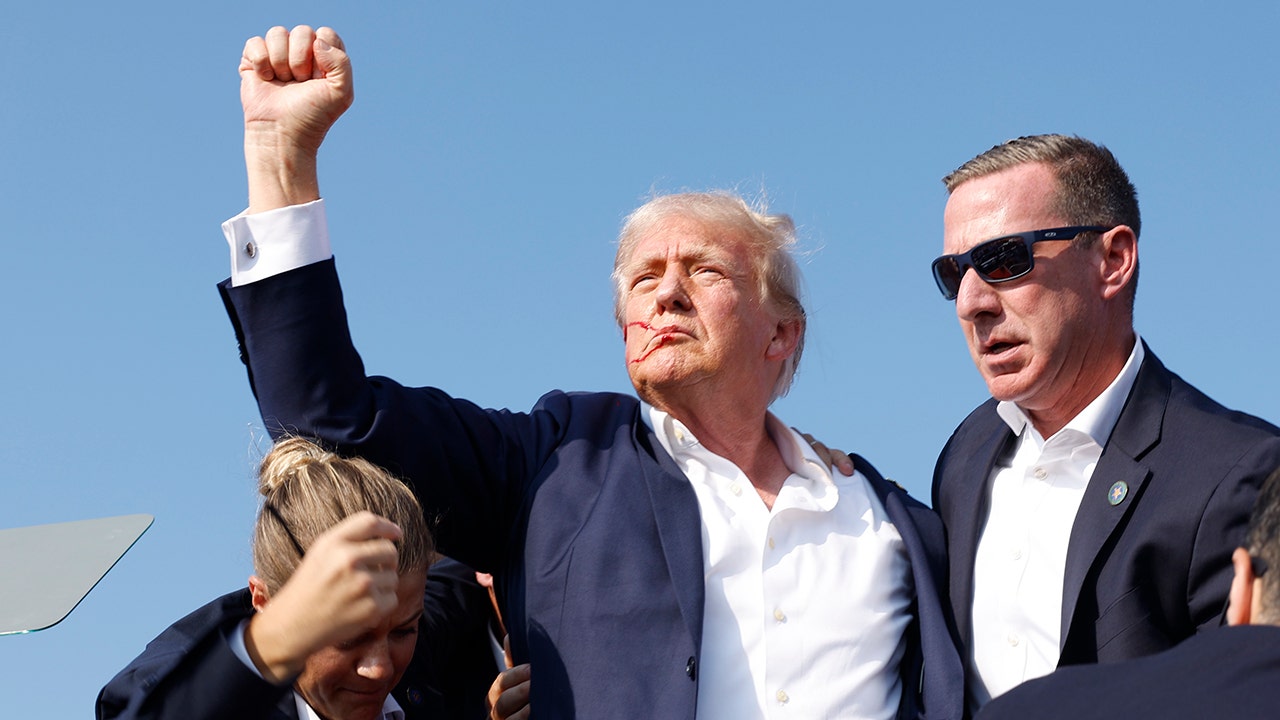
Former President Trump gestures with a bloodied face after multiple shots rang out during a campaign rally in Butler, Pennsylvania. (Reuters/Brendan McDermid)
Via a graphic, the Post reported Crooks may have moved over and used an HVAC unit on the far side of the AGR glass complex to get on the roof.
Various videos have shown Crooks around that time moving about the roof.
Once a police officer was able to peek over the top of the roof, as previously reported, Crooks was seen with his rifle.
According to the Post report, as Lenz radioed the QRF or “quick response force” about the now-armed threat, shots rang out.
On Wednesday, District Attorney Goldinger said concerns from local officials went unheeded by federal agents, and that it essentially left the locals to set up their own command post, according to the Pittsburgh Tribune-Review.
Law enforcement from Butler, Beaver and Washington Counties reportedly set up their post the morning of the rally. The Secret Service’s command post was set up at the rear of the site – toward where Trump would face from the dais – while the county command trailer was stage-left of the former president. Crook’s perch atop the AGR glass company building was stage-right.
In response to questions about the Post report from Fox News Digital, Secret Service spokesman Anthony Guglielmi said the agency is “committed to better understanding what happened before, during, and after the assassination attempt of former President Trump to ensure that it never happens again.”
“This includes a robust mission assurance investigation by our Office of Professional Responsibility that will meticulously examine all aspects of the event and complete cooperation with Congress, the FBI and other relevant investigations.”
Read the full article from Here

Massachusetts
Missing Massachusetts cat miraculously found underneath owners’ new bathtub — after disappearing for 30 hours

You’ve got to be kitten me!
A beloved feline went missing for an excruciating 30 hours in Massachusetts, only to be found in the most unlikely of places — a hole underneath a newly installed bathtub in its owners’ bathroom.
The Kirby family was renovating a bathroom in their Needham home last week when their cat, Fluffy, suddenly vanished, NBC10 Boston reported.
Assuming the snow white kitty had sneakily slipped out the front door while the construction was ongoing, the Kirby family began to fear for the worst after it failed to return home later that night.
Fluffy’s worried owners raced to Staples the following morning to print out missing cat posters and engaged a pet retrieval specialist equipped with a German shepherd to scour the Boston suburb for the cat.
Treats were also left out to lure Fluffy home — but the search came up empty.
“I thought I was never going to see him again,” Melissa Kirby told the outlet.
Thirty hours after the puzzling disappearance, things took a bizarre turn.
“I was upstairs crying and I heard a little meow,” she said.
“I thought at that point I was hallucinating.”
Melissa was left stunned when she saw a “little paw sticking out a hole” in the bathroom floor where a new bathtub had been recently installed.
Her husband, Ed Kirby, frantically called an after-hours plumber, who asked if it was an emergency.
“Yes, this is an emergency. It’s not a leak,” he desperately recalled telling the plumber.
“Our cat is trapped under our tub.”
Photos showed Fluffy peeking its little white head up from the hole it was stuck in.
In under an hour, Fluffy was rescued from the hole, unharmed and unbothered, and reunited with his family.
While it was a miracle that Fluffy wasn’t hurt, the Kirby family said they won’t be taking any more chances on their little escape artist — and plan to install an AirTag tracker on him.
“If he ever gets out again or gets trapped under another appliance,” Melissa Kirby said, “we’ll be able to locate him.”

A federal judge has dismissed a lawsuit by the Justice Department aimed at compelling New Hampshire to turn over its voter rolls, dealing the Trump administration another setback in its quest for detailed information about the nation’s voters.
The ruling from U.S. District Judge Joseph LaPlante found that the request to provide the state’s voter registration list did not comply with a section of the Civil Rights Act of 1960 pertaining to federal election records. His ruling, issued Monday, also found that the Justice Department failed to allege any violation under the Help America Vote Act of 2002, which established standards for states’ voting systems and voter registration lists.
That prevents “allowing the Attorney General unrestricted access to New Hampshire’s (voter list) to conduct a line-by-line audit to assess a ‘possible’ violation of a federal statute,” wrote LaPlante, an appointee of former President George W. Bush.
New Hampshire Secretary of State David Scanlan, a Republican, welcomed the ruling.
“I am committed to protecting the private information of New Hampshire voters to the fullest extent required by law,” he said in a statement.
The dismissal in New Hampshire brings to 10 the number of states where the Justice Department has lost similar cases. The department has sued to force release of detailed state voter data — which includes dates of birth, addresses, driver’s license numbers and partial Social Security numbers — in 30 states and the District of Columbia.
In addition to New Hampshire, judges have rejected those attempts in Arizona, California, Maine, Massachusetts, Maryland, Michigan, Oregon, Rhode Island and Wisconsin. In Georgia, a judge dismissed a Justice Department lawsuit because it had been filed in the wrong city, prompting the government to refile elsewhere.
In explaining their push for the records, federal officials have said they need the voter data to ensure that states are complying with federal election laws related to maintaining voter registration lists, even though states already have detailed processes to do that. In the case out of Rhode Island, a Justice Department attorney acknowledged that the department was seeking unredacted voter roll information so it could be shared with the Department of Homeland Security to check citizenship status.
Democratic and some Republican officials have objected to the Justice Department requests for detailed voter data and said such a demand violates state and federal privacy laws.
At least 13 states have either provided or promised to provide their voter registration lists to the department, according to the Brennan Center for Justice and Associated Press reporting: Alaska, Arkansas, Indiana, Louisiana, Mississippi, Nebraska, Ohio, Oklahoma, South Carolina, South Dakota, Tennessee, Texas and Wyoming.
TRENTON – Today, Governor Mikie Sherrill signed three bills aimed at strengthening public safety, privacy, and trust across New Jersey’s diverse communities. The bills outline clear standards to increase transparency and accountability for law enforcement during operations, protect personal privacy, and ensure that all residents can access vital public and health care services without fear of deportation.
The “Law Enforcement Officer Protection Act,” or S-3114, sponsored by Senators Benjie E. Wimberly, Troy Singleton, and Nick Scutari, requires law enforcement officers, including federal agents, to reveal their facial identities when conducting official duties. The bill also requires officers to provide sufficient identification prior to arresting or detaining an individual, such as department-issued photo identification, a uniform bearing agency insignia, or a badge. The bill allows exceptions for officers to wear facial coverings, including during undercover assignments, use as protection against chemical agents, medical exemptions, or shielding during severe weather.
“The trust local police have worked hard to build in our towns and cities is being undermined by unidentifiable ICE agents who seek to intimidate our neighborhoods while avoiding accountability,” said Senator Wimberly (D-Passaic/Bergen). “Banning the use of masks, with limited exceptions, will help us protect the civil rights of all residents and will send a clear message that anonymous and unchecked immigration enforcement will not be tolerated in New Jersey.”
“When law enforcement hides behind masks and operates without visible identification, it erodes trust, sows fear, and encourages dangerous and irresponsible behavior from civil servants who should be held to the highest standard,” said Senator Singleton (D-Burlington). “Requiring all law enforcement to provide facial and material identification during their operations is a reasonable measure that is in the best interest of public safety and accountability for our communities and all levels of law enforcement.”
“In New Jersey, we respect the professionalism of our law enforcement agencies and the standards of accountability they follow. Federal immigration officers should adhere to the same standards. This is vital in maintaining the public’s trust in the rule of law and their confidence that our laws are being enforced fairly and humanely. Protecting the rights of all of our residents will serve the best interests of law enforcement and help to keep our communities safe for everyone,” said Senate President Scutari (D-Union/Somerset).
The “Privacy Protection Act,” or S-3522, sponsored by Senators M. Teresa Ruiz, Andrew Zwicker, and John McKeon, limits the collection and sharing of data by government and health care entities to ensure all New Jersey residents are not discouraged from seeking necessary services. The act prohibits government entities and health care facilities from requesting or collecting certain personal identifying information related to a person’s immigration status, place of birth, social security number, and individual taxpayer identification number unless it is strictly necessary to assess eligibility for, or to administer, a requested public service, benefit, or program. When collected, this information would remain confidential and not subject to public disclosure, with some exceptions.
“Across the country, the hostile climate this administration has created for immigrants and their families is making individuals hesitant to access essential services, regardless of their legal status,” said Senate Majority Leader Ruiz (D-Essex/Hudson). “No one should be afraid to seek health care or public services because of the personal information they are asked to provide. The ‘Privacy Protection Act’ limits the collection of private information when it is unnecessary to receive services and ensures confidentiality so all New Jerseyans can access the support they need without fear.”
“Protecting people’s personal information is fundamental to maintaining trust in government and ensuring access to necessary services,” said Senator Zwicker (D-Middlesex/Mercer/Somerset/Hunterdon). “As federal authorities use government records for their aggressive and mean-spirited immigration enforcement, New Jersey must strengthen our privacy protections to prevent harm.”
“This legislation will modernize our privacy protections to safeguard personal data collected by government agencies and health care providers,” said Senator McKeon (D-Essex/Passaic). “With the Trump Administration trying to access these records in order to identify and deport our law-abiding, undocumented neighbors, we must stand up to defend their right to privacy and protect them from undue harassment by federal agents.”
The third bill, S-3521, sponsored by Senators Britnee Timberlake, Gordon Johnson, and Raj Mukherji, would codify the Attorney General’s Directive, “Strengthening Trust Between Law Enforcement and Immigrant Communities,” also known as the “Immigrant Trust Directive.” The landmark Directive, first issued in 2018, has been upheld in State and federal court.
The Directive draws a clear distinction between state, county, and local law enforcement officers, who are responsible for enforcing state criminal law, and federal immigration authorities, including ICE, who enforce federal civil immigration law. It limits the voluntary assistance New Jersey law enforcement may provide to federal authorities, ensuring state resources remain fully dedicated to protecting the public, enforcing state law, and fostering trust within our communities.
Under the bill, law enforcement is prohibited from engaging in racially biased policing and may not stop, question, arrest, search, or detain anyone solely based on actual or suspected citizenship or immigration status.
“We must assert our constitutional authority under the anti‑commandeering doctrine, which prevents the federal government from forcing states to administer federal programs. These laws make New Jersey communities safer, safeguarding people— documented and undocumented—while protecting local police from being drawn into federal actions that could expose them to serious legal and moral consequences. Lessons of the Nuremberg trials remind us ‘just following orders’ is not an excuse to violate fundamental constitutional and human rights. Advancing this legislation shields individuals from unfair treatment, upholds constitutional protections, and reflects the inclusive values of a nation built by immigrants. When my future grandchildren read about this moment in history, they will know we used the law to protect people,” said Senator Timberlake (D-Essex).
“Our state and local law enforcement must focus on building trust among residents and keeping our communities safe—not carrying out a cruel, anti-immigrant agenda that instills fear among hardworking, everyday people,” said Senator Johnson (D-Bergen). “Codifying the Immigrant Trust Directive will help reaffirm New Jersey’s commitment to our immigrant neighbors, who are our friends and vital contributors to our state, and stand against escalating threats from Washington.”
“These bills advance public safety at a time when the federal government is acting lawlessly, sowing division, and inciting chaos,” said Senator Mukherji (D-Hudson). “When victims and witnesses are afraid to come forward, violent offenders remain on the streets. This legislation strengthens and maintains trust between our diverse communities and state and local law enforcement, and it allows police to do their jobs — focusing on real public safety threats, preventing violence, and solving crime — while ensuring taxpayer resources are not misused to enforce federal civil immigration violations at a time when ICE has repeatedly disregarded due process and civil rights across the country.”
-

 Maryland2 minutes ago
Teen allegedly hits off-duty officer, crashes into Maryland home
-

 Michigan8 minutes ago
Michigan mayor’s 7-year-old nephew found dead in Menands, New York, authorities say
-

 Massachusetts15 minutes ago
Missing Massachusetts cat miraculously found underneath owners’ new bathtub — after disappearing for 30 hours
-

 Minnesota17 minutes ago
St. Paul resident’s special connection to the Declaration of Independence
-

 Mississippi22 minutes ago
Amy Carruth named director of Mississippi State Hospital – SuperTalk Mississippi
-

 Missouri30 minutes ago
Gov. Kehoe signs Missouri FY27 budget totaling $50.7B. What you need to know
-

 Montana32 minutes ago
New health care system director appointed at Montana VA
-

 Nebraska37 minutes ago
Hilgers says Nebraska, Colorado water dispute could take years, but Perkins County Canal should progress

