Northeast
New York's universal mail-in voting law challenged in court

The state of New York’s universal mail-in voting law is being challenged by a legal watchdog group that claims the alteration to election protocol is unconstitutional.
A court brief has been filed in the New York Court of Appeals seeking to overturn the law, passed by the state legislature and signed by Gov. Kathy Hochul, which allows every registered voter in the state to vote via mail-in ballot.
The Public Interest Legal Foundation is leading the effort on behalf of multiple Republican leaders — including GOP Reps. Elise Stefanik and Claudia Tenney.
MAIL-IN BALLOTS MUST HAVE DATES ON ENVELOPES, PENNSYLVANIA APPEALS COURT RULES
Officials sort mail-in-ballots at the San Francisco City Hall polling location in San Francisco. (David Paul Morris/Bloomberg via Getty Images)
New York residents overwhelmingly voted against universal mail-in ballots through a 2021 referendum seeking a constitutional amendment.
Democratic lawmakers bypassed the failure of this referendum by simply voting the mail-in ballot expansion through the state legislature. Democratic Gov. Kathy Hochul signed it into law late last year.
Public Interest Legal Foundation President J. Christian Adams accused the New York Legislature of having “unconstitutionally passed a law to allow every registered voter to cast a ballot in the mail” with this law.
NEW YORK REPUBLICANS SUE TO BLOCK DEMOCRAT GOV. KATHY HOCHUL’S NEW LAW EXPANDING EARLY MAIL-IN VOTING
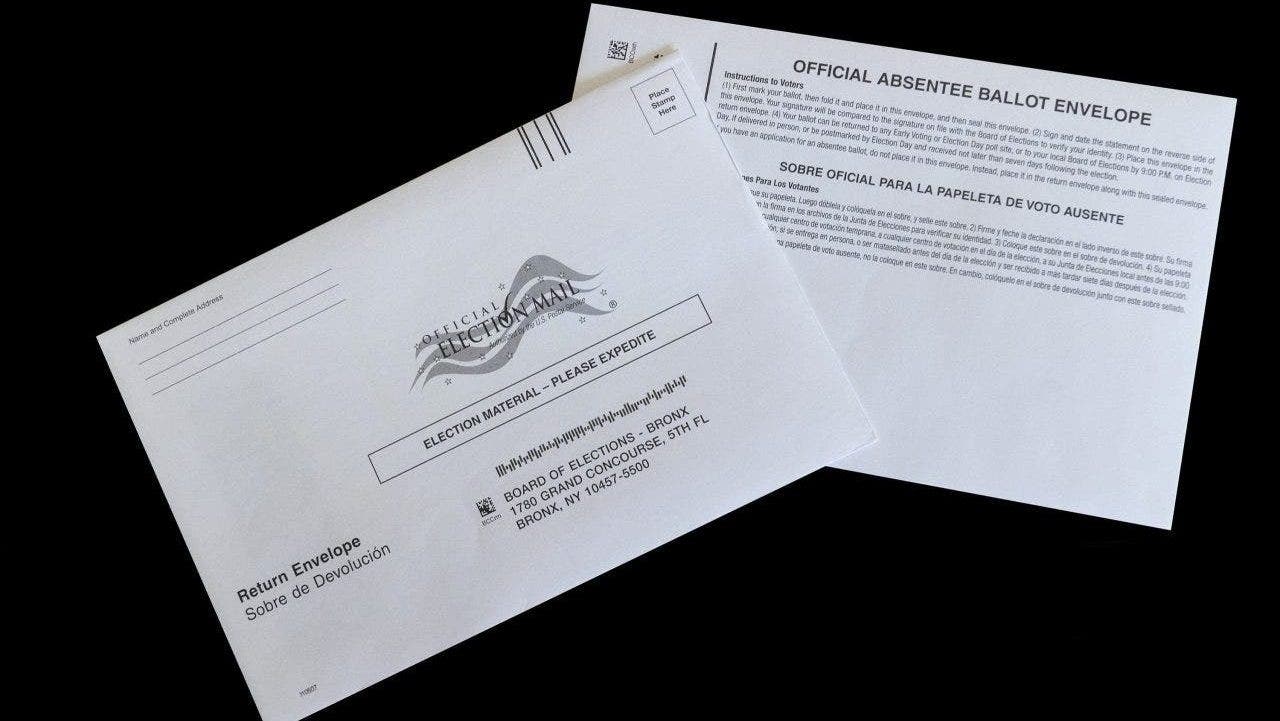
This photo illustration shows an absentee mail-in ballot for the 2020 general election sent by the Board of Election in the Bronx borough of New York City. (Lev Radin/Pacific Press/LightRocket via Getty Images)
“The plain text of the New York Constitution prohibits the expansion of mail voting,” Adams added. “If New York lawmakers want to expand mail voting, they need to pass a constitutional amendment.”
Democrats claim that the expanded avenue for absentee voting makes the democratic process easier for voters. Their critics contend this change in protocol makes voter fraud much easier.
This is not the Public Interest Legal Foundation’s first time in court fighting the expansion of absentee ballot eligibility.
Chester County election workers process mail-in and absentee ballots for the 2020 general election in the United States at West Chester University in West Chester, Pennsylvania. (AP Photo/Matt Slocum)
The foundation previously led the 2022 legal challenge against a similar law in Delaware.
The campaign saw initial success when a state superior court sided against the proposed permanent absentee voting expansion.
However, the New York Supreme Court shot down that decision last month in a 5-0 ruling, finding that the Public Interest Legal Foundation did not have standing to sue.
Read the full article from Here


Following similar legislature in his native Vermont, singer-songwriter supports “The Great Divide Act” combating speculative tickets, resale fees, and more
Noah Kahan has thrown his support behind a new Massachusetts bill aimed at capping ticket resale prices.
Like other states in recent weeks — including Washington, D.C. just a day earlier — Massachusetts Governor Maura Healey has announced “An Act Relative to Closing the Great Divide between Ticket Prices and Affordability” — or “The Great Divide Act,” named in part after Kahan’s latest LP — a bill that would limit ticket resales prices, bar speculative tiket sales, and cut down on some ticket fees.
Kahan, who previously backed a similar bill in his native Vermont and is fresh off four sold-out shows at Boston’s Fenway Stadium, appeared via video at Healey’s press conference Thursday.
“I heard about what you’re announcing today and I just wanted to let you know how excited I am about it,” Kahan said. “The artist community and fans will greatly benefit from limiting ticket scalping and the sales of speculative tickets. I love my fans and want to protect them however I can. Artists alone could not tackle the market manipulation of secondary resellers. So, thank you so much for making this a priority in Massachusetts.”
Under the proposed Great Divide Act, concert tickets on the secondary market would be capped at 110 percent of their original face value, and secondary ticket sites would similarly only be allowed to take a 10 percent cut of resold tickets.
In the aftermath of the World Cup games at Gillette Stadium, where “speculative tickets” — or sellers offering tickets they don’t actually have — resulted in hundreds of people getting turned away from the soccer games, the Great Divide Act will also aim at prohibiting the practice. “Far too many Massachusetts residents have experienced the pain of being excited to buy tickets to see their favorite singer or sports team, only to realize that resale prices and fees have driven up the cost to outrageous levels,” Healey said Thursday.
New Hampshire
Woman Taken To Concord Hospital On A Trauma Alert After A Rollover Crash On South Main Street

Just after 9 p.m., police were sent to the area of South Main Street near West Street for a report of a rollover crash with a person trapped inside the vehicle. A second caller also reported the crash, and dispatch said the caller sounded as if they were arguing with someone in the background, according to scanner chatter. The crash was just off the street’s intersection with West Street.
The first-arriving officer requested additional officers to shut down the southern part of the street.

6-minute read

NY-NJ World Cup host group failed to register with state | Exclusive
The paperwork that helps New Jersey track nonprofits was filed three years after the NY-NJ World Cup host committee formed.
The New York New Jersey World Cup host committee appears to have operated and solicited donations to support the 2026 World Cup soccer matches held in the Garden State for more than three years without having filed legally required paperwork with New Jersey’s attorney general, according to documents obtained exclusively by NorthJersey.com.
The host committee did not register its 501(c)(6) nonprofit with the Division of Consumer Affairs in the New Jersey Office of the Attorney General until June 4, 2026 — more than three years after the nonprofit was formed in February 2023.
Nelida O’Neill, who works in the Attorney General’s charities registration and investigation section, sent a “notice of unregistered charity” to the host committee on April 7, 2026 — only after NorthJersey.com filed a public information request seeking the registration documents on April 6.
Story continues below photo gallery
In addition, the host committee — which is staffed and overseen by a long list of people associated with former Gov. Phil Murphy, including his wife, board chair Tammy Murphy — made numerous errors on the paperwork it eventually submitted, such as missing documents and inaccurate information.
These documents are one of the few ways the state’s chief law enforcement officer, resident taxpayers and other members of the public can see how the host committee, which is the intermediary between FIFA and local governments, is spending and raising money, including dollars received from taxpayers, how that money is being spent and who is receiving it.
Michael Symons, a spokesman from the Attorney General’s Office, said the office would not comment on “what, if any, investigative or enforcement action is being considered,” but said failure to comply could result in civil penalties, suspension or revocation of a charitable organization’s registration.
The Attorney General’s Office is seeking additional missing documents from the host committee’s paid fundraisers, Symons added — an omission brought to its attention by NorthJersey.com.
Natalie Hamilton, a host committee spokeswoman, said the law requiring registration applies only to 501(c)(3)s, and that they registered their 501(c)(3) fundraising arm, the Welcome World Foundation, Inc.
“When the New Jersey Division of Consumer Affairs reached out to us earlier this year asking for a registration of the 501(c)(6) entity (New York New Jersey 2026 World Cup Host Committee, Inc.) for their database that includes both for-profit and nonprofit entities, we complied with the Division’s request and promptly provided all the information they asked for,” Hamilton said.
The law states that entities exempt from registering include certain religious organizations, educational institutions and those that do not receive gross contributions in excess of $10,000 during a fiscal year. The law does not say that 501(c)(6) nonprofits are exempt. Other 501(c)(6) organizations are registered and listed in the OAG’s public charities portal.
“Generally speaking, under New Jersey’s Charitable Registration and Investigation Act, charitable organizations that engage in fundraising activities that either raise more than $10,000 in gross contributions or compensate a third party for fundraising services must comply with certain conditions, including registering with the Division of Consumer Affairs’ Charities Registration and Investigation Section,” Symons said.
PKF O’Connor Davies Advisory, one of the largest accounting firms in the country, was listed as the host committee’s paid tax return preparer in federal tax filings from 2023 and 2024. In 2024, the host committee paid the Harrison, New York-based accounting firm nearly $218,000 for its accounting and bookkeeping services, according to federal tax documents.
PKF O’Connor Davies did not respond to a request for comment.
Missing documents, errors
Millions of taxpayer dollars were funneled and entrusted to the politically connected host committee and Welcome World Foundation to pay for costs related to the seven World Cup matches already played this June and July at MetLife Stadium in East Rutherford and the World Cup final scheduled there on July 19.
There has been little transparency about how much the tournament is estimated to cost the New Jersey and New York governments and how much each expected to receive in tax dollars. Money from New Jersey was distributed over at least five budget cycles and some budget line items used opaque language like “international events, improvements and attraction.”
In addition to a more than three-year delay in registering, the host committee filed paperwork that contains inaccurate details and is missing information.
Some documents were never filed.
Here are more details about those issues:
- The registration document submitted June 4 was signed by Alex Lasry, the host committee’s CEO, and Wesley Mathews, the president of the host committee’s board. But the law requires at least one of the two signatories to be the nonprofit’s chief fiscal officer.
- The host committee’s June 4 registration document was for 2024, but the nonprofit did not provide the Attorney General’s Office with documents for 2023, the first year the nonprofit was formed, or 2025. Annual renewal registration is required within six months after a nonprofit’s fiscal year ends, which is Dec. 31 for the host committee.
- One question on the registration form requires the name and salary of the “five most-highly compensated executive staff employees.” The document provided by the host committee includes none, instead listing five unpaid board members.
- The host committee’s registration document identifies only Jafri Strategies as a hired private fundraiser, but the organization’s federal tax filings also show the host committee paid Griffin Partners LLC $120,000 in 2024 for “donor development and fund raising.” That wasn’t disclosed to the state.
‘There’s probably going to be mistakes’
The New Jersey Legislature strengthened its laws governing charities in 1994 to require nearly all nonprofits operating in the state to register with the AG’s office and gives that office the ability to “take strong action against those individuals who would defraud or abuse the public’s generosity for their own gain,” according to a commission document describing the changes.
As a result, New Jersey law states “it shall be unlawful for any charitable organization to solicit contributions or have contributions solicited on its behalf before the Attorney General has been given the opportunity to review the registration statement.”
In addition to registering, nonprofits must provide the AG’s office with additional documents, such as federal tax filings, bylaws, annual financial reports and management letters from its auditor.
Paperwork errors aren’t uncommon for nonprofit filings in New Jersey, said Aaron Moore, a professor of public relations and event planning at Rider University in Lawrence Township.
“There’s just so many things that have to be signed, so many times you’re going to have to have your accreditation be renewed,” he said.
When it comes to FIFA, the Swiss soccer organization behind the World Cup that has faced widespread accusations of fraud and corruption, Moore said to expect errors.
Because of FIFA’s reputation, people are often skeptical of them, Moore said. “If you check the paperwork, there’s probably going to be mistakes,” he said.
Taxpayer money at stake
The three-year delay in filing registration documents and then error-filled documents eventually filed by the host committee is especially significant because the host committee received at least $111 million in contributions from the state of New Jersey, New York State and New York City.
Of that $111 million, $61 million is from New York State and New York City, and $50 million is from New Jersey, according to reporting from NorthJersey.com and Politico. Included in New Jersey’s share is a $15 million loan, first approved by the New Jersey Sports and Exposition Authority in November 2022, that has to be paid back by the end of the year.
The committee also secured 20 sponsors for the tournament, but details about those transactions or how much money it raised is not yet known.
Outside of the host committee, New Jersey spent tens of millions to construct a new pedestrian bridge connecting parking lots between MetLife Stadium and the adjacent American Dream mall, prepare NJ Transit to transport up to 40,000 people per match, and cover costs associated with local police, emergency responders and tourism initiatives.
What happens when the host committee disbands?
Hosting mega events, such as the World Cup, comes with promises of putting host cities or states on the map and bringing in windfalls of tourist revenue via taxes and fees from shopping, dining and hotel stays.
But these events also come with significant expenses for local governments to provide security, transportation, emergency responders and, in the case of the World Cup, pay for FIFA-required stadium modifications, special grass for the field, even offices and possible tax breaks.
The host committee provides boots-on-the-ground to set up and execute the tournament in host regions, plans fan events in nearby communities, and raises money to support the tournament and lower costs for local governments.
But once the event ends, the nonprofit dissolves and there will be no organization, board or leadership to hold accountable if the event is not successful and taxpayer money was spent without the intended return.
Phil Murphy, the former governor whose eight-year administration handled the bulk of bidding and planning to host the World Cup, and who brokered controversial agreements to host the World Cup in New Jersey, was no longer in office by the time the tournament started in June.
Because of the transient nature of the World Cup, Moore doesn’t expect many consequences for the host committee’s bungled paperwork.
“There’s going to be no slap on the wrist,” Moore said. “There’s going to be nobody penalized because essentially this nonprofit will go away.”
-

 Maryland11 minutes ago
Great nature trails for hiking, beachcombing on Maryland’s Lower Shore
-

 Michigan17 minutes ago
Michigan’s upcoming Aug. 4 primary: What’s on my ballot?
-

 Massachusetts23 minutes ago
Noah Kahan Backs Massachusetts Bill Limiting Ticket Resale Prices
-

 Minnesota29 minutes ago
Miinesota’s common loons are genetic cousins to penguins
-

 Mississippi35 minutes ago
Mississippi Lottery Mississippi Match 5, Cash 3 results for July 16, 2026
-
Missouri41 minutes ago
Missouri Lottery Pick 3, Pick 4 winning numbers for July 16, 2026
-

 Montana47 minutes ago
Missoula and Western Montana neighbors: Obituaries for July 17
-

 Nebraska53 minutes ago
Obituary | Stephen C. Mason

