Sign up for the Today newsletter
Get everything you need to know to start your day, delivered right to your inbox every morning.

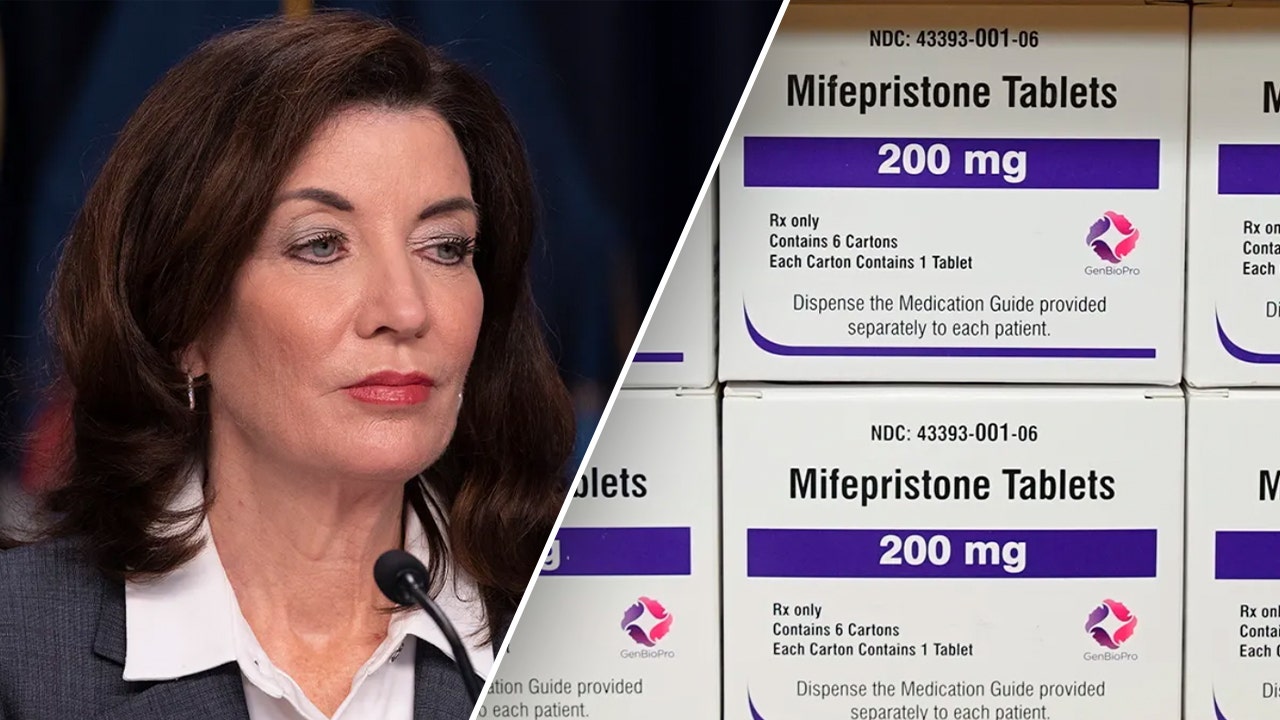
New York Gov. Kathy Hochul, a Democrat, signed a bill Monday aimed at shielding the identities of doctors who prescribe abortion drugs after a New York physician was indicted for prescribing abortion pills to a pregnant minor in Louisiana.
The new law, which is effective immediately, allows for doctors’ names to be omitted from abortion pill bottles and instead replaced with the name of their respective healthcare practices.
This comes after a grand jury in West Baton Rouge Parish, Louisiana, indicted New York physician Margaret Carpenter, her company and an associate on Friday for allegedly using telemedicine to prescribe abortion pills to a girl.
Hochul said she would not sign an extradition request to send Carpenter to Louisiana.
NEW YORK DOCTOR INDICTED FOR ALLEGEDLY PRESCRIBING ABORTION PILL TO PATIENT VIA TELEMEDICINE IN LOUISIANA
New York Gov. Kathy Hochul signed a bill to shield the identities of doctors who prescribe abortion drugs to patients out of state after a New York doctor was charged in Louisiana. (Getty Images)
Authorities in Louisiana learned the name of the doctor because it was listed on the medication label.
“After today, that will no longer happen,” Hochul said at the bill signing.
The case appears to be the first time a doctor has been charged for allegedly sending abortion pills to a patient in another state since Roe v. Wade was overturned in 2022 by the U.S. Supreme Court.
Louisiana prosecutors said the girl experienced a medical emergency after taking the medication and was transported to a hospital. The girl’s mother was also charged and turned herself in to police on Friday.
It is unclear how far along the girl was in her pregnancy.
TEXAS AG SUES NEW YORK DOCTOR WHO ALLEGEDLY PRESCRIBED ABORTION PILLS TO WOMAN IN LONE STAR STATE
The new law allows doctors to ask for their names to be left off abortion pill bottles and instead replaced with the names of their healthcare practices. (AP Photo/Charlie Neibergall)
District Attorney Tony Clayton, who is prosecuting the Louisiana case, said the arrest warrant for Carpenter is “nationwide” and that she could be arrested in GOP-led states with abortion restrictions.
Physicians in Louisiana, which has a near-total abortion ban, could face up to 15 years in prison, $200,000 in fines and the loss of their medical license if they are convicted of performing abortions, including via medication.
New York physician Margaret Carpenter is accused of sending abortion pills to a pregnant minor in Louisiana. (ROBYN BECK/AFP via Getty Images)
Hochul said she would push for another piece of legislation this year requiring pharmacists to follow doctors’ requests to leave their name off a prescription label.
Texas Attorney General Ken Paxton filed a lawsuit against Carpenter in December over allegations she sent abortion pills to a woman in the Lone Star State, though criminal charges were not brought in that case.
The Associated Press contributed to this report.
Read the full article from Here


Local News
A sergeant who served in the New Hampshire State Police for 19 years has died, authorities announced.
Sgt. Brian J. Ross, of Greenland, New Hampshire, died Monday at 41 years old, according to his obituary.
“Our hearts are broken by this loss,” State Police said in a Facebook post. “Sgt. Ross served the people of New Hampshire with courage and integrity, and all of us will miss him greatly.”
Ross began his career as a patrol trooper and later fulfilled other roles, including working with the Major Crime Unit, Special Events Response Team, and Motorcycle Unit. He recently served as the commander of the Collision Analysis and Reconstruction Unit, according to State Police.
“We ask everyone to join us in offering his family, including his wife and three children, the support and privacy they deserve at this time,” State Police said.
State Police added that a fund has been established for Ross’ family.
“Brian was a devoted husband, proud father of three beautiful children, dedicated Trooper, and beloved coach,” the fund states. “His family is now facing a future they never imagined.”
A walk-through for police officers and other public safety personnel is scheduled for 3 p.m. on July 6 at the Remick & Gendron Funeral Home-Crematory in Hampton, according to the obituary.
Public visiting hours are expected to take place from 4 p.m. to 7 p.m. in the funeral home. Services will be at 1 p.m. on July 7 at the United Church of Christ in North Hampton, the obituary states.
Authorities did not specify the cause of death, but said it was “unexpected.”
State Police noted that resources are available for anyone struggling with a mental health crisis.
“Anyone can call or text the Suicide and Crisis Lifeline at 9-8-8 for free and confidential support for themselves, a friend or a loved one,” State Police said.
Get everything you need to know to start your day, delivered right to your inbox every morning.


The legend of the Jersey Shore 4th of July lobster
William Sharp caught the mother of all New Jersey lobsters on July 4th, 2003.
While you’re sitting around the grill this July 4 holiday, raise a glass to William Sharp, who caught the mother of all New Jersey lobsters on this day in 2003.
He was diving on the sunken remains of the Almirante, an old banana boat that everyone knows as the “flour wreck,” which is a story unto itself. The 378-foot freighter belonged to the United Fruit Co. and was steaming from New York City to Colon, Panama, with a full cargo hold.
At 2 a.m., Sept. 6, 1918, a Navy tanker slammed into the ship in rough seas and heavy fog off the South Jersey coast. The Almirante went down in four minutes; five of its 105 crewmembers and passengers didn’t make it out and its entire cargo load was lost. For days after the wreck, a white frothy foam washed up onto the shore, leading people to falsely believe the ship was carrying flour to the banana plantations. Its manifold said it was carrying produce.
As if that’s not enough, during a submarine patrol in July 1942 in the early days of World War II, a blimp spotted the shape of the wreck from the air and reported it as a possible German U-boat. A Coast Guard cutter dropped five depth charges on the wreck, blowing it to pieces. It now lays in scattered pieces of steel in 70 feet of water, nine miles outside Absecon Inlet.
It was under one of those twisted, steel plates that Sharp, a retired Navy shipyard worker, had his standoff with what would turn out to be a New Jersey state record lobster.
“It’s so confusing down there. You can only see 15 feet, 30 feet in front of you on a good day,” said Sharp, who’s 71 today and living where he always has, on a lagoon in the Mystic Islands section of Little Egg Harbor, or “the end of the world,” as he puts it.
Sharp spotted the lobster in its hiding spot with a flashlight. But he was out of air. So he cut the rope to his dive reel, and tied it off at the lobster’s location. He then followed his anchor rope back to his boat called Kitchen Table, aptly named because that’s where his friends all sat around in the winter, planning their dives and fishing trips.
Forty minutes later and with a fresh tank of air, Sharp went back down, following the line on his dive reel. The lobster was still there. He turned the light off, because a bright light can spook the crustacean. Then he reached in with his hand and grabbed hold of the giant lobster, trying not to get pinched by one of its massive claws.
“The lobster will stand up in defense and just get itself stuck in there,” Sharp said. “You have to dig the sand out from under it.”
With the water cloudy with floating sand particles, Sharp won his tug of water and surfaced with the biggest lobster ever caught by a diver in New Jersey waters since the state started keeping records.
The lobster weighed 15 pounds, 3 ounces; it’s carapace, or body, measured 7½ inches. The state’s Fish & Wildlife sent a marine scientist to Scott’s Bait & Tackle, where the lobster was certified, to investigate. A month later, Sharp’s find was anointed king of the lobsters.
Ok, maybe not king of all the lobsters, but his catch became the official state record lobster landed by a recreational fisherman or diver. The record may never be broken either. New Jersey’s Fish & Wildlife retired the lobster category because lobsters that size are illegal to catch recreationally these days. The carapace can’t be bigger than 5¼ inches.
While Sharp’s 15 pounder is the biggest ever recorded by the state for a diver, American lobsters can get bigger, though it’s not common. The largest American lobster was 44 pounds and captured off Nova Scotia in 1977. There is also a Maine legend of a 51.5-pound lobster caught in 1926, but the mount was lost after it got smashed during transportation.
There are New Jersey divers too, that have claimed bigger lobsters, but they just never got them certified. Retired diver Mike Schwartz of Millville said the late Tom Conley caught a 20.4-pound lobster on the wreck Morand, which he said is 30 miles in the ocean from Cape May.
The year was 2001. Schwartz and Conley were diving off of the late Capt. Sam Still’s boat Samar III. Schwartz, who is 77 today, said it never dawned on them to certify the lobster for a record.
“We caught so many big lobsters back then, I don’t think we even thought about records,” Schwartz said.
As far as the fate of the Sharp’s lobster goes, he ate it. But it was too big to cook all at once. It took him and a friend a week to finish it off.
“I didn’t have a pot big enough. I had to eat it one claw at a time. I saved the parts,” Sharp said.
He had the lobster’s carapace, head and claws mounted. He keeps it on shelf with other nautical items. It’s red color long faded out, the lobster mount is now beige.
When Jersey Shore native Dan Radel is not reporting the news, you can find him in a college classroom where he is a history professor. Reach him @danielradelapp; 732-643-4072; dradel@gannettnj.com.

A “large and growing” outbreak of a parasitic infection is spreading in Michigan, health officials warned this week.
As of Thursday, more than 300 cases of cyclosporiasis, an intestinal infection, have been confirmed, the Michigan Department of Health and Human Services (MDHHS) told ABC News. Typically, the state only sees about 50 cases per year, according to MDHHS.
The parasite usually spreads through food or water contaminated with feces, according to the Centers for Disease Control and Prevention (CDC).
“We are working closely with our state and local partners to identify the source of this outbreak that is making so many people ill as quickly as possible,” Lynn Sutfin, public information officer for MDHHS, told ABC News.
Cyclospora cayetanensis is a unicellular parasite that causes an intestinal infection called cyclosporiasis.
AP
The outbreak comes as the CDC reports 145 cases have been infected in 17 states, excluding Michigan, as of June 15, with at least 20 people hospitalized.
Residents in Pennsylvania and New Jersey are among those dealing with the illness.
IMAGE: CDC releases map on July 1, 2026, showing states reporting parasitic infection.
Authorities are investigating several clusters of cyclosporiasis cases in multiple states.
Doctors told ABC News that cases usually start in May, so the Michigan outbreak occurred during the time or year when public health specialists typically would see a rise in cases. However, the number of cases in Michigan is particularly high, doctors said.
Dr. Peter Chin-Hong, an infectious diseases specialist and associate dean for regional campuses at the University of California, San Francisco, told ABC News that in years past, the U.S. used to see many cases cyclosporiasis acquired outside of the U.S, or from imported vegetables and fruits.
“But now we’re starting to have more domestic cases as well,” Chin-Hong said.
Foodborne outbreaks of cyclosporiasis have been linked to various types of imported fresh produce, such as raspberries, basil, snow peas, mesclun lettuce and cilantro, according to the CDC. The agency further said it takes about one week from the time of infection to become symptomatic, but that time can range from two days to two weeks.
Some patients do not experience any symptoms but, for those who do, the most common symptom is “explosive watery diarrhea,” Dr. Zoe Weiss, director of clinical microbiology at Tufts Medical Center, told ABC News.
Other symptoms can include cramping, bloating, low-grade fever, nausea and vomiting, Weiss said.
“Though in most cases this illness causes discomfort from cramping, bloating and watery diarrhea, we are concerned about individuals who may be immunocompromised due to cancer treatment or an organ transplant as the effects may be more severe,” Sutfin from MDHHS said.
Weiss said the infection is very unlikely to spread from person-to-person “because the parasite is passed in the stool, and then it requires days to weeks of sporulation in the environment before it can become infectious.”
Chin-Hong said that oftentimes people dismiss watery diarrhea, but it is important to get a diagnosis to get treatment as soon as possible.
Cyclosporiasis is treated with the oral antibiotic trimethoprim-sulfamethoxazole (TMP-SMX), commonly sold as Bactrim, Septra and Cotrim, taken for 10 days, according to the CDC.
Doctors told ABC News that people can prevent infection by thoroughly washing produce, cutting away bruised or damaged parts of fruits and vegetables, and refrigerating pre-prepared or pre-cut produce.
“If you’re in an area that’s been affected and you have sudden ongoing watery diarrhea, you should definitely seek a physician and get treatment,” Weiss said.
Copyright © 2026 WPVI-TV. All Rights Reserved.


Nebraska outfielder Will Jesske coaches local legion team


US Supreme Court: Nevada, other states can accept late-arriving mail ballots


N.H. State Police announce unexpected death of 19-year veteran


Legendary NJ Fourth of July lobster catch created record that will never be broken


$7K baby bond for each New Mexico child? What the state treasurer is proposing


Warsaw man extradited back to Duplin County in last year’s lottery ticket probe


North Dakota’s Vantis BVLOS system now open to UAS operators at no cost – Unmanned airspace


Licking County real estate transfers for June 15-19, 2026, hit $697K

