Northeast
New York City congestion pricing may begin as scheduled, judge rules

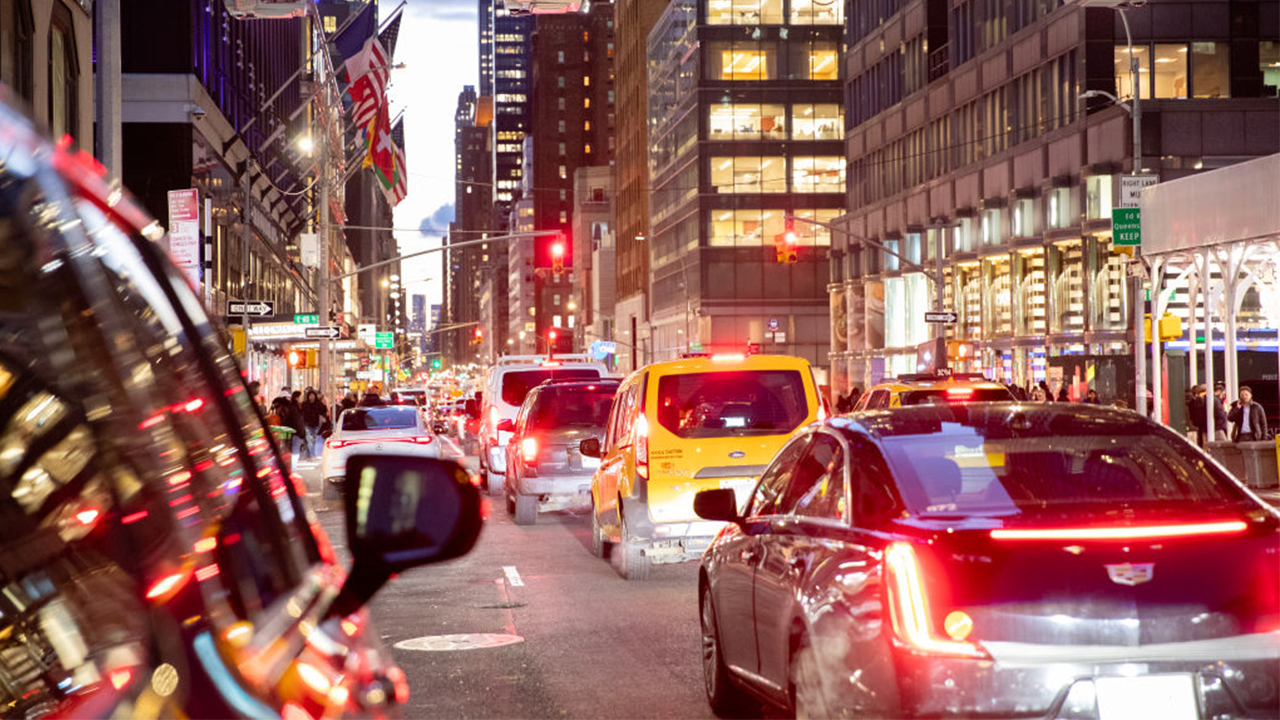
A federal judge in Newark, New Jersey, has rejected the state’s request to pause the implementation of New York City’s controversial congestion pricing plan.
The ruling allows the plan to begin as scheduled on Sunday, according to Fox 5.
New Jersey leaders who filed the lawsuit against the Metropolitan Transportation Authority claimed the agency’s environmental studies were insufficient.
Judge Leo Gordon previously said that regulators must specify how much money communities in New Jersey would receive to reduce the potential effects of pollution from congestion pricing. However, he had not said whether the tolls could go into effect.
FEDERAL JUDGE RULES ON NYC CONGESTION PRICING; INTERPRETATION DIFFERS BETWEEN PARTIES
A federal judge in Newark, New Jersey, has rejected the state’s request to pause the implementation of New York City’s controversial congestion pricing plan. (Getty Images)
Gordon said in his ruling Friday that there was no basis to delay the toll.
Randy Mastro, attorney for the State of New Jersey, said he intends to file an appeal to block the start of congestion pricing.
MTA Chair Janno Lieber praised the ruling, noting the potential benefits of congestion pricing.
NYPD MAKES ARREST IN FATAL STABBING OF ON-DUTY POSTAL WORKER
The ruling allows the plan to begin as scheduled on Sunday. (Getty Images)
“We’ve been studying this issue for five years, but it only takes about five minutes if you’re in midtown Manhattan to see that New York has a real traffic problem,” Lieber said at a news conference. “I recognize there’s been a lot of controversy about this program and there are a lot of people who are concerned about the impact of congestion pricing. To them, I want to say the point is to make the city better for everybody.”
Congestion pricing is expected to generate billions in revenue to modernize New York’s transit infrastructure, but it has faced criticism from New Jersey officials and commuters who say it places an unfair burden on people driving in from outside of New York.
MTA Chair Janno Lieber praised the ruling, noting the potential benefits of congestion pricing. (Getty Images)
CLICK TO GET THE FOX NEWS APP
Some commuters could face daily charges of up to $22, which would include existing tolls for Port Authority crossings.
President-elect Donald Trump has repeatedly said he plans to block the plan after he takes office later this month.
Read the full article from Here

Boston, MA
Jaylen Brown says Celtics showed ‘lack of respect’ after trade to 76ers – The Boston Globe

Amid several reports that said Brown didn’t request a trade and that Boston actually thought Derrick White was the best player on the 2025-26 roster, an already motivated Brown now has an even larger chip on his shoulder after the Celtics dealt him away.
“The message was received,” Brown said. “I wasn’t thrilled with the amount of respect that was shown throughout this process. I think there was a bit of a lack of respect. I think it was fine at one point, then out of nowhere, things just went left. I think Brad [Stevens] is getting a lot of the criticism. I wasn’t thrilled with the way he facilitated some of the conversations.”
After the Celtics fell short in their pursuit of Giannis Antetokounmpo — Brown was the centerpiece of Boston’s trade package — Stevens was noncommittal when asked about Brown’s future in Boston.
“Jaylen Brown is a big part of us,” Stevens said. “I’m never going to predict the future, but every indication, everything that I think about over the past few years has been building around those guys, right? So obviously, you never know. But at the same time, the one thing I want to make very clear is how valued he’s always been.”
“He’s been amazing. He’s been an amazing teammate, a great person to be around. And whether that run ends 10 years from now when he retires, or before, there’s a lot to celebrate. We have a great relationship, an open relationship where we talk about everything. But I don’t want to predict the future. I look at it as, this is our team.”
Stevens traded Brown to the 76ers on Wednesday in exchange for Paul George, two first-round picks, and two second-round picks. The deal was widely criticized.
For Brown, the most puzzling aspect was the lack of an explanation.
“I definitely think there’s more to it,” Brown said. “I just wish that more to it could’ve been explained to me. Because I think if more to it was explained, I would’ve understood. I thought I earned the respect to get that explanation. But hey, obviously, I was wrong. That’s life. You move on.”
Brown will now join a 76ers team that, with Tyrese Maxey, Joel Embiid, and V. J. Edgecombe already in place, could be poised to leapfrog Boston in the Eastern Conference.
“I don’t want [any] special treatment, I don’t need no handouts … I plan on earning my respect one day at a time by putting in the work,” Brown said of playing for Philadelphia. “I’m looking forward to getting in the gym, the whole process.”
“The hard part is, the last 10 years, I’ve been programmed to hate Philadelphia. The history of the rivalry, the playoff battles … I’ve been programmed to think like, ‘[Expletive] The Process’. It’s funny, now I’ve got to reverse-engineer it. But I’ll be ready to go by the time the season starts.”
Conor Ryan can be reached at conor.ryan@globe.com.

The 90-foot tall Ferris wheel will run from July 1 through July 5 on the North Shore. Tickets are on sale now and 50% of all proceeds will be donated to the Veterans Leadership Program. Tickets can be purchased at: pittsburghpa.gov/july4.
The BNY Main Stage at Point State Park will have entertainment starting at 4 p.m. Headlining the performances will be Grammy- and Tony-Award nominated national pop rock band the Plain White T’s. Shows are free,
As part of the National Flag Foundation’s Light to Unite, the city’s skyscrapers will be illuminated in red, white and blue across Downtown at 9 p.m.
The city’s fireworks spectacular is set to be the city’s largest fireworks display in decades. For the first time, there will be a drone performance immediately before the fireworks start.
The fireworks show will utilize six barges on all three rivers – and some rooftops. Fireworks will begin at 9:35 PM on July 4.
Connecticut
Motorcyclist seriously injured after crashing into parked, unoccupied vehicle in Meriden

MERIDEN, Conn. (WTNH) — A motorcyclist has serious injuries after a crash early Friday morning in Meriden, according to police.
The crash happened just after 3:00 a.m. in the area of Lincoln Street. The motorcyclist was navigating a turn when they struck a parked, unoccupied vehicle, police said.
The motorcyclist was taken to an area trauma center, according to police.
A section of Lincoln Street is blocked for the investigation, police said.
Meriden’s accident investigation team responded to the scene.
Additional information was not immediately available.
Download the News 8 app to get breaking news and weather alerts.
Watch News 8 on WTNH.com or the free WTNH News 8 streaming app on Roku, Apple TV, Amazon Fire TV and select Samsung Smart TVs.
-

 Videos29 minutes ago
Iran gets ready for Khamenei’s funeral • FRANCE 24 English
-

 Los Angeles, Ca41 minutes ago
2 arrested after 3 LASD deputies injured during East L.A. World Cup celebration
-

 Detroit, MI59 minutes ago
Ex-girlfriend in custody after Taylor man found fatally stabbed, police say
-

 San Francisco, CA1 hour ago
Marina braces for Golden Gate Bridge fireworks show, massive crowds
-

 Dallas, TX1 hour ago
Maradona’s ‘Hand of God’ ball heads to auction in Dallas
-

 Miami, FL1 hour ago
Miami-Dade sheriff urges residents to celebrate Fourth of July safely
-

 Boston, MA1 hour ago
Jaylen Brown says Celtics showed ‘lack of respect’ after trade to 76ers – The Boston Globe
-

 Denver, CO1 hour ago
Who are the Top 5 offensive linemen in Denver Broncos history?

