New Jersey
24 hours with 3 teenage birders: Welcome to the World Series of Birding


Otys Train, 16, (left) and teammate Jack Trojan, 17, search for different bird species while competing in the world series of birding at High Point State Park in New Jersey on May 9. They competed in the 43rd annual World Series of Birding where they counted as many bird species within New Jersey as they could in 24 hours.
Mohamed Sadek for NPR
hide caption
toggle caption
Mohamed Sadek for NPR
It’s just after midnight in north New Jersey when a white SUV pulls up next to a deserted park, and three teenage boys leap out into the dark. They sprint across a field, vault a fence and peer through binoculars — up toward giant nests atop a pole — all in the hopes of catching a momentary flash of a sleeping parrot’s tail.
By the light of street lamps, they strain to get a look through the nests’ dark holes. Then, after 10 minutes of waiting, 16-year-old Otys Train calls out: “I’ve I got it, I got it, I got it, I got it, I got it, I got the monk parakeet!”
He and his friends, 17-year-old Jack Trojan and 16-year-old Zade Pacetti, have repeatedly come to this park late at night to try to find this bird. And tonight, the work has paid off. They’ve found their first bird of the 43rd annual World Series of Birding. The competition started at midnight on Saturday, and they have until the last seconds of the day to count as many bird species within New Jersey as they can — and claim victory.

A snowy egret flies by a nesting area in Ocean City.
Mohamed Sadek for NPR
hide caption
toggle caption
Mohamed Sadek for NPR
The teenagers are accompanied by their dads: Mark Trojan, Chris Pacetti and Jeff Train. They’re in charge of driving the van and ensuring that their sons remember to drink water and eat food, not just energy drinks and a family-sized bag of M&Ms.
To keep warm, the team sports matching gray sweatshirts, emblazoned with their team name: The Pete Dunnelins. It’s a portmanteau of dunlins, a shorebird often spotted along the New Jersey coast, and a local birding hero: Pete Dunne, who founded the World Series of Birding back in 1984. It’s put on by the nonprofit New Jersey Audubon, part competition for birding glory and part fundraiser for conservation.
It’s become an intergenerational gathering of bird lovers: This year, 87 teams are participating in several divisions sorted by age. They range from birders who have competed for decades, to first-graders who are just learning the ropes. Smack dab in the middle, in the high school division, are The Pete Dunnelins, who have been friends since 2021, around the time they really fell in love with birding.

Pete Dunne uses binoculars during the World Series of Birding in an estuary in Cape May in 2007. He founded the event in 1984.
Stan Honda/AFP via Getty Images
hide caption
toggle caption
Stan Honda/AFP via Getty Images
For them, it’s not just a casual hobby. They’ve placed first in the competition for the past two years — the result of years of practice, mentorship from older birders and training their eyes and ears to catch every bird, no matter how swift the appearance or faint the call. The three of them have been preparing for this year’s competition for months, even creating a spreadsheet with the day’s schedule planned “down to the minute,” Jack Trojan says.
It’s a strategy they hope will lead to another win — or, at the very least, help them reach their goal of 200 species. (Last year, they got 199, tying for first place with their fellow high school competitors and “nemeses,” the Flying Penguins from southeast Pennsylvania.)
“Every minute we’re driving, we’ve accounted for,” Trojan, the team captain, says. But they can’t account for the whims of nature. “Birds are animals, and you can’t really predict too well when you’re going to see or hear everything.”
The clock is ticking, and they have to move on to other locations, Trojan says: “It’s owl time.”
3 a.m. in marshland
After a few hours of looking for owls, bitterns and rails, the team has moved onto a marshland trail on the edge of the state. It’s still pitch-black, and they’re listening to the tell-tale sounds of the marsh birds they want to add to their list — in particular, the elusive sora, which hides in the reeds.
This is when their years of training their ears pays off, says Jeff Train, Otys’ dad and the team’s mentor. The teens can’t see the birds, but they can pick out their calls.
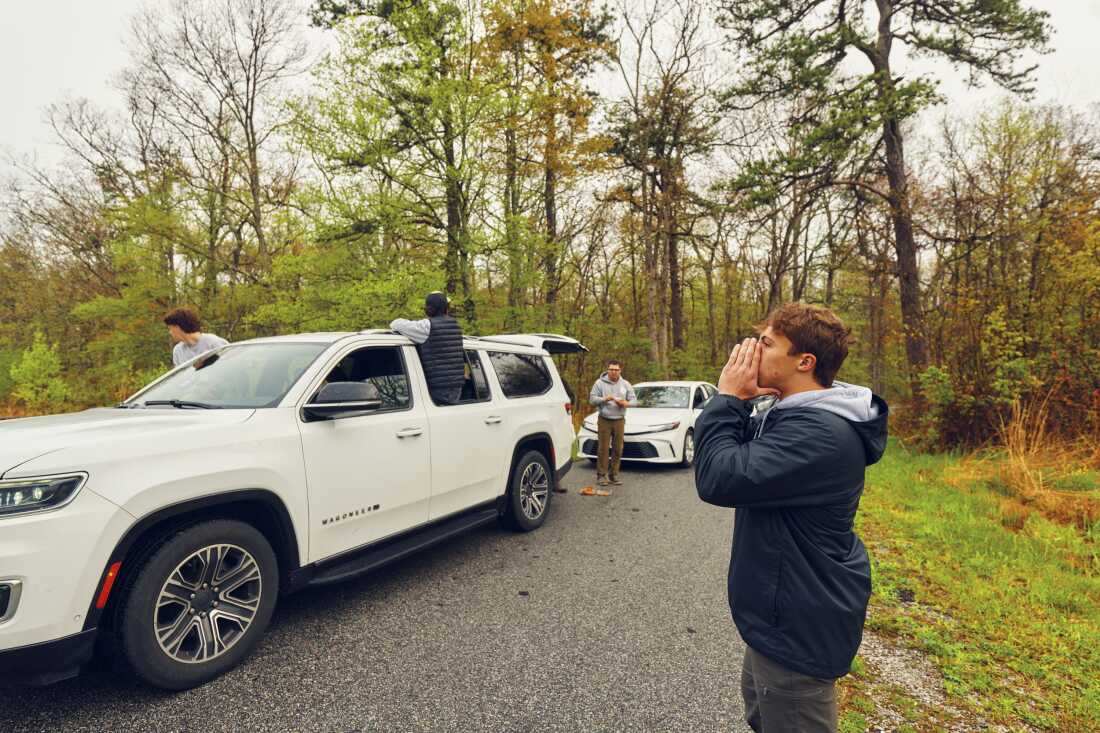
Trojan (right), makes bird calls at High Point State Park in northern New Jersey.
Mohamed Sadek for NPR
hide caption
toggle caption
Mohamed Sadek for NPR
It’s something Otys Train excels at. He went through a list of all the birds that were possible to hear at the World Series. “I memorized them to the point where I would get [them] like, immediately,” he says. “When you go into the field and hear the actual birds and see them, it kind of imprints the song in your head.”
Train, Trojan and Pacetti whisper to each other as they listen to the marsh starting to come alive as the minutes tick by. There’s the whinny of a sora, then the cheep of a swamp sparrow and the nasally “peent” of an American woodcock. “Am I hearing a green heron to the left?” Otys asks. They confer and either agree or disagree on what they hear; competition rules require unanimous team agreement before they can list it.
Jeff Train watches them from a short distance away. He’s careful to stay quiet, keeping his voice to a whisper and walking slowly in the grass; the teenagers are quick to shush anyone making unnecessary noise. The dads have learned this the hard way. “We always used to have a lot of laughing fits,” Train says – but no longer.
Further away on the trail is Chris Pacetti. How’s he holding up? “I’m cold,” he says. “I’m ready for the sun to come up.”
Sunrise in the woods

Zade Pacetti, 16, looks through binoculars.
Mohamed Sadek for NPR
hide caption
toggle caption
Mohamed Sadek for NPR
When the sun comes up a little before 6 a.m., Mark Trojan is driving the crew down a long, winding road in nearby High Point State Park — and The Pete Dunnelins are stressed. They’re running behind schedule, and they need to get back on track.
During this stretch, they’re trying to count as many warblers as possible. For maximum efficiency, they’re staying in the car as it cruises slowly down the road, windows rolled down.
The teenagers stick their heads outside the car to get a better look. “There’s a lot of yellow warblers, there’s a lot of thrushes,” Zade Pacetti murmurs, looking through his binoculars.
Then, all of a sudden, Otys Train sees something and cries out: “Mark! No! Stop!” The senior Trojan groans quietly, and brings the car to a halt.
The teammates begin to “pish” — blowing air through their clenched teeth and lips to make “a pish-pish-pish” sound, trying to draw out the birds from hiding. But not much happens, and after a minute, they continue driving. “We can’t spend too much time on this,” Jack Trojan says.
But not long after, their luck changes: there’s a sharp-shinned hawk’s nest up in a tree. “Sharpie nest is good,” Trojan says. Train agrees: “Ho-ly.”

The teammates sit on the ledges of their SUV’s rolled-down windows while looking for birds at High Point State Park.
Mohamed Sadek for NPR
hide caption
toggle caption
Mohamed Sadek for NPR
As the car continues to move along, Pacetti, Train and Trojan all sit on the ledges of their rolled-down windows, torsos sticking out of the car, arms on the top of the car to balance. It’s a move that they saw one of the top college student teams do during the competition a few years ago, Jeff Train says. And when he saw Otys sit on the ledge for the first time, he “freaked.”
But now that their sons are older, Train says, the dads have agreed that the move helps them hear better and compete. “They are really in their element, and they’ve learned so much, and they’re safe about it,” he says. “We don’t want to hold them back in any way.” After all, he says, birding is where he’s seen his son and his friends really thrive.
It’s not always been something their peers have understood; Jack Trojan says birding is “not seen as cool, actually.” But, Zade Pacetti says, “if you come across as confident … [classmates] respect that. And it’s not something to be made fun of.”
Otys Train used to “get made fun of a good amount for it,” he says. “But I kind of just learned to be myself and now I’m more open about it. And I guess people see it as interesting now.”
Early afternoon, on the side of the road
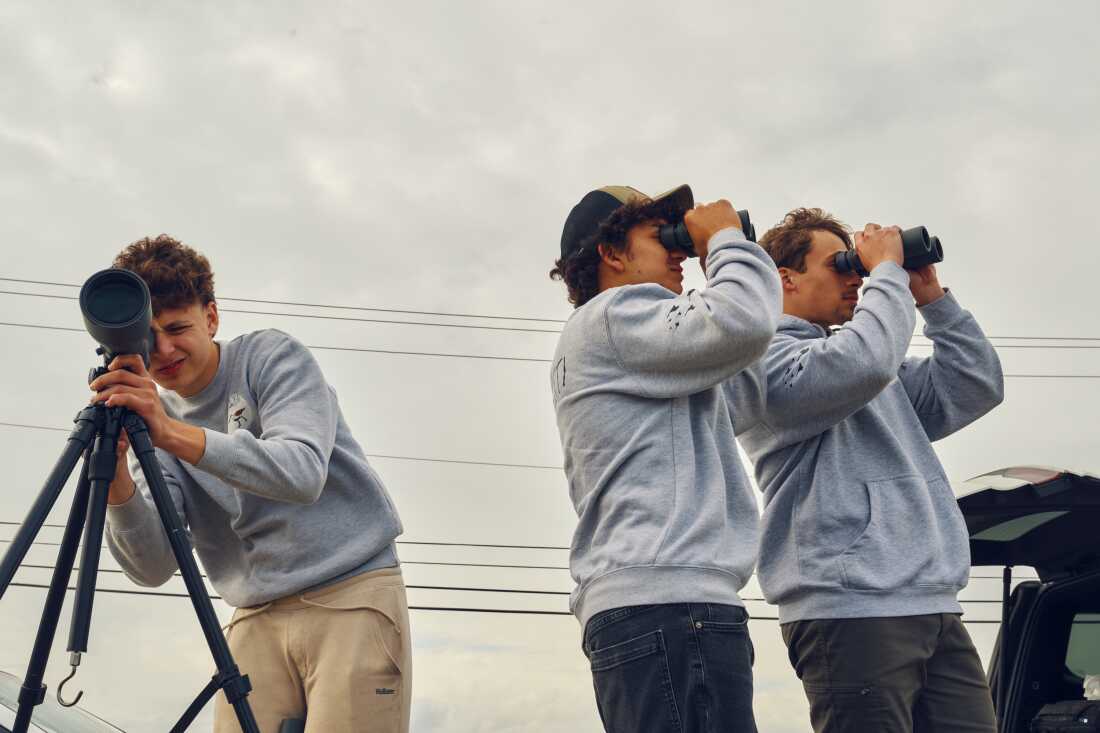
Train (left), Pacetti and Trojan look through a scope and binoculars at Malibu Beach Wildlife Management Area.
Mohamed Sadek for NPR
hide caption
toggle caption
Mohamed Sadek for NPR
Near the coastline of the south Jersey Shore, the team pulls off to the road shoulder, scoping out, among other birds, the piping plover. The fluffy, dull-feathered shorebird camouflages into the sand, hard to pick out among the dunes on an overcast day, Trojan says. They’re peering through the scope, but no dice.
With the day more than half over, they’ve started to use a timer to make sure they don’t linger. Trojan starts the countdown: in 1 minute and 40 seconds, they have to leave, no matter what.
At the 11th hour, Train calls over Pacetti and Trojan — he’s scoped a small, pale dot among other distant birds. His teammates peer through the lens, confirm his sighting, then bolt for the car.

Shorebirds forage along the marsh at Edwin B. Forsythe National Wildlife Refuge in southern New Jersey.
Mohamed Sadek for NPR
hide caption
toggle caption
Mohamed Sadek for NPR
Later, Jeff Train marvels at the teens’ planning acumen. “It’s funny, because I have to remind my son to pack his bag before he goes to baseball. But the spreadsheet he has created, telling him where a bird is and when he’s going to see it and what time he has to get there, it’s pretty funny to see that he definitely has those skills.”
Sunset at the wildlife refuge
The sun is starting to go down when The Pete Dunnelins step out of the car at the coastal Edwin B. Forsythe Wildlife Refuge, a migration hotspot. The team has dozens of species that they need to find in the next two hours: It’s time to do or die.
As the trio walks around the refuge, they dial into the cacophony of wildlife surrounding them. Meanwhile, their fathers hang back, observing, cracking wise about their teens’ antics. Over the years, the six of them have become like family, Jeff Train says; the three sons interact more like brothers than they do teammates. (That brotherliness is particularly apparent that evening: When Zade Pacetti gets the hiccups during a chorus of birdsong, his teammates hiss at him to “shut up.”)
The teammates have grown as birders and as people over the years, Train says, thanks to a village of mentors and teachers. They’ve attended birding camp, been coached by college students, and gotten tips from experts at Cornell’s famed lab of ornithology. And along the way, they became obsessed with not just birds, but nature and conservation, Train says.

Train and Pacetti jog over to Trojan, who has spotted a bird. All teammates all have to see the bird to count towards their total.
Mohamed Sadek for NPR
hide caption
toggle caption
Mohamed Sadek for NPR
“Teenagers get a bad rap sometimes that they don’t care about much,” he says. “And this is clearly an illustration that, you know, the younger generation is not apathetic. They actually care a lot and they’re actually doing a lot of really good things.”
The sun starts to sink below the horizon, and the sky fills with birds gobbling up their last insects of the day. Craning their necks, the three boys try to not miss anything; they’ve got a number of species they need to spot if they have any chance of cracking 200.
“Nighthawk, right up there,” Jack Trojan blurts out, “going right, coming towards us.” His teammates murmur in agreement.

Trojan looks for birds out of the car window as the sun sets.
Mohamed Sadek for NPR
hide caption
toggle caption
Mohamed Sadek for NPR
Trojan picks up another sound — a yellow-breasted chat that has been eluding them. “It’s calling right now! That!”
Then, it chirps loudly, unmistakable. “Yes!” they yell in unison.
“And you say I’m not a good birder,” Trojan says, jostling his friends as they laugh. “I’m picking up so much more. I proved myself.”
The next morning in Cape May
The team stayed out until the very last minute, nabbing a king rail as their last bird of the day. The next morning, at the awards ceremony, the total counts are announced.
The Pete Dunnelins’ final count: 206 species, easily surpassing their goal.
But it wasn’t enough. The Flying Penguins — made up of team members Christian Scheibe, Noah Bieljeski, Ethan Kang and Ellie McDonald — got 209. In the end, three birds made the difference.
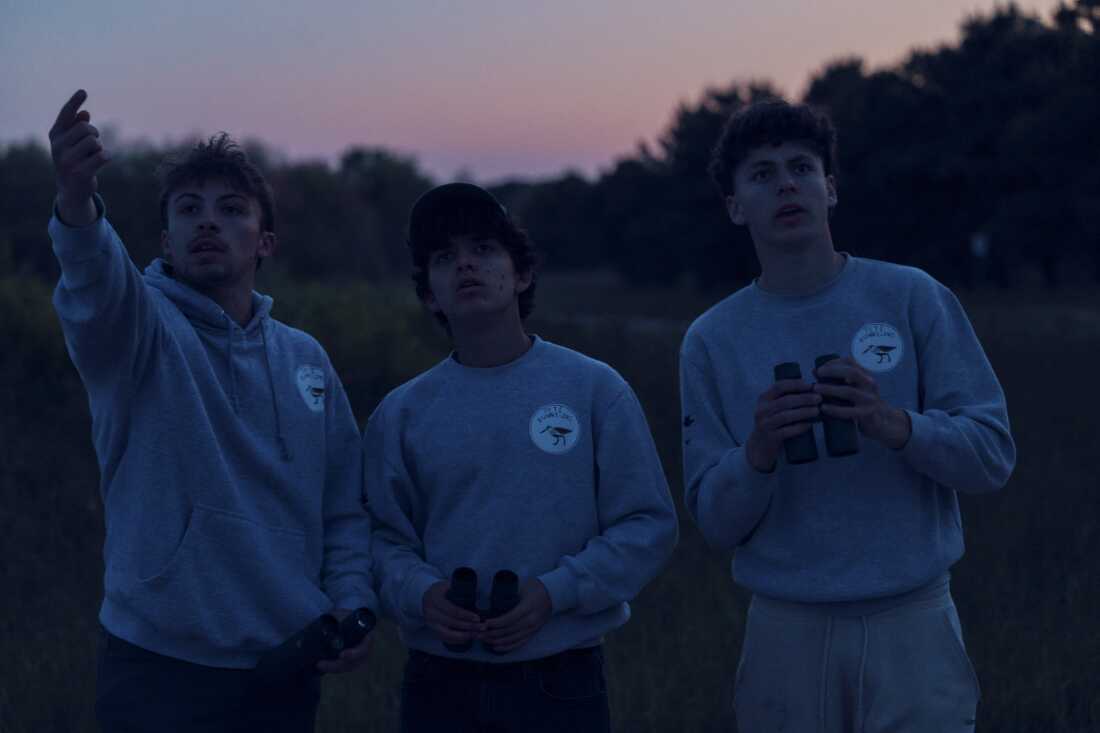
Trojan (left), Pacetti and Train look for a nighthawk at Edwin B. Forsythe National Wildlife Refuge after the sun set.
Mohamed Sadek for NPR
hide caption
toggle caption
Mohamed Sadek for NPR
The trio say they found out about their loss not long after midnight. “We were pretty pissed last night,” Pacetti says. Then, they woke up the next morning in a better mood. There were things Pacetti says they could’ve done better — running behind schedule at times didn’t help. But other factors were beyond their control: Rainy conditions quieted some of the birds, and peak migration hadn’t quite hit the area yet.
Many teams of skilled young birders compete at a high level, so chance is a big part of the day, according to Tom Reed, the migration count coordinator at the Cape May Bird Observatory and a mentor of The Pete Dunnelins.

A mixture of great egrets, snowy egrets and white ibis nesting near the welcome center in Ocean City.
Mohamed Sadek for NPR
hide caption
toggle caption
Mohamed Sadek for NPR
“These birds have wings, they have their own lives they’re going about each day. You try to be in the best place at the best time or the best tide level to try to see each bird. But part of it is luck,” Reed says. “And then, there’s some years when you don’t get those lucky breaks.”
When The Pete Dunnelins go up to congratulate the Flying Penguins on their win, they swap notes on routes – though each is careful to not reveal the locations of their most prized birding spots. Sure, there’s no cash prize at stake in this competition, but they’re still rivals.
The team is already thinking about next year. They’re considering strategy, but there’s a bigger problem at hand: Trojan is heading to college in the fall, meaning he’ll age out of the high school division. Pacetti and Train will need to find a new teammate.

Trojan (left), Train and Pacetti counted 206 bird species but their rivals, The Flying Penguins, got 209.
Mohamed Sadek for NPR
hide caption
toggle caption
Mohamed Sadek for NPR
Trojan has a possible solution: “I was thinking that since I’ll be over 18, at that point, I can be a mentor” to his friends, he says. “So, it’d be like I’m still participating, but I’m just verifying their words and verifying their methods and strategies.”
Pacetti and Train, on the other hand? A little less sure about that plan. “I don’t know if that would be … I don’t know about that one,” Pacetti says, laughing.
After all, they’re still teenagers. Who wants their best friend to tell them what to do?


The risks and costs of being a data broker in the United States just went up — again. On 30 June 2026, Gov. Mikie Sherrill, D-N.J., signed A 5328 into law, making New Jersey the seventh state to enact a data broker law, and the second this year, following Connecticut. The bill was introduced and signed over the course of a few days, as New Jersey’s Legislature sprinted toward an end-of-fiscal-year budget deadline.
This is not a simple copy-paste of any other state. The most notable divergence is its breadth. It creates requirements not only for data brokers, but also for data collectors, entities that have a direct relationship with individuals but sell their personal data to data brokers.
Its greatest impact comes from the creation of a tiered — and costly — structure for annual registration fees, requiring the largest data brokers and data collectors to pay a USD1.5 million annual registration fee. Although the minimum fee, payable for selling the personal data of any number of New Jersey consumers, is not the highest in the country, the second tier is higher than any other state, and kicks in at 100,000 consumers. Data brokers and data collectors also face significant fines for failing to register or update their registration information.
Further, the law prohibits the sale of sensitive data both through the data broker provisions and by amending New Jersey’s consumer data privacy law. Violations of that prohibition carry a severe USD50,000-per-record fine.
The law takes effect immediately, except for the requirement that the New Jersey Division of Consumer Affairs create a registry, which takes effect 270 days after enactment, on 27 March 2027.
Data brokers and their suppliers


Who’s the couple that climbed the Empire State Building?
Daredevil climbers Angela Nikolau and Ivan Beerkus are making waves after their apparent proposal atop the Empire State Building.
The daredevils who climbed to the top of Empire State Building’s spire on July 1 are from New Jersey.
Angela Nikolau, 33, and Ivan Beerkus, 32, who originate from Russia, are residents of East Orange in Essex County, according to the NYPD.
The couple climbed the antenna spire atop New York City’s most famous building to hang a large banner that read: “When the power of love beats the love of power the world knows peace.”
Beerkus then appeared to propose to Nikolau atop the skyscraper some 1,454 feet about the Manhattan streets below.
Nikolau, wearing her trademark Catwoman-style headgear, then was seen admiring her hand and taking photographs of her ring to share on Instagram. The couple and their adventures in what has become known as “rooftopping” were the subject of a 2024 documentary called “Skywalkers: A Love Story.”
When the couple climbed down, they were arrested and charged with burglary, reckless endangerment, criminal mischief, violation of local law, possession of burglar’s tools, criminal tampering, criminal trespass and disorderly conduct, according to the NYPD.
Nikolau’s acrobatics run in the family, and her father, the Russian circus artist Dmitriy Nikolau, was aware of his daughter’s climb when answering a call from a reporter.
“I think it is normal to climb up a roof in any country, including the United States, according to any constitution,” he said. Asked if he was worried about his daughter, he said: “Why should I be worried? I climb up roofs myself.”
Reuters contributed to this article.
New Jersey
Exclusive | NJ’s suburbs are in a full-blown bidding war frenzy — with houses going 33% above asking

New Jersey’s suburban gold rush has no ceiling in sight, and buyers are paying whatever it takes.
Forty-two Euclid Ave in Maplewood hit the market at $1,795,000. It sold for $2,279,000, a staggering 27% above ask. Down the road in South Orange, 376 Melrose Pl listed for $998,999 and closed at $1,332,200, a 33% premium.
These aren’t outliers. They’re the new normal across a stretch of Essex and Union County suburbs where inventory has all but evaporated and buyers are throwing caution, and hundreds of thousands of dollars, to the wind.
Maplewood, South Orange and Montclair are leading the charge, with homes across the region averaging double digit percentages over asking price and spending under two weeks on the market before going under contract.
The numbers, according to weekly market data compiled by Mark Slade of Keller Williams Midtown Direct Realty, tell the story clearly.
Maplewood’s average sale price sits at $1.34 million as of late June, with buyers paying 15.6% over ask. South Orange isn’t far behind at 16.2% over asking with an average sale price topping $1.27 million. Montclair, meanwhile, is running the hottest of the bunch, with buyers paying nearly 25% over list.
Slade, who has tracked these markets since becoming a realtor in 2009, says the upward march has been remarkably steady.
“I don’t think I’ve ever seen a down-trending year in Maplewood, South Orange or Montclair,” he told The Post, adding that the last several years in particular have brought “dramatic changes in the performance of the market.”
The pandemic supercharged an existing trend, according to Slade, who traces the appeal of these towns back to 1997, two years after Midtown Direct train service began running straight into Penn Station without a transfer in Hoboken.
“That’s when we started to see some movement, some significant movement and attraction to the area,” he said.
Slade has a name for what’s happening now. He calls it “value convergence equilibrium” — a theory built on the idea that Northern New Jersey buyers are catching up to what Westchester and Long Island commuters have paid for decades.
“What we now see is that more and more people as buyers, are recognizing that with their economics, they can afford more house for less money in Northern New Jersey,” he said.
The buyers driving this frenzy aren’t only fleeing Manhattan. Slade says most are also coming from Brooklyn, Hoboken and Queens, current apartment dwellers looking to trade up.
“Northern New Jersey offers some of the best values as much as it may seem crazy for someone like me watching these prices grow by leaps and bounds,” he said. “It’s still a better value if you’re looking for a 45 minute and under commute to the city.”
Basic economics explains the rest. Supply simply hasn’t kept pace. Slade points to Maplewood specifically, a town of 25,000 residents with more than 5,500 single family homes, yet only a couple dozen actively listed at any given time.
“I mean, that’s just ridiculous,” he said. He tracks a metric he calls a “hypermarket,” where the number of homes under contract nearly doubles the number of active listings, a ratio he considers more telling than the traditional six month absorption rate used across the industry.
The demand has changed the character of these towns, longtime residents complain.
Slade says he’s heard grumbling that the small town feel is being “supplanted by more New York, impatient, higher end buyers.”
He offered an only half joking anecdote about downtown Maplewood’s diagonal parking spots, where illegal U-turns into spaces happen constantly despite signage every 30 feet.
“I think that today’s buyers are much more affluent,” he said. “They’re even more time pressed, so to speak, which is why they’re choosing these areas to live for the more manageable commutes.”
Township meetings haven’t been immune to the anxiety. After a record breaking sale in Maplewood’s Hilton neighborhood last year, Slade recalls committee members raising concerns at the next public meeting about what runaway prices mean for longtime residents. Still, he sees the appreciation as a feature, not a bug, of homeownership.
“This is real estate,” he said. “This is what real estate is all about.”
Momentum tends to soften slightly as the year goes on, Slade says, a seasonal pattern he attributes half jokingly to what he calls “bonus baby syndrome,” when buyers flush with year end bonuses resolve to finally buy a house “so we don’t have to trip over the stroller.”
When buyers get priced out of one town, they simply move to the next rung down.
Montclair shoppers frustrated by bidding wars often land in Maplewood. Maplewood buyers priced out end up in West Orange, where the year to date average sits at $763,000 with a 10.7% premium over ask, or Union, averaging around $600,000.
Bidding wars, meanwhile, have become simply expected.
“Bidding wars are very much part of the current market scenario, given the limited number of homes for sale and the fact that the amount of buyers far outweighs the supply,” Slade said.
“Buyer’s should generally expect some type of bidding war.”
He uses an ice cream metaphor to describe buyer psychology, borrowed from a Cold Stone Creamery portion chart.
“There are three sizes of ice cream at Cold Stone Creamary, Like It, Love it and Gotta Have It!,” he said. “So, if a buyer is in the Gotta Have It mode, their offer could likely blow everyone else away.”
Homes that have recently traded well above ask include 8 Colony Dr in West Orange, which sold for $1,178,000 against an $865,000 list, a 36% jump, and 35 Porter Pl in Montclair, which closed at $1,525,000 on a $1,395,000 ask, pricing out at 30% higher per square foot than the town average.
Whether this run has a natural endpoint is another matter. Slade doesn’t see one coming, short of the state “building a wall around Manhattan.”
New Jersey remains the most densely populated state in the country, meaning new construction is largely limited to developers subdividing larger lots rather than building fresh inventory from scratch.
Relief in the form of significantly lower mortgage rates also seems unlikely anytime soon, Slade says, leaving buyers to keep competing for a shrinking pool of homes in towns that offer what he still considers, even amid the chaos, the better deal.
-

 Alabama19 seconds ago
Potential for Severe Storms Through Early Evening – Alabama Emergency Management Agency (EMA)
-

 Alaska5 minutes ago
Alaska is celebrating America’s 250th in the fast lane… off a cliff
-

 Arizona12 minutes ago
Arizona Chamber installs Monica Coury as board chair – Chamber Business News
-

 Arkansas15 minutes ago
Arkansas accumulates $655 million general revenue surplus, fifth-largest in state history | Arkansas Democrat Gazette
-

 California20 minutes ago
What’s open, closed for Independence Day weekend in California?
-

 Colorado27 minutes ago
MAP: Where Colorado wildfires are burning
-

 Connecticut30 minutes ago
Local priest dies after crashing car into tree in West Hartford, police say
-

 Delaware35 minutes ago
County councilman says Newark data center plan paused after deal

