New Hampshire
Meet the people behind the loon cam, a New Hampshire-bred YouTube sensation

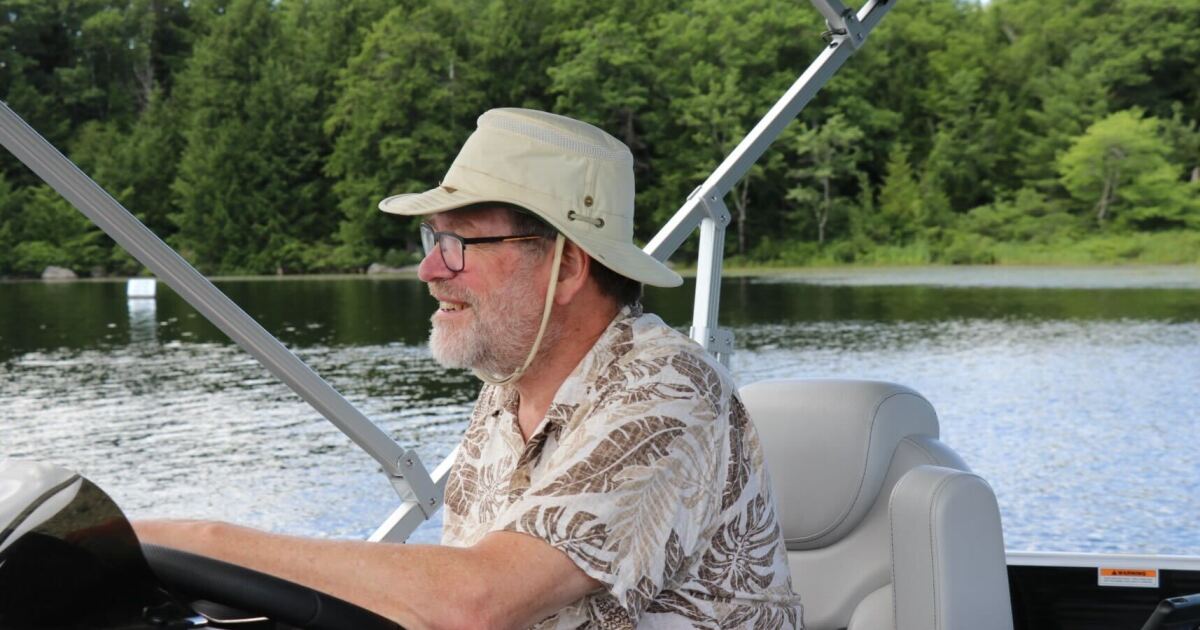
On a busy day, the corner of YouTube run by the New Hampshire’s Loon Preservation Committee gets hundreds of visitors.
Viewers come for the close-up views of loons: striking black and white feathers, ruby red eyes. But they stay for the drama, as the birds mate, lay eggs and protect their nests. And the day everyone’s waiting for, when a chick hatches.
Editor’s note: We strongly recommend listening to this piece by hitting the “listen” button above.
Sara Plourde
NHPR
The loon cam has an enthusiastic fandom. But the channel has humble beginnings. A decade ago, it started sort of as a science project, in an effort to figure out why almost half of loon eggs don’t end up hatching.
“Sometimes these things fail in the blink of an eye. And so unless you have somebody who’s watching that loon nest at the instant a wave crashes over that nest, or a gull or an eagle comes down and snatches the egg, you’re often just not going to know,” said Harry Vogel, the head of the Loon Preservation Committee.
The committee was started in 1975, as loon populations were plummeting. The birds were facing new challenges as humans built dams and vacation homes, and warmed up the atmosphere.
The committee does research and raises money. They help loons escape from icy lakes, if they don’t migrate fast enough. And they put out dozens of pre-made nests every year for loons to use if they can’t build one of their own.
“We are essentially trying to right a wrong that we have done to our loons,” Vogel said.
The loon live streams have helped add to biologists’ understanding of the birds for a decade. Anecdotes pile up over the years, showing different facets of loon behavior. The microphones have picked up cooing noises not previously recognized as loon sounds.

But Vogel says the birds are also a powerful force for conservation. They get people to care. In part, that’s because their calls are hard to forget.
“Then you add a little chick riding up on the back of a parent, and you’ve hooked a fair proportion of your human population,” he said.
Vogel says his team figured, if they were already filming the loons, they might as well share the livestreams with the public. But running a loon cam is hard work.
Enter: Bill Gassman.
About ten years ago, a Loon Preservation Committee biologist recruited Gassman to help out while he was working at a lobster festival. After a 40-year career in technology, he figured he’d be able to help out.
Now, in his retirement, he spends May through July fixated on loons: one eye on the birds, and another on the fast-moving YouTube chat. When chicks are hatching, he’s especially glued to the stream.
“I can’t not watch at all times because I might miss something. You never know when something’s going to happen,” he said.

Gassman’s dedication to his volunteer job as loon cam operator, or L-C-O as he’s affectionately called by viewers, is intense. The birds are the first thing he thinks about when he wakes up.
“The light starts at 4:00. I usually check it to see what’s going on, and I keep it really close overnight in case something attacks an egg. So I’ll usually pull the camera back and go back to sleep,” he said with a laugh.
Gassman controls the loon cam – a security camera attached to a post in the water – with his laptop or phone. He’s skipped parties to attend to loon cam duties, pulled over while driving to catch a big moment, even run the loon cam from the audience at a wedding.
His devotion to the loons extends to his tech setup. He’s fine-tuning it year after year, often to protect it from wildlife. A goose pecked a microphone to death, so now the mics are protected. This year, a bear was suspected of unplugging power cords. Turtles have chewed through cables several times.
“We’re going to put the microphone cable inside a garden hose next year,” he said. “So it’s going to have to chew through that first.”
Gassman says he didn’t know loons that well before his retirement gig. But watching them so closely every summer, he gets why they have so many fans.
“They’re mystical, right? They’re prehistoric. They were around when the dinosaurs were around. They’re beautiful birds. The closer you look, you see how intricate they are,” he said. “The sounds are very haunting.”
He knows of people in New York City who turn on the livestream when they go to sleep, to drift off to the sounds of the lake. Viewers on different time zones leave notes in the chat about what happened overnight.
A small community of viewers – chatters, as they call themselves – come back year after year. And they’re not just fellow YouTube travelers. They’re friends.
Carol Horn DiLernia is one of them. Her family knows her as a loon fanatic. Other livestream viewers know her by her screen name, Tailfeather. She reads about loons, researches them, and loves to talk to other people about their behavior.

Screenshot, Loon Preservation Committee LoonCam
“We bounce things off of one another. We think out loud on the cam. And if I do that at a cocktail party, people will walk away from me, you know,” she said with a laugh.
She’s been watching since the cam’s early days. She watches all kinds of livestreams – red tailed hawks, ospreys. She had an eagle cam phase. But the loons are always on.
Seeing the chicks hatch is a treat, but Horn DiLernia says she also likes to watch the birds bonding and sitting on their eggs.
Often it’s not so idyllic. Eagles attack. Loons accidentally crush their own eggs, or sometimes they abandon them, if they don’t seem viable. This year, out of four eggs in the two nests being live streamed, only one chick hatched.
Horn DiLernia says she tries not to attribute human characteristics to the birds. But she does connect to them.
“I feel for them deeply,” she said. “I also find that they do their grieving process, and then it’s another day and they pick up where they left off.”
In the chat, Horn DiLernia is something like an unofficial moderator, especially when the chicks are hatching. That’s when the chat gets newcomers, and sometimes on YouTube, she says, people make uninformed observations.
“That’s all you need for a group that doesn’t really know what’s going on, and then panic ensues. And it’s like, ‘Stop it!’” she said.
But ultimately, viewers seem to respect her interpretation of what they’re seeing on the cam. And that’s part of why she stays.
“I think it’s important for everybody to champion something. I think that that’s what part of life is, is being a champion to something or someone,” she said. “I think that that’s what I try to do on the cam. I try to give people the education that they’re looking for when they come.”
The loon cam is over for the season. But next spring, the loons will come back. And, unaware they’re being watched, they’ll give another show for their fans.
Copyright 2024 New Hampshire Public Radio



Join us for a community conversation exploring how land conservation supports thriving communities, healthy ecosystems, and local economies. Recent research from Maine highlights the growing economic value of conserved lands — from supporting recreation, forestry, agriculture, and tourism to protecting clean water, storing carbon, and strengthening climate resilience. The findings reveal something important: protecting natural landscapes is not only good for the environment, but also for the people and communities that depend on them.
Together, we’ll explore what this research means both regionally and here at home. How do conserved lands shape our quality of life, local economy, and sense of place? How can communities balance growth, conservation, and long-term sustainability? And what role can each of us play in protecting the landscapes that support both nature and people?
At each “Let’s Talk Nature” gathering, we share a short article in advance and come together for an informal, welcoming discussion. Each session stands on its own, and everyone is welcome. No expertise needed. Bring your curiosity and a willingness to listen and share. Drinks and cookies provided.
Read this session’s article: Conserved Land in Maine has Growing Economic Power
Grey Rocks Conservation Center
10:30 AM – 11:30 AM on Wed, 1 Jul 2026
Event Supported By
Newfound Lake Region Association
603-744-8689
info@NewfoundLake.org

High winds and widespread rain contributed to more than 12,000 power outages Saturday as a low pressure system passes over New Hampshire.
A high wind advisory remains in effect for southeastern New Hampshire until midday.
There is a high surf advisory in effect for the Seacoast area until 8 p.m. Saturday, with large-breaking waves in the range of 6-9 feet, according to the National Weather Service.
The forecast warns of dangerous wintry winds for hikers and campers, with heavy wet snow likely at higher elevations and a foot of snow possible on summits in the White Mountains.
In southeastern New Hampshire, the wind advisory calls for steady winds of 15-25 mph, and potential wind gusts up to 50 mph.
Eversource reported over 10,000 outages as of 9:30 a.m. Unitil had about 1,400 outages at that time.
The Mount Washington Observatory has recorded winterlike weather over the past 24 hours. Weather observers there say over half a foot of snow and sleet has fallen at the summit.
New Hampshire
Opinion: The farm bill passed the House. Western New Hampshire got the bill. – Concord Monitor

In 1794, George Washington wrote that he knew of “no pursuit in which more zeal and important service can be rendered to any Country than by improving its agriculture.” Two hundred and thirty years later, the House just passed a farm bill that proves his successors stopped believing it.
Drive Route 12 through Walpole. Take Route 10 up through Haverhill. Cut across to Littleton, past the diner that has been feeding the town since 1930. The farms are there. Lush land that produces. People who work till their sweat and blood soak the ground they nurture. A region with every ingredient to feed itself.
What is not there is the processing facility that makes it worth raising the animal. The cold storage that keeps the crop from spoiling before it finds a buyer. The regional market that pays a price worth planting for. I want to believe Washington did not forget to build those things. Regardless, it built something else instead — a system that works beautifully for an operation running 10,000 acres in the Midwest and leaves the farmer on Route 12 doing the math at the kitchen table at midnight wondering if this is the last season.
And the 2026 Farm Bill just made that system more expensive to survive. Large commodity operations received a $54 billion subsidy increase over the next 10 years, with individual payment caps that can exceed $900,000 per operation. Is the farmer at your farmers market in position for this kind of payout?
The bill guarantees money, codified by law, for the people who need it least. Local food programs were reauthorized with zero mandatory funding, but plenty of empty words. They exist on paper and nowhere else. It means a farmer in Plainfield cannot count on them. It means Coos County, where one in seven people cannot reliably put food on the table, keeps waiting for help that has been promised and deferred so many times the promise itself has become an insult. Especially when supermarkets and superstores — just 15% of SNAP-accepting establishments — vacuum up nearly 74% of every food assistance dollar, while the local farm stand sees almost none of it.
And that is before the input costs.
Local farmers know this better than most. You buy fuel and fertilizer on global markets you have no vote in and no say over. Russia invaded Ukraine in 2022, causing record high prices for fertilizers globally, all because Russia is the world’s top exporter and suddenly it wasn’t exporting. And while that news cycle is long buried, remember that the Iran war has closed the Strait of Hormuz, through which a third of the world’s seaborne fertilizer travels. Diesel recently crossed $5 a gallon, which large trucks that move food and tractors rely on. Fertilizer went from $500 a ton to $850. One tractor cost $350 more than it did last year. You did not start either of those wars, yet you pay for both of them. And that is not even accounting for the sharp sting of tariffs on the inputs you depend on to plant next season.
Chapter 12 farm bankruptcies rose 55% in 2024. Then another 46% in 2025, and those numbers only count the farms that qualified for Chapter 12, which requires the majority of family income to come from farming. The ones that don’t qualify quietly disappear, not even a balance sheet to mark the years of struggle, labor and community these farmers gave. They just stop. Since 2018, this country has lost more than 158,000 farms, with every size category shrinking except operations over a million dollars in annual revenue. Those are still growing, and will do so as long as the policy is written to grow them. Another example of an unlevel playing field where the rich get richer.
To be clear about something: large-scale agriculture feeds a lot of people and nobody sat in a room and decided to destroy the small farm. But does intent matter when these are the results? The system produces what it was designed to produce. That is exactly the problem. It was not designed with you in mind, and after enough years of that, the results look intentional even when they are not.
I got involved locally here because I believe western New Hampshire has everything it needs to feed itself and then some. Four thousand farms, nearly half a million acres, led by a direct-sales culture that leads the entire country. What is missing is not the land or the people or the will. What is missing is a representative who walks into bill negotiations fighting for the farmer on Route 12 instead of the operation collecting a $900,000 subsidy check in a state they have never visited, and pretending it actually helps their constituents.
I have a specific plan for how existing federal dollars already flowing into this district get redirected toward processing, storage and regional market access that actually serves the farms here. No new appropriations. No new programs. A full breakdown is at livefreenh02.com/food-independence.
Daniel Webster, born thirty miles from where I am writing this, put it in the Capitol: “The farmers, therefore, are the founders of human civilization.” Washington and Webster were not just statesmen. They farmed. They understood what was at stake when the land stopped producing for the people who worked it. The authors of the 2026 farm bill apparently do not.
Robbie Mahrou is an independent candidate for U.S. Congress in New Hampshire’s Second District and a Walpole resident. She can be reached out robbie@livefreenh02.com.
-

 Los Angeles, Ca38 minutes ago
$50,000 reward offered in 2019 Koreatown killing; family still seeks answers 7 years later
-

 Detroit, MI60 minutes ago
A newspaper seller with a giving nature is David Woods’ legacy
-
San Francisco, CA1 hour ago
I’m a San Francisco bar operator. Young tech bros are going sober — but they still want to sip on mocktails
-

 Dallas, TX1 hour ago
Family shares memories of mother and toddler killed in Dallas apartment explosion
-

 Miami, FL1 hour ago
Search underway for 89-year-old man reported missing from SW Miami-Dade – WSVN 7News | Miami News, Weather, Sports | Fort Lauderdale
-

 Boston, MA1 hour ago
Where to watch Boston Red Sox vs Cleveland Guardians: TV channel, start time, streaming for May 31
-

 Denver, CO1 hour ago
Rockies’ Ryan Feltner pitches a gem, Jake McCarthy shines in 8-3 win over Giants
-

 Seattle, WA2 hours ago
Sunday Movies: With and Without a Car

