Northeast
Missing Dartmouth College student found dead in Connecticut River, her bike in woods

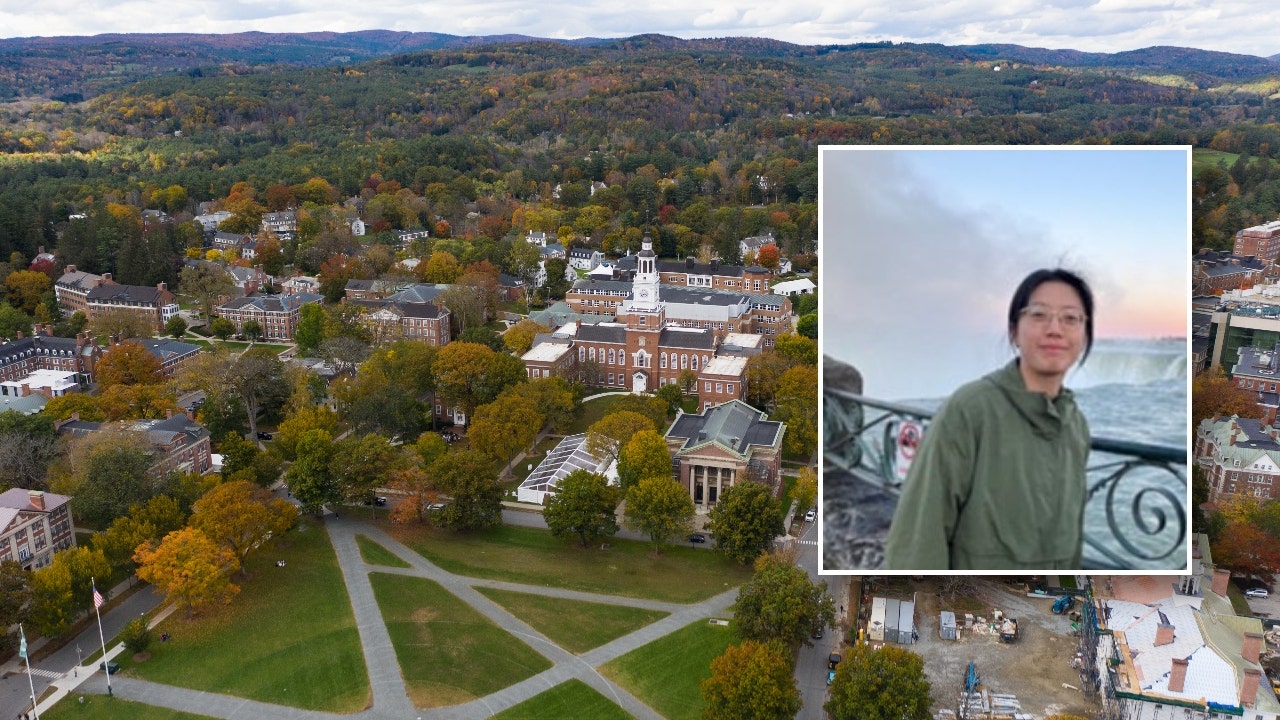
Kexin Cai, a missing Dartmouth College student, was found dead Monday in the Connecticut River, several days since she was last seen.
Around 4 p.m. Monday, a fisherman “alerted authorities to a sighting” along the river in Windsor, Vermont. Authorities were dispatched to the area, where they retrieved a body from the water that was later identified as Cai.
Police said their preliminary investigation suggests no foul play.
The Lebanon Police Department was notified on May 17 that the Dartmouth doctoral student, 26, had been missing since May 15, and authorities issued a missing persons report.
MISSING MADALINA COJOCARI’S MOTHER PLEADS GUILTY TO FAILURE TO REPORT DISAPPEARANCE, MAY BE DEPORTED
Kexin Cai was last seen riding her e-bike on May 15. (Lebanon Police Department)
The reporting party told the LPD that Cai was last seen leaving her residence in an unknown direction on an e-bike on the afternoon of May 15, a Wednesday.
NEW YORK MAN WITH TIES TO EUROPEAN ROYALTY REPORTED MISING IN CALIFORNIA: POLICE
“The Police Department quickly deployed personnel to search the area. An extensive investigation and search continued throughout the weekend into Monday,” LPD said in a press release at the time.
A fisherman in Windsor, Vermont, spotted Cai’s body in the Connecticut River on Monday. (Lebanon Police Department)
Two local businesses had surveillance video footage showing Cai leaving on her e-bike around 6 p.m. that Wednesday and heading south on NH RT 10 toward West Lebanon. A “passing motorist” spotted her e-bike at the Boston Lot Conservation Area on May 20, police said.
Local law enforcement agencies, along with Dartmouth Safety and Security, the New Hampshire Fish and Game Department, good Samaritans and others joined the intensive search for Cai around the Boston Lot and Wilder Dam areas in the days following her disappearance.
US COAST GUARD SUSPENDS SEARCH FOR MISSING FLORIDA DIVER: ‘DEEPLY SADDENED’
The College Green on the campus of Dartmouth College in Hanover, New Hampshire, on Oct. 17, 2021. (Bing Guan/Bloomberg)
Cai, a Chinese native, reportedly admitted herself to the campus medical clinic prior to her disappearance because she was experiencing a mental health crisis.
CLICK TO GET THE FOX NEWS APP
“She was a second-year doctoral student in psychological and brain sciences with a special interest in communication challenges in autism,” Jon Kull, dean of the Guarini School of Graduate and Advanced Studies, wrote in a Monday statement.
“According to her adviser, Kexin was an exceptionally gifted and humble researcher with a genuinely sweet personality. She loved cats so much that she would sneak images of them into every poster or presentation. Kexin loved the Upper Valley. Here, she discovered the joys of hiking, skiing, and road trips,” Kull wrote.
Read the full article from Here

Boston, MA
Jaylen Brown says Celtics showed ‘lack of respect’ after trade to 76ers – The Boston Globe

Amid several reports that said Brown didn’t request a trade and that Boston actually thought Derrick White was the best player on the 2025-26 roster, an already motivated Brown now has an even larger chip on his shoulder after the Celtics dealt him away.
“The message was received,” Brown said. “I wasn’t thrilled with the amount of respect that was shown throughout this process. I think there was a bit of a lack of respect. I think it was fine at one point, then out of nowhere, things just went left. I think Brad [Stevens] is getting a lot of the criticism. I wasn’t thrilled with the way he facilitated some of the conversations.”
After the Celtics fell short in their pursuit of Giannis Antetokounmpo — Brown was the centerpiece of Boston’s trade package — Stevens was noncommittal when asked about Brown’s future in Boston.
“Jaylen Brown is a big part of us,” Stevens said. “I’m never going to predict the future, but every indication, everything that I think about over the past few years has been building around those guys, right? So obviously, you never know. But at the same time, the one thing I want to make very clear is how valued he’s always been.”
“He’s been amazing. He’s been an amazing teammate, a great person to be around. And whether that run ends 10 years from now when he retires, or before, there’s a lot to celebrate. We have a great relationship, an open relationship where we talk about everything. But I don’t want to predict the future. I look at it as, this is our team.”
Stevens traded Brown to the 76ers on Wednesday in exchange for Paul George, two first-round picks, and two second-round picks. The deal was widely criticized.
For Brown, the most puzzling aspect was the lack of an explanation.
“I definitely think there’s more to it,” Brown said. “I just wish that more to it could’ve been explained to me. Because I think if more to it was explained, I would’ve understood. I thought I earned the respect to get that explanation. But hey, obviously, I was wrong. That’s life. You move on.”
Brown will now join a 76ers team that, with Tyrese Maxey, Joel Embiid, and V. J. Edgecombe already in place, could be poised to leapfrog Boston in the Eastern Conference.
“I don’t want [any] special treatment, I don’t need no handouts … I plan on earning my respect one day at a time by putting in the work,” Brown said of playing for Philadelphia. “I’m looking forward to getting in the gym, the whole process.”
“The hard part is, the last 10 years, I’ve been programmed to hate Philadelphia. The history of the rivalry, the playoff battles … I’ve been programmed to think like, ‘[Expletive] The Process’. It’s funny, now I’ve got to reverse-engineer it. But I’ll be ready to go by the time the season starts.”
Conor Ryan can be reached at conor.ryan@globe.com.

The 90-foot tall Ferris wheel will run from July 1 through July 5 on the North Shore. Tickets are on sale now and 50% of all proceeds will be donated to the Veterans Leadership Program. Tickets can be purchased at: pittsburghpa.gov/july4.
The BNY Main Stage at Point State Park will have entertainment starting at 4 p.m. Headlining the performances will be Grammy- and Tony-Award nominated national pop rock band the Plain White T’s. Shows are free,
As part of the National Flag Foundation’s Light to Unite, the city’s skyscrapers will be illuminated in red, white and blue across Downtown at 9 p.m.
The city’s fireworks spectacular is set to be the city’s largest fireworks display in decades. For the first time, there will be a drone performance immediately before the fireworks start.
The fireworks show will utilize six barges on all three rivers – and some rooftops. Fireworks will begin at 9:35 PM on July 4.
Connecticut
Motorcyclist seriously injured after crashing into parked, unoccupied vehicle in Meriden

MERIDEN, Conn. (WTNH) — A motorcyclist has serious injuries after a crash early Friday morning in Meriden, according to police.
The crash happened just after 3:00 a.m. in the area of Lincoln Street. The motorcyclist was navigating a turn when they struck a parked, unoccupied vehicle, police said.
The motorcyclist was taken to an area trauma center, according to police.
A section of Lincoln Street is blocked for the investigation, police said.
Meriden’s accident investigation team responded to the scene.
Additional information was not immediately available.
Download the News 8 app to get breaking news and weather alerts.
Watch News 8 on WTNH.com or the free WTNH News 8 streaming app on Roku, Apple TV, Amazon Fire TV and select Samsung Smart TVs.
-

 San Francisco, CA9 minutes ago
Marina braces for Golden Gate Bridge fireworks show, massive crowds
-

 Dallas, TX12 minutes ago
Maradona’s ‘Hand of God’ ball heads to auction in Dallas
-

 Miami, FL17 minutes ago
Miami-Dade sheriff urges residents to celebrate Fourth of July safely
-

 Boston, MA24 minutes ago
Jaylen Brown says Celtics showed ‘lack of respect’ after trade to 76ers – The Boston Globe
-

 Denver, CO27 minutes ago
Who are the Top 5 offensive linemen in Denver Broncos history?
-

 Seattle, WA32 minutes ago
Seattle’s Lake Union to light up with big July 4 fireworks show for America’s 250th
-

 San Diego, CA39 minutes ago
New training program grants tribal members access to reservation land during emergencies
-
Milwaukee, WI42 minutes ago
Leaders of ‘United for Venezuela Emergency Relief Campaign’ grateful for support


