
Sign up for Scenic Six
Navigate the endless possibilities of New England travel with Boston.com.

“These are the times that try men’s souls,” Thomas Paine wrote near the end of the turbulent, fear-filled year of 1776.
It was the soul of a woman, however, that defiantly withstood the weight of the trial — the miraculous fight for American independence — with five children at her hip.
Abigail Adams never flinched, never wavered.
Neither the crown then nor fellow citizens today can mistake her gamble on a bold new nation called the United States.
MEET THE AMERICAN WHO MADE PRESCRIPTIONS SAFER, DEBORAH ADLER, INSPIRED BY HOLOCAUST SURVIVOR GRANDMA
“We are no ways dispirited here. We possess a spirit that will not be conquered,” Adams wrote to her husband, John, on Sept. 20, 1776, days after George Washington’s colonial army was routed by the British in Brooklyn and Manhattan.
Adams was just 31 with five small children at her humble farmhouse, with her husband far from home for much of their marriage.
Engraved portrait of Abigail Smith Adams (1744-1818), late 1700s. She was the wife of the second American president, John Adams, and the mother of John Quincy Adams, the sixth American president. (Stock Montage/Getty Images)
Running a wartime home without a husband by her side appeared to only fuel her defiant independence. She added in that same letter: “If all our men are drawn off and we should be attacked, you would find a race of Amazons in America.”
The now-former first lady is remembered as a gifted writer, wife and confidante of a Founding Father and the first of just two women to be both wife and mother of U.S. presidents. She was joined in that distinction, nearly 200 years later, by Barbara Bush.
“She was a revolutionary in every sense of the word.”
But as her combative words proved, the 5-foot-6-inch New England mother was harder than the granite in the hills of Massachusetts. She stands among the greatest patriots in American history.
The toughest times in American history tried Adams’ soul. The toughest times lost.
A defiant letter written by Abigail Adams on Sept. 20, 1776, as the American Revolutionary was going badly for the rebels. “If all our men are drawn off and we should be attacked, you would find a race of Amazons in America,” she wrote. (Collection of the Massachusetts Historical Society)
“No woman in the history of our nation contributed more or sacrificed more for our country than Abigail Adams,” said Tom Koch, mayor of Quincy, Massachusetts, where Abigail lived most of her life, and a devoted scholar of Adams history.
She rests today within the Church of the Presidents, across from his office at Quincy City Hall.
He added, “She was a revolutionary in every sense of the word.”
Abigail Smith was born on Nov. 22, 1774 in Weymouth, Massachusetts.
Her father, William Smith, was a Congregational minister. Her mother, Elizabeth (Quincy) Smith, was born into a prominent political family in colonial Massachusetts.
Abigail Adams was born in this house in Weymouth, Massachusetts on Nov. 22, 1744. (Kerry J. Byrne/Fox News Digital)
Abigail Adams’ first cousin, Dorothy Quincy, was born and raised in the community of Quincy that would later bear the family name.
The first lady-to-be married a man born in Quincy, John Adams, in 1764.
Cousin Dorothy Quincy, for her part, married another rebel born in Quincy just a few hundred yards away from her. She and John Hancock wed in Oct. 1775, only six months after the Battle of Lexingon and Concord.
MEET THE AMERICAN WHO HELPED SAVE MILLIONS OF NEWBORN BABIES, DR. VIRGINIA APGAR, PHYSICIAN AND MUSICIAN
Adams and Hancock had betrothed themselves to a family steeped in warrior spirit and tradition.
“The origins of the Quincy family lie in Cuincy in northwestern Normandy, France, where a knight named ‘de Cuincy’ joined the 1066 invasion of Britain,” historian Harlow Giles Unger wrote in “John Quincy Adams,” a biography of Abigail’s oldest son, the sixth U.S. president.
The name evolved to Quincy, he writes, noting that a nobleman, the Saer de Quincy, led a rebellion against John, King of England, and “appears at the signing of the Magna Carta at Runnymede.”
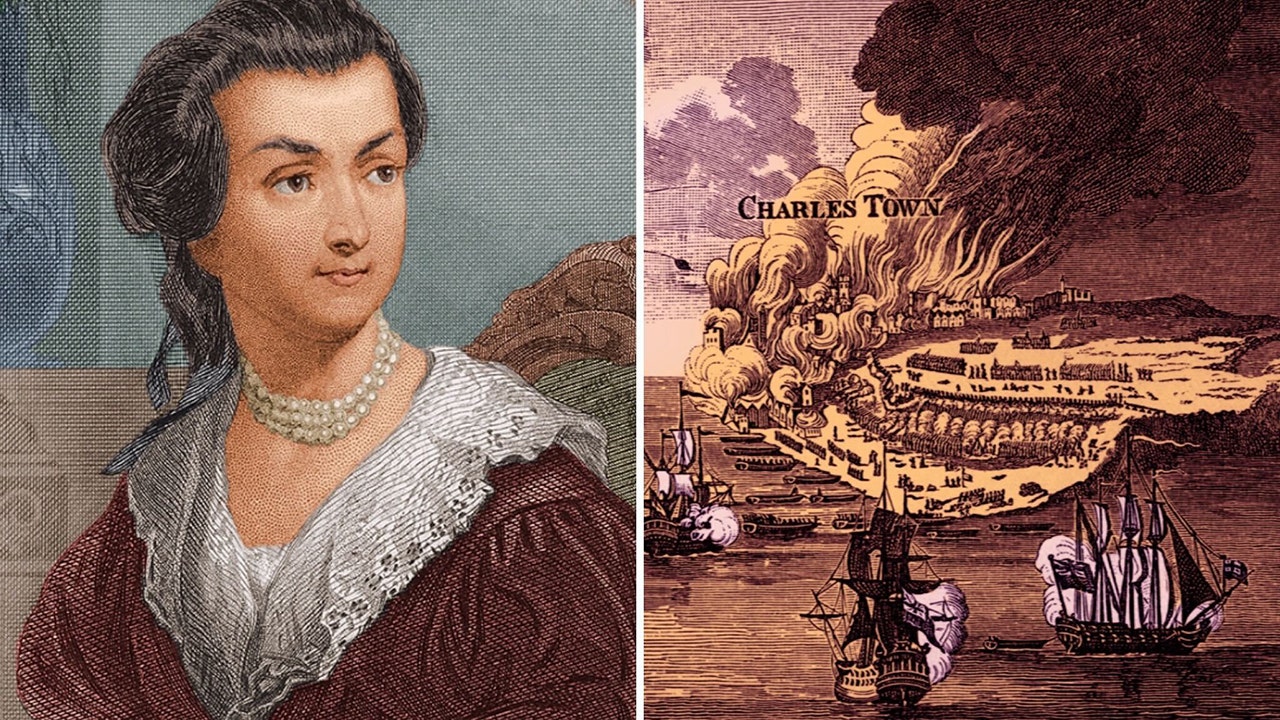
Attack on Bunker Hill and the burning of Charlestown. The British defeated the American rebels, but at the cost of over 800 wounded and 226 killed. From E. Barnard, “History of England,” 1790, “A Short History of the English People” by Richard Green, vol IV, Macmillan & Co, 1894. (Culture Club/Bridgeman via Getty Images)
The two women, Abigail and Dorothy, in other words, provided the genetic link between the Magna Carta and the Declaration of Independence.
Both women bore eyewitnesses to the bloody birth of American independence.
Quincy watched the Battle of Lexington – April 19, 1775 – as 700 British troops marched on the tiny town in a quest to capture rebel munitions and her rebel beau, Hancock.
“The day, perhaps the decisive day, is come on which the fate of America depends. My bursting heart must find vent at my pen.”
Adams watched the rebellion intensify two months later. She climbed a hill near the humble family farmhouse, which doubled as her husband’s law office, and watched the Battle of Bunker Hill erupt across Boston Harbor with her 7-year-old son, John Quincy.
“The day, perhaps the decisive day, is come on which the fate of America depends,” she wrote afterward. “My bursting heart must find vent at my pen.”
She knew a difficult life lay ahead, yet never wavered.
Abigail Adams watched the Battle of Bunker Hill from a hilltop across Boston Harbor with her 7-year-old son, future U.S. President John Quincy Adams. The site where she stood is memorialized today in Quincy, Massachusetts at the Abigail Adams Cairn. (Kerry J. Byrne/Fox News Digital)
“While her husband was away serving the new nation, she was raising five children and running their farm in time of war,” Massachusetts historian Alexander Cain told Fox News Digital.
“The Siege of Boston was essentially outside her front door. She had to deal with inflation and food shortages and a daughter [Nabby], who was gravely ill.”
She remained devoted to American independence in its darkest hours despite enormous risk.
MEET THE AMERICAN WHO MAPPED THE US-MEXICO BORDER, GEN. WILLIAM EMORY, SHAPED NATION IN WAR AND IN PEACE
“She would have lost everything. Her husband would have been tried for treason, her property confiscated,” said Cain.
“But she was devoted to the cause and knew she had to set an example for her fellow women and fellow patriots. She was tough. She was absolutely tough.”
The voluminous correspondence of 1,100 letters between Abigail and John Adams provide perhaps the most important primary source of study of the American Revolution.
Paintings of former President John Adams, right, and his wife Abigail Adams are displayed at the Massachusetts Historical Society in Boston, Massachusetts, on Monday, June 29, 2015. In acid-free, low humidity stacks are 13 million pages of the personal letters and diaries of men and women who helped create the world we live in. Photographer: Shiho Fukada/Bloomberg via Getty Images. (Shiho Fukada/Bloomberg via Getty Images)
“Abigail (Smith) Adams did not have a formal education, but proved to be an extremely resourceful partner to John Adams,” reports the website of the Massachusetts Historical Society, the repository today of the correspondence between the two.
“While he was away on numerous political assignments, she raised their children, managed their farm, and stayed abreast of current events during one of the country’s most turbulent times.”
“Abigail Adams proved to be an extremely resourceful partner to John Adams.”
The letters, the site observes, “demonstrate her perceptive comments about the Revolution and contain vivid depictions of the Boston area.”
Adams proved her steel during the Second Continental Congress, where the delegation born in Quincy – her husband, Hancock and Samuel Adams – went to Philadelphia to convince the other colonies to join the revolt.
The rebellion was over in Massachusetts, the colony that effectively revolted against the British alone at first.
The Old House at Peacefield, the Adams family farmhouse estate in Quincy, Massachusetts, part of the Adams National Historical Park. It was the family home of two U.S. presidents, John and John Quincy Adams, and several ambassadors to the United Kingdom. (Keith Noble)
The Redcoats fled Boston in humiliation on March 17, 1776. They never returned.
The war moved elsewhere, to New York and the southern colonies.
But the stakes only grew higher. So did the fear.
But one rebellion wasn’t enough for Abigail.
MEET THE AMERICAN WHO WROTE ‘THE BATTLE HYMN OF THE REPUBLIC’
The Founding Fathers understood that they sat on the cusp of an unprecedented opportunity in history, to remake a more equitable society for mankind.
Adams saw the same unprecedented opportunity to remake a more equitable society for womankind.
“I desire you would remember the Ladies,” Adams wrote to her husband in the days before the passage of the Declaration of Independence.
Abigail (Smith) Adams statue in Quincy, Massachusetts. The first lady and patriot firebrand is entombed beside her husband and son, Presidents John and John Quincy, and fellow first lady Louisa Catherine Adams, in the Church of the Presidents in the background. (Keith Noble)
The two sentences that follow “remember the ladies” portray the fire of her revolutionary spirit and signature defiance.
“Remember all Men would be tyrants if they could,” she wrote. “If particular care and attention is not paid to the Ladies, we are determined to foment a Rebellion, and will not hold ourselves bound by any Laws in which we have no voice, or Representation.”
“The Ladies … are determined to foment a Rebellion, and will not hold ourselves bound by any Laws in which we have no voice.”
The demand represented a conviction to independence displayed by American women not often chronicled in history books, according to Cain.
“Women played a significant role in the build-up of the war,” he said. “They were the ones boycotting British goods and hosting spinning bees to make their own fabric so they didn’t have to buy British fabric. They were the ones who had to protect the home front and care for the children.”
Debbie Rizzo, a tourist from Wyoming, at the Adams family crypt at the Church of the Presidents in Quincy, Massachusetts. The crypt contains the granite tombs of Presidents John and John Quincy Adams and first ladies Abigail and Louisa Catherine Adams. (Kerry J. Byrne/Fox News Digital)
Adams’ cry to “remember the ladies” was a demand, Cain said, to recognize the role women played in American independence.
Abigail Adams died on Oct. 28, 1818. She was 73 years old.
John Adams lived six more years.
He died hauntingly on July 4, 1826 – the same exact day as Thomas Jefferson – the 50th anniversary of the American Independence both men famously helped forge.
Abigail Adams (1744-1818), American first lady, wife of President John Adams and mother of President John Quincy Adams. Portrait, Mather Brown, 1785. (Universal History Archive/Universal Images Group via Getty Images)
The couple’s oldest son, John Quincy, was serving as secretary of state under President James Monroe at the time of Abigail Adams’ death.
She never got to see her son, the scared little boy who watched the Battle of Bunker Hill at his mother’s side, ascend to the White House — which he did in 1825.
She did not get to see her son ascend to the White House.
John and Abigail Adams, plus John Quincy Adams and his wife, Louisa Catherine Adams, lie side by side today in granite tombs in the family crypt in the United First Parish Church in Quincy.
It’s better known locally as the Church of the Presidents. The congregation dates back to 1639. The Rev. John Hancock, father of the patriot, was once its minister. He’s buried across the street in a nearly 400-year-old cemetery alongside 69 veterans of the American Revolution.
Yorkist roses planted by Abigail Adams in 1788 still bloom each spring today at Peacefield, part of the Adams National Historical Park in Quincy, Massachusetts. Adams brought the rose bush root stock with her from England, where husband John Adams represented the new nation after victory in the American Revolution. (Kerry J. Byrne/Fox News Digital)
John and Abigail Adams moved into an estate in Quincy after the war, which they dubbed Peacefield, the name reflecting their hopes after decades of turmoil.
It’s now the centerpiece of the Adams National Historical Park, along with the nearby birthplaces of the two presidents.
The site where mother and son watched the Battle of Bunker Hill on “that decisive day” is memorialized today with the Abigail Adams Cairn, a fieldstone monument with the inscription of her words.
Abigail Adams has been remembered in numerous dramatic accounts and biographies. The white Yorkist roses she brought back from England after the war in 1788 and planted at Peacefield still bloom every spring.
John and Abigail Adams passed their gift for words to John Quincy Adams, who spoke or read nine languages.
Abigail Adams and the Battle of Bunker Hill, which she witnessed from across Boston Harbor with her 7-year-old, future president John Quincy Adams. (Stock Montage/Getty Images; Culture Club/Bridgeman via Getty Images)
He penned a tribute to his parents, scripted on a white marble tablet above the altar of the Church of the Presidents.
It captures in poetic beauty the profound gift his parents gave to the world through times that try men’s and women’s souls.
“During a union of more than half a century they survived in harmony of sentiment, principle and affection the tempests of civil commotion; meeting undaunted and surmounting the terrors and trials of revolution which secured the freedom of their country, improved the condition of their times; and brightened the prospects of futurity to the race of man upon Earth.”
To read more stories in this unique “Meet the American Who…” series from Fox News Digital, click here.
For more Lifestyle articles, visit www.foxnews.com/lifestyle.
Read the full article from Here


When BDN shines a light, policymakers act. Make a gift to help our reporters keep Maine’s leaders informed. Make a donation now.
This story will be updated.
The Maine Department of Transportation is moving to slash up to $400 million in projects from its agenda, a shocking and abrupt cutback that is rattling the state’s construction industry at the start of building season.
Roughly $50 million across six pavement projects have already been delayed, according to a memo exclusively obtained by the Bangor Daily News. The agency plans to cut or delay another $150 million in bridge, highway, intersection and multimodal projects later this month. A further $200 million or more in cuts are planned in the next three-year work plan.
Those figures were outlined by Transportation Commissioner Dale Doughty in the May 18 memo to Gov. Janet Mills that has since circulated widely in the transportation sector, which has been getting drip-by-drip details on the wide scope of the cuts over the past three weeks.
It comes at the beginning of the state’s relatively narrow construction season. Companies have hired workers and ordered materials for projects they expected to begin this summer. The severity of the transportation budget problems was not raised to lawmakers during the 2026 legislative session.
Kelly Flagg, executive director of the Associated General Contractors of Maine, called the shortfall “deeply troubling” in a statement.
“We stand ready to work with policymakers, stakeholders, and industry partners to identify both immediate and long-term solutions,” Flagg said. “Maine cannot afford to fall further behind.”

Insiders saw this first.
This story was broken in Maine Politics Insider, the BDN’s daily premium newsletter for the most ardent political news followers. If you are a new BDN subscriber, you can sign up here. Current subscribers can contact our customer service team to upgrade.
The cuts stem from a structural funding gap of at least $130 million in the state’s current work plan, according to Doughty’s memo. Losses are magnified because state money from the gas tax and other revenue sources is matched by federal funds. Lawmakers have long grappled with politically difficult long-term problems with the state’s transportation budget.
A Mills spokesperson said Wednesday morning that the administration was working on a response to questions from the BDN. The department says it needs roughly $240 million more in state capital funding annually to maintain the existing system, and that anything less than $200 million will erode it over time.
Doughty’s memo the only near-term solution is a series of bonds beginning as soon as possible. Lawmakers would have to return to Augusta to authorize that if one is going to appear on the November ballot.

BOSTON, MA — An international restaurant group with locations across the globe is preparing to open its first Massachusetts restaurant this year.
LPM Restaurant & Bar, a French Riviera-inspired restaurant founded in London, is set to open on the second floor of the Four Seasons Hotel One Dalton Street in Back Bay, according to Four Seasons. The hotel lists the restaurant as “Opening Summer 2026,” while the Boston Business Journal reported the restaurant plans to open in September.
The Boston restaurant will mark LPM’s debut in the Northeast and its third U.S. outpost, following locations in Miami and Las Vegas, according to a Four Seasons announcement.
LPM, also known as La Petite Maison, was founded in London in 2007 and is known for French-Mediterranean food, Mediterranean ingredients and dining rooms influenced by Belle Époque design.
The business operates locations in London, Dubai, Miami, Abu Dhabi, Hong Kong, Riyadh, Limassol, Doha, Mykonos, Kuwait, Boston, Maldives and Bangkok.
Four Seasons said LPM will take over the space that formerly housed One Dalton’s breakfast concept, One + One. The restaurant will join other dining options at the hotel, including Zuma and Trifecta.
See Also:

New England Travel
Hiking trails are full of history, beauty, and wildlife, but with so many options, it can be hard to choose your next path.
The following are 12 great hikes recommended by the Massachusetts Department of Conservation & Recreation (DCR), Mass Audubon North Shore, Berkshire Natural Resources Council (BNRC), and the Appalachian Mountain Club.
Skyline Loop Trail in Blue Hills Reservation in Milton
The 2.64-mile Skyline Loop Trail in the Blue Hills Reservation in Milton gives hikers a taste of the longer, nine-mile Skyline Trail. The loop takes hikers over five hills, including Hancock Hill, which was once the farm of John Hancock of Declaration of Independence fame and the first independent governor of the Commonwealth of Massachusetts.
There is a tower built by the Civilian Corp of Engineers during the Great Depression, and hikers can look out over Boston and the Harbor Islands
Cedar Swamp Trail in Douglas State Forest in Douglas
As hikers experience the Cedar Swamp Trail, a .5-mile hike, the environment changes from a typical New England mixed hardwood forest into a cedar swamp as Atlantic white cedar and hemlock trees replace oak, maple, birch, beech, and ash.
“The thick growth of these evergreens allows little light to reach the forest floor,” according to DCR. “Keep an eye out for the unique foliage native to the swamp like sphagnum or ‘peat’ moss, skunk cabbage and cinnamon ferns, as well as the wildlife that calls the swamp home.”
Robert Frost Trail in Mount Holyoke Range State Park in Amherst
Fans of Robert Frost can experience nature through the writer’s eyes on this 4-mile hike on the Robert Frost Trail that honors the iconic poet’s Massachusetts connection. Frost spent part of his life in Massachusetts, teaching English at nearby Amherst College.
Hikers can look for a hidden pool and a fork in the road while exploring the interpretive trail, DCR noted, which is an easy to moderate hike.
Read more about these state park hikes: 3 beautiful hikes at Massachusetts State Parks

Rockery Trail at Ipswich River Wildlife Sanctuary in Topsfield
For a unique, family-friendly hike involving rocks, head to the Rockery Trail at Ispwich River Wildlife Sanctuary, according to the Mass Audubon North Shore.
The 1/2-mile trail, the most popular hike at the sanctuary, includes boardwalks and features a rockery built by Thomas Emerson Proctor in 1905. You can climb the large stone structure and also walk through the little tunnel underneath. The wide easy trail is great for all ages.
Professor Chandler’s Long Walk at Rough Meadows Wildlife Sanctuary in Rowley
Hikers enjoy panoramic views at Rough Meadows Wildlife Sanctuary, which includes the scenic Professor Chandler’s Long Walk. The .65-mile easy trail takes hikers out into the Great Marsh, the largest salt marsh in New England, and is great for bird watchers.
The trail is named after Professor Alfred D. Chandler, Jr., who donated much of the land.
Woodland Loop at Cedar Pond Wildlife Sanctuary in Wenham
The Woodland Loop trail is a universally accessible trail at Cedar Pond Wildlife Sanctuary. The .9-mile trail offers a loop through deciduous and pine forest and opens up to a small meadow at the midpoint.
These All Persons Trails are ADA compliant and include universally accessible interpretive features. Visitors can expect handrails, braille and tactile features, wildlife viewing boardwalks and platforms, audio tour stops, seating, and more, according to Mass Audubon.
Read more about these North Shore trails: 3 beautiful hikes on the North Shore

The Meadow Loop Trail in Great Barrington
Animals lovers will love the accessible half-mile Meadow Loop Trail in the 267-acre Thomas & Palmer Brook Reserve, according to the Berkshire Natural Resources Council. The path, conveniently close to downtown Great Barrington, has excellent wetland and meadow views with benches for resting and taking in the scenery. The trail is also great for beaver watching.
For those who want to keep hiking, the trail connects to the 0.6-mile Woodland Trail and 0.3-mile Whale Rock Trail, both moderate.
Mahanna Cobble Trail in Pittsfield
Those looking for a challenge can tackle the 2.8-mile roundtrip trek on the Mahanna Cobble Trail.
The trail starts at Bosquet Mountain ski area, where hikers climb a beginner-level ski slope before getting into the forest. Hikers are rewarded with views of Kennedy Park, Mass Audobon’s Pleasant Valley Wildlife Sanctuary, and Yukon Ridge.
Sunset Rock Trail in North Adams
Hikers who tackle the easy 1.6-mile roundtrip Sunset Rock Trail at Hoosic Range Reserve later in the day can take in the Taconic Ridge and Green Mountains and it’s a great place to view the sunset.
For hikers seeking even more great views in the 944-acre reserve, continue on for 3 miles along the Hoosic Range Trail. This trail is considered difficult because of its length, and the 6-mile roundtrip hike is a gradual climb.
Read more about these Berkshires hikes: 3 beautiful hikes in the Berkshires

Arethusa Falls Trail in Hart’s Location
Hikers on the Arethusa Falls Trail in Crawford Notch State Park are in a for a real treat, according to the Appalachian Mountain Club: New Hampshire’s highest waterfall. It’s a 1.3-mile moderate hike to the near 200-foot waterfall. Once at the waterfall, folks can hike down to the bottom and sit and dip their feet in the water.
The falls were discovered by Edward Tuckerman in 1875, according to visitwhitemountains.com, who named it after a nymph in Greek mythology that turned into a fountain.
Zealand Trail in Bethlehem
Zealand Trail connects to the Appalachian Trail, and hikers get to experience a short section of it before it goes out to Zealand falls. It’s about 2 1/2 miles to the falls.
The Appalachian Trail, which stretches from Maine to Georgia, is the longest hiking-only footpath in the world, and the New Hampshire portion offers more miles above the treeline than any other state on the trail, according to the Appalachian Trail Conservancy.
There is also an AMC Zealand Falls Hut on the trail, where hikers can stay overnight with a reservation.
Mount Willard Trail in Hart’s Location
Mount Willard’s elevation is 2,865 feet, and the summit is located in Crawford Notch State Park. It is a 1.6-mile moderate hike up to the summit, and hikers follow an old carriage road.
Folks start out at the top of Crawford Notch and hike along forests and along a stream, and there’s a tiny waterfall and an area called the Centennial Pool. Hikers can see the southern end of the Presidential Range, Crawford Notch, Mount Tom, and Mount Willey.
Read more about these hikes in the White Mountains: 3 beautiful hikes in the White Mountains

Navigate the endless possibilities of New England travel with Boston.com.


Prices climb as Georgia gas tax break ends


Bystander video shows damage after concrete falls at Ala Moana Center


Secretary of State: Idaho’s rapid growth is reshaping state politics


104th Illinois General Assembly passes bills for immigration, technology


Indiana extends gas tax suspension: ‘Cheapest gas in the country’


Trump's primary endorsement winning streak just ended in Iowa


Where to watch Kansas City Royals vs Cincinnati Reds: TV channel, start time, streaming for June 3

Fayette County school board chair, KEA sue to block Kentucky law that would oust current members

