Massachusetts
Weekend storm: Latest forecast, timing, expected snow totals for Massachusetts

:quality(70)/cloudfront-us-east-1.images.arcpublishing.com/cmg/TMWRCY2JB5BRDPF652PHEVNXS4.jfif?ssl=1 "Weekend storm: Latest forecast, timing, expected snow totals for Massachusetts")
DEDHAM, Mass. — A storm on track to move into Massachusetts this weekend is expected to bring snow, rain, and strong wind gusts.
Friday will feature steady rainfall through at least lunchtime, and the drizzly, foggy conditions will linger into Saturday morning. Things will then dry out before an impactful storm arrives during the daylight hours on Sunday.
“We’ve got rain and snow. Some areas are expecting plowable snow. I’m not expecting coastal flooding, but winds will get gusty,” Boston 25 Meteorologist Shiri Spear said in her latest forecast.
Spear shared an “early-look” snow map on Friday morning that showed the chance for a half foot of snow in some parts of the Bay State.
“There’s no doubt that we’re going to have to make some adjustments over the next couple of days, but for your planning purposes, it does look like less than 3 inches for a good chunk of southeastern Massachusetts, 3 to 6 inches north and west of Taunton up to Boston and the North Shore,” Spear said. “North and west of 495 and the Mass. Pike — the best chance for getting 6 inches of snow. It’s because those spots stick with all snow the whole time even as it begins on Sunday with very minimal rain mixing in.”
There will likely be more mixing of rain during the day on Sunday for points south of the Mass. Pike and along the coastline. Southeastern Massachusetts, including Cape Cod and the Islands, will start with mainly rain before a late flip to snow.
“That change to snow doesn’t happen until later down across Cape Cod and the Islands, with just a little bit of accumulation,” Spear said.

Temperatures will be mild enough during the day on Sunday to limit snow accumulation in some areas but overnight into Monday could become a problem.
“Overnight into Monday morning is when I think we get the real problems,” Spear said. “The Monday morning commute is probably going to be slow.”
Snow will look to taper off around mid-day Monday before dry, chilly weather moves in by the middle of the week.
For the latest updates, visit the Boston 25 Weather Page.
Download the FREE Boston 25 News app for breaking news alerts.
Follow Boston 25 News on Facebook and Twitter. | Watch Boston 25 News NOW
©2024 Cox Media Group



Massachusetts
Two men indicted for Hinsdale robbery after ‘cigarette trail’ leads through Vermont, Massachusetts

HINSDALE, N.H. (ABC22/FOX44) – Two men from Massachusetts have been indicted after they allegedly stole more than $200,000 in cigarettes and fled in a stolen U-Haul van before setting it on fire.
According to court documents, the men robbed the T-Bird Mini Mart on Brattleboro Road in Hinsdale, New Hampshire back on March 15. They then allegedly drove the U-Haul north into Brattleboro, Vermont before heading south on Interstate 91 down in Massachusetts.
Cartons of cigarettes reportedly fell from the back of the van as it drove through Brattleboro, which were estimated to be worth more than $50,000. The “trail of cigarettes” was reportedly used by investigators examining surveillance footage to track the path of the van leading up to the arrest of two suspects last week.
Richard Conner, 64, of Greenfield, Massachusetts, and James Ferguson, 66, of Worcester, Massachusetts, were arrested on Friday.
According to court documents, Ferguson was also seen on camera earlier in March stealing the U-Haul van in Northampton, Massachusetts.
The two men now face federal charges under the Hobbs Act and, if convicted, could spend up to 20 years in prison.

BOSTON (WWLP) – The Healey-Driscoll Administration and the Massachusetts Department of Conservation and Recreation announced the opening of 24 swimming pools for the summer season across the state.
This initiative includes the return of its free Learn to Swim Program for children and expanded lifeguard services at 30 DCR swimming areas. Registration for the free swimming lessons begins on Monday, June 22, providing children between the ages of 4 and 12 the opportunity to learn life-saving skills.
The DCR’s efforts aim to provide residents, visitors and families with safe places to swim and cool off during the summer. This commitment to water safety is supported by extending lifeguard coverage to seven days a week, which began last Saturday, running from 10:15 a.m. to 5:45 p.m., though continued coverage is subject to staff availability.
DCR Commissioner Nicole LaChapelle emphasized the importance of aquatic education. “Every child deserves the opportunity to learn how to swim. Swimming is more than a summer activity –it’s a life-saving skill that helps children safely enjoy our pools, lakes and beaches with confidence,” LaChapelle said. “By offering free swimming lessons at pools across Massachusetts, we’re helping remove barriers for families while helping more children safely enjoy the outdoor spaces that belong to all of us.”
The Learn to Swim Program will be offered at 19 DCR pools throughout Massachusetts and is structured into three sessions during the summer. Each session consists of eight half-hour group swim classes tailored for beginner-level swimmers and organized by age.
The curriculum for the classes is based on the American Red Cross and focuses on water safety and basic swimming skills. Registration is required and will operate on a first-come, first-served basis, closing once classes at each facility are full.
Participating DCR pools for the program are located in Agawam, Boston, Cambridge, Chelsea, Chicopee, Clinton, Fall River, Fitchburg, Hyde Park, Lawrence, Malden, Melrose, Milford, Somerville, Springfield, Watertown and Worcester.
The DCR is also actively recruiting certified lifeguards for its beaches and swimming pools for the current summer season. Positions are available through Labor Day and offer competitive hourly wages ranging from $22 to $27, depending on the position and associated certifications. More information about lifeguarding opportunities and application details are available on the agency’s lifeguarding webpage.
Beyond lifeguard services, the DCR maintains water safety at its state beaches and waterfronts through regular water quality testing at all 79 designated swimming areas. These areas are equipped with ropes and buoys to delineate swimming sections. Safety signage, which can be translated into nine languages including Spanish, Portuguese, Vietnamese and Traditional Chinese via a QR code, is also present.
To enhance safety, life rings are available for public use at both guarded and unguarded swimming areas in case of an emergency. All DCR swimming pools are equipped with chair lifts to provide water access. Several pools also feature ramps or zero-depth entry and select pools and spray decks offer beach wheelchairs for use.
All facts in this report were gathered by journalists employed by WWLP. Artificial intelligence tools were used to reformat information into a news article for our website. This report was edited and fact-checked by WWLP staff before being published.
Local News Headlines
WWLP-22News, an NBC affiliate, began broadcasting in March 1953 to provide local news, network, syndicated, and local programming to western Massachusetts. Download the 22News Plus app on your TV to watch live-streaming newscasts and video on demand.

If you watch a movie, send an email, or put your photos in the cloud, there is a data center involved. With the rise of AI, there is more need for data storage and that means more power and more water. So, more Massachusetts communities are saying they don’t want them.
Data centers are growing increasingly unpopular. How unpopular? Polling shows people would rather live near a nuclear power plant. A Gallup poll found 71% of Americans would oppose a data center being built near their home and 53% would oppose a nuclear reactor.
Communities across the country have been fighting to stop the construction of mega sized data centers used to power the future of artificial intelligence.
In Massachusetts, several projects have been put on hold. The city of Lowell recently passed a one-year moratorium to stop the building or expansion of data centers. Lowell is the site of the largest data center in the state.
Markley data center in Lowell
The Markley data center is a mammoth building. It was built by Markley in 2015 on the site of an old Prince Spaghetti factory. Markley cleaned up the lot, painted the building black and set up a complex digital warehouse which stores data from more than a hundred customers ranging from hospitals to universities to police stations.
Like all things data center, this one comes with controversy. Jake Fortes lives in his childhood home where he takes care of his elderly parents. The data center, about 100 feet away, dwarfs his home.
Fortes says the building has nicknames including the “dungeon” and the “Death Star.”
“It’s nicknamed by a lot of residents in the neighborhood the dungeon,” Fortes said. “Because it seriously is just this black building that looms over us.”
Fortes said the rows of industrial air conditioners on the roof of the data center constantly hum and he claims exhaust from the four metal chimneys that rise from the data center’s emergency generators flow toward his bedroom windows.
“You will hear the A/C units. That’s a constant. And it’s worse in the summer,” Fortes said.
Markley has two data centers in Massachusetts. They built their first on top of Macy’s in downtown Boston in 2013.
From Lowell to Los Angeles, there are coast to coast concerns about what these data centers can do to the environment. From the massive amount of energy they use, to the incredible amount of water they need to keep the equipment from overheating. Some large data centers can use up to five million gallons of water every day. But the owners of the Lowell data center say it is not a drain on resources.
WBZ-TV’s David Wade asked Markley for tour of the data center, which they never do, and they agreed. They have grown frustrated with the negative narrative of data centers across the country and wanted to show they are different than the huge data centers built solely for AI companies.
Markley’s corporate VP Adam Burnham took him around the 350,000 square foot facility. The front entrance is teeming with a few dozen people, filled with colorful artwork and a TV monitor showing old video of a train that used to run through the property.
Beyond that there are long hallways with white tile floors and white walls that lead to rooms full of loud machines taking in, transforming and distributing large amounts of electricity throughout the building. How much electricity? Markley doesn’t say. Most data centers don’t. It’s why some lawmakers like Senator Elizabeth Warren are calling for more transparency from all data centers. But Markley’s Boston location boasts up to 30 megawatts of power, which is comparable to what tens of thousands of homes could use at any given time.
“Many petabytes” of data
There is a constant hum from the air conditioning machinery that helps to cool down the racks of servers.
How many servers are in the building? “There must be thousands,” Burnham said. “From hundreds of different customers.”
And how much data is that? “It would be hard to even quantify it. To use technical terms, it would be petabytes,” Burnham said. “Many petabytes for many customers.”
You have heard of megabytes and gigabytes but what is a petabyte? Well, just one petabyte is equal to roughly 250 million high resolution photos or the storage capacity of 250,000 smartphones or 13 years’ worth of continuous high-definition movies.
Markley says it stores data from all different types of companies. Financial companies, life science companies, universities, public safety companies. All those servers need lots of water to feed the system that keeps them cool.
How much water is used?
Some data centers use millions of gallons of water every single day. Markley says over the past year, they have used between 60,000 and 120,000 gallons of water per day. Those numbers match up with some of their water bills that WBZ was able to obtain.
Besides the effect on water and power, another criticism of data centers is once construction is done, they don’t create many jobs. Markley brought Lou Antonellis, a representative from the IBEW, an electrical workers union, to our shoot. Wade asked how many union workers he had working inside the building.
“Right now, it’s a little bit of a slow period. Probably about a dozen,” Antonellis said. That’s it. A dozen. Antonellis said there were also another dozen pipe fitters inside. He said there can be 80-100 workers when there’s a big project on site.
Hopes to expand in Lowell
But Antonellis and the IBEW say they really want Markley to expand. New buildings mean new construction jobs. WBZ learned Markley has been buying more land nearby with hopes of expanding, including an old power plant up the road. But they have a problem. The city of Lowell recently voted for a one-year moratorium on data centers. It means no new building, and no expansion.
On the final stop on the tour, the Markley people wanted to show the emergency generators that neighbors have complained about.
An hour earlier, Jake Fortes, the neighbor who calls the building the Death Star, had predicted they would take David Wade to the generators, and it would be less noisy than usual.
“Usually when they detect that there’s a reporter coming, they will turn it off and it will go very quiet and you will hear the birds,” Fortes said.
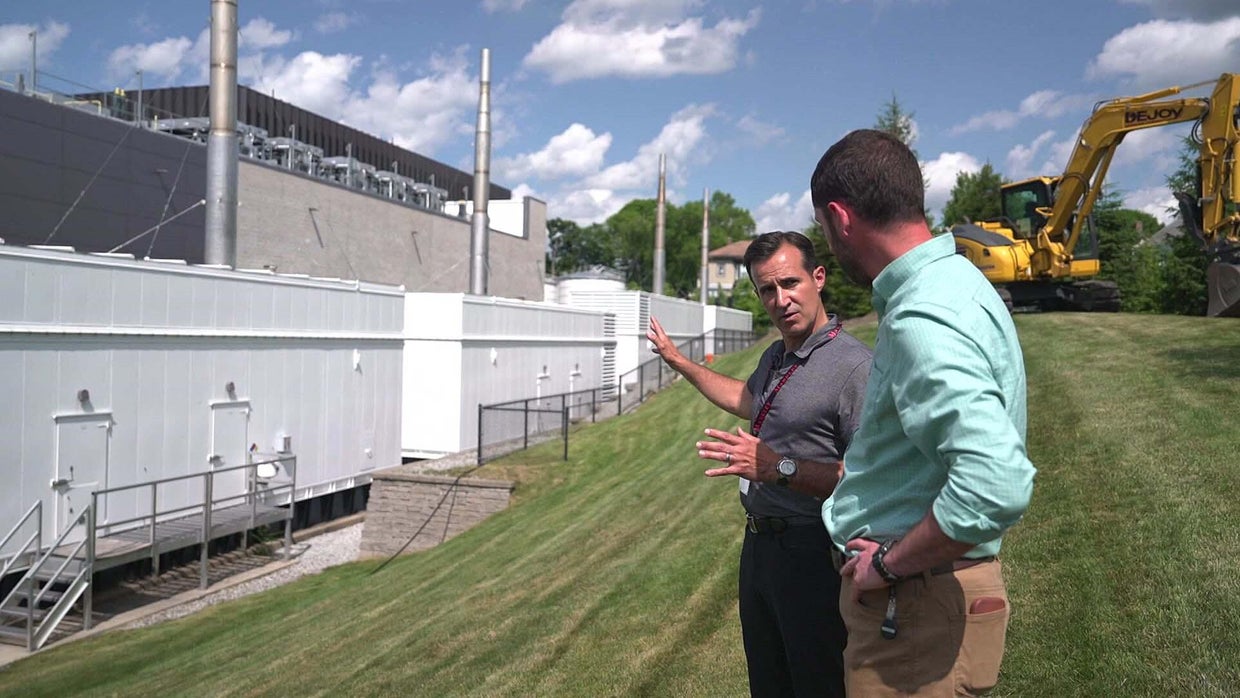
When they took David Wade to the emergency generators, which they fire up for a test every week for five minutes, you could barely hear the machines over the sounds of chirping birds.
“So, it’s not under a complete load, but this is the typical noise you’re going to get,” Burnham said.
Wade asked if the generators weren’t running at “full load” were they running at 20%, 50%, 80%? They couldn’t answer.
Then Wade asked if he thought neighbors had been exaggerating about the noise at the data center and the answer was clear. “I think they’re exaggerating, yes,” Burnham said.
If you have a question you’d like us to look into, please email questioneverything@cbsboston.com.
-

 New York56 minutes ago
Video: Knicks Fans Celebrate With Ticker-Tape Parade
-

 Los Angeles, Ca1 hour ago
Armed, dangerous CHP pursuit suspect tied to double homicide in Pomona
-

 Detroit, MI1 hour ago
First responders honored after rescuing 12 people from capsized sailboats near Belle Isle
-

 San Francisco, CA2 hours ago
Oakland man faces hate crime charges for Castro District attack
-

 Dallas, TX2 hours ago
At least 4 injured after vehicle drives into Dallas crowd, driver arrested
-

 Miami, FL2 hours ago
Miami Central students prepare for life changing trip to Zimbabwe amid funding challenges
-

 Boston, MA2 hours ago
Giannis to Boston is a possibility. Should the Knicks be worried?
-

 Denver, CO2 hours ago
Denver Public Schools’ decline in enrollment continues to reshape district

