Northeast
Massachusetts foster parents stripped of license for refusing to sign transgender policy

NEWYou can now listen to Fox News articles!
A Massachusetts couple says their foster license was revoked after they refused to sign a state contract requiring them to “affirm” a child’s gender identity because of their Christian beliefs.
Lydia and Heath Marvin, who live in Woburn, Massachusetts, with their three teenage children, have fostered eight children under age 4 since 2020, including a baby with special medical needs they fostered for 15 months.
“We decided that we wanted to do foster care because it’s a key part of being Christian to care for those who are most in need, like orphans,” Heath Marvin told Fox News Digital.
But everything changed after the Marvins received a new parent agreement in August 2024 asking them to agree they would “support” and “affirm” the LGBTQIA+ identity of children in their care.
SUPREME COURT SKEPTICAL OF ‘CONVERSION THERAPY’ LAW BANNING TREATMENT OF MINORS WITH GENDER IDENTITY ISSUES
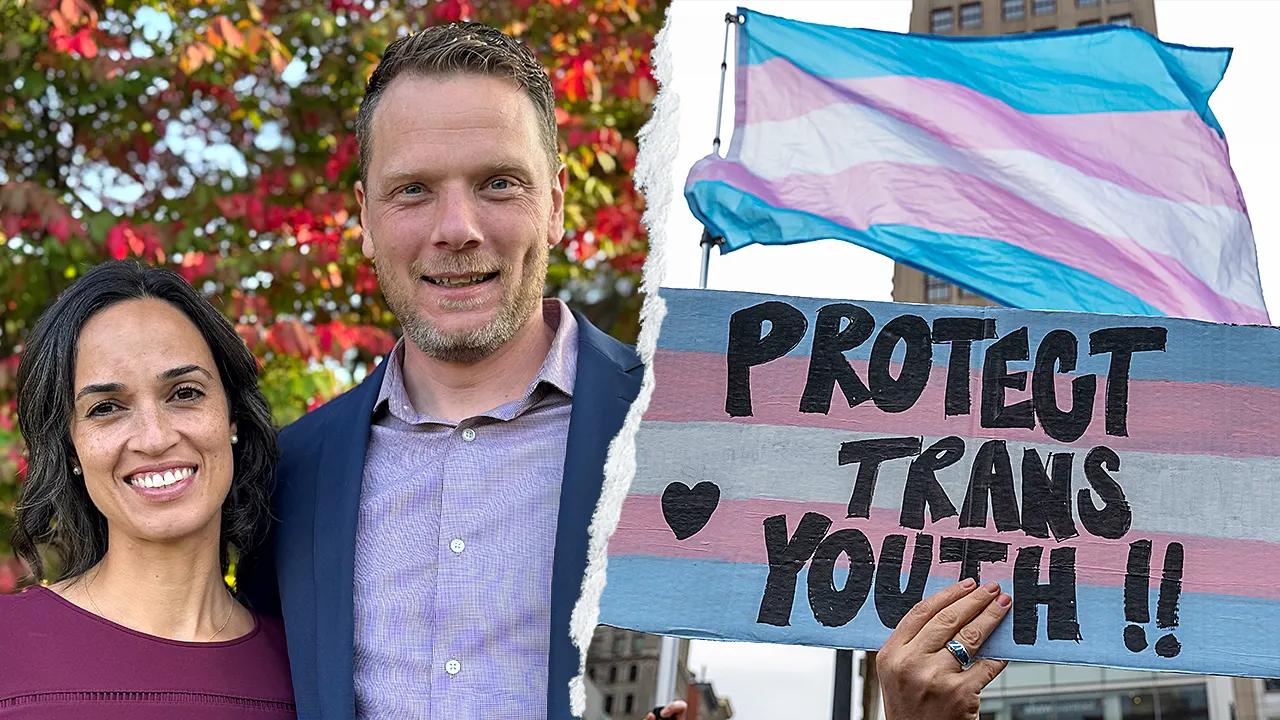
Lydia and Heath Marvin said they pleaded with the Massachusetts Department of Children and Families to provide religious accomodation to the gender policy but were denied. (The Marvins/Stephanie Keith/Bloomberg via Getty Images)
The Marvins asked for an accommodation or waiver from the state, citing their Christian beliefs about gender and sexuality. They said they assured the agency that any child in their home would be loved and taken care of.
“We would absolutely love, care, and support any child in our home, but this was asking us to go against our Christian faith,” Lydia Marvin told Fox News Digital. “We were ultimately told, ‘No, you have to sign the form as is, or else you will lose your license.’ And so, in fact, we lost our license in April of this year.”
The Marvins said they had just completed medical training in order to take care of another child with specialized needs when they learned they were no longer approved by the Massachusetts Department of Children and Families (DCF) to do so.
“It’s obviously not been what we’ve been hoping for,” Heath said, adding that their focus has always been on providing a loving home for kids who need help.
CHRISTIAN FOSTER FAMILIES FIGHT BACK AGAINST MASSACHUSETTS TRANSGENDER MANDATE
Protesters for and against gender-affirming care for transgender minors demonstrate outside the Supreme Court on Dec. 4, 2024, in Washington, D.C. (Jose Luis Magana/Associated Press file)
The couple appealed the decision in May and found out in September that the state upheld the decision to revoke their license.
According to DCF policy, the agency “actively recruits, screens, and assesses foster families for their ability and willingness to support and affirm LGBTQIA+ children placed in their care, including recruiting foster families that identify as LGBTQIA+.” But religious liberty advocates argue this requirement forces families of faith to violate their beliefs.
At least two other Christian foster families in the state are fighting the policy in court.
Alliance Defending Freedom (ADF) is representing the Schrocks and the Jones in a federal lawsuit against the DCF, alleging the policy violates their clients’ constitutional rights. These families also foster young children and refused to sign the gender contract. The Schrocks had their license revoked in June.
WASHINGTON STATE’S RADICAL NEW LAW TURNS PRIESTS INTO GOVERNMENT INFORMANTS
Nick and Audrey Jones, two foster parents who are suing Massachusetts over its “gender-affirming” policy. (Alliance Defending Freedom; Drew Angerer/Getty Images)
According to the suit, Massachusetts did not previously require foster families to pledge verbal affirmation of a child’s gender identity. That changed between 2023 and 2024, when the state began requiring families to sign agreements to speak and act in certain ways, including affirming a foster child’s sexual orientation or gender identity.
Senior Counsel Hal Frampton told Fox News Digital the state’s actions are hurting vulnerable children instead of helping them.
“What really hurts about all of this is that this hurts kids more than anything else,” he said. “Every child deserves a loving home. And children suffer when the government excludes people of faith who are ready to provide those homes to them based on the government’s radical ideology.”
ADF argues the policy is particularly harmful to children at a time when the state faces a foster parent shortage.
“They have more kids than homes ready to support them,” Frampton said. “And so the idea that you’re going to take loving families like the Marvins, like the Shrocks, like Joneses, the people we represent in our case, who have successfully provided for kids for years and say, now those people are just out of the system. In the end, what that does is it deepens the crisis, and it results in more kids not having loving homes.”
CLICK HERE FOR MORE COVERAGE OF MEDIA AND CULTURE
The Trump administration has also weighed in on the Marvins’ case.
In a Sept. 30 letter addressed to the DCF from the U.S. Department of Health & Human Services, Acting Assistant Secretary for the Administration for Children and Families Andrew Gradison called the state’s policy “troubling” and in violation of the Constitution.
“These policies and developments are deeply troubling, clearly contrary to the purpose of child welfare programs, and in direct violation of First Amendment protections,” the letter said, according to the Massachusetts Family Institute.
“It’s really heartening to see the administration noticing this issue and taking it seriously and coming down on the side of loving families like the Marvins and recognizing that states shouldn’t be in the business of using their radical gender ideology to hurt kids,” Frampton added.
CLICK HERE TO DOWNLOAD THE FOX NEWS APP
A spokesperson for the Massachusetts Department of Children and Families declined to comment when reached by Fox News Digital.
Read the full article from Here



New data is shedding light on the state of Connecticut’s economy and labor force.
On this episode of the CBIA BizCast, CBIA Foundation director Dustin Nord joins host Amanda Marlow to talk about new Connecticut Department of Labor data that highlights the mismatch between increased job openings and a shrinking labor force.
Connecticut job openings jumped 2.6% in May to 87,356—however, since May 2025, 37,700 people have left Connecticut’s labor force.
Nord breaks down some of the reasons for this mismatch and what needs to be done to address Connecticut’s economic challenges.
He also shares insights into a U.S. Bureau of Economic Analysis report showing Connecticut’s economy expanded 1.8% in the first quarter of 2026.
Episode Highlights:
- Job Openings vs. Workforce Shortage
- Unemployment Trends
- GDP Growth Amid Labor Challenges
- Affordability and Long-Term Competitiveness
Headlines You May Have Missed:
The CBIA BizCast is made possible through the generous support of Google. Subscribe to the BizCast wherever you get your podcasts. Please rate the podcast and leave us a review—we appreciate your support! And be sure to give us your feedback and share guests you’d like to hear.

The allegations against Platner could constitute gross sexual assault, a felony crime in Maine law used to prosecute rape, according to a Maine criminal defense lawyer.

Graham Platner drops Maine Senate bid after sexual assault allegation
Facing a slew of controversies including a sexual assault allegation, Graham Platner dropped out of the closely watched Maine Senate race.
The recent sexual assault allegations against Graham Platner aren’t just the political flashpoint that forced a rising populist Democrat to suspend a major Senate campaign. They also potentially amount to criminal conduct.
Jenny Racicot, 41, had been casually dating Platner for about two years when he came to the home where she was staying in 2021 and sexually assaulted her, while she repeatedly told him to stop, according to allegations she made in interviews with Politico and CNN.
Those allegations could constitute gross sexual assault, a felony crime in Maine law used to prosecute rape, according to William T. Bly, a Maine criminal defense lawyer. However, he said Racicot, who didn’t report the incident to law enforcement in 2021, would need to decide now that she wants to report it.
“If you take a look at the statutes, you can see all the different ways it could be charged, but it is gross sexual assault,” Bly said.
“A lot of it’s going to come down to victim credibility and what, if any, corroborating evidence can they get?” Bly added.
Racicot said the assault took place in the village of Marlboro, which is in Maine’s Hancock County.
In a lengthy email to USA TODAY, Hancock County District Attorney Bob Granger said his office cannot comment on whether any criminal investigation exists, noting that Maine law criminalizes unlawfully disseminating information from an investigative record.
Granger added that his office wouldn’t ordinarily open an investigation unless a victim makes a formal sexual assault complaint to law enforcement for the area where the crime happened, and that victims of sexual assaults may be reluctant to move forward criminally for “a number of valid reasons,” including “horrendous emotional and psychological pain.”
However, Granger said his office takes formal complaints seriously.
“If a victim exercises the courage to come forward to law enforcement with credible allegations, we owe it to both them and the general public to carefully examine those claims,” he said.
Shannon Moss, a spokesperson for Maine’s Department of Public Safety, told USA TODAY in an email that the Maine State Police haven’t received or investigated any criminal complaints involving Platner. USA TODAY also left a voice message at the Hancock County Sheriff’s Office seeking information on any complaints.
USA TODAY was unable to reach Racicot for comment.
Ryan Barto, the communications director for Platner’s campaign, didn’t respond to a request for comment, but Platner has previously denied that he sexually assaulted anyone.
“This is all false. The things that have been claimed did not happen. It’s not real,” Platner said in a video posted to Instagram July 8, in which he didn’t address the specifics of Racicot’s account, but said her allegations were surfacing in the media in an effort to get his name off the ballot.
“Accusations are supposed to be the beginning of things, not the end,” he said.
Here’s a look at what kinds of charges could be in play if a complaint were lodged and prosecutors chose to move forward, what penalties they could involve, and what a defense might look like:
Prosecuting rape in Maine
Gross sexual assault, Maine’s central felony rape statute, can be prosecuted in many different forms, depending on the nature of the allegations. For instance, if a defendant compelled another person to engage in a sex act, the person could face a “Class A” assault felony charge, Maine’s most serious class of gross sexual assault.
Other forms of sexual assault in Maine, such as getting someone to engage in a sex act by threat or being criminally negligent about whether the other person consented, amount to lower-class felonies.
Racicot alleged that Platner was heavily intoxicated when he entered her home uninvited and ignored her repeated pleas for him to stop. She told Politico she cut off contact after telling him the incident was not consensual.
If prosecutors were considering gross sexual assault charges against Platner, the time that has passed since the alleged assault wouldn’t prohibit them from moving forward. Maine allows prosecutors to bring gross sexual assault felony charges anytime within 20 years of the offense.
What kind of penalties could Platner face if charged and convicted?
Defendants convicted of the most serious form of gross sexual assault – Class A felonies – can be imprisoned for up to 30 years. Class B and Class C gross sexual felonies allow judges to sentence a defendant to up to 10 years and five years in prison, respectively.
Maximum penalties often don’t reflect the actual penalties defendants receive from a judge. In Maine, judges take various factors into account when determining the appropriate sentence, such as defendants’ age, the nature of the underlying crime, their criminal history, and evidence that reflects on their character.
“It’s not just the classification of the crime, but what are the details that come out,” Bly said. “There’s so many different things to look at.”
What kinds of defenses could Platner raise?
Bly said Platner’s potential defense, if he were to face charges, would be driven by details in the case that may currently be largely unknown.
Still, one potential line of defense is already clear: Platner has suggested that the timing of Racicot’s account is intentional. The allegations emerging just days before a July 13 deadline to remove him as Maine’s Democratic Senate nominee, Platner said, indicate they were politically motivated.
“This was the last week to try to get me off of the ballot. And that’s why this is occurring,” Platner said in his July 8 Instagram video message.
“I’m sure a defense would be that this was politically motivated, the person had a personal issue and an ax to grind,” Bly said.
Racicot told Politico she didn’t go public earlier in part because she believes in Platner’s platform.
“One of the reasons I didn’t come forward sooner was the huge moral conflict that I had between supporting his politics, but not supporting him as a person,” she said.
With all the years gone by, there might also be a lack of physical evidence for prosecutors to present in court, and questions from the defense not just about an accuser’s motive, but her memory.
“The longer in time someone waits to bring allegations, especially when they’re already adults when they occurred, tends to weigh against, I think, the credibility potentially of the alleged victim,” Bly said.
Still, corroboration could persuade prosecutors they have a strong enough case, Bly said. They may be able to point to accounts from people Racicot spoke with after the alleged crime occurred.
CNN spoke with two people who said that Racicot previously disclosed that Platner sexually assaulted her. She spoke with a then-boyfriend in 2023 and a close friend in late August of 2025, around the time Platner launched his campaign. The former boyfriend said Racicot disclosed Platner’s identity to him after Platner launched his campaign. The friend said Racicot initially referred to her assailant as an “oysterman,” but later shared that it was Platner.
According to Platner’s campaign website, he started working on his friend’s small oyster farm in 2018 and eventually took over the oyster farm.
Massachusetts
Healey administration vows to appeal as Trump rejects Massachusetts blizzard aid request – The Boston Globe

Governor Maura Healey said in a statement that she was “deeply disappointed” by the president’s decision and would keep fighting to secure federal dollars for Massachusetts.
“Our first responders, public works crews, and local communities worked around the clock to keep people safe and begin recovery,” she said. “They did their job, and now President Trump needs to do his.”
Climate advocates say the denial — which came on the same day that Trump rejected three other Democrat-led states’ requests for winter storm relief — reflects the administration’s politicization of disaster aid.
“Communities in Massachusetts and everywhere deserve a federal government that makes decisions for all people, and not just those that they perceive as having voted for them,” said Kate Sinding Daly, senior vice president for law and policy at the Conservation Law Foundation.
The president can declare a major disaster when a natural catastrophe is shown to have exceeded a state’s capabilities and resources. An analysis conducted by POLITICO in March found that it is three times harder for blue states than red states to get disaster funding under Trump.
According to the analysis, the president has approved just 23 percent of disaster funding requests from states with a Democratic governor and two Democratic senators, compared with 89 percent of requests from states represented by Republicans — an unprecedented discrepancy.
The analysis also found that Trump takes an average of 80 days to respond to disaster requests from Democrat-led states, compared to 39 for Republicans.
Abigail Jackson, a White House spokeswoman, strongly disputed that the Trump administration was politicizing decisions on disaster relief. She did not comment on why Trump denied Massachusetts’ request.
“President Trump provides a more thorough review of disaster declaration requests than any Administration has before him,” she said in a statement. She said the president was ensuring tax dollars were used by states “to supplement — not substitute, their obligation to respond to and recover from disasters.”
Former Washington governor Jay Inslee described the president’s approach to disaster aid as “outrageous, immoral, and illegal.” During Trump’s first term, the president reportedly ignored Inslee’s request for wildfire relief because of a personal dispute.
“He will consciously, willfully, and joyfully deny people aid who are at the most difficult moments of their lives,” said Inslee, who co-chairs the advocacy group Climate Power. “It is so infuriating to see an American president use disaster aid as a cudgel.”
The Healey administration announced in early April that it had requested a major disaster declaration for the February blizzard. It sought to reimburse state agencies and local governments in the southeastern part of the state for snow removal and other storm-related costs. The blizzard downed hundreds of power lines and trees, and nearly 300,000 people lost power at the peak of the storm.
Last week, Trump rejected disaster declaration requests from four Democrat-led states who had sought aid for the February storm: Massachusetts, Rhode Island, New York, and New Jersey. The president’s decision came just days after he approved aid for six Republican-led states.
“Trump is either politicizing disaster declarations or he is attacking states where it snows — neither is good,” wrote Senator Ed Markey in a social media post. “The February blizzard was costly for our communities, and Trump must approve the Commonwealth’s need for assistance.”
Senator Elizabeth Warren said a statement that the president’s decision was “cruel and makes clear he doesn’t see himself as a president for all Americans.”
“Communities in Massachusetts were hit by one of the worst storms we’ve seen in decades, and instead of sending a lifeline, the President is leaving everyday Americans out to dry,” she added.
Rhode Island officials also slammed the Trump administration for denying the state’s request. The winter storm hit the state with the intensity of a Category 2 hurricane. Providence had to cap spending for the rest of the fiscal year after record-setting snow.
The state’s congressional delegation — Senator Sheldon Whitehouse, Senator Jack Reed, Representative Seth Magaziner, and Representative Gabe Amo — wrote a letter calling on the president to reverse the denial. A preliminary assessment found more than $19 million in damages across the state, the letter said.
“You chose to leave Rhode Islanders out in the cold,” the lawmakers wrote.
Meanwhile, the president approved a major disaster declaration for the Mashpee Wampanoag Tribe in Massachusetts related to the February blizzard. (Federally recognized tribal governments can directly request a disaster declaration.)
Additionally, FEMA announced on Thursday that it had approved nearly $5.7 million for projects to reduce future disaster costs in New England, including more than $1 million for Massachusetts projects combating flooding.
Kate Selig can be reached at kate.selig@globe.com. Follow her on X @kate_selig.
-
Augusta, GA2 seconds ago
Augusta domestic violence shelter faces shortfall after Georgia funding veto
-

 Washington, D.C7 minutes ago
Why Gov. Kim Reynolds turned down previous request to send National Guard to D.C.
-

 Cleveland, OH10 minutes ago
LGBTQ+ Ohio Nonprofit Guide
-

 Austin, TX15 minutes ago
Think tank says state education reforms have set up future of the ‘Texas Miracle’
-

 Alabama22 minutes ago
New Alabama women’s basketball coach Pauline Love credits late mentor for coaching career
-

 Alaska25 minutes ago
Fatal crash closes Glenn Highway southbound lanes near Eagle River
-

 Arizona30 minutes ago
Arizona Cardinals’ Jordan Burch takes lessons from rookie year
-

 Arkansas37 minutes ago
Dino Fest brings interactive experiences, lifelike dinosaurs and reptiles to Arkansas July

