Northeast
Maryland thieves connected to theft ring from South America, in US illegally: ICE

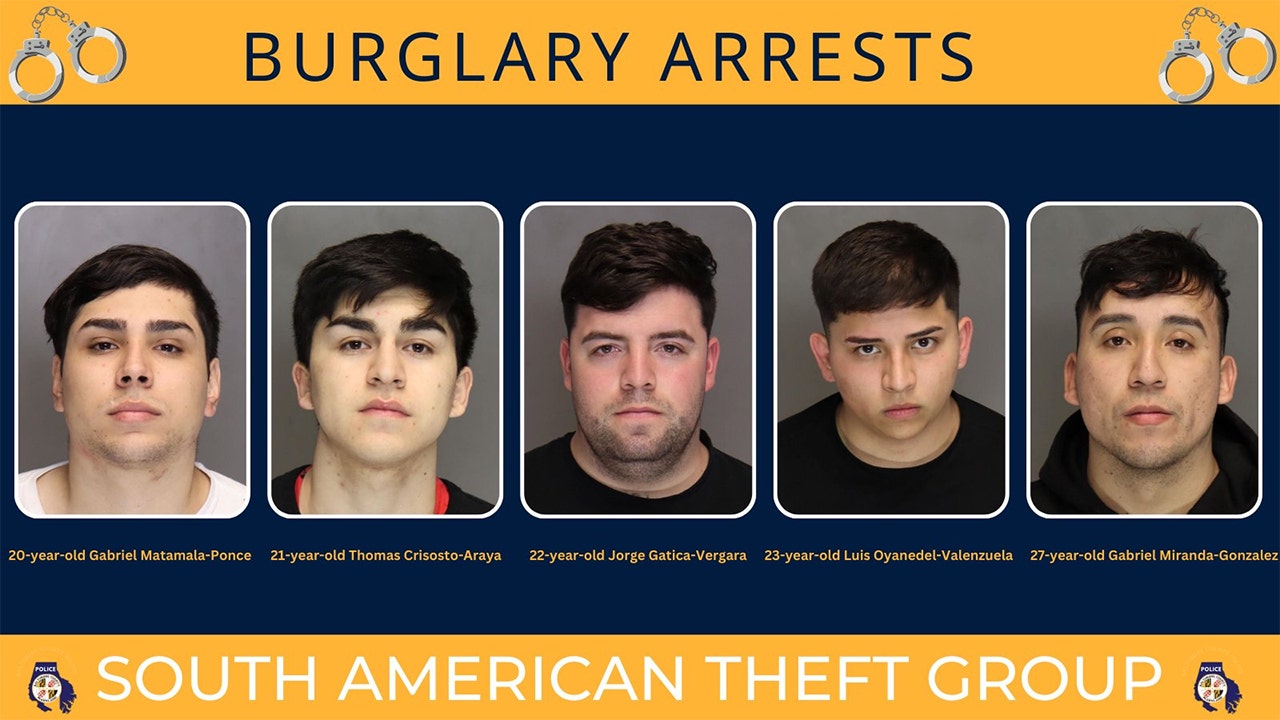
Five Chilean nationals accused of burglarizing a Baltimore County, Maryland residence last month and being linked to crimes in other states, were all in the country illegally, according to U.S. Immigration and Customs Enforcement (ICE).
On Feb 3, 2024, the Baltimore County Police Department arrested 20-year-old Gabriel Matamala-Ponce; 21-year-old Thomas Crisosto-Araya; 22-year-old Jorge Gatica-Vergara; 23-year-old Luis Oyanedel-Valenzuela; and 27-year-old Gabriel Miranda-Gonzalez and charged them with first-degree attempted burglary and various other burglary-related crimes.
Officers were called to the 2300 block of Tufton Springs Lane at about 6:45 p.m. that day for a burglary in progress, and quickly located the suspects fleeing from the scene in a vehicle, before stopping them and taking them into custody.
A follow-up investigation discovered the five suspects were possibly connected to four other burglaries in the county, as well as crimes in North Carolina, Alabama and Oklahoma. They were also allegedly part of a theft ring out of South America.
MARYLAND BURGLARS LINKED TO SOUTH AMERICAN THEFT GROUP CONNECTED TO CASES IN MULTIPLE STATES: POLICE
Baltimore County, Maryland police arrested five men suspected of being part of a South American theft group. (Baltimore County Police Twitter)
ICE told Fox News Digital that Enforcement and Removal Operations (ERO) in Baltimore had lodged immigration detainers against all five individuals.
“ERO Baltimore is closely tracking the five individuals that Baltimore County Police arrested Feb. 3 for burglary charges,” ERO Baltimore Spokesperson James Covington said. “All five of the individuals are Chilean nationals.”
ICE said Crisosto-Araya, Gatica-Vergara, Miranda-Gonzalez, and Oyanedel-Valenzuela all entered the country lawfully as non-immigrants but did not depart according to the terms of their admittance.
MARYLAND WOMAN CONVICTED OF KILLING, DISMEMBERING BOYFRIEND, DISPOSING HIS REMAINS
June 2, 2022: ICE agents conduct an enforcement operation in the U.S. interior. (Immigration and Customs Enforcement)
The fifth individual, Matamala-Ponce, entered the U.S. illegally without admission by a U.S. immigration official, ICE said.
All five are also connected to crimes in other states.
The Orange County, North Carolina sheriff’s office issued arrest warrants for Crisosto-Araya, Gatica-Vergara, Oyanedel-Valenzuela and Matamala-Ponce on Feb. 28, 2024 for burglary-forced entry of a residence.
BALTIMORE POLICE OFFICER INDICTED ON EXCESSIVE FORCE, RECKLESS ENDANGERMENT
Miranda-Gonzalez was arrested by the Orange County, Florida sheriff’s office on Feb. 22, 2022 and charged with petty retail theft and paid a fine for the crime on April 22, 2022.
All five are being held in Baltimore County on an immigration detainer.
The detainers are lodged against non-citizens who have been arrested for criminal activity.
Under the detainer, ICE asks local and state law enforcement agencies to notify them as early as possible before releasing a non-citizen from custody.
The detainers place a hold on the release of the non-citizens for no more than 48 hours beyond the time they would otherwise be released, which allows ERO to assume custody for removal purposes.
Read the full article from Here


A poster of Joan Sebastián Durán Guerrero, the man killed by US Immigration and Customs Enforcement, is displayed at a memorial in Biddeford, Maine.Robert F. Bukaty/AP
The day after hundreds of locals poured into the streets of Biddeford, Maine in protest of ICE’s killing of 26-year-old Joan Sebastián Durán Guerrero on Monday, I drove through the former mill town. It seemed eerily still, as if in shock. When the horrors of Minneapolis and Houston come to your small corner of New England, what can you do?
In Mechanics Park in Biddeford, a small but diligent group presented one answer: you keep showing up.
“When I woke up this morning, I knew that this was the place I should go right to,” said Wayne Miller, 71, a retired pilot of 35 years and resident of Beverly, Massachusetts. “This is my backyard. This is my neighborhood.”
He paused, then started to cry. “I’m ashamed of my country. I love the country. I’m ashamed.”
Miller was standing with a sign that read “Dissent while you still can” at the corner of Mechanics Park in Biddeford, where the protest and vigil for Guerrero had been held the day before. A nearby chain-link fence served as a memorial, lined with flowers, signs, and letters of grief and apology for Guerrero and his family. One read, “3-year-olds should be watching Bluey, not their fathers being executed.” Above a “No Trespassing” sign, someone had placed another: “Biddeford was built by immigrants.”
I spoke with Miller and others who had come out on Tuesday to continue expressing their grief for their neighbor, the second person killed by federal agents in less than a week.
“It’s one thing to see a news story from a distance,” said Tessa, 28, a waitress and resident of Biddeford. “But watching it happen close to home, it really recontextualizes the safety that you feel walking around in your neighborhood.”
For Linda Henry, 27, a retired firefighter and Gloucester, Massachusetts resident, it was only a matter of time. “I know that it doesn’t matter where you live. It’s going to happen, you know. ICE is going to come.”
“I’m ashamed of my country. I love the country. I’m ashamed.”
Guerrero was a Colombian citizen who lived in Biddeford, Maine with his partner and 3-year-old daughter. He is one of at least nine people killed by federal immigration agents since the start of Donald Trump’s second term. Homeland Security Secretary Markwayne Mullin claims Guerrero “weaponized” his vehicle during a traffic stop. But similar claims by DHS have quickly fallen apart after video footage of shootings has come to light.
Reports say that not only was Guerrero authorized to legally work in the US, but he wasn’t the target of ICE’s operations that day.
Katie, a 48-year-old educator from New Hampshire, shared her anger. “A gun is not a license to kill. These agents have no business drawing their guns,” she said. “They aren’t judge, jury, and executioner, and they don’t have the right to be killing people the way that they are.”
“We were taught from the time we were little, ‘liberty and justice for all.’ We were taught that the United States was a place for everyone, and the current regime has changed that,” Katie continued.

Most of the protesters were standing with signs on the sidewalk along the adjacent intersection, shouting “ICE OUT” while passing cars honked. Near the memorial, a man on a bike caught my eye. He was off to the side, alone, quietly reading the letters addressed to Guerrero.
He introduced himself as Diego, 30, a restaurant worker and Biddeford resident. “I knew the guy. He was always around,” he said. “I was working and I was about to cry, to be honest. Because it’s injustice, you know? I’m an immigrant, and this country was built for immigrants.”
“We work, we pay taxes. We also need rights, as everybody does,” he said. “It’s not about left or right. It’s not about a political party. It’s about human rights.”
He told me that while he’s never felt disrespected by his neighbors and the people of Biddeford are good, the government is not the same. He said he feels unsafe and his community of immigrants feels like it’s hiding.
“How many need to die for us to understand?” Diego said. “He’d got a kid, a little daughter. And that’s the most devastating. Because, you know, if I do something wrong, I can say ‘I’m sorry, I apologize.’ But he’s dead. There’s no apology that can bring him back, you know? He’s dead. I can’t even believe it, I can’t even believe this is happening.”

When I asked Diego why he had stopped on his bike, he said out of solidarity—for Guerrero, for his partner and daughter. And when I asked what he would say to his community, he said, “Thank you for all the solidarity of people. Thank you for all the understanding. And I hope we can stop the violence.”

BOSTON (WWLP) – The Massachusetts Broadband Institute (MBI) announced Wednesday that it is distributing 5,063 internet-enabled devices to 45 organizations across the state.
The statewide effort, administered through the Connected and Online program, aims to expand economic opportunity by increasing digital access. This program is a $31.6 million initiative funded through the U.S. Treasury’s Capital Projects Fund that provides Massachusetts-based organizations with laptops, tablets, and desktop computers to help residents access the internet.
Equipment provided through the program also includes supportive items, such as braille keyboards, intended to assist vulnerable populations.
Both Gateway Cities and rural communities are supported by the Connected and Online program, as residents are provided with direct access to devices through lending programs or resources at publicly accessible locations.
“The Connected and Online program opens doors for communities to access critical services and build relationships with their neighbors,” said Governor Maura Healey. “By partnering with trusted local organizations, we’re helping more people get online, access essential services, and connect to new educational and economic opportunities.”
To date, the program has provided nearly 32,000 devices and more than 13,000 pieces of supportive equipment. These devices have been distributed to hospitals, municipalities, nonprofits, public libraries, elder and youth aid groups, and workforce training organizations across the Commonwealth.
This latest award announcement follows a prior distribution launched by MBI on April 2, which included nearly 27,000 devices to over 200 organizations across the state.
“MBI is leveraging strong relationships with local and regional organizations to deliver digital devices for Massachusetts residents,” said MBI Program Executive Jody Jones. “The Connected and Online program is a statewide effort to expand access, increase digital skills training, and, at its core, expand the ability to connect to the internet.”
For a full list of awardees, visit broadband.mass.tech.org.
Local News Headlines
WWLP-22News, an NBC affiliate, began broadcasting in March 1953 to provide local news, network, syndicated, and local programming to western Massachusetts. Download the 22News Plus app on your TV to watch live-streaming newscasts and video on demand.
All facts in this report were gathered by journalists employed by WWLP. Artificial intelligence tools were used to reformat information into a news article for our website. This report was edited and fact-checked by WWLP staff before being published.

-

 Indiana20 seconds ago
Indianapolis firefighter hospitalized after battling fire at vacant home
-

 Iowa6 minutes ago
Iowa State Basketball Will Have Work To Do Following Recent Bracketology Update
-

 Kansas12 minutes ago
Kansas cases climb in ‘explosive diarrhea’ outbreak
-

 Kentucky18 minutes ago
Drafted by Reds, Matt Ponatoski enrolls at University of Kentucky
-

 Louisiana24 minutes ago
New Louisiana waterway cleanup initiative aims to start in September
-

 Maine30 minutes ago
“I’m Ashamed of My Country”: Biddeford, Maine Locals Grieve Neighbor Killed by ICE
-

 Maryland36 minutes ago
Maryland Fall Home & Garden + Craft Show returning in October
-

 Michigan42 minutes ago
University of Michigan’s David C. Miller chosen to succeed Jeff Balser as Vanderbilt Health’s President and CEO and Dean of Vanderbilt University School of Medicine

