Maine
Stories from Maine: The Great Brunswick Fire


This hand tub was purchased from the City of Rockland in 1885 for $200, and the “engine” remained in service until 1919. The firefighting apparatus is now on display at Brunswick Fire Department headquarters on Pleasant Street. Lori-Suzanne Dell photo
Brunswick has had many notable fires since its settlement in 1628, but this month marks the 199th anniversary of the Great Brunswick Fire of 1825.
In that year, with a population of nearly 3,000, Brunswick was a flourishing little village brisk with sawmills, cotton manufacturers, lumber mills, grist mills, tenement houses, shops and businesses.
At approximately 11 a.m. on Tuesday, Dec. 13, 1825, a fire began under “the heating furnace” at the cotton manufactory on the banks of the Androscoggin River, just “above where the swinging bridge exists today.” The temperature was -13 degrees Fahrenheit.
Brunswick did not have an officially organized fire service, other than a handful of private citizens who devoted themselves to operating the town’s only fire pump, a 15-year-old “hand tub” known as “the Mechanic.” And fire suppression relied heavily on volunteers from the Washington Fire Club.
The Mechanic was a centrifugal force pump built over the deck of a wooden wagon that, in time of fire, was manned by a team of men who manipulated the see-saw action of the pump using brute force. Water was fed into the Mechanic by a human bucket brigade.
At the factory, the blaze likely spread quickly along the flax oil–soaked wooden floors before consuming stored cotton bales, which then engulfed the timbers of the mill’s structure. Arctic breezes flowing in off the Androscoggin River likely fanned the inferno. Meanwhile, volunteers with another apparatus raced from Topsham and Bath to join in the fight.
Soon, the fire jumped from structure to structure along the crowded banks of the river’s edge. The fire moved rapidly eastward, westward and southward, spreading to tenements buildings housing mill workers and their families. Citizens struggled against frostbite while hauling buckets of water up the banks of the river to the waiting reservoir of the Mechanic.
Men rapidly pushed and pulled on the handles of the Mechanic, forcing the icy water supply through the frosty hoses and nozzles that were trained onto the rapidly spreading flames, which had burned as far as Maine Street, along Mill, Bow and Union streets.
When the conflagration was over, both the Brunswick Cotton Manufactory and the Maine Cotton and Woolen Factory were laid waste in a heap of smoldering ruins. “Two stores, a grist mill, and two sawmills” were also gone. Five tenement houses were destroyed, and “a number of mechanic shops” had vanished, while many other buildings suffered repairable damages.
In all, 33 buildings were leveled. Eleven families consisting of 68 people were now homeless, and at least 50 people were now out of work, leaving the Christmas wishes of many of Brunswick’s youth also in ruins.
The Great Brunswick Fire of 1825 was a hard-learned lesson which led to the purchase of a state-of-the-art hand pumper affectionately called “the Hydraulian.” Twenty-five men were committed to the crew of the Hydraulian and the Washington Fire Club morphed into Brunswick’s first organized volunteer fire company.
Volunteers were required “to keep, in readiness for use, a canvass bag, a bed key and two leather fire buckets.” The canvass bags helped firemen to save family heirlooms, the two leather buckets were used to bring water to the pumper and to extinguish flames, while the bed keys were carried to disassemble the family bed so that it too could be saved from fire.
By 1826, the Brunswick Watch Association was formed to patrol the town and specifically look for fires and to exert some measure of fire prevention. Fifty men now swelled the ranks of Brunswick’s firefighting volunteers, and a formal move was planned to purchase a new engine and build a new engine house.
Ten years later, in November 1836, the village of Brunswick was charged with “the construction of reservoirs and aqueducts for the procuring of water” to assist fire companies in fighting conflagrations, and the order also called for the “organizing and maintaining of an efficient fire department,” while the town further sought “to devise ways and means for protecting the village against fire.”
By 1885, the Town of Brunswick owned four hand tubs. The “Niagara No. 3,” the third hand tub pumper to bear that name, was purchased and remained in service until 1919. Today, the “Niagara No. 3” is on display at the Brunswick Fire Department’s new central fire station on Pleasant Street.
Today, the Great Brunswick Fire of 1825 is remembered as a historic event that transformed our town and still offers hard-learned lessons from one of the more locally disastrous of our Stories from Maine.
Lori-Suzanne Dell is a Brunswick author and historian. She has published four books and runs the “Stories from Maine” Facebook page.


If you’re gluten-free or have celiac disease, you know the feeling: sometimes you just want what everyone else is eating. Wings, fries, pizza, those classic comfort foods that can often feel off-limits. Thankfully, Maine is really starting to show up for the gluten-free community. More restaurants are adding gluten-free options to their menus, and even better, more places are investing in separate fryers to help keep us safe.
One local favorite that deserves a reminder is 104 Main Public House in Topsham. They’ve been serving gluten-free wings, pizza, and fries for quite a while, but it’s worth highlighting again because they do it right. Their menu includes gluten-free wings and gluten-free pizza options, and they are known for accommodating gluten-free diners.
As someone who has personally eaten their wings, I can confidently say they’re delicious and I’ve always felt safe ordering them. Knowing they have a dedicated fryer makes all the difference when you’re navigating celiac disease and trying to enjoy a meal without worrying about cross-contact.
The real question is: are you a ranch or blue cheese person? Do you go for classic BBQ or are you all about the hot wings? Either way, if you’ve been craving crispy, flavorful wings this summer, 104 Main should be at the top of your list.
It’s great to see more Maine restaurants making gluten-free dining easier, and tastier, for all of us.
8 of the Best and Most Cozy Portland, Maine, Cafes
Gallery Credit: Allyssa Marson
12 Things That Absolutely Surprise People When They First Visit Maine
Let’s chat about the things that shock you when you visit the great Pine Tree state.
Gallery Credit: Lizzy Snyder

Pilots of the Atlantic Explorer, which lifted off from Presque Isle Thursday in a quest to make the first trans-Atlantic crossing by hydrogen balloon, smile after heading out over the open ocean Friday. From left are Alicia Hempleman-Adams, Bert Padelt and Peter Cuneo. (Courtesy of Peter Cuneo)
Days after Bert Padelt completed a history-making 2,852-mile balloon journey from Maine to Europe across the Atlantic Ocean, the whole experience still felt like a blur.
The closet-sized basket where he and his co-pilots endured torrential rain, snow and freezing temperatures was packed up, its voluminous canopy deflated, but the world record-holding American balloon builder couldn’t believe he had finally accomplished a lifelong dream.
“I kept waking up thinking, did this really happen?” Padelt said in an interview with the Bangor Daily News from Luxembourg, where the Atlantic Explorer landed on June 7. “It’s now starting to sink in, and it has turned out better than I ever thought it would.”
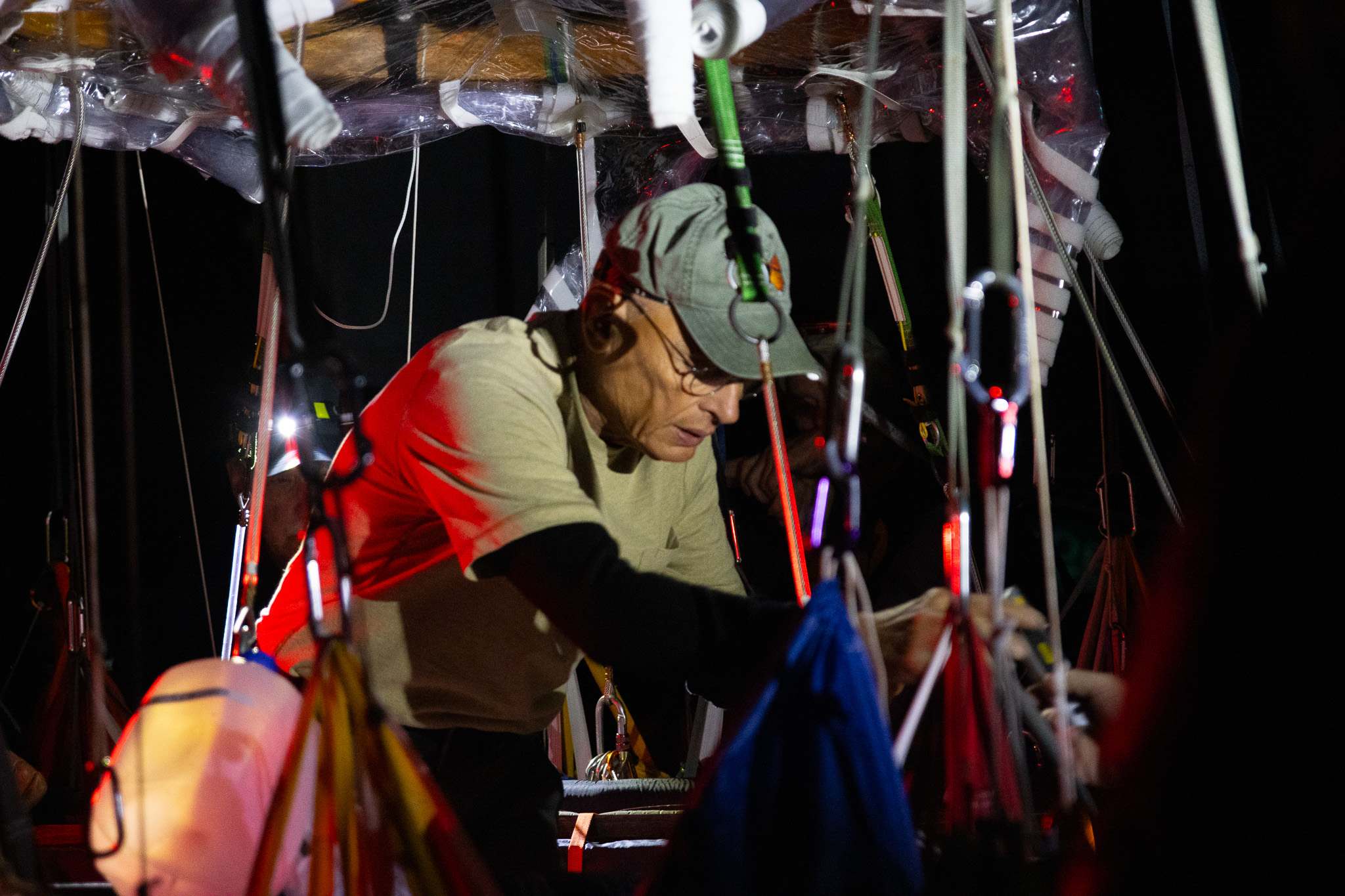
Padelt — who is from Pennsylvania — alongside fellow American Peter Cuneo and British explorer Alicia Hempleman-Adams, are now the first people to cross an ocean in a hydrogen-powered open-basket balloon, and just the 20th team ever to mount a successful trans-Atlantic balloon flight.
The trio spent more than 70 hours in the air after taking off from a Presque Isle field early June 4, traveling as fast as 90 miles an hour and as high as 25,000 feet as they navigated strong winds and a storm above the open ocean. They set down near the city of Diekirch in northeastern Luxembourg on a “very peaceful” morning, a stark contrast to the conditions they had faced earlier.
“It was almost like we were on another flight altogether,” Padelt said. “You could hear birds chirping, roosters crowing, cows mooing. You saw fog in the valleys, which was indicating calm winds. Our final hour in the air was an extremely peaceful, wonderful moment.”

The Atlantic Explorer set off from Presque Isle after hours of delays from high winds. The delay prevented the team from getting ahead of bad weather that would catch up to them later, Padelt speculated.
The first day went well, he said. All their equipment functioned perfectly and the balloon flew well. The team crossed New Brunswick, then Prince Edward Island over the first 12 hours, surpassing where the Atlantic Explorer had been forced down in its previous two attempts due to bad weather and a gas leak.
By that evening, they cleared Cape Breton Island and headed for Newfoundland, the last landmass before the open ocean. A few hours later, Padelt, Cuneo and Hempleman-Adams committed to the crossing and ventured out over the Atlantic.
Atmospheric conditions on the second day meant the team had to drop more ballast — jettisoning sand bags from the basket to gain altitude — than they wanted to.
“We basically knocked off two days of duration [of] ballast,” Padelt said. “But the saving grace is we knew that the speed was going to pick up, so we weren’t all that concerned.”
Then came the storm.
“It was a surprise,” Padelt said. “We knew the weather was there with the hopes that it was going to be south of us.”
With little more than a thin rain cover, the Atlantic Explorer battled heavy precipitation through the night. It rose into the clouds, where temperatures dropped as low as 17 degrees below zero and snow built up on top of the balloon, forcing it to sink. The snow turned to rain and then the process repeated itself.
“This continued probably for about four hours or so,” Padelt said. “But when the sun came up, it was a bright blue sky above us and [the storm] was beyond us.”
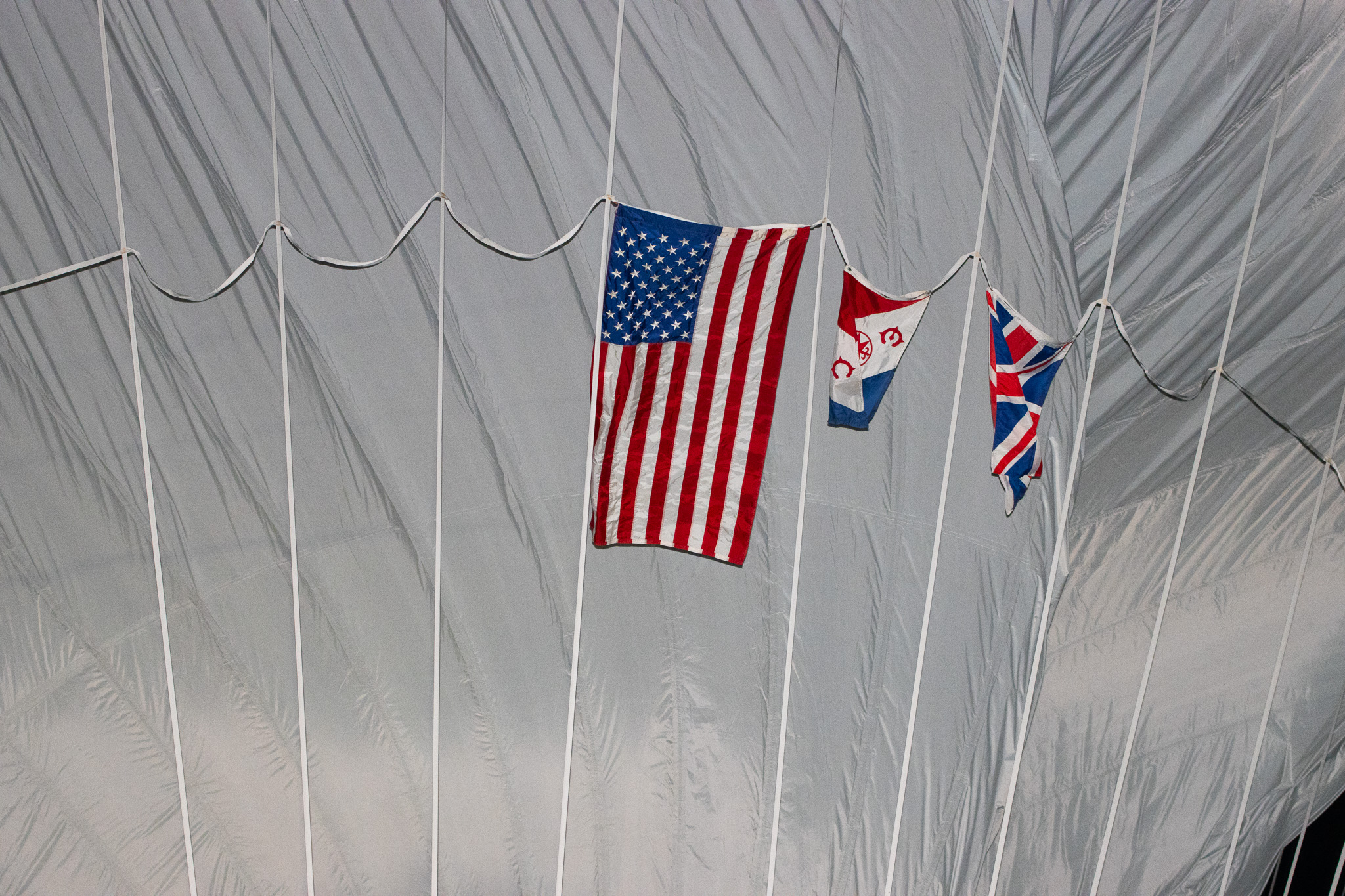
The pilots had projected a successful flight would take four to six days averaging around 35 miles per hour. But as the wind picked up and the sun beat down on the balloon the morning after the storm, the Explorer topped 90 miles per hour. The balloon crossed the open Atlantic Ocean in approximately 37 hours.
They passed over the beaches of Normandy along the French coast on the evening of June 6, the 82nd anniversary of the D-Day invasion, when the Allied forces used hydrogen powered barrage balloons to prevent German aircraft from attacking their position from a low altitude.
They flew inland overnight, crossing into Luxembourg as the sun rose on June 7, and landed in a field.
Besides being the first hydrogen-powered trans-Atlantic trip, the journey set a world distance record for the size and type of balloon. Hempleman-Adams, once the youngest person ever to visit the North Pole, also became the first woman to cross the Atlantic in a gas-powered balloon, and the second to do so in any type of balloon.
The balloon’s chase team reached the site within an hour. That group included Padelt’s wife, Joanie, with whom he built the Atlantic Explorer.
“All the times I’ve been thinking about this flight and how I wanted it to end, I wanted it to end with a stand-up landing with my wife there to see the balloon,” Padelt said. “The odds of that are very slim when you think about how far you’re flying … but as it turned out, it worked. And so when she arrived, there were some strong emotions, for sure.”

Members of the Cercle Luxembourgeois de l’Aérostation, a nearby balloon club, also arrived to help the crew deflate and pack up the balloon.
As their successful crossing drew attention, the royal family of Luxembourg invited the group to the Palais Grand-Ducal — the country’s royal palace. Padelt, Cuneo and the chase team met with the Grand Duke Henri, whom they presented with one of their final two bags of ballast from the flight.
“He was very, very interested in the flight and how it turned out,” Padelt said. “He was asking quite a few questions and so forth and went to great efforts to welcome us to Luxembourg.”
The crew headed back to the U.S. on Thursday, capping off an adventure Padelt had dreamt of since he was awed by the first trans-Atlantic balloon flight. That balloon, the Double Eagle II, launched from Presque Isle in 1978.
As the Atlantic Explorer took off from the same city last week, hidden in the canopy was a 1978 silver dollar, both a good luck charm and an homage to the Double Eagle II, as a new group of balloonists made history.
“I knew it would be hard. So there were no surprises,” Padelt said. “But the sense of reward afterwards is exactly the feeling I was looking for.”


When BDN shines a light, policymakers act. Make a gift to help our reporters keep Maine’s leaders informed. Make a donation now.
More than $200 million was spent in Maine’s U.S. Senate race in 2020, a historic figure that raised eyebrows and became a case study for advocates of campaign finance reform.
Six years later, as Democrats bank on progressive Graham Platner and Republicans look to defend five-term U.S. Sen. Susan Collins to keep hold of the Senate, that record is about to be obliterated in political advertising alone.
Overall ad spending in Maine this election cycle could reach almost $500 million, according to the latest projection from AdImpact. The amount is driven by a whopping new estimate of $384 million in the Collins-Platner race alone, making the contest the fourth-most expensive Senate race in the country behind Texas, Michigan and Georgia. The races for the 2nd Congressional District and governor could also see heavy spending.
The new estimate nearly doubles what AdImpact previously expected in Maine’s Senate race. It comes after contentious primary season spending and after Platner weathered a string of controversies in the fall and recent weeks to secure the Democratic nomination.
More than $150 million in ads through Election Day have already been booked in the race, about $100 million of it by Collins-aligned groups. But Democrats — who outspent Republicans in former Maine House Speaker Sara Gideon’s losing bid in 2020 — are sure to catch up as they push to take back Congress from President Donald Trump’s Republican Party.
“From record-setting races and surging party committee war chests to a competitive landscape that continues to expand, all indicators point to 2026 being the most expensive political advertising cycle in history,” AdImpact said in its report.
Nationwide, AdImpact expects $11.6 billion in ad spending this year, up from the 2023-2024 cycle’s record $11.2 billion. Political spending has exploded nationwide since the U.S. Supreme Court’s 2010 decision in Citizens United v Federal Election Commission.
Ads are also increasingly costly in Maine. A candidate’s 30-second spot in Portland cost an average of almost $250 in 2020, compared with $314 this year. But the rate for a 30-second ad from an issue group has nearly doubled, at almost $945 compared to $490 in 2020, according to AdImpact. Stations must give candidates priority and their lowest rates.
Month-by-month averages have fluctuated this year, but issue groups that have dominated the airwaves have seen costs rise each of the last three months, with the current average for 30 seconds of airtime almost $1,600.
Running on a message of overhauling the power structure in Washington, Platner has proven a solid fundraiser who effectively booted Gov. Janet Mills from the Senate race. Collins and her allies have offered ads touting the senator’s track record of bringing home federal investment and others targeting Platner’s background, from a Nazi-linked tattoo he’s since covered to offensive social media comments and alleged toxic behavior in past relationships.
Platner outraised Collins between January of last year and May, about $16 million to more than $12 million. Platner has almost $350,000 in ads booked from the day after he won the primary through Election Day. Platner’s bid has received a boost of almost $11 million combined in ads going after Collins from the nonprofit dark money groups Majority Forward, Unrig Our Economy and Duty and Honor.
The Collins campaign hasn’t booked nearly as many ads yet between this week and Election Day. But she has significant help from dark money political action committees such as One Nation and Pine Tree Results PAC, which have already been running ads and have booked more than $46 million million combined so far.
Pine Tree Results has seen at least $1 million in donations from the Lexington Fund-connected Republican legal activist Leonard Leo, and $2.5 million from Florida hedge fund billionaire Ken Griffin. Nearly 100 billionaires and their spouses have donated almost $10 million collectively to Collins’ network since the beginning of last year, The Maine Monitor reported.
The Winning for Women Action Fund, a super PAC boosting Republican women, has booked $16 million in pro-Collins ads. Her campaign has also received more than $538,000 from at least 315 individual donors bundled through AIPAC, the pro-Israel lobbying group.
Collins’ campaign and allies make the case that Platner will likely pick up just as much if not more super PAC and dark money donations, including from billionaires. They also say while some wealthy donors give based on ideology, many are more focused on stable government, leading them to embrace the longtime lawmaker and chair of the Senate Appropriations Committee.
Platner has rallied progressives around the argument that the money flowing into politics leads to votes that too often help donors, not working Mainers. His campaign on Friday pointed to his endorsement in May by the anti-corruption group End Citizens United, which accuses Collins of never meeting “a corporate PAC check she didn’t like.”
“We’re building a movement to get money out of politics and build a government that represents working people, not billionaires,” Platner said at the time.
American Promise, a Massachusetts-based nonprofit pressing for a constitutional amendment to empower states and Congress to regulate campaign fundraising and spending, has made progress, according to spokesperson Jenny Parker. Idaho in April became the 25th state to formally urge Congress to move on the issue.
“Fifty years of Supreme Court rulings mean voters don’t have a say over the rules,” she said. “Our solution is seeing very strong momentum, and it is across parties.”
-

 West Virginia5 minutes ago
Commentary: As Mountaineers ready for elimination game, harping on errors does no good – WV MetroNews
-

 Wyoming8 minutes ago
Old Wyoming Missile Silos Used For Train Restorations
-

 Crypto13 minutes ago
Binance Research: April DeFi Exploits Triggered $13 Billion in Outflows
-

 Finance20 minutes ago
New global framework launched to help financial firms make transition plans
-

 Fitness23 minutes ago
US Health Clubs and Studios to Offer Free Memberships for Military Recruits Under New Service Ready Program – Health & Fitness Association
-

 Movie Reviews35 minutes ago
Review | Dog Day Evening: Kafkaesque comedy reflects on a Hong Kong hostage incident
-
World43 minutes ago
Author Amy Griffin sues woman who alleged she stole her stories of sexual abuse in memoir ‘The Tell’
-

 News50 minutes ago
Video: What We Learned About Jeffrey Epstein’s Death


