Maine
Record number of breeding puffins recorded on island in Gulf of Maine


This summer, despite the long-term warming of the Gulf of Maine and a long-term increase in the severity of weather events, conditions were so uneventful that Seal Island set a record for breeding puffins. Derrick Z. Jackson/Maine Monitor
From a bird blind on Seal Island, I watched as puffins zoomed in from the sea with a rainbow of fish drooping from their beaks.
They carried copper and golden juvenile haddock, redfish and white hake. Others had pink krill from massive upwellings that created magenta blotches just offshore.
A puffin returns to Seal Island with a fresh catch. Derrick Z. Jackson/The Maine Monitor
Some even carried bright silver herring: juicy fish that were once key prey for puffins in Maine. Atlantic herring are also a prime commodity for humans, who have overfished the species so badly that the fishery in New England has routinely been shut down early in recent years.
To see a number of puffins bringing herring to chicks was a stirring reminder of what the ocean can still offer.
Seal Island, which sits 21 miles off Rockland, was once home to the largest Atlantic puffin colony in the Gulf of Maine. It is now managed by the Audubon Seabird Institute, and was the second island that Audubon’s Project Puffin restored puffins to after a century’s absence spurred by hunting in the late 1800s. The first was Eastern Egg Rock, 6 miles off Pemaquid Point.
Both islands were seeded with puffin chicks brought from Newfoundland. Puffins began breeding anew on Eastern Egg Rock in 1981 and Seal Island in 1992.
This summer, despite the long-term warming of the Gulf of Maine and a long-term increase in the severity of weather events, conditions were so uneventful that Seal Island set a record for breeding puffins.
The crew of Coco Faber, Amiel Hopkins, Liv Ridley, Reed Robinson and Nacho Gutierrez counted 672 active puffin burrows, about 100 more than the last census five years ago. The total number of known burrows surpassed 1,000 for the first time.
Other birds also did well. Razorbills, a larger cousin of the puffin, established a record of 101 active burrows.
“The weights for the puffin chicks were just so good,” said Faber, 30, the crew supervisor. “Unlike many recent years when there were big shifts or drops in what puffin parents could find, this was a summer where they steadily found fish.”
That buoyant mood was shared on Matinicus Rock, another island 23 miles from Rockland, also managed by the Seabird Institute. Crew supervisor Tracey Faber, Coco’s sister, said that not only were the puffin chicks doing well, but Arctic tern and common tern nest numbers were up.
Common murres, another bird re-established in Maine after being gone for more than 100 years, fledged a record 16 chicks.
“We saw some great growth in some birds,” Tracey Faber said.
But elsewhere there were reminders that seabird islands in the Gulf of Maine are highly vulnerable.
Earlier this month, researchers at the Gulf of Maine Seabird Working Group gathered at a conference hosted by the Seabird Institute in Bremen.
One topic was the damage caused by last winter’s violent storms, particularly on Petit Manan Island, which sits off a stretch of Downeast coastline that got hammered in January.
Island supervisor Amanda McFarland and U.S. Fish and Wildlife Service biologist Linda Welch said the vast majority of natural sod burrows under relatively small rocks and artificial nesting structures were destroyed.
The artificial structures had been built by Welch over the years to entice puffins to breed higher up on the island.
This winter’s obliteration left puffin parents competing for available space, with multiple eggs in the same burrow complex and parents trying to roll unwanted eggs out of the way – puffins hatch and raise only one chick at a time.
“There was a nest of a 30-year-old nesting pair that was shot down the shoreline 30 feet. We found burrow markers tossed all over the island,” said McFarland. “It was so ironic and sad because the food for the puffins was so good.”
The island’s puffins saw one of their lowest birth rates in recent years.
“When I saw the damage, I almost started to cry,” Welch said. “We really need to think more than ever about taking a hard look at climate resilience for seabirds.”
This story was originally published by The Maine Monitor, a nonprofit and nonpartisan news organization. To get regular coverage from the Monitor, sign up for a free Monitor newsletter here.


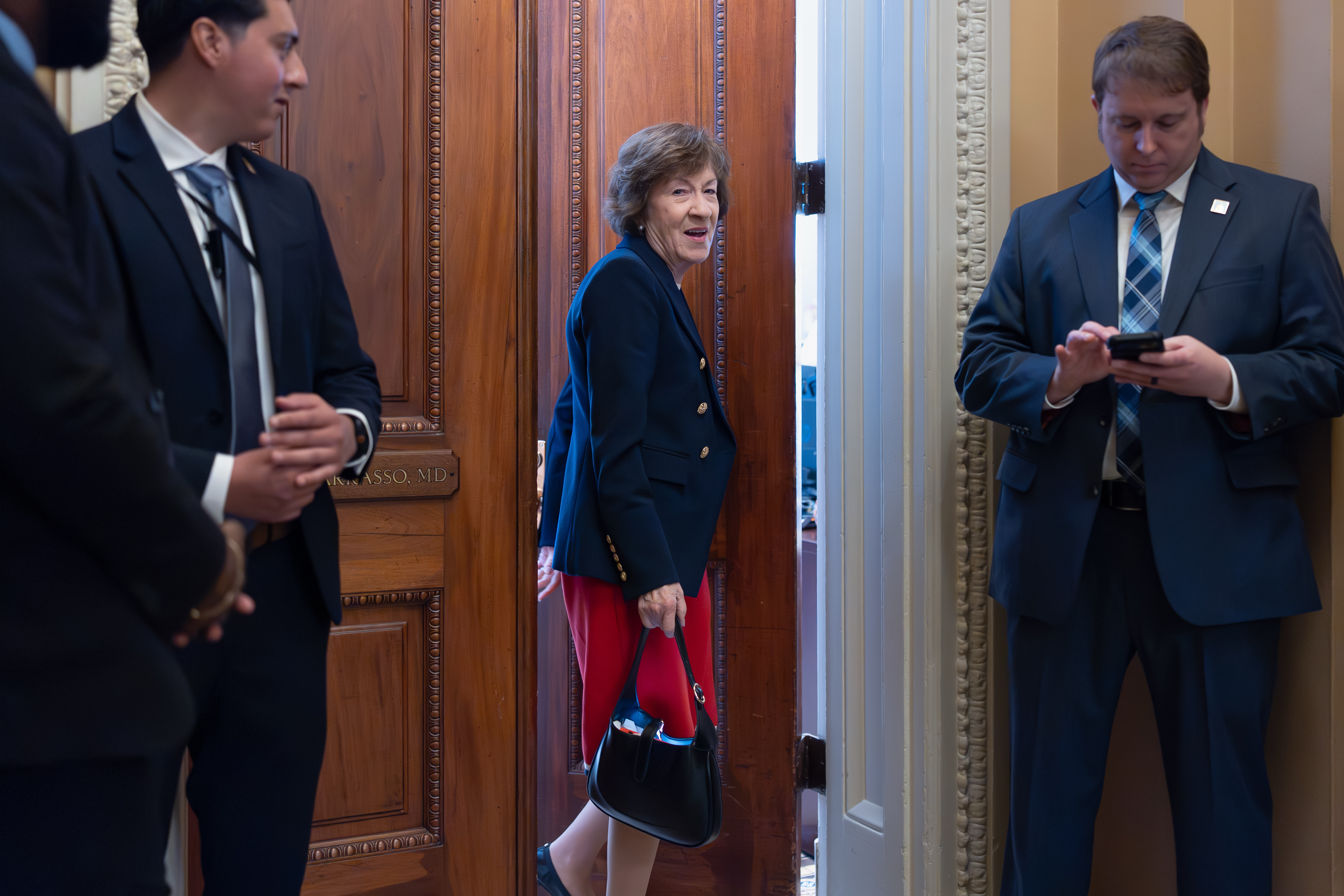
Sen. Susan Collins had just finished taking photos in front of a new fire station in the town of Sweden when a television reporter asked her about Graham Platner.
Four days earlier, on June 9, the political newcomer secured the Democratic nomination to take on Collins. Instead of addressing his victory, Collins pivoted to talk about her position on the Senate Appropriations Committee, a leadership role that in many ways is the culmination of her three decades in office.
The fire station, she said, was an example of what she has been able to do as chair “of the most powerful committee in the Senate.”
“These communities cannot, on their own, build a new fire station,” Collins said in an interview with the Portland Press Herald/Maine Sunday Telegram after the event. “They just don’t have the tax revenue.”
Maine’s top ranking Republican worked for years to get to the position of influence so she can make more fire stations like this a reality. As appropriator-in-chief, she directs earmark spending to cities, towns, hospitals, organizations and universities; influences selections for competitive grants for things like transportation infrastructure; and inserts programs and rules into congressional bills that specifically benefit Maine and its industries.
She’s running for reelection to her sixth term largely on these hard-won abilities. At every opportunity, she talks about the approximately $1.5 billion in earmarks she has brought to Maine since her last election. One of the major questions facing voters this year will be just how much that matters.
Collins’ federal earmarks since her last election have supported the construction or renovation of 45 firehouses in Maine, a Press Herald review shows, as well as 43 wastewater treatment facilities, at least 31 state road improvements, 17 childcare centers, six YMCAs and hundreds of other beneficiaries from affordable housing to historic preservation.
“The amount of funding she has secured for Maine is astonishing,” said Heideh Shahmoradi, an appropriations expert who worked for the Senate Appropriations Committee and is now a bipartisan consultant in Washington.
While all senators can bring money to their states, there is ample evidence that Collins’ success couldn’t be replicated by a freshman.
It’s attributable to more than her seniority, though. Collins has broken with the Republican Party to support programs that create pots of funding that could benefit Maine; and she’s having to defend Congress’ spending power against a Trump administration that wants to take some of it away.

But Platner argues that the money Collins has brought home has failed to address the underlying issues that have made Maine less affordable for many, which is a key motivating issue in this election.
As a senator, Platner says he would work to massively expand the country’s social safety net.
“For all of the money that Susan Collins brags about earmarking for Maine, the reason we’re still seeing housing become unaffordable, we are still seeing our healthcare system collapse, we’re still seeing our wages collapse while the price of goods and services go up,” he said at a May event in Phippsburg, “is that she never did a thing to change the structures.”
Platner’s ambitious policy talk would be difficult to achieve: Medicare for All would likely need 60 votes in the closely divided Senate to become law. Collins’ earmarks, officially known as Congressionally Directed Spending, and grant awards regularly get approved within a year.
Some voters, including people who supported Collins in the past, said in interviews that they don’t plan to vote for her this year, despite the funding she brings home.
On primary election day, outside a Sanford library that was recently expanded with a $3 million congressional earmark from Collins, Mallory Mulrath said she uses the library three or four days a week as part of her work with children.
“I love this library,” she said. “(But) I do feel like there’s more important things. The old library needed updates, but not to this extent.”
This November, Mulrath said she is voting on economic issues and does not plan to vote for Collins. She’s paying more for gas, groceries and car insurance.
“No one can afford to pay bills, let alone actually live and have fun,” she said.
PRIORITY ON APPROPRIATIONS
Earlier in her Senate tenure, Collins chaired the Homeland Security and Aging committees. She felt like she did important work, but said it became increasingly evident that, “You can pass the best legislation imaginable, but if it’s not funded by the Appropriations Committee, you can’t accomplish the goals.”
That’s one reason why she made it her focus to get on the committee.
She also noted that Maine is what she calls a “low-income state” that needs federal support, and that she could use her position to benefit the state’s defense and biomedical research industries.
Appropriators are able to go through each federal spending bill and write amendments to help their states. Collins was appointed to the committee in 2009, and in 2015 became chair of the subcommittee on transportation, housing and urban development. She was a leader of the subcommittee on defense, and became chair of the full committee in 2025.
Former staffers say Collins stands out for her attention to detail and passion for following Senate rules and that, as an appropriator, she makes sure she understands each budget request.
Shahmoradi, who was clerk and staff director of the subcommittee Collins chaired, said one of the questions Collins asked about each item in front of her was, “What are the benefits to Maine?”
Of the five senators she worked with, she said Collins was the most strategic about bringing money to her state.
One way she does that is by putting language directly into spending bills to solve a specific Maine problem or support an industry. Since the Appropriations Committee touches each obscure part of the federal government, the possibilities are vast.
For example, logging industry leader Dana Doran said Collins funded a grant program to support biomass for wood energy in 2018; and she incorporated language in appropriations bills starting in 2016 that classify wood biomass as a carbon-neutral fuel source.

Purchase this image
In another instance, starting in 2009, trucking business owner Brian Bouchard said his industry and big companies like Irving, Dead River and Poland Spring told Collins they were frustrated with a federal rule that prohibited them from driving 100,000-pound loads on interstates. It was causing safety issues on local roads, and made trucking less efficient.
Collins was able to use an appropriations bill to increase the weight limit along Maine’s section of Interstate-95.
“Senator Collins just bulldogged this thing,” said Brian Parke, president of the Maine Motor Carriers Association.
The longtime head of the construction industry group in Maine, Matt Marks, said infrastructure upgrades have been sorely needed in Maine and while he’s grateful for the entire congressional delegation, Collins in particular has become like the third leg of the stool to get any project done. (He counts the industry as one leg, and state and local governments as another.)
There is evidence that appropriators like Collins also help steer money to their states through competitive grants. For example, she was one of three members of her party who voted for the Obama-era stimulus package after the 2008 financial crisis (former Maine Sen. Olympia Snowe was another), which created a pool of money for states to compete to fund transportation projects.
The federal transportation department chose recipients for the so-called TIGER grants, but in Collins’ first campaign ad released this spring, she made clear that she had input on who got selected.
The ad shows a flash of light and rows of boats bobbing in the ocean when a breakwater collapsed in Eastport on the northeastern tip of the state in 2014. A local official in the ad thanks Collins for bringing $6 million to help restore the breakwater. According to a news release from Collins’ office sent when the rebuild was complete, the money was secured a year before the breakwater’s collapse through a TIGER grant, when it was already clear the breakwater was in bad shape.
Members of Congress routinely write letters of support for applications from their home states and try to help them get approved. Though Shahmoradi, who had previously worked at the federal transportation department and reviewed TIGER applications in years prior to the Eastport project, said there was not enough money to fund all the worthy applications.
During her time on staff, when the department needed a secondary way to choose among the high-scoring applications, it would look to politics.
“That’s the reality in making these selections,” she said.
Smaller states and projects would not have prevailed without the kind of influence members like Collins had, Shahmoradi believes. The nonprofit news outlet APM Reports came to a similar conclusion when it analyzed TIGER grantees and found that all of Maine’s 13 applications got funded.
Molly Reynolds, vice president of the centrist Brookings Institution, said that kind of power can extend across the federal government. “If you know that Sen. Collins has a lot of power in the appropriations process, you’re more likely to want to say yes to things she wants to see in other legislation.”
Collins’ office said since she joined the Appropriations Committee, she’s helped Maine win more than $1 billion in competitive transportation grants, including through a rural bridge program she helped create.
If she were voted out, said Daniel Schuman of the American Governance Institute, “You’re not going from all to nothing. You’re going from all to less.”
EARMARKS GALORE
Competitive grants gave appropriators a way to get money for their home states during a decade-long period in which Congress suspended direct earmarks. Since 2022, when Congress restarted them, senators can make an unlimited number of requests for specific projects, although members have to compete to get their requests funded.
“It truly is your seniority on the committee, your seniority in the Senate, that determines how much money you’re going to get,” Shahmoradi said.
Collins’ success in bringing money home increased as she moved her way up the committee’s ranks. In 2024, she had the most in earmarks of any member of Congress: $577 million. The only state that got more per capita was Alaska, according to the independent watchdog Citizens Against Government Waste.
Some of the requests go to tiny places, like the $1.15 million to support the fire station in Sweden, which has a population of about 450. Penobscot, Collins’ home county of Aroostook, and Washington have drawn the most funding from Collins per capita. All three lean significantly more conservative than southern parts of the state.
Maine’s most populous and most liberal county — Cumberland — has drawn 7% of Collins’ earmarks but has 22% of the state’s population. Collins said that’s in part because some places make fewer requests, and because when she’s selecting projects she considers an area’s ability to pay its own way.
At times that’s left communities off of Collins’ funding list even when their projects match the kinds of things she regularly touts. For example, Falmouth asked for funding for a new fire station this year, and South Portland is about to borrow $58 million to upgrade its wastewater infrastructure.
Both are on the request list submitted by Sen. Angus King, an independent who caucuses with Democrats, but his success rate has been much lower than Collins’: She gets nearly 100% of her requests funded, while King was at about 50% in 2024 and 26% in 2026 (though King asked for nearly twice as much funding).
“I very much value her position and what she brings to the table,” South Portland Economic Development Director Lea Duffy said of Collins. But Duffy is disappointed not to have Collins’ financial support to lessen the rate increases for residents and companies.
“We have some really important industries that happen to be located in South Portland,” she said, like technology companies she said keep the state relevant in the 21st century. They’ll see big increases in their sewer costs to pay for the upgrades.
In response to any suspicion that her selections are political, Collins pointed to several earmarks she’s directed to places that didn’t vote for her, like drinking water infrastructure in Brunswick and mental illness treatment in Rockland.
“If I made political assessments, Portland would not be getting any money,” she said. Instead, she pulled out a printed book to show where Portland has gotten funds for a food bank, teen shelter, a residential treatment center and more.
Some cities have had repeated success. Auburn has gotten an earmark from Collins each year since 2022, for a public safety center, a youth community center, a riverwalk expansion and utilities for housing. (Auburn is a politically purple city; voters supported both Collins and Democrat Joe Biden in 2020.)
VOTERS WEIGH IN
Collins hopes these community investments are persuasive in an election when the economy will drive decisionmaking, according to University of Massachusetts Lowell pollster John Cluverius. He said it’s the most important issue for the narrow slice of voters whose choices will determine the outcome of the election.
In Auburn in May, voter and retiree Mike Heon was asked about the Senate race. “Why would you want to give up Susan Collins? Are you kidding me?” he said.
If other voters disagree and replace her with a freshman senator, Mainers can expect its share of federal earmarks to drop. When Vermont Sen. Patrick Leahy left Congress, and his post as Appropriations chair, his successor brought in just 20% of Leahy’s total.
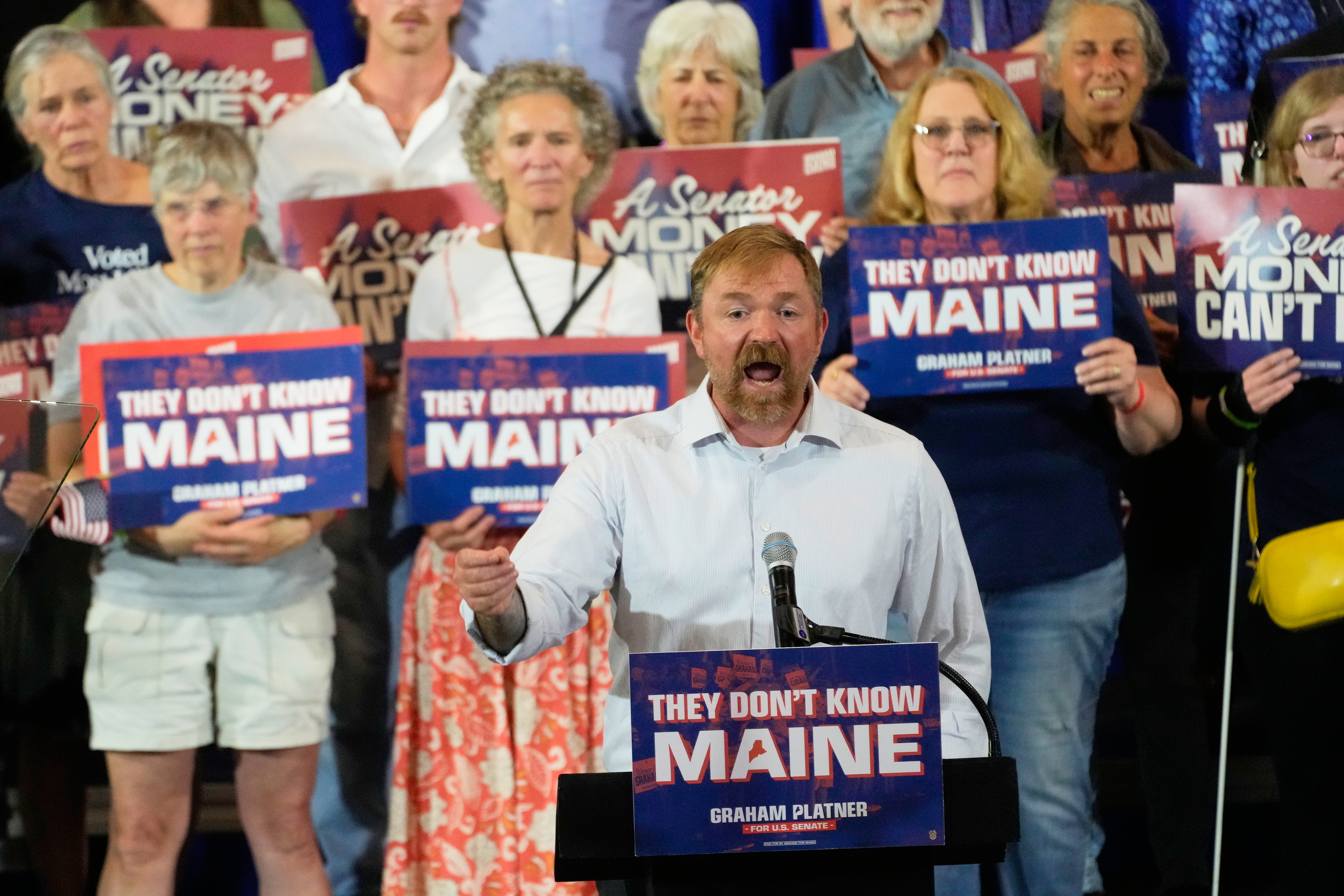
Platner said in Phippsburg that if he joins the Senate, he’ll have the time to rebuild the power she has, while also advocating for systemic changes.
Mainers could hope Platner follows in the footsteps of Georgia Sen. Jon Ossoff, who was appointed to the Appropriations Committee by party leaders just a few years into his first term.
Platner’s earmarks could differ from Collins’ ideologically, as well. Researchers at the University of Texas and the University of Illinois Chicago found liberal Democrats have used earmarks to accomplish their core policy goals, while moderate Democrats and Republicans spread them out on other issues, when they analyzed House appropriations requests from 2022.
While Maine’s members of Congress have largely used earmarks to support infrastructure, there are also some that reflect ideological priorities. Rep. Chellie Pingree’s lists include a couple of items to support clean energy and environmental sustainability, for example.
But no one, not even Collins, got earmarks in 2025, when Congress couldn’t agree on spending bills and decided to continue its prior year budget instead of passing new ones. That kind of gridlock resulted in three distinct federal shutdowns in just the last year. It makes Collins’ job much harder, and means she may not get to use all the power her position traditionally afforded, experts said.
She has also contended with a Trump administration that has tried to make big cuts to priorities she likes to fund, like the low-income energy program.
Bath resident Margaret Allen said on primary day this month that she’s voted for Collins five times before. “She’s done good things,” Allen said. But she doesn’t plan to vote for Collins again. This time around, she doesn’t care about the money Collins has brought home.
“The national issues are way more important than anything Susan Collins is going to do for fire stations,” she said.
Allen is a retired data researcher and said she worries about Social Security, America’s place in the world, the environment and what will happen when the One Big Beautiful Bill Act’s health insurance cuts take full effect.
Maine is expected to lose billions of dollars, not all of which will be replaced by a rural hospital fund Collins championed — one indication that while she has brought money home to Maine, money has also been taken away on her watch.
“I’m not OK with what the Republicans are getting away with,” Allen said.
In Sanford, voter Kevin Mulherin, who works in IT for an engineering firm, said he voted for Collins in 2020 but doesn’t plan to in November.
He said her ability to bring funding to Maine has favored some businesses and industries.
“That’s great for those people that’ll benefit, but at the end of the day I’m still working with less money,” he said.
Not all moderate voters agree. Also voting in Sanford during the primary, Bill Frederick said the cost of living matters to him quite a bit, and he doesn’t think the Trump administration is doing good things, but he plans to vote for Collins.
He said she keeps money coming to Bath Iron Works, which builds naval ships, and Pratt & Whitney in North Berwick, which manufactures aircraft engines, as well as the nearby Portsmouth Naval Shipyard.
That money could go elsewhere, Frederick said, but Collins makes sure it comes to Maine.
Coming soon: How Collins and the Trump administration are jockeying for control of the federal budget, and what it means for Maine.

VAN BUREN, Maine — Van Buren’s Acadian Village brought guests back centuries in time on Saturday as a blacksmith worked in his shop while others sewed quilts and prepared traditional French food.
It is northern Aroostook’s first large-scale immersion event. It coincides with the 50th anniversary of the Acadian Village. The village has seventeen buildings, with the oldest dating back to the 1790s, all of which are connected to early French heritage. The village is the second-largest of its kind in the United States.
The Saturday festivities cap off a “Living Acadia” (or “Acadie Vivante”) workshop that brought educators throughout the entire state together to learn about Maine’s French settlers and heritage. The workshop began Tuesday and ends on Sunday. Activities took place throughout the St. John Valley and included history lessons at the University of Maine at Fort Kent’s Acadian Archives, lectures on Acadian identity, French language lessons and cooking in a traditional outdoor bread oven.
Most of the workshop was specifically for instructors, but the Saturday immersion event was open to the general public.
Fort Fairfield French teacher Jonna Boure led the workshop’s activities. The immersion event at the Acadian was inspired by King’s Landing in Fredericton, which includes people acting out several historical roles. Boure has also worked at the Acadian Village for several years.
Boure, dressed in period clothing, said on Saturday morning after showing guests around the Roy House, the village’s oldest building, that everything was going fantastically. She also commended the work of Cindy Matthews, a Waterboro French teacher who also serves as vice president of the American Association of Teachers of French’s Maine chapter.
While Boure instigated the event, Matthews brought her prior experience with organizing institutes focused on studying Acadian history.
Matthews worked with Boure on creating the workshop. She ran the village’s post office during the event. Even the post office was tailored to accurately represent the experience of sending letters during the early days of French settlers. Guests could use hand stamps on their own postcards, and they would later be sent through the actual mail.
Some participants acted out roles based on historical figures and their heritage. Diane Michaud greeted guests in French as Evangeline, the protagonist in Henry Wadsworth Longfellow’s poem about a woman separated from her husband following the expulsion of Acadians in the 1700s. Michaud’s husband, Ron, was dressed as his ancestor Pierre Michaud, one of the first Acadians to come off the boat and settle in the Canadian village of Kamouraska.
At the blacksmith shop, Matt Grandy demonstrated how metal items were made using tools from the 19th century.
“The blacksmith was a very important person in town,” he said. “At the period of time when the Acadian Village was starting, basically everything that was metal would have come from the blacksmith shop – your door hinges, latches, the both on the inside of the odor, nails, different things in the kitchen, some of the pots and pans, and the irons in the fireplace.
The blacksmith’s shop, since nearly everyone had to go there at some point, was also a central community hub where people often met and even gossiped about what was happening in town.

“It was a good place for the exchange of information as well as the exchange of goods,” Grandy said.
People have already approached organizers about holding another event in the future, Matthews said, adding that part of the focus is emphasizing that French people, and the French language, is still alive in Maine.
“We want more people to know that there’s living French in our state, not just a historical thing that happened, but that there are still real people who speak French and that this is a place coming to and learning about,” Matthews said. “So, in terms of that, this has definitely been a success.”
The Maine Marine Patrol has launched the newest and largest patrol vessel in its fleet, the 57-foot P/V Allegiance, which will support safer and more effective offshore patrols, according to the Maine Marine Patrol, in a news release. The vessel was officially put into service on Thursday, June 11, during a christening event at Perry’s Lobster in Surry.
“Maine Marine Patrol routinely patrols commercial fishing activity offshore and hauls and inspects tens of thousands of lobster traps annually,” said Marine Patrol Colonel Matt Talbot, in the news release.
“While still capable of supporting Marine Patrol’s mission near shore, the new vessel will better position Marine Patrol to conduct offshore commercial fisheries enforcement, including the ability to safely haul and inspect large lobster trawls in federal waters,” said Colonel Talbot.
The vessel will also be used to respond to search and rescue incidents, monitor fisheries in addition to Lobster including scallop, Atlantic Herring, Menhaden, and Groundfish, and others.
The P/V Allegiance will be based in Boothbay Harbor and assigned to Marine Patrol Specialist Evan Whidden. It replaces the 29-year-old, 35-foot P/V Vigilant.
The P/V Allegiance was constructed and finished by Wesmac Custom Boats in Surry.
“This is the fifth patrol vessel built or refitted by Wesmac and we are once again very pleased with the quality of work and attention to detail by the Wesmac team,” said Colonel Talbot.
The P/V Allegiance is powered by a low-emission Tier 4 Man Diesel V-12 1450hp engine which can cruise in excess of 20 knots. It is equipped with state-of-the-art Furuno navigation electronics, and a heavy duty 17-inch hauler. It has significant deck space and an open stern which will allow Officers to safely handle and set back the larger offshore lobster trawls Marine Patrol Officers will be inspecting. The vessel is also equipped to carry a 15-foot Ribcraft Rigid Hull Inflatable boat on deck, which can be used for at-sea boardings to check vessels for compliance with marine resources laws.
-
 News5 minutes ago
Three firefighters killed on Colorado-Utah border as wildfires intensify
-

 Los Angeles, Ca1 hour ago
6 members of suspected South American burglary crew arrested by Irvine police
-

 Detroit, MI2 hours ago
Detroit Tigers seek split in home series vs Houston Astros on Sunday
-

 San Francisco, CA2 hours ago
People’s Budget Coalition Claims Victory After San Francisco Budget Restores Most Proposed Service Cuts – Davis Vanguard
-

 Dallas, TX2 hours ago
Dallas weather: June 28 morning forecast
-

 Miami, FL2 hours ago
Where to watch Miami Marlins vs St. Louis Cardinals: TV channel, start time, streaming for June 28
-

 Boston, MA2 hours ago
Police: Man killed in crash caused by wrong-way driver on I-93 in Boston – Boston News, Weather, Sports | WHDH 7News
-
Denver, CO2 hours ago
Even without extension talks, Nikola Jokic has reiterated his desire to stay long-term in Denver

