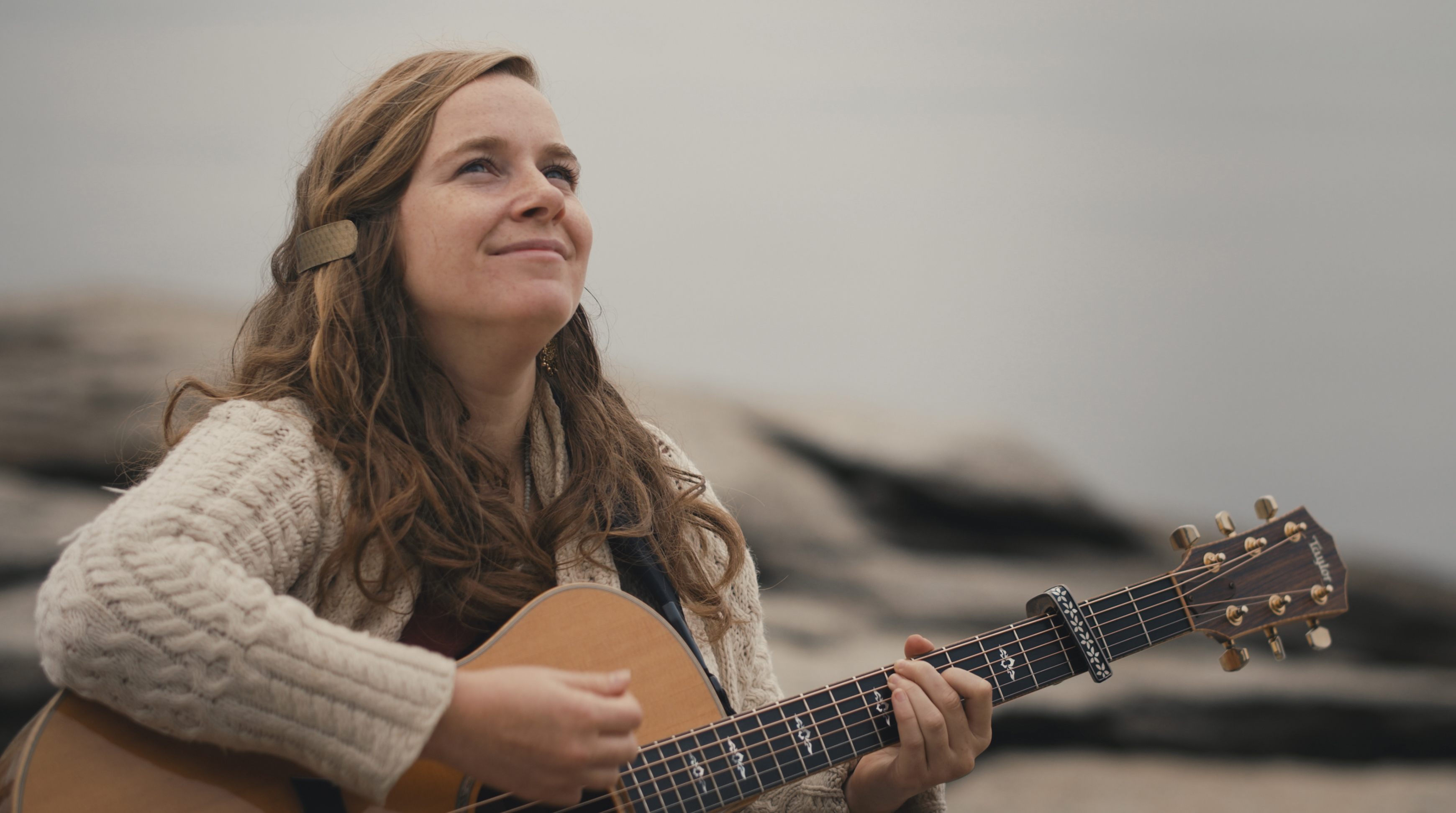
Ross Adam plays guitar (left) while performing at his CD release party at RiRa in Portland on Dec. 1. A few days later at his day job (right), he walks by a homemade sign made in his honor at a delivery stop in Portland’s Deering neighborhood. Credit: Troy R. Bennett / BDN
PORTLAND, Maine — Ross Adam is two people at once.
By day, as a gray-and-blue-clad mailman, he has trudged the same Deering neighborhood route on foot for nearly a decade. He stuffs letters through mail slots, scans bar codes, takes care with the occasional aggressive dog and deals with the weekly flood of Saturday fliers that make his satchel extra heavy.
By night, dressed in his trademark tartan trousers, Adam packs pubs and venues all over southern Maine with his brand of high-energy, multi-instrumental folk music. Adoring fans and strangers alike hoist their glasses and sing at full volume, eager to forget their troubles and revel in the tattooed, Scotland native’s relentless charm.
But late night music gigs and early post office mornings aren’t a friendly fit, and maintaining the balance is nearly impossible.
Advertisement
Increasingly, like many artists with day jobs and successful side hustles, Adam feels like he must make the difficult choice between one or the other.
Adam is a responsible father of two children with college expenses. He’s got a mortgage, a wife and a future retirement fund he’s nearly vested in.
At the same time, he recently released a popular new album and secured a music manager who is helping him get better-paying gigs. He’s about to embark on his first international mini-tour of Ireland, using vacation time.
He has the nagging feeling that at age 36, it’s now or never for becoming a full-time musician.
“You only get one life,” Adam said. “It’s so sacred. You’ve got to be able to look back and be happy with what you did with it.”
Advertisement
Ross Adam checks his postal scanning device while delivering mail in Portland’s Deering Center neighborhood on Dec. 10. Adam, who is originally from a small town in Scotland, has walked the same route for a decade. Credit: Troy R. Bennett / BDN
Growing up in the small Scottish town of Burntisland, Adam didn’t come from a musical family. He discovered music as an eight-year-old while sheltering from a rainstorm on a family camping trip inside a music store.
There, he picked out the melody to “The Skye Boat Song,” a traditional lullaby his mother sang to him, on a piano. His astonished parents soon bought him a small keyboard.
At 11, he and a friend wandered into a free bagpipe lesson. Adam stuck with it, coming back every Wednesday night, learning the pipes and life lessons from older men he recalls as being “big, tough guys.”
The band was called the Burntisland and District Pipe Band, and Adam was soon traveling, marching and competing with it, all around Scotland and England.
“When I joined that pipe band, it changed who I was,” he said. “It was my whole life. It gave me discipline.”
High school rock bands followed but, at the same time, Adam was fascinated by folk musicians who could get a crowd of distracted pub-goers all singing together. He was especially impressed by Alex Killin of the Kingdom Folk Band.
Advertisement
“He could get everyone singing — old people, young people, even the bartender,” Adam said. “I always thought it was a cool superpower.”
Ross Adam plays fiddle while performing at his CD release party at RiRa in Portland on Dec. 1. Adam is a mailman by day and a folk singer many nights and most weekends. Credit: Troy R. Bennett / BDN
Adam was soon emulating his hero, playing solo gigs and doing whatever it took to get a crowd singing. But, as a young adult, grownup realities also started to take over. He earned a social work degree, worked with at-risk youth, married an American woman, moved to South Portland and started a family.
Crossing the ocean, he left his professional musical ambitions behind. Instead of gigging, Adam got a good job at the post office with decent pay, union benefits and a retirement plan.
But a subsequent divorce and what turned into a new marriage changed all that.
Shortly before the pandemic, he went on a blind date that morphed into a bonfire party with friends. There, Adam pulled out his guitar and entertained the gathering the way he would have, in a pub back home.
“I knew I was going to marry him after about the first 10 minutes,” his blind date and now spouse, Shannon Adam, said.
Advertisement
Enamoured and encouraging, she urged Ross Adam to take his talents seriously and booked him for a St. Patrick’s Day show at a pub. The gig was a success, and his music career took off.
The crowd hoists their pints with Ross Adam while watching his performance at RiRa in Portland on Dec. 1. Credit: Troy R. Bennett / BDN
At a recent show at RiRa in Portland, it was standing room only with all eyes and ears on Adam as he commanded the room. Using special, sound-looping pedals, he played guitar, fiddle and banjo at the same time while stomping another pedal creating a drum sound — which made the crowd clap along to the beat.
At one point, wearing a wireless headset microphone, Adam left the stage and asked the rowdy crowd to be quiet while he sang them a tender song about whiskey. Almost like magic, the hushed room stayed silent as he walked among the audience like a revival preacher, singing, patting children on the head and laying his hands on shoulders.
Then, as Adam finished the a capella song, he raised his pint and released the audience with a toast. The crowd burst into whoops and applause while he remounted the stage and got the party going again with traditional Scottish and Irish songs, as well as the hip-hop classic “No Diggity.”
A few days later, on a gray, snowy morning, Adam pulled his postal van up to the sidewalk on Stevens Avenue, and he stepped out of the sliding side door. There was no applause as he started his route, mail satchel slung off one shoulder, his steaming breath hanging in the air.
A fan shouts along with one of Ross Adam’s songs while he performs at RiRa in Portland on Dec. 1. Credit: Troy R. Bennett / BDN
Adam said he genuinely likes his post office job and cherishes the connections he’s forged.
Down one side street, he found Steve Robnett, standing in his driveway. After handing Robnett his mail, the two chatted for a while. Robnett said he knew all about his mailman’s other life.
Advertisement
“We’ve actually had him play two house concerts here,” he said. “We love Ross.”
Further on, at the Rwanda Bean coffee shop, manager Alexa Kelly said Adam has always been more than just a mailman and helped her as she struggled through a messy divorce.
“He was one of my biggest rocks,” Kelly said, “I didn’t have anyone else in my life who knew what I was going through.”
To this, Adam mostly shrugs.
“You leave a trail wherever you go,” he said, “so I try to be good to people.”
Advertisement
But, as his music career blossoms and takes up more time, Adam has a decision to make. A recent bout of pneumonia exacerbated by exhaustion made it even more clear: one job or the other has to give.
Right now, he’s leaning toward full-time music. There isn’t anything which makes him feel more alive or in the moment.
“There’s nothing like it, even in a small pub. It feels incredible when people sing along. It’s almost like they’re part of the band — it’s magic,” Adam said. “I feel like I was made for this.”
The National Weather Service is predicting a scorcher for parts of western and northern Maine on Tuesday, with the possibility of thunderstorms, high winds and hail.
“The heat and humidity is going to supply energy to the atmosphere,” said meteorologist Hunter Tubbs on Monday. “That energy is going to clash with a cold front expected to come down from Canada tomorrow night. That clash has the potential to produce severe storms.”
The evening storms could bring large hail up to 2 inches in diameter and heavy thunderstorms, but severe winds are likely to cause the most damage, forecasters say. There is a low possibility oftornadoes, according to the severe weather bulletin.
The areas at most risk include Maine’s western mountains and the northern part of Maine, from its northern foothills up to the Canadian border, Tubbs said. There is some risk of severe storms in the south, but not as much, he said.
Advertisement
Heat and humidity are expected to peak Tuesday, Tubbs said, with heat indices climbing into the upper 90s in cities like Augusta, Lewiston and Waterville. The heat index temperature — or how hot it feels when combining heat and humidity — is predicted to hit 104 in Fryeburg.
The humidity will ease Wednesday, Tubbs said, but the heat will linger into Thursday with highs in the low 90s. By Thursday evening, a gradual cooling trend will emerge that is likely to last into the weekend.
Advertisement
Penny Overton is excited to be the Portland Press Herald’s first climate reporter. Since joining the paper in 2016, she has written about Maine’s lobster and cannabis industries, covered state politics…
More by Penelope Overton
The poster for “The Texas Carol.” (Courtesy of Lakewood Theater)
“THE TEXAS CAROL”
Don’t miss “The Texas Carol” set to be performed at various times July 16-25 at Lakewood Theater, 76 Theater Road in Madison.
The production by Jayme McGhan and Kevin Dean focuses on the Dinkel family as they head to Mee-Maw Jane’s East Texas ranch for what might be her last Christmas. The only problem? When the first two grandchildren arrive, they discover that Mee-Maw is already gone! Now how to keep that fact (and her body) from a family on the edge and salvage what remains of Christmas?
Starring Donna Irish, Shana Page, Will Stecher, Addie King, Caleb Landry, Quincy Morin, David Shedd and Earl Boyd.
Tickets cost $30-$52 for adults or $23 for children 4-17; lakewoodtheater.org.
Advertisement
Brothers Will and Reid Nichols, of 12/OC, performing August 2025 at Thompson’s Point in Portland. (Shawn Patrick Ouellette/Staff Photographer)
Purchase this image
12/OC
Bowl in the Pines plans to host 12/OC at 6:30 p.m. Saturday at 1 Geranium Lane in Sidney.
Born in a family kitchen in Portland, 12/OC began as a shared dream between brothers Will and Reid, 14 and 11 years old, cutting their teeth at jam sessions and open mic nights. Their sound quickly resonated beyond Maine, capturing the attention of country music fans near and far. With a chart-topping single holding the No. 1 spot on Maine’s premier country radio station for 16 consecutive weeks, their momentum became impossible to ignore.
Tickets cost $52.73-$84-61; bowlinthepines.com.
Singer-songwriter Alice Limoges. (Photo by Alex Burnett)
Alice Limoges & missofija
Stop in at The Playhouse at Waterville Station at 7 p.m. Saturday for an intimate double‑bill featuring two of Maine’s most compelling rising artists: Alice Limoges and missofija.
Limoges has been singing since before she could walk. Whether performing her award-winning poetic songs about love and nature, or shining a light on mental health, her canon is lit up by her storytelling, unique, soulful voice and textural instrumentals. She has released six original albums/EPs, toured festivals and colleges across North America, and performed on Jon Samson’s Grammy Award winning album. She placed in the 2021 International Songwriting Contest and won the 2025 Maine Songwriting Contest.
After writing her first song at 3 years old, missofija never looked back. Her unique sound is inspired by her background as an opera singer and by the folk songs of her Lithuanian upbringing. She uses profound, symbolic lyrics, intricate melodies and complex harmonic structures to send chills through every audience she performs for.
Tickets cost $20; theplayhouse.me.
Advertisement
Trombone Shorty will play Bowl in the Pines in Sidney in July. (Photo by Jean Frank)
TROMBONE SHORTY & ORLEANS AVENUE
Don’t miss the Let ‘Em Go Tour set for 6:30 p.m. Tuesday at Bowl in the Pines – Amphitheather 1 Geranium Lane, Sidney.
Perhaps the most recognizable ambassador for New Orleans music working today, Shorty has spent his entire life carrying the torch for Crescent City culture, and propelling it forward into the 21st century with his ecstatic live performances and intoxicating blend of rock, funk, soul, jazz, blues, hip-hop, and Caribbean influences.
Born Troy Andrews, Shorty made his first appearance at New Orleans’ iconic Jazz Fest at 4 years old, when he took the stage for an impromptu performance with Bo Diddley. By 6, he was heading up his own brass band, and by his early 20s, he’d released the first in a string of albums that would lead to performances everywhere from the White House and the Grammy Awards to Madison Square Garden and the 2025 Super Bowl.
Tickets cost $63-$120; bowlinthepines.com.
THE PRINCESS CONCERT
Check out The Princess Concert set for 3:30 and again at 7 p.m. Tuesday at the Waterville Opera House, 1 Common St. in Waterville.
The performance will pay tribute to the iconic, heartwarming, and nostalgic songs from films including “Frozen,” “Wicked,” “K-Pop Demon Hunters,” “Moana,” “The Wizard of Oz,” “Beauty & The Beast,” “Anastasia,” “Pocahontas,” “Aladdin,” “The Little Mermaid,” “The Lion King,” “Willy Wonka & the Chocolate Factory” and more.
Advertisement
Tickets cost $30-$67 for ages 16-plus; operahouse.org.
BLACK WOLF BAND
Waterfront Wednesday plans to host Black Wolf Band at 6 p.m. Wednesday in downtown Augusta.
The weekly Waterfront Wednesday events scheduled through Aug. 5 will feature free music, food and family fun returning to the Kennebec River.
Each week, concertgoers can bring a lawn chair or blanket and settle in for live music from local bands and DJs. There will be a food truck at every event.
For more information visit mainstreetmaine.org.
Advertisement
Looking for more? Check out theonline calendar listings for other entertainment offerings.
AUGUSTA — As part of the summer speed reduction awareness and high-visibility enforcement campaign, the Maine Bureau of Highway Safety is working in conjunction with the other New England Highway Safety Offices, in a combined effort to slow drivers down. The New England Drive to Save Lives campaign calls on all drivers to recognize speeding as an unnecessary and aggressive driving behavior that endangers all road users.
Communities across America are affected every year by fatalities that occur in speeding-related crashes. In 2024, there were 11,288 speed-related traffic fatalities, accounting for 29% of all traffic fatalities. Young drivers have a higher chance of being involved in speeding-related crashes. In 2024, 39% of male drivers and 20% of female drivers in the 15- to 20-year-old age group involved in fatal traffic crashes, speeding was a factor.
Between July 6th and the 31st, from Aroostook County to York County, more than 47 law enforcement agencies will continue to conduct high-visibility speed enforcement to save lives and reduce speeding and aggressive driving. Law enforcement will be out reminding drivers to slow down and drive with care. Drivers should plan to leave sooner to allow more time to arrive without rushing. Maine Highway Safety Director Lauren Stewart says, “The seconds that you save by speeding are not significant enough to risk your safety or that of anyone sharing the road with you. Crashes are significantly more dangerous, resulting in death or serious injury when speeding is involved. Everyone wants to arrive at their destination safely.”
From Maine to Connecticut, New England is reminding drivers to Drive to Save Lives across the region. Whether you’re vacationing in another state or having a staycation, please slow down and take your time getting to your destination this summer.
Advertisement
Chief Matt Cummings of the Fort Fairfield Police Department says, “Keeping Maine safe isn’t just a job for law enforcement; it’s a shared commitment across our entire community. When you slow down on our local roads, you aren’t just following the law; you are actively protecting your neighbors, our children, and the character of our town. Let’s work together to keep our streets safe for everyone.”
Speeding is an aggressive and deadly behavior. It reduces a driver’s ability to steer safely around another vehicle, a pedestrian, hazardous objects, or an unexpected curve. According to the U.S. Department of Transportation’s National Highway Traffic Safety Administration (NHTSA), local roads are more dangerous than highways for speeders. It’s a common misconception that speeding is an interstate-related issue: In fact, in 2024, 87% of all speeding-related traffic fatalities in the United States occurred on routes other than interstates.
“Every mile per hour matters. Speeding reduces a driver’s ability to react, increases stopping distance, and turns a preventable crash into a deadly one. As Maine’s roads become busier during the summer months, we urge drivers to slow down, stay alert and help ensure everyone arrives safely to their destinations,” says Sgt. Josh Stewart of the Kittery Police Department.
The Maine Bureau of Highway Safety is reminding drivers to Drive to Save Lives this month. Spend your time on the way to your destination, enjoying all of the beauty New England has to offer, not speeding through it. From the lighthouses across Maine’s coastline, New Hampshire’s Mount Washington, Vermont’s Moss Glen Falls, Massachusetts’s Fenway Park, a ferry ride from Point Judith in Rhode Island, to Connecticut’s Gillette Castle State Park, slow down and enjoy your drive.