Address Newsletter
Our weekly digest on buying, selling, and design, with expert advice and insider neighborhood knowledge.
Four protesters are suing Judge Beverly Cannone over a “buffer zone” that they say unlawfully keeps them too far away from the courthouse where Karen Read’s retrial on murder and other charges is underway in Massachusetts.
“Cannone has issued this order primarily to quash criticism directed at her, as…the only protests that have been documented have been the Plaintiffs in this case, who have quietly held signs criticizing Cannone,” the lawsuit alleges.
Those plaintiffs are Massachusetts residents Jason Grant, Allyson Taggart, Lisa Peterson and Samantha Lyons. Their lawsuit also names Geoffrey Noble, the state police superintendent, and Michael d’Entremont, the chief of police in Dedham, where the courthouse is located.
In their lawsuit, they are asking a federal court to declare the “buffer zone” an unconstitutional “prior restraint” on free speech and an injunction, plus legal fees.
KAREN READ JURY SELECTION: DOZENS IN POOL ALREADY HAVE AN OPINION ON THE CASE
Karen Read appears with her attorneys during the first day of jury selection in the retrial of Read at Norfolk Superior Court on Tuesday, April 1, 2025 in Dedham, Mass. (Nancy Lane/The Boston Herald via AP, Pool)
The court established a 200-foot buffer zone around the courthouse building itself and a parking lot behind the nearby Norfolk County Registry of Deeds building ahead of Read’s first trial last year.
The lawsuit takes issue with the expansion of that zone to extend to 200 feet around Bates Court, Bullard Street, Ames Street and Court Street for her second trial.
SIGN UP TO GET TRUE CRIME NEWSLETTER
A map of downtown Dedham, MA, showing the judge’s “buffer zone” around the Norfolk Superior Court building.
“Buffer zones that over-zealously prohibit all First Amendment activity are almost always unconstitutional and this one is no different,” said Mark Trammell, a lawyer for the plaintiffs and the executive director of the Center for American Liberty. “The Karen Read trial continues to inspire passionate public debate—and citizens must be allowed to protest peacefully outside their own courthouse.”
HAVE A NEWS TIP? CLICK HERE
David Gelman, a Philadelphia-area defense attorney who has been following the case, told Fox News Digital the lawsuit is likely to fail.
“The judge is not saying they can’t protest – the judge is saying they just can’t protest at the courthouse,” he said. “The reasons are legit too. It could sway a jury each day they enter and leave the building.”
GET REAL-TIME UPDATES DIRECTLY ON THE TRUE CRIME HUB
Jason Grant, a protester who has been critical of Judge Beverly Cannone, holds signs outside the Norfolk Superior Court in a photo included in his lawsuit seeking to undo a “buffer zone” around the building. (US District Court for Massachusetts)
Similar orders have been upheld around the country, he added.
“The judge is 100% within her right to do this and will prevail,” he said. “It’s the most common gripe among protesters. All speech is not free speech.”
FOLLOW THE FOX TRUE CRIME TEAM ON X
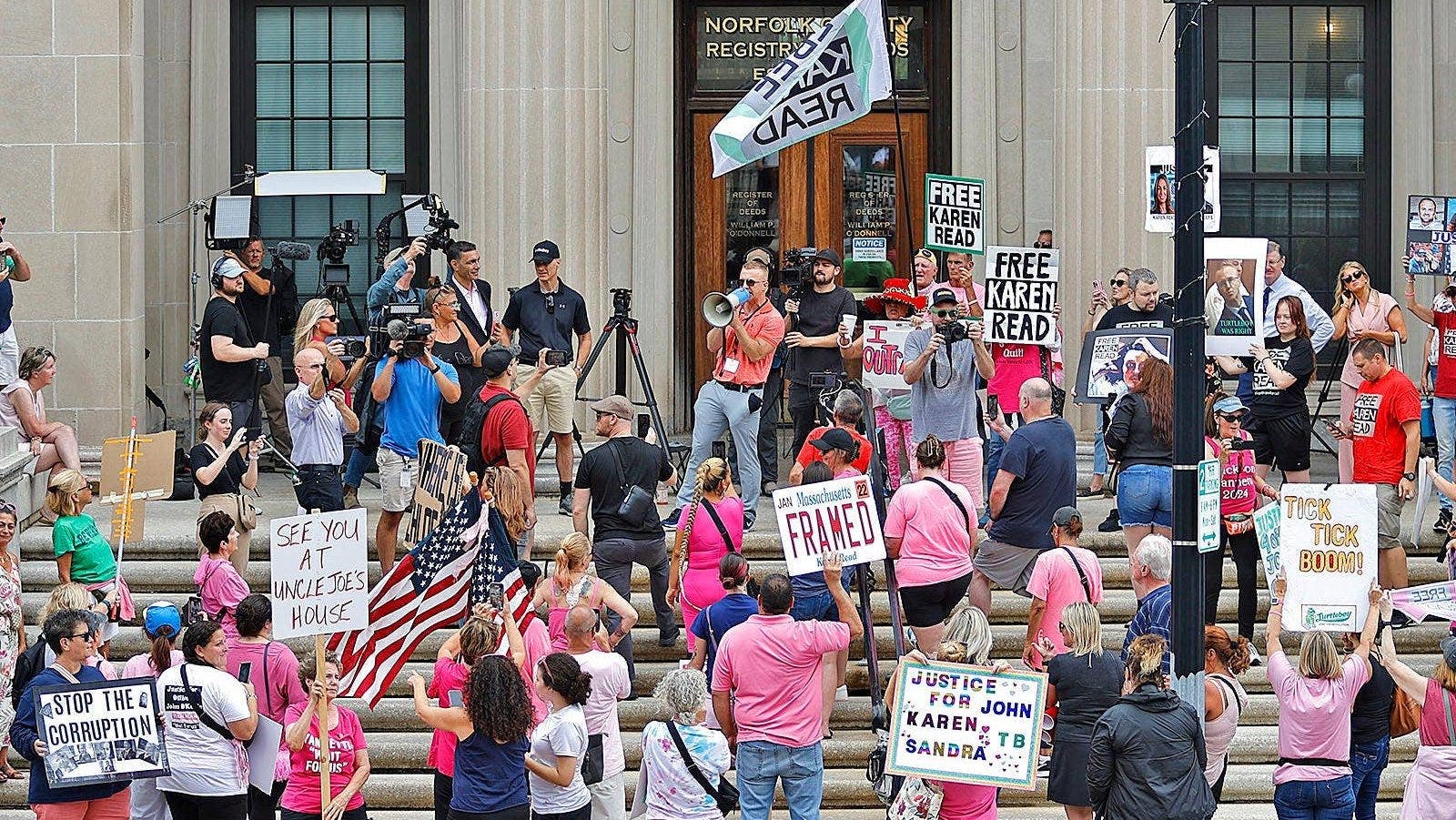
Protesters both for and against Read have been regularly attending many of her court dates since she was charged in 2022 with the murder of her Boston police officer boyfriend, John O’Keefe, 46.
GO HERE FOR FULL COVERAGE OF THE 2ND KAREN READ TRIAL
Read the lawsuit here:
A nor’easter tore through the region on the morning he was found dead – Jan. 29, 2022. An autopsy found he had died from trauma to the head and hypothermia. However, the medical examiner left the manner of death “undetermined.”
Groups both for and against a Karen Read conviction protest outside court. Blogger Aidan Kearney fires up Karen Read supporters outside a Norfolk Superior Court hearing in Dedham, Massachusetts for motions to dismiss some charges against Karen Read on Friday, Aug. 9, 2024. (Pool Images- Greg Derr USA Today Network)
The 45-year-old Read’s first trial over O’Keefe’s death ended with a hung jury last year.
Jury selection for the do-over began Tuesday. It is expected to take six to eight weeks after opening statements.
KAREN READ AND JOHN O’KEEFE: INSIDE EVOLUTION OF BOSTON MURDER MYSTERY SINCE JULY MISTRIAL
Karen Read giving John O’Keefe a kiss on the side of his head in an undated photograph. (Courtesy of Karen Read)
Read is charged with second-degree murder, manslaughter and leaving the scene of a deadly accident. She could face up to life in prison if convicted of the top charge.
Read denied the charges, pleaded not guilty and claimed that she is being framed as part of a police cover-up.
Officer John O’Keefe poses for his official headshot. O’Keefe’s girlfriend, Karen Reed, is currently on trial for a second time on murder and other charges after he was found dead outside of a Massachusetts home in January 2022. (Boston Police Department)
Cannone warned potential jurors at the start of jury selection Tuesday not to be influenced by protesters outside.
Critics of Karen Read gather outside the courthouse in Dedham, MA on Friday, June 28, 2024. Read is facing three charges, including second-degree murder of her Boston police officer boyfriend John O’Keefe in January 2022. (Patriot Pics/Backgrid for Fox News Digital)
“John Adams said that we are a government of laws, not of men, and that the law must be deaf to the clamoring of the public,” she said, referring to the Founding Father with deep Boston roots.
“He meant that while the public opinion about a given subject may ebb and flow, the law must be steady, reliable, and even-handed.”
Read the full article from Here
When activists gathered last week outside a townhouse in Brooklyn, ready to block law enforcement officers from carrying out an eviction, they were there to fight back against something larger than just one case: the nefarious practice of deed theft, which appears to be on the rise in New York City.
The protest and the ensuing arrests of several people, including the local city councilman, underscored just how fraught the topic is, particularly in historically Black areas of the city that are now rapidly gentrifying. Mayor Zohran Mamdani last week created an office dedicated to fighting deed theft.
But while the episode, in the Bedford-Stuyvesant neighborhood, reflected concerns about a very real problem, the specifics of the case involving the townhouse are anything but clear.
The office of the attorney general, Letitia James, said the case was not an example of deed theft. (When asked about that determination, Ms. James herself said, “It emanated from deed theft”; a spokesman later clarified that she had been referring to the protest and not the case.)
The fact that a woman, Carmella Charrington, was living in the home, which her father had partly owned for decades, is not in dispute. Neither are the facts that an eviction case against Ms. Charrington began nearly two years ago and that she was recently jailed in connection with a separate civil case related to custody of her father, who is 84 and a ward of the State of Georgia.
Still, comments from a number of high-profile city leaders have been confusing and contradictory. The councilman who was arrested, Chi Ossé, has said deed theft took place. So have State Senator Jabari Brisport; Brad Lander, the congressional candidate and former comptroller; and a host of others.
What is the truth? Public records reveal a sad and complicated saga involving several court cases and law enforcement agencies, and spanning generations and at least two states.
The term “deed theft” is used to describe fraudulent behavior that can result in longtime homeowners’ losing the rights to their homes. The New York State attorney general’s office received more than 500 complaints of deed theft in New York City last year, more than in the previous two years combined.
The practice can involve thieves misrepresenting themselves as brokers or lenders and tricking someone into signing documents that transfer ownership. Many thieves target older people, sowing confusion over complicated property records or exploiting their trust.
After taking control of the home, the new owner could look to sell it for a profit, rent it out at a high rate, or take out a loan against the property to buy something else.
The home at the center of the current debate, at 212 Jefferson Avenue, is a three-story brownstone that was built in 1909, according to Landmarks Preservation Commission records.
At some point in the 1980s, it was owned by two people, property records show: Allman Charrington, Ms. Charrington’s father, and Gertrude Keene, Ms. Charrington’s great-aunt.
Ms. Keene later transferred her share of the property to Clinton Morrison, her son, who in turn passed it to his children when he died.
As recently as 2024, the property was owned jointly by several Morrison children and Mr. Charrington, according to the records.
In 2020, with Mr. Charrington’s health declining, two of his daughters, including Carmella, filed a petition in probate court in Fulton County, Ga., asking for a court-appointed guardian and conservator to manage his affairs “by reason of mental disability,” according to court records. (Mr. Charrington traveled frequently between New York City and Georgia, where some of his relatives lived.)
Ms. Charrington asserted in the filings that she wanted to be the conservator, saying that her father’s wife, Karen Charrington, was not looking after his best interests. Court records indicate that Mr. Charrington’s wife had signed his property into her name and transferred thousands of dollars out of his bank account. His wife insisted that she had not acted nefariously, but she agreed to return the money and restore the deed, the records show.
Ultimately, the court appointed a lawyer, Luanne Bonnie, in 2021 to be Mr. Charrington’s conservator and to help him manage his property. The court records say that the parties agreed to Ms. Bonnie’s appointment.
Court records filed in Brooklyn show that in 2019, the Morrison family wanted to sell the Bedford-Stuyvesant home, putting them at odds with Mr. Charrington. Mr. Charrington fired back in court papers that he wanted to be reimbursed for money he had spent over the years on property taxes and maintenance. Both parties failed to show up at court dates and the case was never resolved.
But several years later, with Mr. Charrington under a conservatorship, the probate court in Georgia gave Ms. Bonnie permission to sell the property. In an October 2022 order, Judge Barbara J. Koll said that at least a dozen possible buyers had shied away in previous years because of “the legal difficulties surrounding the existing tenants of the property.” The property had been for sale since 2018, the judge said; it is unclear who listed it, given Mr. Charrington’s opposition.
Property records show that the home was sold in January 2024 to a limited liability company called 227 Group, about which not much is publicly known.
Ms. Charrington, 54, who grew up on the block — in the townhouse and another relative’s home across the street — called the sale fraudulent and unlawful.
She asserts that her father was taken advantage of, and says she brought him to New York in November 2023, without the permission of the state of Georgia, and put him into hiding. She also says that Ms. Bonnie was “unlawfully appointed” and had not followed the proper procedures before agreeing to the sale.
“I think that everything will be able to be peeled back and things will become more concrete,” Ms. Charrington said in an interview. “We want to expose them. I’ve been screaming out for two years that this is deed theft.”
But a lawyer for the Georgia Department of Human Services said in a March 2025 court filing that Ms. Charrington and other relatives had “essentially kidnapped” her father, and were “detaining him against his will.”
Ms. Charrington is still living in the townhouse. It remains unclear where Mr. Charrington is, but his daughter said he was staying with friends and relatives in the New York City area.
She recently posted a video of her father on social media, in which he says he is safe and wants to be left alone.
According to records filed with the New York Secretary of State, 227 Group is associated with the investors Simon Blitz and Daniel Gazal. Property records list one of its leaders as Andrew Kastein, who is also associated with the investment group P11 Management.
One point of intrigue is that the property records appear to show that 227 Group shares an address with another limited liability company, Brooklyn Gates. That company is linked to a group of investors known to target properties in gentrifying, historically Black and Latino neighborhoods like Bedford-Stuyvesant.
An investigation by the news website The City found that while Brooklyn Gates’s practices were largely legal, the company had ended up displacing “dozens of longtime city residents.”
Property records indicate that Brooklyn Gates had moved to buy the townhouse at 212 Jefferson Avenue from the Morrison children in 2021. Video and photographs that Ms. Charrington provided to The New York Times show a man, who Ms. Charrington said is one of the owners of Brooklyn Gates, trying to gain entrance to the property, and then leaving when Ms. Charrington threatens to call the police. The contract was later canceled, and the sale did not go through.
Through a spokesman, 227 Group denied any association with Brooklyn Gates, saying it had been made aware that the property was for sale by a lawyer for the Morrisons and Ms. Bonnie.
The company said in a statement that it had never interacted directly with the Morrison family or with Ms. Bonnie. It also said it does not share an address with Brooklyn Gates, and that the fact that the property records show the same address for both entities stemmed from a filing error.
“We are weighing our legal options against those who are spreading the false and malicious ‘deed theft’ narrative,” the statement reads.
The company said Ms. Charrington had continued “to illegally occupy the property rent-free for over two years” and had prevented representatives of the company from gaining access to it.
Before the protest, neighbors and activists had been keeping watch outside the home for months in case officers showed up to evict Ms. Charrington. But the conflict last week involving Mr. Ossé, who said he sustained a concussion after officers wrestled him to the ground for blocking the gate, put a public spotlight on her story.
The announcement of the city’s new office to fight deed theft — though it was already planned when the protest took place — also fueled interest in the case.
And Mr. Ossé has continued to publicly push Gov. Kathy Hochul to issue a moratorium on evictions in cases where deed theft is suspected.
“The community has come together in a way that shows that they are scared,” said William McFadden, Ms. Charrington’s son, who also lives at the Bedford-Stuyvesant house. “How did so much deed theft happen under our noses?”
Home Buying
Mortgage payments in Greater Boston still rank among the highest in the nation. But a shift has taken place. No longer are prospective buyers getting caught up in the frenzy of bidding wars and stretching their purchase price and mortgage payment to the maximum they can afford. Instead, real estate professionals say that buyers are taking a more cautious approach today, thinking twice about what they’re willing to pay.
According to data recently released by LendingTree, the average mortgage payment on home purchases fell 2.4 percent in 2025, from $1,990 in 2024 to $1,942 per month (for principal and interest only). Still, home affordability remains a challenge: LendingTree reported that one in 10 borrowers are significantly cost-burdened, with 10.2 percent of borrowers nationwide spending 40 percent or more of their income on new mortgage payments.
According to the data, Greater Boston ranked seventh for metros with the highest average new mortgage payments in 2025. The average mortgage payment in the area was $2,784 a month, and 31.4 percent of borrowers spent at least 30 percent of their income on their mortgage payment.
Of course, if you add the other costs that get rolled into mortgage payments — property taxes, home insurance, and private mortgage insurance — that monthly housing cost goes up even higher, and that doesn’t even include utilities and homeowners association fees. While LendingTree couldn’t provide a total monthly housing cost for the Boston metro, WalletHub recently released data on the states where people spend the most and least for housing, and Massachusetts ranked third on that list, with average homeowners there paying about 34 percent of their income on housing costs, second only to Hawaii and California.
“Boston’s core issue is simple: too many people are chasing too few homes,” said Matt Schulz, LendingTree’s chief consumer finance analyst. “The area has struggled with housing supply for years, and that is unlikely to change anytime soon.”
The good news is that despite the price pressure and challenge of bidding wars, local experts say that buyers today are not stretching their budgets just to get into a home and then find that they became cash-poor in the process.
“People today are a little more strategic,” said Melvin A. Vieira Jr., a real estate agent with Re/Max Real Estate Center in Boston. “Buyers are more educated, and they’ve heard about the bidding wars of the past, so they’re making reasonable decisions rather than emotional ones.”
Consider Sarah, 36, and Mike McCracken, 38. When they were searching for their first home, they were approved for a $900,000 mortgage and could have easily afforded the four-bedroom, three-bath Colonial in Sudbury that they fell in love with. But Sarah was nervous about owing more than $650,000. So, they expanded their search and found a smaller Cape Cod-style home in Walpole, which they purchased for $575,000.
“We could have made the numbers work with the original house,” said Sarah, who has since become a real estate agent for Coldwell Banker. “But being more conservative and making a decision that made sense for the present, rather than a hypothetical future, allowed us to have a smaller mortgage payment and keep other costs lower so we could travel when we want to and were able to do a renovation when we needed to. Giving ourselves the flexibility to make decisions as they came up because we hadn’t locked in that higher payment was the best decision.”
Our weekly digest on buying, selling, and design, with expert advice and insider neighborhood knowledge.
“Nothing happens only when it happens,” writes Ross Gay in “Be Holding,” his acclaimed book-length 2021 poem that spins a single iconic basketball move from 1980 into a passionate meditation on togetherness, care and Black life in America.
Now the live performance built around the poem, which premiered in 2023, in Philadelphia, is itself happening again as part of the 59th Carnegie International.
The remounted show features two performers reciting the poem, inspired by Hall of Famer Julius “Dr. J” Erving’s famous “baseline scoop” basket in Game 4 of the 1980 NBA finals, with live music and a small troupe of student performers. It gets two performances on the International’s opening weekend, Sat., May 2, and Sun., May 3, at the Hill District’s Thelma Lovette YMCA. (The May 2 show is sold out.)
The International, Pittsburgh’s largest showcase of international art, features work by some 60 artists and collectives. Opening weekend includes a number of performances and special events at the museum and other satellite locations.
The Carnegie’s Ryan Inouye says he and his fellow International co-curators commissioned the new version of “Be Holding” after seeing the 2023 premiere production.
“We were just floored by it,” Inouye said. He said the show’s blend of poetry, new music and theater with community performers in a community space expressed the themes of collective effort suggested in the International’s title, “if the word we.”
“This is really emblematic of what we are trying to build within the exhibition,” he said.
Gay is known for works like his best-selling 2019 collection “The Book of Delights.” He’s a basketball player and fan who grew up near Philadelphia, but was just 5 when the 76ers’ Dr. J seemed to defy gravity in a baseline drive against Kareem Abdul-Jabbar’s Los Angeles Lakers that ended in a reverse layup.
As Gay describes the move, Erving left his feet on the baseline and, finding his path to a straightforward dunk blocked by a Lakers defender, “simply decided, in the air, to knock on other doors by soaring more.”
Bill O’Driscoll
/
90.5 WESA
“Have you ever decided anything … anything … in the air?” Gay asks in the poem.
Gay studied the play obsessively on YouTube, and produced a poem that marries an anatomy of that moment to thoughts about the Middle Passage, Black flight, music and more. “Ross Gay takes one fluid human gesture and through it expands the lungs of personal and communal history so they might hold all joy, terror, and violence of this world,” wrote the American poet and editor Gabrielle Calvocoressi.
Before he’d even finished writing “Be Holding,” his friend Brooke O’Hara, a theater artist, convinced him it should also be the basis for a live performance.
“It is a beautiful poem about Black flight and Black genius, and it definitely addresses how we look at each other and how we engage each other through the point of holding and caring for and embracing each other, and through joy,” O’Harra said. “There are moments when [Gay] kind of analyzes a kind of looking that is about violence and pain, but always is turning back to how do we look with joy, and how do we look at Black images, and understand and experience the Black experience as one of genius and flight and joy.”
The show was created in collaboration with Pulitzer Prize-winning composer Tyshawn Sorey and New York-based new-music quartet Yarn/Wire.
O’Harra developed choreography for the original show with a small ensemble of high-school students and the Philadelphia-based poets and performers David Gaines and Yolanda Wisher, who performed the text in the premiere production, at Philadelphia’s Girard College.
“Be holding is a Black epic poem, which we don’t really see many of them. A 90-page poem about a five second YouTube clip,” said Gaines. “And Black in a way that it is still human that anyone can get anything from the piece.”
Gaines again takes a lead role in the Pittsburgh production, this time joined by Gay himself. Yarn/Wire will perform the partly improvised score on two grand pianos and a pair of large percussion ensembles including drums, chimes and gongs. And a group of performers from Pittsburgh-area high schools worked with O’Harra to develop their version of the show.
“We are just letting them embody these moves and see what it looks like on stage or with the music,” said O’Harra during a Sunday rehearsal this past February, in Downtown’s Trust Arts Education Center.
The general idea is to turn basketball moves into dance moves, to the tune of composer Sorley’s atmospheric score.
“I like the basketball aspect,” said Isaac Walker, a Mt. Lebanon High School sophomore who’s in the show. “I’m not on a team, but I would say I’m pretty good. And it was an interesting opportunity.”
As Gay learned after publishing “Be Holding,” few young folks recall Dr. J, who retired from the NBA in 1987, let alone his iconic baseline move against the Lakers. (In 1980, Michael Jordan was still in high school and LeBron James was not yet born.)
“I would say it’s about Ross’ like point of view in life, like with basketball and without, like his experiences in just being Black in America,” Walker said.
“Be Holding” performer Gigi Dutrieuille, a City High student and aspiring actor, said in February she hadn’t yet read Gay’s entire poem. “I got through like half of it, low-key, and left it in my bedroom for the time being,” she said.
Because all the show’s adult performers are based in other cities (O’Harra in Philadelphia), rehearsals were confined to one weekend in February and the week before the show. This past Monday, students met O’Harra in the Thelma Lovette gym to finalize the choreography.
Courtesy of Brooke O’Harra
Despite challenges like getting transportation to the venue for the late-afternoon-into-evening rehearsals, and finding time to complete homework, the young performers remained enthused about the project, doing movement exercises and passing basketballs as a way of establishing communication.
The Y’s gym was closed for several days for the load-in, on-site rehearsals and this weekend’s performance. The court sat outlined with audio, video and power cables, with a monitors facing out to the low bleachers where the audience will sit, and a screen for projected video suspended above the floor at half-court.
David Gaines, who’d performed “Be Holding” in the gym of Girard College, said the venue remains apt.
“I love being in a gym space because this poem is clearly about practicality, it is about togetherness, it is about community and it’s about basketball!” he said. “And so to be able to do a piece like this in a grounded setting, reflects really all the values that the poem is about.”
US adds Vietnam and EU, removes Argentina, Mexico from trade investigation watchlists
Jury Convicts Florida Ex-Rep. David Rivera in Conspiracy Trial
Authorities Release Video of Gunman in White House Correspondents’ Dinner Attack
Stocks and Oil Prices Sent Conflicting Signals in April Amid Havoc of Iran War
The Vaccine Skeptic in Trump’s New C.D.C. Leadership Team
Top Psychiatrists Call for a Greater Focus on Ceasing Medication
Book Review: ‘Chernobyl, Life, and Other Disasters,’ by Yevgenia Nayberg
When Does a Shoe Stop Being a Shoe?