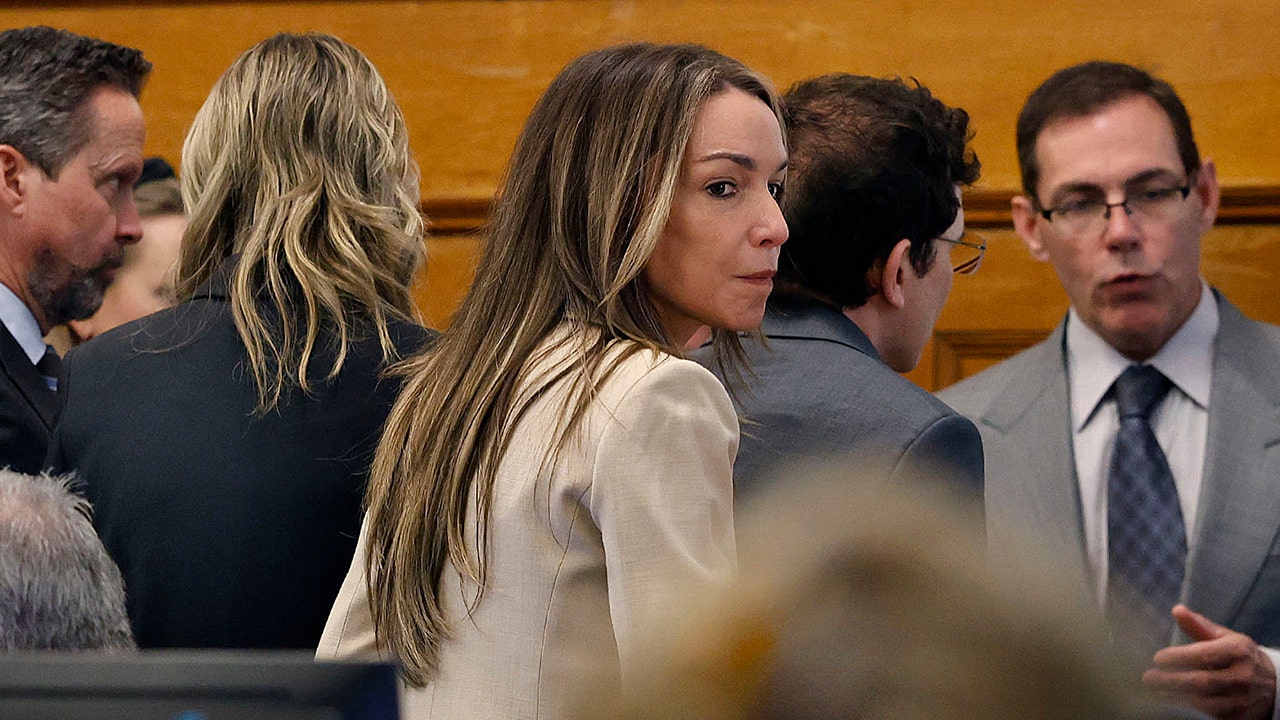
Karen Read’s defense team looked to chip away at a crash expert’s credibility by pointing to eye-watering expenditures and alleged inconsistencies in experiments as the state enters the 11th hour of testimony in their case.
Read is accused of killing her then-boyfriend, Boston police officer John O’Keefe, by striking him with her Lexus SUV outside a house party at 34 Fairview Road and leaving him to die in frigid temperatures shortly after midnight on Jan. 29, 2022.
The state’s expected final witness, Dr. Judson Welcher, a crash reconstructionist with Texas-based Aperture LLC, held firm on his findings that Read’s vehicle allegedly struck O’Keefe.
KAREN READ’S SUV REACHED ‘74% THROTTLE’ MOMENTS BEFORE JOHN O’KEEFE’S FINAL MOVEMENTS, CRASH EXPERT TESTIFIES
Advertisement
Karen Read listens to the cross-examination by Robert Alessi of expert accident witness Dr. Judson Welcher during her retrial at Norfolk Superior Court, Wednesday, May 28, 2025, in Dedham, Massachusetts.(Greg Derr/The Patriot Ledger via AP, Pool)
“[O’Keefe’s injuries are] consistent with being struck by a Lexus and also contacting a hard surface, such as frozen ground,” Welcher told special prosecutor Hank Brennan.
In a sometimes-evasive line of cross-examination, Welcher often provided non-answers to defense attorney Robert Alessi’s questions surrounding his modifications to a PowerPoint presentation used in Read’s trial to depict Aperture’s investigation.
“Assume the trial started approximately April 22, 2025,” Alessi said. “Did you create your updated presentation before or after [it began]?”
“I don’t know,” Welcher replied.
Advertisement
KAREN READ TRIAL WITNESS FACES BRUTAL CROSS-EXAMINATION OVER VEHICLE DATA
Dr. Judson Welcher, an accident reconstruction expert, speaks on the witness stand during the Karen Read retrial, Wednesday, May 28, 2025, in Dedham, Massachusetts.(Greg Derr/The Patriot Ledger via AP, Pool)
Alessi looked to nail down a timeline of when Welcher may have made changes to the document and whether the prosecution communicated with him regarding the alterations.
Welcher eventually relented before testifying that he altered the presentation for the first time on May 13, with the most recent change occurring “like, 10 minutes ago.”
“Half of that was in response to objections from the defense,” Welcher said. “I had to add all the parts to where everything was. Then, when I got out here, Mr. Brennan asked me to take out references to evidence about statements that I was not allowed to present. So that would have been within the last three days. Then I’ve modified it a couple of times today based on rulings from the judge.”
Advertisement
BRAIN SURGEON TESTIFIES JOHN O’KEEFE DIED FROM FALL ON FROZEN GROUND IN KAREN READ TRIAL
Read lawyer Robert Alessi cross-examines Dr. Judson Welcher during the Karen Read retrial, Wednesday May 28, 2025.(Greg Derr/The Patriot Ledger via AP, Pool)
However, Welcher testified on cross-examination that the amendments he made to the presentation did not alter the overall document.
“I changed one slide,” Welcher said. “There were 130 slides originally, or something like that. So half of the changes [were] on that day, which was one slide. I added one line to the bottom of the previous slide.”
“Well then, why did you make it in the middle of trial if it wasn’t significant?” Alessi asked. “Why didn’t you just leave it off and then discuss it in terms of testimony?”
Advertisement
EXPERT WITNESS IN KAREN READ MURDER TRIAL CAUGHT WITH ‘ERRORS’ INFLATING HIS CREDENTIALS
Karen Read, who works with her defense lawyers, attends a “side bar” conference with the prosecution and Judge Beverly Cannone at Norfolk Superior Court, Wednesday, May 28, 2025.(Greg Derr/The Patriot Ledger via AP, Pool)
“So it ultimately was left off because it was insignificant, and I didn’t need to have it,” Welcher said. “The way it got presented was exactly the way it was before May 13. So it didn’t change anything.”
On cross-examination, Welcher revealed the district attorney’s office previously agreed to pay Aperture at least $325,000 for the firm’s services, along with covering the cost of the Lexus SUV used in testing.
“We’re keeping [the vehicle] until the trial’s over,” Welcher said. “[Then] we’re selling it and charging the commonwealth the difference in the price exactly.”
Advertisement
KAREN READ SCORES MAJOR WIN AS JUDGE ALLOWS CRASH RECONSTRUCTION TESTIMONY
Images presented of an accident reconstruction test by Dr. Judson Welcher show impact via paint transfer from an SUV similar to Karen Read’s to a human subject at Norfolk Superior Court, Wednesday, May 28, 2025.(Greg Derr/The Patriot Ledger via AP, Pool)
Aperture has been paid $44,510 for its services to date, with the state expected to pay upwards of $400,000 for around eight months of work, according to Alessi.
“Dr. Welcher was perfect on direction, but only a B- on cross-examination,” retired Massachusetts Superior Court Judge and Boston College law professor Jack Lu told Fox News Digital. “He is not answering the questions from Mr. Alessi directly. He may not be intentionally being evasive, but he’s no longer a near-perfect example of how an expert witness should testify.”
O’Keefe’s arm injuries were concurrent with being struck by the make and model of Read’s vehicle, Welcher testified on direct examination. The crash expert pointed to a video showing him painting the taillight of the car before brushing up against it to mimic a collision.
Prosecutor Hank Brennan questions Dr. Judson Welcher during the Karen Read retrial, Wednesday, May 28, 2025.(Greg Derr/The Patriot Ledger via AP, Pool)
Alessi looked to create doubt surrounding Welcher’s findings, grilling the biomechanical engineer on the methodology behind his experiment surrounding the cause of the injury to O’Keefe’s eye.
“I’m trying to make it clear,” Welcher said. “We don’t know his exact body position at the point of impact, nor do we know the exact position on the ground. Which is part of the reason why I haven’t tried to exactly simulate this, because we don’t have enough parameters to do that. So I don’t have that information. I’m showing the geometry relative to someone of Mr. O’Keefe’s height.”
“So you don’t have the information to do that properly,” Alessi said. “So therefore, you can’t preclude that he had a laceration to the eye from the spoiler by your own answer that you just gave, correct?”
Advertisement
Welcher doubled down on his investigation, asserting on the stand that Aperture’s experiment was correct based on the information the firm had at the time, despite Alessi revealing the vehicle in Welcher’s test was moving only two miles per hour — significantly less than the speed of Read’s vehicle.
SIGN UP TO GET TRUE-CRIME NEWSLETTER
“Would you agree that you did a blue paint test with the vehicle going at two miles per hour?” Alessi asked.
“Of course,” Welcher said.
“You didn’t do a blue paint test with the vehicle going at 20 miles per hour, correct?” Alessi said.
Advertisement
“That is correct,” Welcher said. “I was not going to hit myself with the Lexus at 20 miles an hour.”
Wednesday marked the second day of testimony from Welcher, as the state is expected to rest its case this week.
Read pleaded not guilty and is facing the possibility of life in prison if convicted of the top charge, second-degree murder.
“The model being followed here is very good and professional,” Lu said. “What you have here is a very nice judge meets a very nice lawyer,” adding, “This results in a looser, less-focused cross-examination. It’s working out fine here, partially because the witness is not being super evasive.”
Advertisement
Julia Bonavita is a U.S. Writer for Fox News Digital and a Fox Flight Team drone pilot. You can follow her at @juliabonavita13 on all platforms and send story tips to julia.bonavita@fox.com.

The 12-year-old boy from Allagash was excited to go with his father to the picket line.
It was 1981, and local loggers on strike were hoping to talk with Jim Irving of the massive Irving conglomerate in Canada and Maine. Times were changing, and they were worried about mechanical harvesting cutting into their paychecks.
The boy noticed the northern Maine loggers were laughing and joking. Then, Irving drove up, got out of his vehicle and delivered an ultimatum: go back to work at your current wages, or else I’m going to replace you with Canadians in the morning. The lighthearted banter between the loggers quickly turned into yelling, screaming and swearing.
It scared the boy. His father, along with most of the other loggers, would end up accepting the status quo and returning to work.
Advertisement
Decades later, the boy named Troy Jackson recounted that memory. He realized how his father, Joe, must have been feeling.
“He couldn’t say anything,” Jackson told a reporter on a recent weekday before meeting with electricians at their union building in Lewiston. “You lose your sense of pride, your sense of dignity.”
That feeling stuck with Jackson as he grew up to be a logger himself, then a state lawmaker.
What his father lost that day informs Jackson’s drive to be Maine’s next governor.
Jackson, now 57, has the life story and experience to make him a serious candidate for statewide office, but making it to November is not guaranteed. This year’s gubernatorial field vying to succeed term-limited Gov. Janet Mills is crowded and wide open. Some polls have put Jackson as high as second or as low as fifth in the five-person Democratic primary.
Advertisement
But he feels his roots in northern Maine and record of winning election after election in a pro-Trump part of the state as a progressive make him stand out. So does his past, his waking up at 2 a.m. for 18-hour days as a logger; his protests to try to improve conditions for him and lower-income workers.
“That wealth inequality and that power differential is something I’ve had to deal with my whole life,” Jackson said. “And that is what has probably shaped me more than anything.”
HISTORY REPEATS ITSELF
Troy Dale Jackson was born June 26, 1968, to a 16-year-old mother, Colleen McBreairty, in a Catholic family in Maine’s St. John Valley. Jackson’s father and mother got married young and “separated so many damn times” throughout Jackson’s childhood, he remembered. They officially divorced around the time Jackson was in middle school.
He attended the later-shuttered Allagash Consolidated School, playing any sports the tiny high school offered, and shot pool with his dad in his spare time. He later earned an associate’s degree in business from the University of Maine at Fort Kent.
His logger father and teacher mother didn’t want their son to go into logging, but he couldn’t stay out of the woods. (“I missed a lot of school,” Jackson said with a chuckle.) He rode in his father’s logging truck as a kid before starting as a logger himself at age 19.
Advertisement
In 1998, about a decade later, Jackson helped lead a weeklong blockade along the Quebec border to try to keep out the Canadian loggers their American counterparts felt were driving down pay rates. Jackson and his peers mostly blamed large American landowners for favoring the Canadian contractors. It felt like his dad’s experiences were repeating themselves.
Troy Jackson, then 6 years old, is pictured with his mom, Colleen McBreairty, on Christmas morning 1974. (Provided by Troy Jackson)
There were 90 loggers on the Maine side who were supposed to help, but only 15 showed up to block the Canadians from driving across three border checkpoints during the week, Jackson recalled.
By Friday, officials whom Jackson and his fellow loggers felt had to that point ignored them — including Republican Sens. Olympia Snowe and Susan Collins, and Democratic Rep. John Baldacci, asked the loggers to meet with them in Fort Kent.
The meeting was meant to calm tensions. Jackson called it “bullshit.” Negotiations went nowhere. After the loggers tried to continue the blockade the following Monday, it ended with them being banned from that land.
“That was government basically just telling everyone that (we’re) just scumbags,” Jackson said in his trademark St. John Valley accent.
Advertisement
Additional labor actions happened in Augusta the following year, but all those protests brought little change from policymakers, so Jackson ran for the Legislature as a Republican in 2000. Jackson said he had “no concept of parties” but he knew the Bush family had ties to Maine and respected that, so that’s why he started in the GOP.
He lost the rural Maine House of Representatives race for the district that was still heavily blue at the time to the Democratic incumbent, Rep. Marc Michaud. In 2002, he tried again as an independent and beat Michaud.
Jackson switched to the Democratic Party before his 2004 reelection, feeling aligned with lawmakers in that party who pushed to allow independent logging and trucking contractors to collectively bargain with landowners.
He has stuck with the party ever since, while Aroostook County shifted right and backed President Donald Trump in his three presidential elections.
He rose to the Maine Senate in 2008 and beat Republican opponents over the years in the northern part of the state that increasingly turned red. In 2018, he became Senate president. Except for losing an Allagash Select Board race by six votes in 2023, Jackson has a near-spotless record running as a progressive in Trump country.
Advertisement
“It doesn’t matter if you’re progressive or not. People will elect you if they think that you’re fighting for them,” Jackson said. “And they know I have been.”
RUNNING TO THE LEFT
Jackson, who is endorsed by U.S. Sen. Bernie Sanders of Vermont and an array of labor unions, is running for governor on his populist legislative accomplishments.
He was behind a childcare overhaul in 2023 that expanded childcare subsidy eligibility to families making 125% of the state’s median income and that doubled the average monthly stipend for childcare workers, among other changes. As governor, he says he’d push to make childcare free for that income group — about $145,000 for a family of four. It would cost about $350 million per year.
He touts a 2018 bill requiring brand-name prescription drug companies to make their drugs available in Maine to generic producers, which became law without former Republican Gov. Paul LePage’s signature. And Jackson points to a measure he sponsored in 2019 to create a prescription drug affordability board, allow the wholesale importation of prescriptions and make other reforms. Mills signed that one into law.
Perhaps more than any other candidate, he is running against his Democratic predecessor’s legacy. He frequently butted heads with Mills, bashing her for vetoing his 2021 effort to ban drugmakers from enacting “excessive” price increases to certain prescriptions.
Advertisement
Though Mills approved a 2% tax on incomes above $1 million in her final state budget after previously opposing it, Jackson said the millionaire’s tax doesn’t go far enough. He would bump it up to a 4% surtax as governor and repeal LePage’s income tax cuts that lowered the top rate from 8.5% to 7.15%.
“The wealthy elite … are going to be fine,” while working-class residents have been “getting the shaft,” Jackson said earlier in April.
“(Working-class residents) are the people that I worry about,” Jackson said. “That’s my special interest group that I’m going to fight for.”
He wants to double Maine’s Earned Income Tax Credit to nearly $3,500 for families with three or more kids. (Jackson himself has a partner and two adult sons.) He says he would create a Department of Housing Affordability and consider surcharges on homes worth more than $1 million. And he would implement his long-sought “Buy American, Build Maine” effort that echoes Trumpian rhetoric by requiring state contracts to use domestic goods and give preference to products made in the state.
His views have evolved over time on certain issues. For example, Jackson went from identifying as anti-abortion in 2012 to saying he had a pro-abortion rights stance by the time of his 2nd Congressional District primary bid in 2014. (He lost the race to Democrat Emily Cain.) And on gun control, Jackson went from having a National Rifle Association endorsement to supporting new Democratic-backed limits, particularly after the 2023 mass shooting in Lewiston.
Advertisement
Jordyn Rossignol, of Caribou, has gotten to know Jackson well over the years. She saw Jackson’s dedication to tackling challenges firsthand while owning her childcare center that eventually closed in 2023 after succumbing to financial pressures. Rossignol, who is 37 and now in the process of taking over her mom’s dance studio, said “what you see is what you get with Troy.”
“I’ve seen him cry multiple times,” Rossignol said. “He definitely is passionate about what he is doing, and he cares.”
READY TO FIGHT
Jackson has worked across the aisle with Republican lawmakers and fought with governors from both parties. He’s not shying away from fights now.
That was exemplified by Jackson debating Republican Bobby Charles, who has led the GOP field in several polls. The one-on-one matchup got heated, with Jackson calling Charles a “little man” and Charles claiming Jackson was complicit in welfare fraud.
Jackson has spent years “trying to fight for the little guy,” said former state Sen. Bruce Bryant, a Democrat and retired mill worker in Rumford who overlapped with Jackson in the Legislature.
Advertisement
U.S. Sen. Bernie Sanders of Vermont hugs Troy Jackson after Jackson introduced Sanders at his Fighting Oligarchy rally at the Cross Insurance Arena in Portland on Sept. 1, 2025. (Brianna Soukup/Staff Photographer)
“He’s not going to be intimated by big money,” Bryant said. “He’s not going to be intimidated by big corporations because he’s been fighting them all his life.”
Jackson and his campaign have a lighter side, too. They’ve used social media and Reddit to interact with voters and let them get to know the candidate and his mother, for example, in a more intimate way.
Jackson seeks to win over not only Democrats in June but also voters of various stripes in November. He is the voter that Democrats have lost to Trump: white, male, no bachelor’s degree. Jackson believes he can get that voter back by showing him a positive vision of government.
He comes back to thinking about his father and all the time away from home the old man spent while working as a logger.
Advertisement
“Now it just feels like people are working a couple jobs,” Jackson said. “And why can’t people have time with their grandkids, with their kids, go to a basketball game, go fishing? It’s not being lazy. … We have to put more money in people’s pockets so that they can just spend a little bit more time with family), because you can’t get that back.”
Here are notable performances from boys’ lacrosse players competing in Eastern Mass. conferences/leagues in the past week.
Tomas Babine, Winthrop — The senior became a jack of all trades during a 13-2 victory over Malden Catholic on Monday, scoring a hat trick along with an assist, winning all three of his faceoff attempts, and jumping in net for the last five minutes to make two saves.
Mason Gadbois and Evan Roach, Danvers — Gadbois, a senior, scored four goals and delivered five assists in a 19-5 win over Peabody on Friday, after netting five goals and two assists in a 13-11 victory against Winthrop the day prior. Roach, a senior FOGO, went 22 for 26 on faceoffs with a goal and an assist against Peabody, and finished 19 of 27 from the X vs. Winthrop.
Cole Hogencamp, Mansfield — The Brown-bound junior began his week with two goals and three assists in a 16-4 win against Westwood on Thursday, followed by a six-goal performance to clinch the Chowda Cup title in an 11-9 win against Marshfield on Saturday. For good measure, he posted a hat trick to defeat Sharon, 16-5, on Monday.
Advertisement
Get Starting Point
A guide through the most important stories of the morning, delivered Monday through Friday.
Freddy Torcasio, Newton North — The senior, committed to Roger Williams, erupted for six goals and three assists during a 13-6 win over Waltham on Saturday, then fired in four more goals to beat Milton, 9-1, on Tuesday.
Greg Walsh, Westwood — The junior middie found the net four times and supplied two assists to fight off a comeback attempt and defeat Falmouth, 13-11, to earn third place in the Chowda Cup on Saturday. On Monday, he collected three goals and three assists in a 15-3 triumph over Ashland.
Connor Wicken, Reading — The Albany-bound junior attack reached 100 career points through a four-goal, one-assist performance to defeat Catholic Memorial, 17-7, on Thursday. He then provided an identical 5-point day during a tight 12-11 win over North Andover on Saturday, for a fifth-place finish in the Players Cup.
Advertisement
Cameron Pellegrino can be reached at cameron.Pelegrino@globe.com. Follow him on X @cam_pellegrino.
The State of New Hampshire will invest in a new system to ensure timely restitution payments for crime victims following approval by the Governor and Executive Council today.
The Governor’s Office and the New Hampshire Department of Corrections (NHDOC) worked to deliver this solution following an issue with the State’s previous payment system that temporarily disrupted restitution payments.
“New Hampshire is the safest state in the nation because we protect victims of crime and hold offenders accountable, and we have an obligation to ensure timely restitution payments for those who have been harmed,” said Governor Ayotte. “Commissioner Hart and his team at the Department of Corrections worked tirelessly to identify a solution that would make the system more efficient, transparent, and accountable. I thank the Executive Council for approving this contract today. Together, we are bringing more justice and peace of mind to victims.”
NHDOC manages approximately 13,000 restitution cases involving more than 21,000 victims, with over $2.6 million in court-ordered payments collected annually.
Advertisement
“The contract the Council approved today provides a much-needed system upgrade to ensure that the more than 21,000 victims receiving restitution payments get the timely service they deserve,” said Executive Councilor Janet Stevens. “I thank Commissioner Hart and his team for the time and effort devoted to resolving this matter. I’m committed to working with Governor Ayotte, my fellow Councilors, leadership at NHDOC, and all our state public safety officials to protect victims. We must hold those responsible for making restitution payments accountable and ensure we meet our restitution obligations outlined in the law. Presently, 60 percent of those required to make restitution payments have not done so within 60 days. This is unacceptable.”
The agreement has a total value not to exceed $600,000 and is funded at no cost to New Hampshire taxpayers. NHDOC will use revenue from its 15% administrative surcharge for offenders paying restitution to fund the new system.
“Restitution is about more than just a financial obligation; it’s about accountability and justice for victims,” said NHDOC Commissioner William Hart. “We know the delays over the past year have been frustrating and have had a real impact on people’s lives. This new system will help make the process more reliable and transparent. Victims deserve that, and it’s something we are committed to getting right.”