Northeast
Gilgo Beach investigators link another victim to suspected serial killer Rex Heuermann, sources say

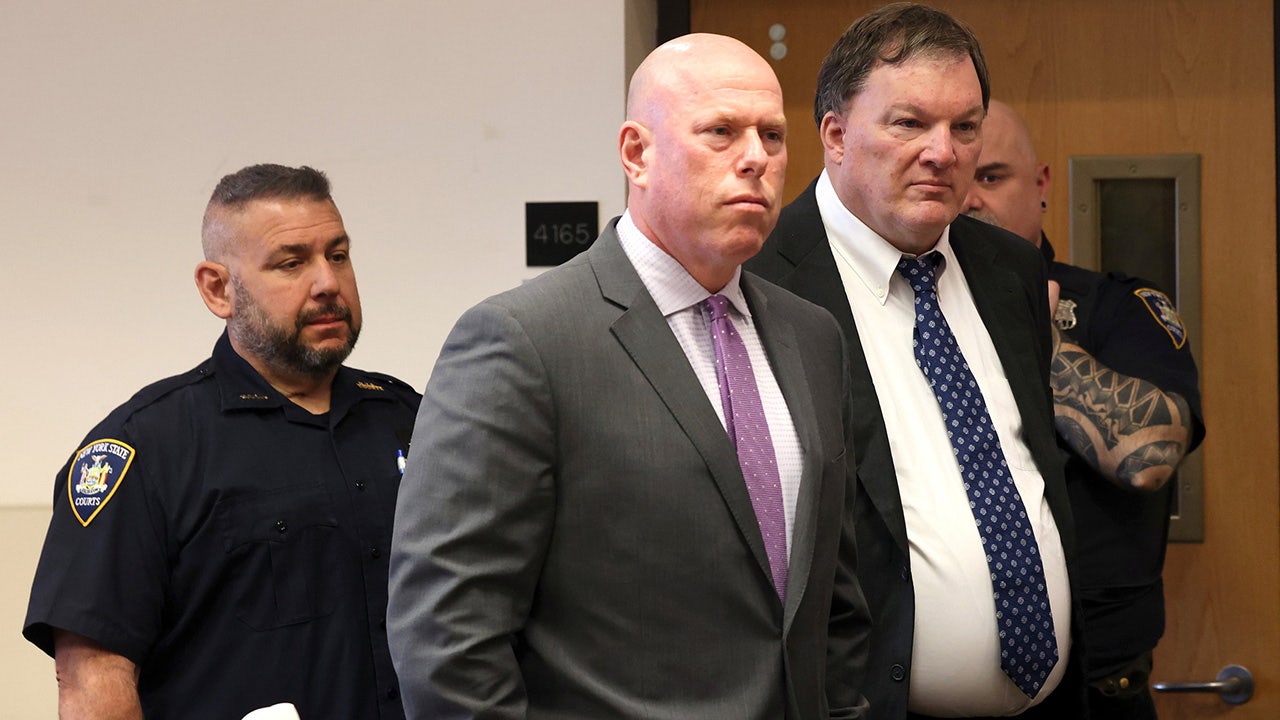
Long Island, New York, investigators have linked a fifth alleged victim to Rex Heuermann, the suspected Gilgo Beach serial killer who was accused last year of murdering four women and dumping their bodies along a remote highway more than a decade ago, sources tell Fox News Digital.
The Suffolk County District Attorney’s Office declined to comment but acknowledged that Heuermann is due back in court Thursday morning for a previously unscheduled hearing.
Unnamed sources told Newsday, the local newspaper, that the suspected serial killer has already been indicted on unspecified charges in connection with new developments in the case.
A task force including police K-9s from Suffolk County, the NYPD and New York State uncovered evidence in Manorville in April, a month before investigators returned to Heuermann’s house in May for a second search warrant.
REX HEUERMANN’S FAMILY KEPT GRUESOME PIECE OF EVIDENCE, SOURCE SAYS
The “Gilgo Four” clockwise from top left: Maureen Brainard-Barnes, Melissa Barthelemy, Megan Waterman and Amber Costello. The background shows a wooden cross in the marsh next to Gilgo Beach, New York, where the victims’ remains were found in the brush just yards from Ocean Parkway. (Suffolk County Police Department/Mega for Fox News Digital)
In July 2023, they arrested Heuermann outside his Manhattan architecture firm and spent nearly two weeks scouring through his home in Massapequa Park, about 20 minutes from where police found the bodies of Melissa Barthelemy, 24; Megan Waterman, 22; and Amber Costello, 27, in 2010. Prosecutors later tacked on charges for the murder of Maureen Brainard-Barnes, 25, whose remains they found near the others.
Collectively, those women are known as the Gilgo Four because they were found close together and under similar circumstances.
Alleged Gilgo Beach serial killer Rex A. Heuermann, right, appears in Judge Tim Mazzei’s courtroom next to his attorney Michael Brown at Suffolk County Court in Riverhead on Wednesday, April 17, 2024. (James Carbone/Newsday/Pool)
Seven other victims were found farther east along Ocean Parkway. Most of those deaths remain under investigation.
Two of those belonged to Jessica Taylor and Valerie Mack, who were both dismembered and dumped in separate locations.
Police discovered their partial remains in Manorville in 2000 and 2003. Additional remains of both victims were uncovered near the Gilgo victims.
SIGN UP TO GET TRUE CRIME NEWSLETTER
GET REAL TIME UPDATES DIRECTLY ON THE TRUE CRIME HUB
Paul Mauro, a former NYPD inspector who has been following the case for years, said the search in Manorville likely turned up DNA evidence that police wanted to compare to something at Heuermann’s home.
Heuermann has pleaded not guilty to murder charges in connection with the Gilgo Four.
Jessica Taylor, left, and Valerie Mack, right, were both murdered and dismembered. Suffolk County police discovered partial remains of each victim in both Manorville, New York, and along a stretch of Ocean Parkway near Gilgo Beach. (Suffolk County Police Department/Handout)
He is being held without bail at the Suffolk County Jail in Riverhead, New York.
The case has not yet gone to trial.
SUSPECTED SERIAL KILLER REX HEUERMANN’S HOME SEARCHED AGAIN
Police discovered 11 sets of remains scattered across several miles of the brush alongside Ocean Parkway after Shannan Gilbert, 24, went missing from Oak Beach around 5 a.m. on May 1, 2010.
Shannan Gilbert’s remains were found near Oak Beach, New York on Dec. 13, 2011. (The family of Shannan Gilbert)
FOLLOW THE FOX TRUE CRIME TEAM ON X
She placed a panicked 911 call and begged neighbors for help before vanishing into the marsh.
Police in 2020 said they believed her death had actually been an accident, a decision the attorney for her family has opposed.
Police said she suffered from mental illness and was known to use drugs that had a disorienting effect.
Dr. Michael Baden, the famed forensic pathologist and former chief medical examiner of New York City, was hired by the family. He found “insufficient information to determine a definite cause of death, but the autopsy findings are consistent with homicidal strangulation.”
Key bones in her throat were missing, but the adjacent ones had “a roughness at the margins.” He also found no drugs in her system.
Read the full article from Here

Powerball, Mega Millions jackpots: What to know in case you win
Here’s what to know in case you win the Powerball or Mega Millions jackpot.
Just the FAQs, USA TODAY
The Vermont Lottery offers several draw games for those willing to make a bet to win big.
Those who want to play can enter the MegaBucks and Lucky for Life games as well as the national Powerball and Mega Millions games. Vermont also partners with New Hampshire and Maine for the Tri-State Lottery, which includes the Mega Bucks, Gimme 5 as well as the Pick 3 and Pick 4.
Drawings are held at regular days and times, check the end of this story to see the schedule.
Here’s a look at June 28, 2026, results for each game:
Winning Pick 3 numbers from June 28 drawing
Day: 3-7-3
Evening: 3-8-8
Check Pick 3 payouts and previous drawings here.
Winning Pick 4 numbers from June 28 drawing
Day: 7-2-3-0
Evening: 2-5-9-9
Check Pick 4 payouts and previous drawings here.
Winning Millionaire for Life numbers from June 28 drawing
04-11-31-54-58, Bonus: 03
Check Millionaire for Life payouts and previous drawings here.
Feeling lucky? Explore the latest lottery news & results
Are you a winner? Here’s how to claim your lottery prize
For Vermont Lottery prizes up to $499, winners can claim their prize at any authorized Vermont Lottery retailer or at the Vermont Lottery Headquarters by presenting the signed winning ticket for validation. Prizes between $500 and $5,000 can be claimed at any M&T Bank location in Vermont during the Vermont Lottery Office’s business hours, which are 8a.m.-4p.m. Monday through Friday, except state holidays.
For prizes over $5,000, claims must be made in person at the Vermont Lottery headquarters. In addition to signing your ticket, you will need to bring a government-issued photo ID, and a completed claim form.
All prize claims must be submitted within one year of the drawing date. For more information on prize claims or to download a Vermont Lottery Claim Form, visit the Vermont Lottery’s FAQ page or contact their customer service line at (802) 479-5686.
Vermont Lottery Headquarters
1311 US Route 302, Suite 100
Barre, VT
05641
When are the Vermont Lottery drawings held?
- Powerball: 10:59 p.m. Monday, Wednesday, and Saturday.
- Mega Millions: 11 p.m. Tuesday and Friday.
- Gimme 5: 6:55 p.m. Monday through Friday.
- Lucky for Life: 10:38 p.m. daily.
- Pick 3 Day: 1:10 p.m. daily.
- Pick 4 Day: 1:10 p.m. daily.
- Pick 3 Evening: 6:55 p.m. daily.
- Pick 4 Evening: 6:55 p.m. daily.
- Megabucks: 7:59 p.m. Monday, Wednesday and Saturday.
- Millionaire for Life: 11:15 p.m. daily
What is Vermont Lottery Second Chance?
Vermont’s 2nd Chance lottery lets players enter eligible non-winning instant scratch tickets into a drawing to win cash and/or other prizes. Players must register through the state’s official Lottery website or app. The drawings are held quarterly or are part of an additional promotion, and are done at Pollard Banknote Limited in Winnipeg, MB, Canada.
This results page was generated automatically using information from TinBu and a template written and reviewed by a Vermont editor. You can send feedback using this form.

What are the Red Sox going to do with Patrick Sandoval?
The veteran left-hander has yet to appear in a big league game for the Red Sox, having missed his first season and a half with the organization while working his way back from Tommy John surgery. But after a deliberate ramp up throughout the spring and then an April setback Sandoval is now nearing a return to the big league roster.
Sandoval made the fifth start of his current rehab assignment Sunday for the WooSox, allowing one run over four innings on three hits, a walk and three strikeouts. He threw 60 pitches, a slight uptick from the 53 he threw over 3 1/3 innings his last time out on Tuesday.
Under MLB rules rehab assignments for a pitcher can last up to 30 days, which means there’s only enough time for Sandoval to make one more start before the Red Sox would have to either activate him or designate him for assignment. Red Sox interim manager Chad Tracy said Sandoval might make one more start in the minors, but he acknowledged a decision will have to be made soon.
“There’s still room to get the count built up some more,” Tracy said. “He got to 60 today and there’s probably room for another one to get it further and then we have to have a conversation after that.”
The Red Sox likely won’t want to lose Sandoval, but how he fits in roster-wise is tricky. The Red Sox starting rotation has been on a roll recently, and the most likely candidate to be optioned is rookie left-hander Jake Bennett, who has pitched brilliantly since coming up to fill Brayan Bello’s spot.
Boston could also insert Sandoval into the bullpen, but the Red Sox are likely about to get fellow left-hander Jovani Moran back off the injured list, and long reliever Ryan Watson can’t be optioned as a Rule 5 pick without being DFA’d himself.
Tracy said those will be issues the Red Sox will have to sort out, but noted that these sorts of logjams often have a way of working themselves out.
“Having depth is a good thing and it’s been tested for us, we had depth when Brayan went down and you know he’s down there and he’s got a specific purpose and mind of trying to get it right, well we’re kind of out of starting depth,” Tracy said. “So getting Sandy helps us in that way, but what we’re going to do yet we haven’t gotten that deep into it but obviously it’s looming.”
Extra innings
Left-hander Jovani Moran (left elbow inflammation) made his second rehab appearance for the WooSox on Sunday, retiring all six batters he faced on just 14 pitches over two perfect innings. Tracy said the club hasn’t decided if Moran will need another rehab outing before he’s activated. … Tracy said shortstop Trevor Story (sports hernia) is continuing to make progress but likely won’t start a rehab assignment before the All-Star break. … Right-hander Kutter Crawford (right wrist surgery recovery) is in the early stages of his throwing program in Fort Myers but remains a long way off from a return.

The Cincinnati Reds are in a rain delay for the second consecutive day. Saturday’s rain delay came before the game even started. Sunday’s rain delay occurred in the bottom of the 8th inning.
“The tarp is on the field, and we are in a delay here at PNC,” the Pirates official account posted on X. “We’ll update when we have info.”
Update: The grounds crew is taking the tarp off the field and the game is expected to resume around 5:20 ET.
The Pittsburgh Pirates lead the Reds 5-4 in the 8th.
Let’s take a look at how we got there.
Game Recap
In the second inning, Esmerlyn Valdez hit a ground-rule double off Reds starting pitcher Brady Singer that scored Nick Gonzalez, giving the Pirates an early 1-0 lead.
Later in the inning, former Red Tyler Callihan hit his third home run of the year, giving Pittsburgh a 4-0 lead.
However, in the fourth, the Reds would battle back. After Elly De La Cruz reached on an error and Sal Stewart singled, JJ Bleday added a single of his own that would score both, making it a 4-2 Pittsburgh advantage.
The Reds continued to rally in the fifth. After Noelvi Marte walked, Tyler Stephenson stayed hot with an RBI double to left field, getting the Reds back within a run.
Edwin Arroyo followed with an RBI single of his own that tied the game at 4.
The Pirates got a run back in the bottom half of the fifth when Ryan O’Hearn hit his 12th home run of the season. That would be it for Singer, who gave up five runs on nine hits in 4 1/3 innings. He struck out six and did not walk a batter.
The Pirates had a big opportunity to break the game wide open in the seventh when Zach McCambley walked the bases loaded. Reds manager Terry Francona brought in Brock Burke, who was miraculously able to get out of the jam with a pop-up and an inning-ending double play.
The Reds had a big chance to tie the game in the 8th when they had runners on first and second with nobody out. However, Nathaniel Lowe popped out, Spencer Steer flew out, and Noelvi Marte grounded out to end the threat.
Pierce Johnson was set to come in the game for the Reds when the game entered a rain delay.
We will provide an update as we know more.
Sign Up For Our DAILY Newsletter for More Free Coverage of the Cincinnati Reds Delivered to YOU Directly
Follow me on X at @RedsDaily4 for more.
Make sure you bookmark Cincinnati Reds Talk for the latest news, exclusive interviews, and daily coverage of the Cincinnati Reds! Follow Cincinnati Reds OnSI on Twitter/X: @RedsTalkSI. Like Our Cincinnati Reds On SI Facebook Page. Follow Cincinnati Reds On SI on Instagram.
 Add us as a preferred source on Google
Follow
-
South Dakota16 seconds ago
SD Lottery Millionaire for Life winning numbers for June 28, 2026
-
Tennessee7 minutes ago
TN Lottery Cash 3 Evening, Cash 4 Evening winning numbers for June 28, 2026
-

 Texas10 minutes ago
After historic floods, Texas Hill Country Little League is back
-

 Utah15 minutes ago
Sculptor to build $55 million monument depicting American history in Utah
-
Vermont22 minutes ago
VT Lottery Pick 3, Pick 3 Evening results for June 28, 2026
-

 Virginia25 minutes ago
Virginia farmers devastated by late spring frost may be eligible for federal aid
-

 Washington30 minutes ago
Opinion: Washington just taxed the world’s best anti-poverty program
-

 Wisconsin37 minutes ago
Wisconsin’s Most Wanted: John Luckett has history of drug, gun charges

