Northeast
Fall leaf-peeping New England travel has Americans eyeing 6 states and dates

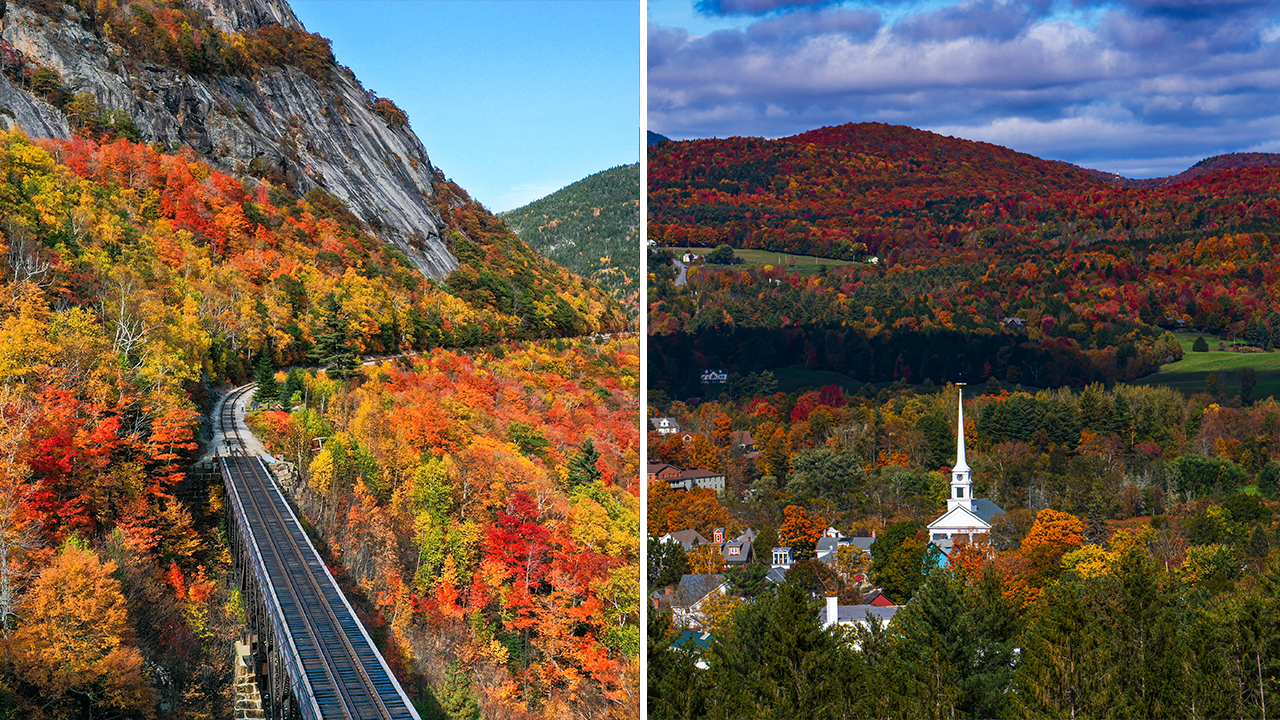
The days are already getting a bit crisper and the first day of fall, September 22nd, is coming up fast.
Millions of tourists flock to rustic New England in hopes of catching the best views of fall foliage.
In 2023, 3.6 million people visited New Hampshire alone in the fall, according to the New Hampshire Department of Business and Economic Affairs.
10 ‘MOST FUN’ STATES IN AMERICA: DID YOUR FAVORITE MAKE THIS LIST?
FOX Weather reported that foliage in the Northeast will have a delayed start due to warm temperatures but will be vibrant due to an over-abundance of precipitation.
Heat waves occurring in late summer and early fall can delay the relaxation of chlorophyll production in trees, keeping leaves greener for longer into the season.
Heat waves occurring in late summer and early fall can delay the relaxation of chlorophyll production in trees, keeping leaves greener for longer into the season, according to FOX Weather. (Visions of America/Joseph Sohm/Universal Images Group via Getty Images)
In areas experiencing drought, the stress on trees can alter the timing of leaf shedding and lead to more muted colors.
Dana Honor, travel magazine Visit New England publisher, told Fox News Digital via email that she hopes this year’s leaves have extra-vibrant colors.
“October is the time to head to New England to see some great color.”
“The expectation is the peak will be the days leading up to Halloween in the northern and western-most points of the region and in the days following Halloween for more central, southern, and eastern areas,” Honor said.
Southern Vermont will be the first state to reach peak leaf viewing on Sept. 24, 2024, according to weather experts. (Anadolu Agency via Getty Images)
Visit New England has been advising travelers and tourists to discover the Northeast region since 1996.
Honor said Vermont tends to be the most popular state for fall foliage, followed by New Hampshire and Maine.
For more Lifestyle articles, visit www.foxnews.com/lifestyle
“So far this year, we’re seeing Maine slightly outpace New Hampshire, but the season is still early,” Honor said.
While the top destinations tend to be the Green Mountains, Vermont, the White Mountains, New Hampshire, Western Maine and the Berkshires in Massachusetts, other spots in New England are also great for viewing fall foliage.
Visit New England publisher Dana Honor says they’re seeing more travelers visit Maine this year. (Anadolu Agency via Getty Images/Visions of America/Joseph Sohm/Universal Images Group)
“While hiking trails and bonfires are incredibly cozy during the cool fall nights, it’s also beautiful to escape to cities like Boston, Newport and Portland to experience the fall colors as you meander the streets or explore the coastline,” said Honor.
Leaf peepers can take in the red, orange and yellow while driving through the region.
Honor suggests experiencing road trips driving along Route 7, Upper Connecticut River Valley Loop, and the Castine and Penobscot Bay Loop.
HERE ARE THE 10 HAPPIEST CITIES IN AMERICA, WITH SOME ‘ASTONISHING’ LOCATIONS
The Merritt Parkway, which connects New England to New York, is one of the oldest roads in the country, according to the Merritt Parkway Conservancy.
The parkway is known for its scenic sprawling trees and unique bridges.
“October is the time to head to New England to see some great color, with our best picks for October 12-15 in the more northern parts of New England and a bit later for southern areas,” a Farmers’ Almanac representative told Fox News Digital.
Check out this list of six states and peak leaf viewing dates.
Farmers’ Almanac list of peak fall leaves
Connecticut
October 12 to 28
Maine
Inland: October 1 to 17
Coastal: October 5 to 21
Massachusetts
Inland: October 5 to 21
Coastal: October 12 to 28
New Hampshire
Inland: September 28 to October 9
Coastal: October 5 to 21
Rhode Island
October 12 to 28
Vermont
Northern: September 24 to October 10
Southern: October 5 to 14
Andrew Wulfeck of FOX Weather contributed reporting.
Read the full article from Here

New Hampshire
Gilmanton Iron Works Man Accused Of Possessing Guns, Hundreds Of Grams Of Fentanyl In Hooksett, Manchester

Editor’s note: This post was derived from information provided by the Hooksett and Manchester police departments and does not constitute a conviction. This link explains how to request the removal of a name from New Hampshire Patch police reports.
Stark was arrested later by police during a motor vehicle stop in Manchester and charged with drug sale, possession, driving after revocation or suspension, and armed career criminal. He was then turned over to Hooksett police on that department’s charges, processed, declined bail, and was held at the Merrimack County Jail for future arraignment.
Decades Of Priors
Stark, according to superior court records, has more than two decades of criminal history, mostly in the Lakes Region.
In Laconia in December 2005, when he was a teen, Stark was accused of second-degree assault and felony theft. He pleaded guilty to both charges in August 2006. Stark was given work release in January 2007 and about 11 months later, was accused of violating probation. After being sentenced, he was accused of violating probation again in August 2008. A bail forfeiture hearing was held in December 2008, and a probation violation hearing was held in March 2009.
Stark was accused of controlled drug act in Laconia in December 2009, but the charge was nolle prossed in August 2010. In June 2010, he was accused of controlled drug act in Laconia, but the charge was nolle prossed in November 2010. Stark was charged with bail jumping in May 2010 and pleaded guilty a year later to the charge and received a two-to-four-year prison sentence with 113 days time served credit.
New Jersey
Ex-NJ GOP aide accused of staging slashing attack shows off horrific scars — and mystery man — in new snap

The unhinged ex-GOP aide who claimed she had been viciously attacked and labeled “Trump whore” — but who authorities say staged the assault and hired a fetish artist to carve her up — showed off her jaw-dropping scars in a new photo, along with a heavily-tattooed mystery man.
Natalie Greene, the Ocean City, NJ woman accused of faking a gruesome politically-driven assault while working for Republican Rep. Jeff Van Drew, shared a glimpse into her life for the first time since the scandal broke nearly a year ago.
The 26-year-old updated her Facebook profile picture on the Fourth of July to a smiling selfie of herself and the new pal.
She wore a knitted tank top – exposing multiple thick, pink scars across her shoulder, chest and neck.
Her dark hair was slicked back into a low ponytail, and her manicured hand covered her mouth as she laughed.
A man wearing sunglasses and a baseball cap with tattoos up his neck and arm smiled next to her.
Greene, a Masarati-driving ex-Rutgers Law student, was charged with conspiracy to falsely report a violent attack and giving false statements to law enforcement after claiming she was repeatedly slashed by three masked gunmen in a local park because she worked for Van Drew, a pol who had switched from Democrat to Republican in 2020.
Authorities found Greene on the ground with her hands and ankles zip-tied on a trail at a nature preserve in Egg Harbor Township on the night of July 23, 2025. She had dozens of bloody surgical-like slashes across her back, shoulder, chest and face. The words “Trump whore” were written across her stomach in black marker.
But the attack was nothing but a hoax, according to the Department of Justice, which said Greene hired a Pennsylvania-based “scarification” fetish artist to cut her up. Detectives even discovered a reference photo that Greene showed the artist – and her cuts matched the image exactly, investigators said.
Greene was granted supervised release in January as she awaits trial.
Childhood campmate Kristin Haughton James — who was previously busted for cocaine possession and riding an unlicensed vehicle in the streets, a Camden court heard in January — welcomed her into her Florida home and has been acting as her custodian.
Before moving in with Haughton James, Greene had already cycled through two other guardians – including her mother – and had been ordered to attend inpatient treatment.
But the arraignment quickly descended into a nightmare, Haughton James revealed.
“I have never met chaos incarnate until I met this person,” she told NJ.com. “Lives for the drama – wants everything to be about her.
“She just feeds off attention.”
She claimed Greene left her home a wreck, tried to get her evicted and falsely told cops that she was dealing drugs and threatened her with a gun.
Haughton James said she kicked her out in March. It is unclear where Greene is currently living.
Haughton James, Greene and Greene’s attorney did not return messages seeking comment.

WILKES-BARRE — When people think about transportation in Northeastern Pennsylvania, their first thoughts are likely cars and buses.
While those are the most common modes of transportation in the region, an important question is gaining attention among planners, community leaders, and residents alike:
How easy is it to get around NEPA on foot?
A recent report by The Institute examined accessibility and walkability across the region. The findings reveal a region with some highly walkable downtowns and neighborhoods, but also many communities where residents remain heavily dependent on vehicles.
“Walkability refers to how easily people can reach everyday destinations such as stores, restaurants, schools, parks, and health care facilities by walking,” said Jill Avery-Stoss, President and CEO of The Institute, “Factors that influence walkability include street connectivity, proximity to destinations, access to transit, and the strength of the infrastructure network. Walkability supports the resilience, environment, health, and economy of communities.”
Using the Environmental Protection Agency’s National Walkability Index, The Institute confirmed that some of the region’s traditional downtown communities scored the highest.
• In Lackawanna County, communities including Scranton, Carbondale, Old Forge, Jessup, Blakely, Clarks Summit, and Moosic ranked among the county’s most walkable areas.
• In Luzerne County, strong scores were recorded in Wilkes-Barre, Pittston, Hazleton, Kingston, Forty Fort, Plymouth, Dallas, and Freeland.
• In Wayne County, the boroughs of Honesdale and Hawley emerged as the most walkable locations.
The broader regional picture, however, highlights a continuing dependence on automobiles.
“Most municipalities in Northeast Pennsylvania are categorized as car-dependent, particularly in more rural areas where destinations are spread farther apart, and transportation options are limited,” notes Avery-Stoss.
Data from America Walks, which combines EPA and Census Bureau information to evaluate walkable land use, shows that a majority of residents in all three counties live in areas rated as below-average for walkability.
Approximately 66.4% of Lackawanna County residents, 59.5% of Luzerne County residents, and 53.1% of Wayne County residents live in neighborhoods classified as below-average walkable.
Despite these challenges, Avery-Stoss said there are opportunities for improvement.
She said Northeastern Pennsylvania already benefits from an extensive network of trails and greenways, including the Lackawanna River Heritage Trail, the Luzerne County Levee Trail, and other rail-trail systems that support walking, biking, and recreation. Avery-Stoss said investments in sidewalks, pedestrian crossings, trail connections, traffic-calming measures, and transit-oriented development could further improve mobility and quality of life throughout the region.
“While walkability varies significantly from one community to another, many of the region’s most vibrant downtown areas demonstrate what is possible when homes, businesses, parks, and services are located within easy walking distance,” Avery-Stoss said. “As communities continue to invest in transportation and redevelopment projects, walkability is becoming an increasingly important part of how Northeastern Pennsylvania grows and connects its residents to their larger community.”
Reach Bill O’Boyle at 570-991-6118 or on Twitter @TLBillOBoyle.
-

 New Hampshire10 minutes ago
Gilmanton Iron Works Man Accused Of Possessing Guns, Hundreds Of Grams Of Fentanyl In Hooksett, Manchester
-

 New Jersey22 minutes ago
Ex-NJ GOP aide accused of staging slashing attack shows off horrific scars — and mystery man — in new snap
-

 New Mexico25 minutes ago
New Mexico AG Wants to Know Where Epstein Records Are
-
North Carolina25 minutes ago
UNC shortstop selected in first round of MLB Draft by Red Sox; list of NC players drafted
-
North Dakota37 minutes ago
The Crookston Masonic Lodge and Order of the Eastern Star present a donation check to Honor Flight of North Dakota and Minnesota
-

 Ohio40 minutes ago
Ohio’s first mountain coaster coming to Hocking Hills
-

 Oklahoma45 minutes ago
Housing affordability act becomes law, Oklahoma lawmakers react
-

 Oregon52 minutes ago
East Evans Creek Road wildfire swells to about 2,000 acres; homes threatened


