Northeast
Dem congressman lashes Musk in opening salvo of populist bid in 2026 swing-state Senate race

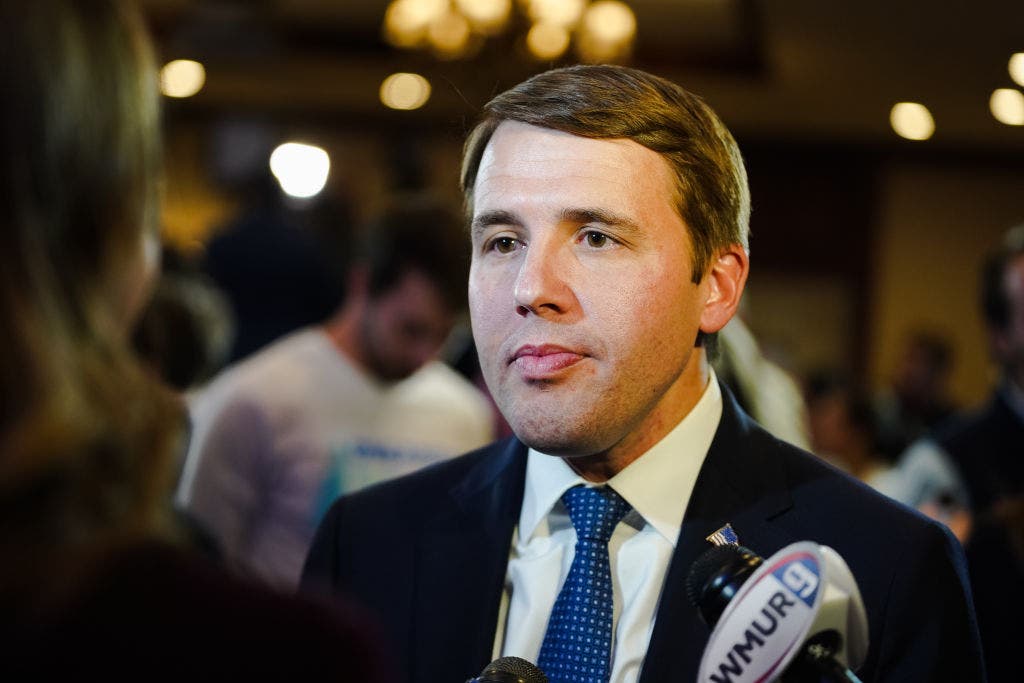
Striking a populist theme and showcasing that he is a fighter, Democratic Rep. Chris Pappas on Thursday declared his candidacy in the 2026 race to succeed retiring Sen. Jeanne Shaheen, a fellow Democrat, in the key swing state of New Hampshire.
“What I hear from people, they want someone who shows up, someone who listens and someone who isn’t afraid to take on the big fights, and more importantly today, who knows how to win them,” Pappas said in a campaign launch video posted on social media.
Using clips of a listening tour he made through all 10 of New Hampshire’s counties last month as he ramps up toward running for the Senate, Pappas said voters feel like “the system’s rigged.”
“You think about the Social Security office that’s going to be closed in Littleton, drastic cuts to Medicaid, all in the name of giving big tax breaks to billionaires like Elon Musk,” he argued, as he pointed to President Donald Trump’s top donor and the world’s richest person, who is leading the administration’s controversial downsizing of the federal government workforce.
WHY THIS LONGTIME DEMOCRATIC SENATOR ISN’T RUNNING FOR RE-ELECTION NEXT YEAR
Pappas emphasized, “I do get angry, because when you’re talking about public service, you should be focused on how you can help people, how you can make people’s lives better.”
The four-term congressman, who represents the eastern half of the state, is the first major candidate in the race to succeed the 78-year-old Shaheen.
RISING DEMOCRATIC PARTY STAR CRITICAL OF SCHUMER’S LEADERSHIP LAUNCHES SENATE RUN IN KEY BATTLEGROUND
Shaheen, the first woman in the nation’s history elected governor and to the Senate, announced last month that she would not seek a fourth six-year term representing New Hampshire when she is up for re-election next year.
The seat is one of the Senate Republicans’ top targets as they aim to expand their 53-47 majority in the chamber in next year’s midterms.
Democratic Rep. Chris Pappas of New Hampshire on Thursday announced his candidacy for the Senate in the 2026 race to succeed retiring longtime Sen. Jeanne Shaheen. (Getty Images)
For its part, the National Republican Senatorial Committee (NRSC) instantly took aim at Pappas as being out of step with everyday New Hampshire voters.
“Chris Pappas supports biological males competing in women’s sports, wants to ban gas-powered vehicles, and voted to raise taxes on hard-working Granite Staters,” NRSC regional press secretary Nick Puglia charged in a statement. “Pappas is extremely out of touch, and New Hampshire families deserve better.”
Additionally, Fox News obtained a memo from the NRSC to donors making the case that the GOP can flip the seat.
“Our internal polling data in New Hampshire demonstrates a favorable political environment for Republicans in this toss-up Senate race,” the NRSC argued in the memo. “With a registration advantage, edge on the generic ballot, stronger enthusiasm among our voters, and alignment with independents on core party policy issues, Republicans are well positioned to flip this open Senate seat in New Hampshire regardless of who either party nominates.”
ONLY ON FOX NEWS: SENATE REPUBLICAN CAMPAIGN CHAIR REVEALS HOW MANY SEATS HE’S AIMING FOR IN 2026
In the race for the GOP Senate nomination in New Hampshire, former longtime Gov. Chris Sununu told Fox News Digital last month that he was holding a dialogue with national GOP leaders about potentially running.
Republican Gov. Chris Sununu of New Hampshire, on his last full day in office, is interviewed by Fox News Digital in Concord, New Hampshire, on Jan. 8, 2025. (Fox News – Paul Steinhauser)
Sununu, who enjoys a large national profile thanks to his regular appearances the past few years on the cable news networks and Sunday talk shows, said he expected to make a decision in the coming weeks.
However, Sununu noted that while “the door’s open” to running, he emphasized “it’s not open a lot, to be honest.”
The former governor’s comments in recent interviews are a switch from last year, when he repeatedly said he would not seek to run for the Senate in 2026.
A POPULAR FORMER REPUBLICAN GOVERNOR MULLS SENATE RUN
Four years ago, Sununu expressed interest in running for the Senate against his predecessor as governor, Democrat Sen. Maggie Hassan, who was up for re-election in 2022. The popular governor was heavily courted by national Republicans to take on Hassan.
However, on Nov. 9, 2021, Sununu announced that he would instead run for a fourth term as governor, upsetting many Republicans in the nation’s capital.
He also heavily criticized the Senate. “They debate and talk and nothing gets done,” he said at the time.
Sununu is not the only Republican mulling a Senate bid in New Hampshire.
Republican former Sen. Scott Brown is interviewed by Fox News Digital on Dec. 24, 2024 in Rye, New Hampshire. (Fox News – Paul Steinhauser)
Former Sen. Scott Brown of Massachusetts, who later narrowly lost to Shaheen in New Hampshire in the 2014 election, is seriously considering a 2026 run.
Brown, who served four years as U.S. ambassador to New Zealand during President Donald Trump’s first administration, has been holding meetings with Republicans across New Hampshire for a couple of months and has met multiple times with GOP officials in the nation’s capital.
TOP POLITICAL HANDICAPPER REVEALS DEMOCRATS CHANCES OF WINNING BACK THE SENATE MAJORITY
Pappas may not have the Democratic Senate primary in New Hampshire all to himself.
Sources close to Rep. Maggie Goodlander in New Hampshire’s 2nd Congressional District said last month that the first-term representative is considering a Senate run.
Now-Rep. Maggie Goodlander, D-N.H., speaks at a campaign event ahead of then-President Joe Biden at the New Hampshire Democratic Party headquarters on Oct. 22, 2024 in Concord, New Hampshire. (Fox News – Paul Steinhauser)
Pappas, in his launch video, highlighted his Granite State roots, his business background and his record on Capitol Hill.
Pappas, a former state representative and county treasurer who later served on New Hampshire’s five-member executive council before winning election to Congress in 2018 — including a re-election victory in 2022 over now-White House press secretary Karoline Leavitt — hails from a family that has owned and operated the famed Puritan Backroom restaurant and conference center for over a century.
The restaurant, in Manchester, for decades has been a must-stop for White House hopefuls campaigning in New Hampshire’s first-in-the-nation presidential primary.
Sen. Jeanne Shaheen, D-N.H., speaks at a policy event on Tuesday, Oct. 22, 2024, in Concord, New Hampshire. Shaheen announced last month that she would not seek re-election in 2026 to a fourth six-year term in the Senate. (AP Photo/Steven Senne)
“I learned about serving the community, running our family business, which has been around for over 100 years, every day at the restaurant, you need to bring hard work and determination to get the job done,” Pappas highlighted in his video.
However, Brown took to social media to take aim at Pappas, in a possible preview of a potential general election clash.
“.@ChrisPappasNH talks about being grounded in ‘New Hampshire values,’ good luck squaring that rhetoric with his record in Washington D.C. supporting wide open borders, men in women’s sports and lying to his constituents about Joe Biden’s senility,” Brown charged in his post.
The Pappas campaign says the candidate will hold a kick-off event at the Puritan Backroom later on Thursday and will stump across the state over the weekend.
Pappas, who is the first openly gay man to represent New Hampshire in Congress, currently serves on the House Committee on Veterans Affairs and on the Transportation and Infrastructure committee.
Read the full article from Here


NEWYou can now listen to Fox News articles!
New York City officials confirmed Sunday that two devices recovered during protests near Gracie Mansion a day earlier were improvised explosive devices (IEDs).
“The FBI and NYPD confirmed the suspicious items to be improvised explosive devices (IEDs),” FBI New York wrote on X. “Additionally, the FBI Joint Terrorism Task Force (JTTF) will be conducting interviews, reviewing videos, collecting evidence, and chasing down all leads.”
A third “suspicious device” was also found Sunday afternoon in a vehicle in Manhattan in connection with the investigation, officials said.
In a statement posted to X earlier on Sunday, NYPD Commissioner Jessica Tisch said the department’s Bomb Squad determined the first device was neither a hoax nor a smoke bomb.
“The NYPD Bomb Squad has conducted a preliminary analysis of a device that was ignited and deployed at a protest yesterday and has determined that it is not a hoax device or a smoke bomb,” Tisch wrote. “It is, in fact, an improvised explosive device that could have caused serious injury or death.”
WHO IS BRIAN COLE, THE DC PIPE BOMB SUSPECT?
A man throws a hand-made explosive at supporters of U.S. President Trump during a rally to stop public Muslim prayer, in New York City, on March 7, 2026. (Eduardo Munoz/ Reuters)
At the time, Tisch said authorities were continuing to analyze a second device recovered at the scene.
Police arrested Emir Balat and Ibrahim Kayumi on Saturday. Both remain in custody.
Three federal law enforcement sources told Fox News that the two suspects are believed to be U.S. citizens and that one suspect allegedly shouted “Allahu Akbar” before igniting and throwing an IED toward the protest area.
The NYPD is working alongside the U.S. Attorney’s Office for the Southern District of New York and the FBI through the Joint Terrorism Task Force.
The incident unfolded during dueling demonstrations Saturday morning near East End Avenue and East 87th Street, just steps from Gracie Mansion, the official residence of New York City Mayor Zohran Mamdani.
DC PIPE BOMB SUSPECT PLEADS NOT GUILTY TO PLANTING DEVICES AT DNC AND RNC HEADQUARTERS
The incident unfolded amid two dueling protests on March 7, 2026, near Gracie Mansion in New York City. (FNTV)
One rally was organized by right-wing activist Jake Lang to oppose public Muslim prayer. Counter-protesters also gathered at the scene.
Though police initially kept the groups separated, tensions escalated after pepper spray was deployed during a confrontation.
Approximately 30 minutes later, authorities say an 18-year-old counter-protester ignited and threw a device toward the protest area. Witnesses reported seeing flames and smoke before it extinguished itself near responding officers.
Police say the 18-year-old then retrieved a second device from a 19-year-old, lit it, and attempted to flee.
Both suspects – identified as Balat and Kayumi – were taken into custody.
Three additional arrests were made on charges including disorderly conduct and obstructing traffic.
Bomb squad technicians on Saturday described the devices as jars wrapped in black tape, slightly smaller than a football.
X-rays revealed nuts, bolts and screws inside – materials commonly used as improvised shrapnel – along with a hobby fuse that could be lit.
‘LOUD BANG,’ DAMAGE REPORTED AT US EMBASSY IN NORWAY; POLICE INVESTIGATING
Right-wing activist Jake Lang leads a rally to stop public Muslim prayer, in New York City, U.S., March 7, 2026. (Eduardo Munoz/Reuters)
CLICK HERE TO DOWNLOAD THE FOX NEWS APP
Mayor Zohran Mamdani condemned both the protest and the violence in a statement posted Sunday.
“Such hate has no place in New York City. It is an affront to our city’s values and the unity that defines who we are,” Mamdani wrote. “What followed was even more disturbing. Violence at a protest is never acceptable. The attempt to use an explosive device and hurt others is not only criminal, it is reprehensible and the antithesis of who we are.”
He thanked NYPD officers for their response and said his administration is “closely monitoring the situation.”
The NYPD could not be immediately reached by Fox News Digital for comment.
Fox News’ Bill Melugin and CB Cotton, as well as Fox News Digital’s Alexandra Koch contributed to this report.
Read the full article from Here

VANCOUVER, British Columbia (AP) — Shay Maloney scored 41 seconds into overtime and the Boston Fleet edged the Vancouver Goldeneyes 2-1 on Tuesday night.
Much of the game was a goalie duel, with neither side scoring until the third period.
Haley Winn was first to strike, getting the Fleet on the board early in the final frame with her second goal of the year.
Hannah Miller responded for the Goldeneyes with 3:26 remaining, blasting a one-timer past Boston goalie Aerin Frankel from just inside the blue line. Frankel stopped 25 of the 26 shots she faced, and the Fleet won its sixth straight game.
Kristen Campbell made 25 saves in the Vancouver net.
The win moved the Fleet back into sole possession of first place in the league standings, two points ahead of the Montreal Victoire.
Vancouver was without goalie Emerance Maschmeyer, who is listed as day to day with an upper-body injury. Kimberly Newell served as Campbell’s backup.
Pittsburg, PA
How Pittsburgh area drivers can save money on gas as prices rise during the war with Iran

Until the prices at the gas pump start to come down, we’re all looking for a way to trim our spending on fuel. The good news is that there are a number of ways to do that, and they just might be in your wallet or on your phone right now.
Whether it’s credit card reward programs or brand loyalty programs, finding a discount at the gas station is easier than you might think.
Most major gas stations either have loyalty programs or memberships that can save you money. There’s also the option of using AAA to find some savings.
On your phone, there are several apps and options that can save you money, like GasBuddy or Waze.
“The Auto Club app, which is our app, it actually will guide you toward the least expensive fuel in the area near you,” explained Jim Garrity of AAA East Central.
Both AAA and AARP have deals with Shell, where members can get five cents off a gallon.
Meanwhile, if you’re getting your shopping done at one of the warehouse, wholesale stores such as Sam’s Club, BJ’s, or Costco, part of your membership is a gas discount, which is usually at least 10 cents cheaper.
Even if you aren’t a member of one of these wholesale stores, many grocery stores have rewards programs that can get you a discount at gas stations.
Garrity said there are also things you can do behind the wheel that can save you money on gas, starting with slowing down.
“Essentially, for every five miles over 50 miles an hour you’re driving, we found that you’re decreasing your fuel economy exponentially,” he explained.
He also said that drivers should avoid jack rabbit starts – basically pushing down on the gas pedal instead of easing off the brake and putting slight pressure on the gas pedal. Drivers also should make sure that they’re keeping up with regular maintenance.
“They save up pennies that over time really add up,” he said.
Obviously, changing your driving habits is hard, especially because you don’t see immediate results, and that can lead to frustration.
Using those memberships, rewards programs, and discount resources, that’s real money and more immediate.

Not ‘a litre of oil’ to pass Strait of Hormuz, expect $200 price tag: Iran

Tornadoes hit Illinois, Indiana and Texas as severe storms sweep US

Coast Guard rescue swimmer dies after medical evacuation mission off Washington coast turns tragic

WATCH: Walz, Ellison, Omar refuse to answer when pressed on fraud after contentious fraud hearing

Texas Gov Abbott issues warning of Chinese spying in medical tech

Florida High School Football Rankings: Top 25 teams – Oct. 21

Cleary's 21 help Le Moyne down Central Connecticut State 69-64 in OT

How old is Bo Nix? What to know about Oregon quarterback ahead of 2024 NFL Draft

99th annual Pony Swim held in Virginia

Indiana Members Credit Union announced as new anchor tenant at Bottleworks District
Not ‘a litre of oil’ to pass Strait of Hormuz, expect $200 price tag: Iran
Tornadoes hit Illinois, Indiana and Texas as severe storms sweep US

EXCLUSIVE: ICE says El Paso detention facility will stay open under new contractor after $1.2B deal scrapped

Von der Leyen ‘acting outside of competence,’ Araud tells Euronews

Wheelchair curler Steve Emt’s path from drunk driver to three-time Paralympian
-

 Wisconsin1 week ago
Setting sail on iceboats across a frozen lake in Wisconsin
-

 Massachusetts1 week ago
Massachusetts man awaits word from family in Iran after attacks
-

 Detroit, MI5 days ago
U.S. Postal Service could run out of money within a year
-

 Pennsylvania6 days ago
Pa. man found guilty of raping teen girl who he took to Mexico
-

 Miami, FL7 days ago
City of Miami celebrates reopening of Flagler Street as part of beautification project
-

 Sports7 days ago
Keith Olbermann under fire for calling Lou Holtz a ‘scumbag’ after legendary coach’s death
-

 Virginia7 days ago
Giants will hold 2026 training camp in West Virginia
-

 Culture1 week ago
Try This Quiz on the Real Locations in These Magical and Mysterious Novels