Northeast
Cuomo to testify on COVID orders, nursing home deaths as spox predicts a ‘master class in gaslighting’

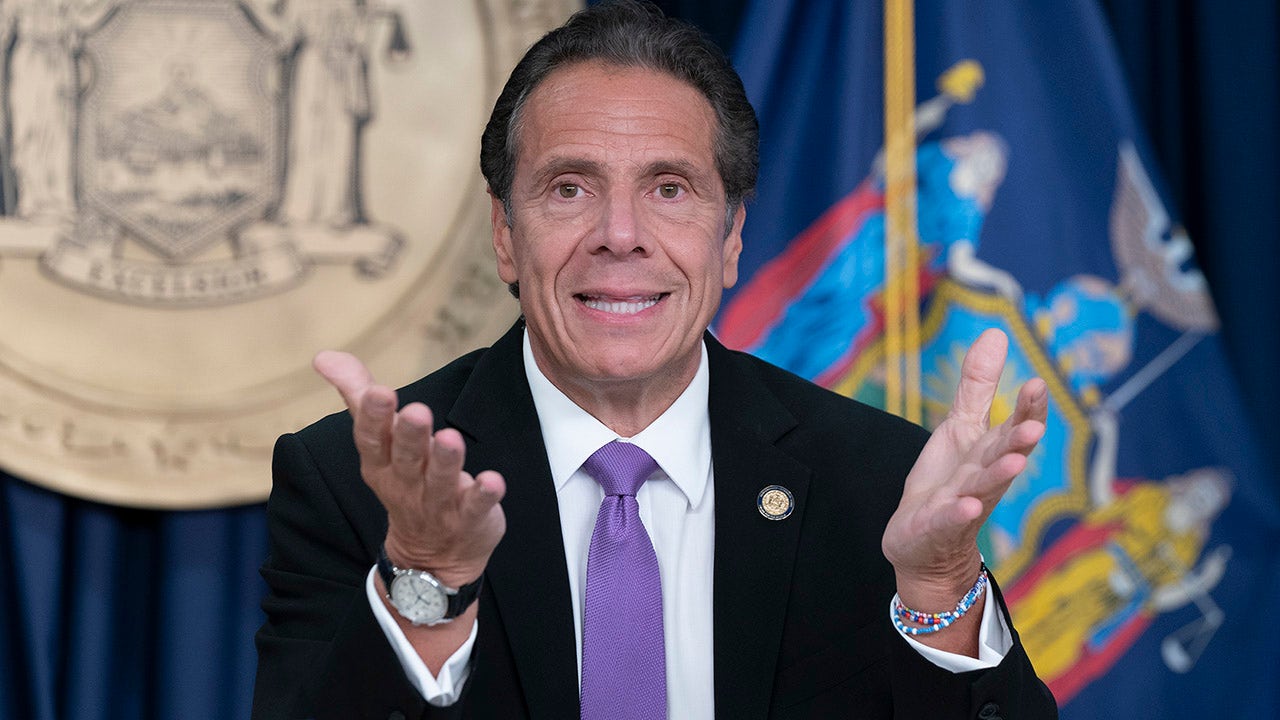
Former New York Gov. Andrew Cuomo will sit for a hearing Sept. 10 before the congressional subcommittee tasked with probing the coronavirus pandemic, the panel announced Tuesday.
Cuomo, one of the most visible governors during the height of the pandemic, was lambasted for implementing stringent social and economic restrictions throughout the Empire State.
He also was blamed for thousands of COVID-related deaths that occurred in nursing homes, which a 2023 report from the NYS Department of Health calculated to be 826 in Suffolk County, 813 in Erie County – which includes Buffalo — and 623 in Queens County.
“Mr. Cuomo will be questioned about his Administration’s issuance of unscientific guidance that forced New York nursing homes and long-term care facilities to admit COVID-19 positive patients,” an announcement for the hearing read.
CUOMO ALLEGATIONS HAVE NEW YORK DEMOCRATS GOING AFTER EACH OTHER ‘MORE THAN THE ROYAL FAMILY’: GAETZ
Former New York Gov. Andrew M. Cuomo. (Getty Images)
Cuomo, a Democrat, previously sat for a seven-hour transcribed interview with the subcommittee. The panel also interviewed Cuomo’s former secretary, Melissa DeRosa, and then-NYS Health Commissioner Dr. Howard Zucker.
Rep. Nicole Malliotakis, R-N.Y., a Staten Island lawmaker who sits on the subcommittee, said in an interview Tuesday that Cuomo still refuses to take responsibility for his orders and their repercussions.
She recounted how no one in Albany could point to exactly where the order partitioning nursing home patients came from.
“We still don’t know who approved that directive because the governor saying he didn’t know about it, he’s claiming that [Zucker] knew about it before it went out. And yet somehow they’ve been unable to identify who the person was that approved it and issued it, which is so negligent for a directive like that to go out without the health commissioner approving it at minimum,” she said.
The New York lawmaker also pointed to then-President Donald Trump dispatching a military medical ship to New York Harbor, the Jacob Javits Center, and the availability of a mental hospital in her district for the purposes of treating and partitioning serious COVID-19 patients.
“They weren’t being used. So why you have that directive in place, forcing the nursing home to take the COVID positive patients, even when you had alternatives? That was a big failure because at that point he was very clear about this directive.”
SUNUNU NAMES THE TWO GOVERNORS ALL THE OTHERS ‘HATE’
Representative Nicole Malliotakis, a Republican from New York, will be one of the lawmakers questioning former New York Gov. Andrew Cuomo next week. (Susan Walsh/AP Photo/Bloomberg via Getty Images)
When asked how people in her district feel about the situation, Malliotakis said many had lost loved ones during the pandemic from “preventable deaths.”
“They were a result of putting COVID-positive patients in nursing homes. And that was based on a directive and mandate by the Cuomo administration. And the buck stops with him, and he needs to be held accountable,” she said.
“[He blamed] everybody but himself. No apology, no accountability. No remorse… the public deserves answers, and we’re going to push for them at this hearing.”
However, a Cuomo spokesman told Fox News Digital, “the facts speak for themselves” when it comes to the former governor’s handling of COVID, calling congressional Republicans’ oversight a “master class in gaslighting.”
“New York had a lower nursing home death pro-rata than all but 11 states,” said Rich Azzopardi.
The New York Capitol building is seen, June 30, 2023, in Albany, New York. (AP Photo/Ted Shaffrey, File)
Azzopardi called the committee a “farce” and criticized it for being comprised of a “foot doctor” – referring to Chairman Brad Wenstrup, R-Ohio, — “Trump’s personal physician” – former White House doctor; current Rep. Ronny Jackson, R-Texas, and “a representative with a Ph.D. in QAnon,” in regard to Rep. Marjorie Taylor Greene, R-Ga.,
“[The committee] refuse[s] to look in the mirror at their own anti-science policies that caused hundreds of thousands of unnecessary deaths or call the one witness who is most relevant and was supposed to lead the entire effort: Donald Trump,” Azzopardi said.
While in office, Cuomo was at times questioned by the press on the matter. In one notable exchange during a July 2020 press conference, the governor was asked about a state report on nursing homes and why an independent investigator was not appointed.
“I don’t believe your characterization is correct – I believe it is a political issue,” Cuomo shot back at the reporter.
Cuomo then went on to blame the New York Post and Fox News, as well as political motivations, for the issue’s prominence.
“People died in nursing homes. That’s very unfortunate. Just on the topline, we are number 35th in the nation in percentage of deaths in nursing homes. Go talk to 34 other states first.”
Cuomo was also criticized for interviews during the pandemic with his brother, Chris, on CNN. In one exchange, the siblings shared a laugh after Chris brandished two comically-large nasal swabs to suggest Andrew has exceptionally large nostrils.
Read the full article from Here


An oversized poster board tracks the deep cleaning happening across Pittsburgh’s Mount Washington neighborhood. All of the yellow highlights denote the streets already adopted.
“We got all the streets on Grandview [Avenue] and we’re still working on a few on Duquesne.”
It’s the brain of Helen Oldfield, who told KDKA-TV that her recent move from the West Coast left something to be desired at first.
“I was very depressed and shocked by the amount of dirt and litter everywhere,” said Oldfield, creator of the Adopt-A-Block program.
She started volunteering for the large cleanups along Grandview Avenue and loved seeing people rappel down the sides to collect the accumulated trash.
“It’s the iconic street in Pittsburgh. It needs to be clean and look nice, but what about the rest of Mount Washington? When people wandered back through the streets, it was just horrible; it was a mess,” Oldfield said.
It was from that idea that Oldfield’s Adopt-a-Block program was born. Now she’s more than 60 volunteers deep and trying not to just clean but shift attitudes.
“I think a lot of the mess that accumulates up here on Grandview, unfortunately, is due to groups of young people collecting in the evening and just hanging out,” she said. “And it’s a cool place to hang out, so why not? They come with their motorbikes, and they come with their fast cars, and they drink, and they eat fast food, and then they chuck it all over the edge. I don’t believe the trash is due to any local residents or any visitors or sightseers.”
Volunteers Barbara and Paul Franklin say this is part of their life now.
“We’ve been here about a year, and we moved back to Pittsburgh after being away for 37 years, and we noticed there’s just a lot of trash out there,” Paul Franklin said.
The couple is now donning yellow safety vests, using an embroidery hoop to keep the trash bags open, and using grabbers to snag cigarette butts, cans, and even gum wrappers.
“When we do McCardle Roadway on Sunday mornings, I feel really good about that,” Barbara Franklin said.
The volunteers keep on coming, snapping pictures of themselves getting their steps in and making a difference, block by block.
“There is still a long way to go, and we are getting there, and I feel the motivation going here,” said Oldfield.
The Franklins told KDKA-TV that it’s addicting, and now they notice trash everywhere. They hope people will see this story and spread it beyond Mt. Washington.
“We’re proud of this city, we’re proud of this neighborhood, and we want to show it in its best light, and we think we’re helping to do that,” said Paul Franklin.
Oldfield said she hopes to secure some funding to continue supplying her volunteers with much-needed gear. She’s currently receiving some money from the community organization Neighbors on the Mount to purchase the vests and grabbers.
She’s soon applying for grant money in the form of a Neighborhood Economic Development grant and told KDKA-TV that she hopes the city will consider her group for the funds to keep this going.

The second-year Golden State Valkyries keep clearing hurdles that have never been scaled in the history of the WNBA.
They did it again Friday night.
Across the country from Ballhalla, against an opponent with the league’s worst record, the Valkyries became the fastest WNBA expansion franchise to 40 victories.
They needed just 68 games over two seasons to hit the mark.
That was among the bullet points in their 79-64 victory over the Connecticut Sun, an outcome that extended Golden State’s franchise-record win streak to seven games, including the first four in a five-city trip that concludes Wednesday at Indiana.
The Valkyries overcame a rough start on a night in which their All-Star forward, Gabby Williams, was ruled out before tip-off because of a back injury that sidelined her in the fourth quarter of the team’s win in Toronto on Wednesday.
Connecticut, which fell to 5-18, stormed to a 9-2 lead in the opening minutes and maintained an advantage into the second quarter even though its leading scorer on the season, center Brittney Griner, missed her second consecutive game because of a quad strain.
But the Valkyries’ highly touted defense eventually put a grip on the home team, and Golden State grabbed its first lead, 24-23, when Kaila Charles drove for a layup.
The visitors led 30-25 at halftime.
Connecticut kept the margin within single digits for nearly all of the third quarter, but Veronica Burton closed the period with an up-and-under layup as time expired to give Golden State a 54-44 cushion heading into the final 10 minutes.
The Valkyries put the score out of reach when Charles and Burton made back-to-back 3-pointers to widen the lead to 60-44 with 7:19 to play.
Burton had a superb game against her former team, finishing with 17 points, six assists, three rebounds, two blocks and a steal. The Valkyries are undefeated this season when the point guard has at least six assists.
Golden State’s bench contributed 42 points, seven more than its league-high season average. Janelle Salaun led the reserves with 16 points, seven rebounds, and three steals. Laeticia Amihere added six points, five rebounds, three blocks and three assists. The Valkyries also got nine points from Tiffany Hayes and eight from Kaitlyn Chen.
Williams, meanwhile, gave the team a boost from the bench.
“Gabby is still going to contribute, and she still helped us,” Burton said. “She was one of the loudest people throughout the entire game. With that … it’s a next-man-up mentality. There is not necessarily any drop-off. We find different ways to win, and we just rely on every single person on this team.”
With the win, Golden State is the first to 17 victories this season, as the result on Friday improved its record to 17-7, tying the Valkyries with Las Vegas and Minnesota (both 16-6) for the league’s top mark.
How has Golden State done it?
It starts with “high-character” players the front office brought in, coach Natalie Nakase said, noting that everyone has accepted their roles, some more challenging than others.
“The best thing about our team is we have a selfless team that understands matchups,” Nakase said. “Having a deep bench was intentional. But it also comes with the humility that each player has to have that sometimes they can start, sometimes they’ll have a night, sometimes they might not start, sometimes they might not have a night.
“This is a very special group. I am not going to take this group for granted at all because they have meshed a lot better together than I anticipated.”
But even with far more highs than lows, the Valkyries are not a finished product in the eyes of their coach. Nakase noted the team’s slow starts in its previous two games, against Washington and Toronto, and stressed stronger consistency.
The Valkyries had another rough start on Friday.
Afterward, Nakase pointed to fatigue caused by an extended period on the road.
“We lost our vocalness in the first quarter, so I wasn’t really happy with that,” she said. “When you’re tired, the first thing that goes is the mind and they stop talking. We found pockets tonight of when we were very, very connected. But I need to see some rest. They deserve it. Four games in seven days and the emptying-the-tank mentality, I saw a lot of consistency there. But this game was really tough. Credit to Connecticut.”

LEWISTON (WGME) Nearly three years after the Lewiston mass shooting, the Maine Resiliency Center is asking the public to share how the tragedy has affected them and the community.
The nonprofit has launched a survey to better understand the impacts of the mass shooting in October 2023 and to help guide future support efforts.
The director of the Maine Resiliency Center said the ripple effects have spread widely and the organization wants to hear from anyone who has been affected.
“You could have been a service provider who is providing therapy or counseling for people; you could have been a funeral home director or city employee; you could be someone who lives in this community and knows somebody who is directly impacted or you could be directly impacted yourself. All of those opinions and information are really valuable to us as we look to support the broader community moving forward,” the director said.
To take part in the survey, go to maineresiliencycenter.org.
-

 Seattle, WA58 seconds ago
VIDEO: West Seattle Summer Fest 2026 day 1, evening report
-

 San Diego, CA4 minutes ago
The World’s Number One Wellness Retreat is Right in Our Backyard
-
 Milwaukee, WI9 minutes ago
Festivalgoers say Milwaukee’s summer events fill a gap in downtown entertainment
-

 Atlanta, GA16 minutes ago
Atlanta mentoring program brings ‘Save Our Sons Tour’ to Jacksonville’s Duval Day
-

 Minneapolis, MN18 minutes ago
Minneapolis police highlight missing person found by drone as city weighs aerial tech program
-

 Indianapolis, IN24 minutes ago
Indiana Silver Alert issued for 14-year-old girl in Indianapolis
-

 Pittsburg, PA31 minutes ago
Volunteers work to keep Pittsburgh clean: “We’re proud of this city”
-

 Augusta, GA34 minutes ago
South Augusta YMCA will not renew Tobacco Road lease

