Connecticut
UConn Student Participates in Panel on the Future of Civic Engagement in Connecticut – UConn Today


A UConn student leader recently joined state officials on a public panel examining the future of civic engagement in Connecticut, offering a student perspective rooted in hands-on experience with local government and policy research.
Ryan Engels ’27 (CLAS), a political science major and fast-track MPA student, was one of three panelists at Forum Encore! From Campus to the Capitol: The Future of Civic Engagement in Connecticut, a free community discussion held Feb. 3 at the Hartford Public Library. The event followed last week’s sold-out Connecticut Forum conversation featuring Pete Buttigieg and Jonah Goldberg at The Bushnell. Both events were presented in partnership with UConn’s School of Public Policy and the Institute for Municipal and Regional Policy (IMRP).
Moderated by Frankie Graziano of The Wheelhouse on Connecticut Public, the discussion brought together Secretary of the State Stephanie Thomas, former state senate minority leader Len Fasano, and Engels to explore how younger generations can reconnect with government and civic life.
Engels acknowledged that sharing the stage with long-serving Connecticut leaders was initially intimidating. Still, he emphasized that there are no prerequisites for making a difference.
“I tell other young people and students interested in getting involved, you belong in these spaces,” Engels said. “If you have the motivation and dedication to the causes that you feel strongly about, you can make an impact — no matter your age.”
Engels’ participation on the panel reflected the kind of civic engagement the discussion encouraged.
Engels was recently elected as a zoning commissioner in his hometown of Westbrook, where he also serves as chairman of the Sustainability Committee. He has also completed an internship with IMRP working with associate director Ken Barone, who serves as project manager for the Connecticut Racial Profiling Prohibition Project (CTRP3). As part of that work, Engels helped collect and organize data from Inspector General use-of-force reports to inform state’s attorneys and IMRP on police use of force statewide.
In addition to his public service experience, Engels is an active leader at UConn. As a first-year student, founded the Connecticut Youth Political Advocacy Center (CYPAC) in his dorm room. The nonpartisan nonprofit focuses on promoting civic engagement and youth participation at the state and local levels. Engels has also served as a senator in the UConn Storrs Undergraduate Student Government and as executive vice president of College Democrats of Connecticut.
The panel addressed what speakers described as a growing disconnect between younger generations and government. Engels pointed to the ways social media can sometimes replace direct conversation.
“Young people are disillusioned,” Engels said. “Young people too often rely on social media for their engagement. We can get into the habit of seeing each other as usernames rather than having human conversations. Getting back to having conversations like these is important.”
Thomas echoed that sentiment, stressing the importance of encouraging young people to exercise agency now rather than waiting until later in life.
Fasano — who currently serves on the Connecticut Sentencing Commission, which is supported by UConn IMRP — added that many traditional entry points into politics lack younger participation. He noted that the average age of town committee members he has worked with is 68.
“Town committees are the epicenter for people who want to go into politics,” Fasano said. “That’s the quickest place you can make a change, but I don’t see a lot of younger people getting on these committees and putting the time in.”
As an example of constructive student engagement, Engels highlighted an upcoming debate between UConn College Democrats and UConn College Republicans at the Dodd Center for Human Rights on Feb. 5.
“Young people can engage in respectful civil discourse,” he said.
IMRP director and School of Public Policy adjunct faculty member Andrew Clark brought students from his Public Policy 1001 course to attend the event, reinforcing the program’s emphasis on connecting classroom learning with real-world civic engagement.
Georgia LoPresti, a student in the course, said she appreciated seeing multiple generations represented on the panel.
“He held his own,” LoPresti said of Engels. “At a young age, he’s already doing so much. It’s encouraging for other students to see.”


Connecticut
Florida High School State Bronze Medalist Dajah German Verbals To Connecticut For Fall 2027

Fitter and Faster Swim Camps is the proud sponsor of SwimSwam’s College Recruiting Channel and all commitment news. For many, swimming in college is a lifelong dream that is pursued with dedication and determination. Fitter and Faster is proud to honor these athletes and those who supported them on their journey.
Florida high school state bronze medalist Dajah German has announced her verbal commitment to swim and study at the University of Connecticut beginning in the fall of 2027. She publicized the news on SwimCloud, writing:
I am so excited to announce my verbal commitment to continue my academic and athletic career at the University of Connecticut! I’m incredibly grateful for everyone who has supported me throughout this journey, my family, coaches, teammates, and friends who have pushed me to be my best throughout the years. And a very special thank you to Coach Chris and Coach Nicole for believing in me and giving me this opportunity. I’m so excited for what’s ahead. GO HUSKIES!
A rising senior at Fort Lauderdale High School in Florida, German trains year-round with Swim Fort Lauderdale and primarily specializes in the sprint and middle-distance freestyle events.
German has improved each year of her high school career, most recently dropping from 23.78, 51.39, and 1:50.56 in the 50/100/200 free to 23.54, 51.35, and 1:49.69 during the 2025-26 short course season.
German’s top meet of the season was the Florida Senior Championships in March, where she recorded her current PBs in both the 50 and 200 free. She finished second in the 500 free (4:55.94) and 1650 free (17:02.78), third in both the 50 free and 200 free, and fifth in the 100 free (51.43). She set her current 100 free PB at a smaller holiday meet in December. In the 500 free, she clocked a season-best 4:55.21 at the Speedo Cup in January, with her lifetime best of 4:53.19 coming at the 2025 Florida Senior Championships.
German has qualified for the FHSAA (Florida High School Athletic Association) State Championships for the past three years, with her top performance coming at the 2025 iteration in November. She placed third in the 50 free (23.96), fifth in the 500 free (5:01.12), and helped Fort Lauderdale to fourth place in both the 200 free relay (24.64 leadoff) and 400 free relay (53.08 anchor).
Top SCY Times:
- 50 Freestyle: 23.54
- 100 Freestyle: 51.35
- 200 Freestyle: 1:49.69
- 500 Freestyle: 4:53.19
A Division I Mid-Major program, Connecticut competes in the Big East, with the women’s team placing second out of seven teams at this past season’s conference championships. German’s current lifetime bests would have placed third in the 200 free, fourth in the 500 free, eighth in the 50 free, and ninth in the 100 free, setting her up as an immediate contributor with two full seasons of training still ahead before her first conference meet.
German joins Anna Mumford, Lyla Devlin, Lena Brown, and Louisa Holda in committing to the Huskies’ class of 2031 so far.
If you have a commitment to report, please send an email with a photo (landscape, or horizontal, looks best) and a quote to [email protected].
About the Fitter and Faster Swim Tour
Fitter & Faster Swim Camps feature the most innovative teaching platforms for competitive swimmers of all levels. Camps are produced year-round throughout the USA and Canada. All camps are led by elite swimmers and coaches. Visit fitterandfaster.com to find or request a swim camp near you.

FFT SOCIAL
Instagram – @fitterandfasterswimtour
Facebook – @fitterandfastertour
Twitter – @fitterandfaster
FFT is a SwimSwam partner.

Here are the forecast details for northern Connecticut via the National Weather Service:
Today: Sunny, with a high near 80. Light west wind increasing to 6 to 11 mph in the morning.
Tonight: Partly cloudy, with a low around 56. Northwest wind around 6 mph becoming calm in the evening.
Monday: A chance of showers before 2pm, then a chance of showers and thunderstorms between 2pm and 4pm, then showers likely and possibly a thunderstorm after 4pm. Increasing clouds, with a high near 76. Calm wind becoming southeast around 6 mph in the afternoon. Chance of precipitation is 60%. New rainfall amounts between a quarter and half of an inch possible.
Monday Night: Showers and possibly a thunderstorm. Some of the storms could produce heavy rainfall. Low around 59. Southeast wind around 8 mph becoming southwest after midnight. Chance of precipitation is 90%. New precipitation amounts between three quarters and one inch possible.
-
 Politics4 minutes ago
Supreme Court says ex-LAPD officer may be sued for excessive force in street shooting
-
 Sports12 minutes ago
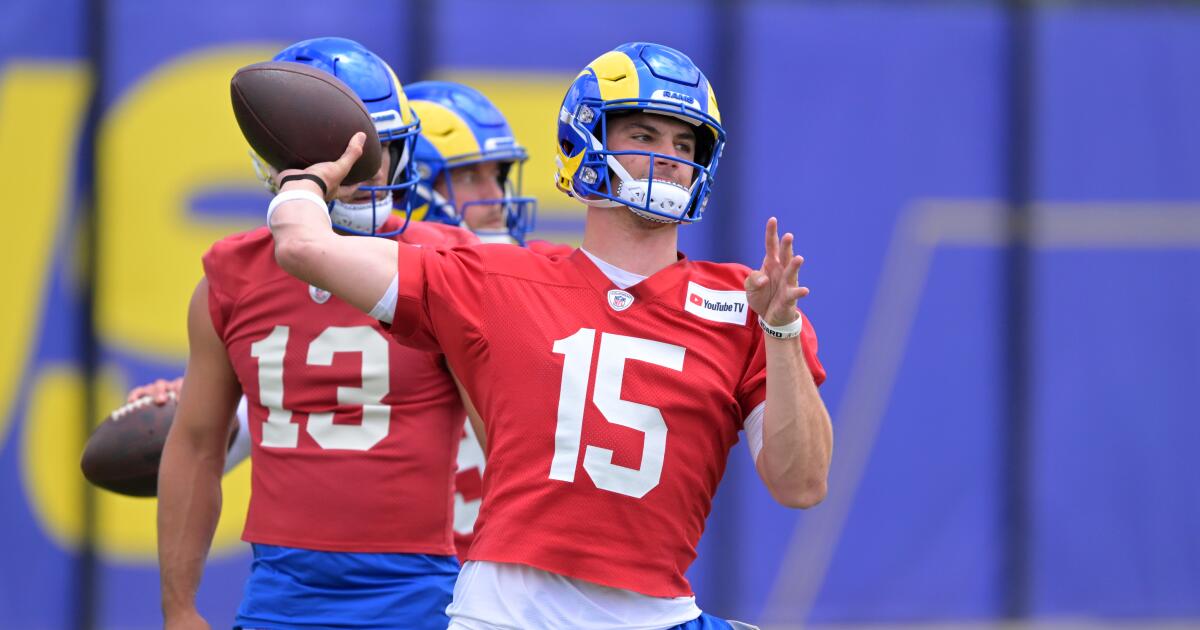
Rams QB Ty Simpson embracing an unusual bedtime routine to spur his development
-

 World22 minutes ago
Lebanon Latest: Israeli attacks surge despite ceasefire efforts
-
 News49 minutes ago
Supreme Court allows a ruling that ends a tool to protect minority voters in 7 states
-

 New York2 hours ago
How a Security Guard Lives on $46,000 a Year in the East Bronx
-

 Los Angeles, Ca2 hours ago
L.A. Tenants Union trying to save business owner given eviction notice ‘without reason or discussion’
-

 Detroit, MI2 hours ago
Grace Hanke crowned Miss Michigan 2026
-

 San Francisco, CA3 hours ago
The U.S. Government Secretly Tested Biological Weapons. The Citizens of San Francisco Paid the Price.

