Connect with us

Connecticut

Reporter’s Notebook: How surging book challenges spurred CT lawmakers to act

Published

on

Reporter’s Notebook: How surging book challenges spurred CT lawmakers to act


Efforts to ban books have surged across the country, and Connecticut is no exception.

In 2022, there were 29 library title challenges in the state, according to the American Library Association. That number more than quadrupled the following year, reaching 117 in 2023.

The Accountability Project paired up with Connecticut Public state government reporter Michayla Savitt to explore the topic.

We interviewed librarians, parents and state lawmakers, and sifted through hundreds of school board meeting minutes.

Advertisement

We found books that spark controversy in Connecticut are often intended for young readers, and discuss themes of gender identity, sexual orientation, sexual education, race and racism.

In one example, at the Cragin Memorial Library in Colchester, a patron filed a petition in 2022 against the book “Who is RuPaul?”, which was on display for Pride Month, a celebration of the impact lesbian, gay, bisexual and transgender people have had in the United States and beyond. The book is part of a popular children’s biography series meant for kids ages 9 to 12.

The book was eventually put back on the shelves. But similar challenges have become more frequent, and the process of evaluating literature differs from one community to the next.

Joe Amon

Advertisement

/

Connecticut Public

Kate Byroade, Library Director at the Cragin Memorial Library with the book “Who Is RuPaul?” open an illustration where VIVA is spelled out by the author in the older children’s section while speaking about how the selection policy at her library works, and how it comes into play with materials that may be viewed as controversial to some in Colchester, Connecticut March 26th 2025.

In response, Connecticut lawmakers have explored creating a more uniform approach. One bill, which is in committee, would immunize librarians from civil and criminal liability stemming from challenges to library materials.

Another bill would require all libraries to create a process to handle book petitions or challenges. Under the measure, a title couldn’t be removed solely because someone finds it offensive. Books would also be protected from additional challenges for three years if an attempt to have them removed fails.

Senate Majority Leader Bob Duff, a Norwalk Democrat, helped introduce that measure. The legislation might make it easier to track exactly how many books are being challenged in the state.

Advertisement

State Republicans have proposed other provisions, saying minors shouldn’t be able to access materials that have sexually explicit content or nudity.

“We’re not trying to ban books,” state Sen. Henri Martin, a Bristol Republican, said in an exchange at a February public hearing. “What we’re trying to do is protect our children.”
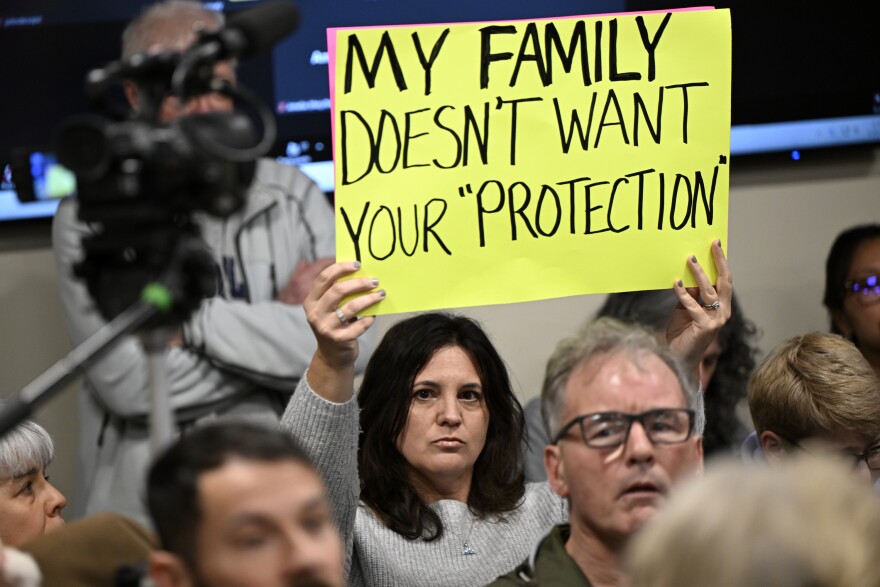
Kristen Hamilton of Suffield raises her sigh as word spreads the Kent Memorial library commission may cancel their public meeting that was to vote on library policy, "youth collection acquisition and retention policy presentation & discussion” at the town hall in Suffield, Connecticut March 20, 2025.

Joe Amon

/

Advertisement

Connecticut Public

Kristen Hamilton of Suffield raises her sigh as word spreads the Kent Memorial library commission may cancel their public meeting that was to vote on library policy, “youth collection acquisition and retention policy presentation & discussion” at the town hall in Suffield, Connecticut March 20, 2025.

The American Library Association, a nonprofit that promotes libraries and library education, tracks efforts to ban or restrict access to reading materials nationally. To collect that information, it relies on news stories and reports from individual librarians.

That means some attempts to take books off the shelves can be missed.

Some librarians won’t report book bans out of fear, said Jenny Lussier, president of the Connecticut Association of School Librarians. Some school librarians in Connecticut have received threats for doing so, she added.

“We’re all professionals,” Lussier said. “We all want what’s best for our kids.”

Advertisement


Source link

Connecticut

Connecticut Senate Approves More Towing Reforms, Expanding on Landmark 2025 Legislation

Published

on

Connecticut Senate Approves More Towing Reforms, Expanding on Landmark 2025 Legislation


Connecticut lawmakers on Wednesday approved more reforms aimed at reining in towing companies in the state, following reporting by The Connecticut Mirror and ProPublica that exposed problems in state law.

The Connecticut Senate passed a bill that would create an online portal so Connecticut drivers can track their towed cars and require towing companies to consider the age of towed vehicles before they’re sold.

Last year, the legislature overhauled the state’s towing laws to end a practice in which towing companies could start the process to sell people’s cars in as little as 15 days if the firm deemed the car to be worth less than $1,500. The window was one of the shortest in the country, CT Mirror and ProPublica found, and meant many people who couldn’t afford to quickly pay the towing fees lost their cars.

The 2025 reform law required 30 days to pass before cars could be sold, and it ordered towing companies to accept credit cards, let people retrieve their belongings from towed cars, and warn owners before towing cars from private property over minor issues.

Advertisement

But CT Mirror and ProPublica continued to hear from residents who said they never received notice that their cars would be sold because their address on file was outdated or because their vehicle was still registered to someone else. The news organizations also performed an analysis that found that many towing companies valued vehicles much lower than their estimated retail values, allowing them to sell the vehicles more quickly.

The Connecticut Senate sought to fix both those issues with the latest bill, in part with the creation of the portal. The legislation, Senate Bill 413, would put new limits on which cars can be sold quickly: Towing companies could only sell vehicles after 30 days if they are at least 15 years old.

The new bill breezed through the Senate, 35-1. The House is expected to vote on it in the next few days.

“There are bad actors,” said Transportation Committee Co-Chair Sen. Christine Cohen, D-Guilford. “We have read about it in the press. It’s what prompted us to take action and really kind of take a look at our towing statutes on the whole.”

She said that legislators wanted to find language that strikes “that necessary balance between protecting consumers from predatory behavior but also supporting the many reputable small businesses that provide these essential services to our communities.”

Advertisement

The bill received bipartisan support. Committee ranking member Sen. Tony Hwang, R-Fairfield, urged members to support the measure. He said it builds on last year’s work, which he called “remarkable landmark legislation.”

The measures came partly from a working group created by last year’s towing reform law that spent the past several months studying towing policy and making recommendations.

The working group, composed of towing companies, consumer rights advocates and Department of Motor Vehicles officials, struggled to come to a consensus on policy changes. DMV Commissioner Tony Guerrera, who chaired the working group, ultimately issued recommendations that didn’t have support from everyone on the panel.

The new bill would create an advisory council to keep studying towing policies and how owners get their vehicles back. The council would also monitor the portal, which would be set up by the state DMV and allow owners to see where their vehicles have been towed and whether they are up for sale.

The bill also addressed towing fees. Towing companies have frequently complained that the fees they are allowed to charge are too low. The bill says fee rates should be set every three years and that those changes must be based on government measures of inflation.

Advertisement

Guerrera said the portal will make his agency more transparent and will help consumers find their vehicles more quickly.

“You have to be accountable and take things head-on,” Guerrera said. “This portal that we will get running as soon as possible will allow someone to go online and — even without all their information — find where their car is.”

But consumer advocate Raphael Podolsky, who served on the working group, said the portal will mostly help towing companies do away with paperwork and make the system easier for the DMV to monitor. He warned that some drivers might not be able to access the system.

“First of all, everybody doesn’t have a computer, and second of all, everybody who does have a computer would not know to go to a DMV portal, and third, not everybody has internet access, even if they have a computer,” Podolsky said.

Sal Sena, president of the industry association Towing & Recovery Professionals of Connecticut, said he thinks the portal will “make it easier for everyone” and that the state is “on the right track.”

Advertisement


Source link

Continue Reading

Connecticut

Damp start today with nicer weather tomorrow

Published

on

Damp start today with nicer weather tomorrow


Rain early today and tapering to spotty drizzle through midmorning! Other than a spotty western CT shower late today it will try to dry out. Some sun, breezy and nicer Friday with some scattered showers at night and for early Saturday morning. On the chilly side this weekend with lots of 50s and another system going by just to our east Sunday that could clip eastern CT with a shower. We have been in a cycle of nice Mondays and that is the plan next week again!

Early this morning: Umbrella weather! Rain, heavy at times. Lows 45-50.

Today: Scattered showers during the morning. Drying out for much of the state with some late day partial clearing. A shower though for western areas. Cool with highs only in the 50s.

Tonight: More clearing with lows in the 40s.

Advertisement

Tomorrow (May 1st): Much nicer! Sun and clouds, warmer with highs in the lower to middle 60s. Scattered showers at night.

Saturday: Some morning showers moving out. Lots of clouds and cool with highs only in the middle to upper 50s.

Sunday: Lots of clouds, breezy and cool with highs in the upper 50s to about 60. Rain could clip eastern CT. during the morning!

Monday: Mostly sunny with highs in the 60s.

Tuesday: Sun to clouds with highs in the middle 60s.

Wednesday: More showers with highs in the middle 60s.

Thursday: Rain likely with highs in the middle 60s.

Advertisement


Source link

Continue Reading

Connecticut

2 babies relinquished under CT safe haven law in April

Published

on

2 babies relinquished under CT safe haven law in April


In April, two babies were relinquished at Connecticut hospitals under the state’s Safe Havens Act, according to the state Department of Children and Families. The babies were surrendered to Yale New Haven Hospital and Connecticut Children’s at the University of Connecticut Health Center, DCF said. 

The Safe Havens Act, which was enacted 25 years ago, allows a parent to give up their infant to hospital emergency room staff anonymously and without the threat of prosecution. DCF then places the baby in a preapproved adoptive home.

At a Wednesday press conference, Lt. Gov. Susan Bysiewicz said the Safe Havens Act has had “an incredible impact” and called it “life-saving.” 

“Those women who find themselves in a situation where they deliver a baby and they cannot or they do not want to raise that baby, they may feel incredibly isolated and challenged and judged, and they may feel they have nowhere to turn,” Bysiewicz said.

Advertisement

Under the law, a baby may be surrendered at a designated location by a parent, relative or advocate for the child, and the parent has 30 days to change their mind and begin working with DCF to see if reunification is possible. There are 37 medical centers in Connecticut — 25 of them hospitals — that allow babies to be surrendered 24 hours a day.

Pam Sawyer, a former state representative who spearheaded the law’s passage, said she intended it to be “so simple it could be shared in the school bus.”

But two babies relinquished in the same month — though these are the only two babies relinquished so far this year — marks a spike from the usual trend. Since the law went into effect, a total of 60 babies have been relinquished. And in 2025, just one baby was surrendered the whole year. 

Co-chair of the General Assembly’s Committee on Children, Sen. Ceci Maher, D-Wilton, outlined a number of issues that could lead a parent to give up their baby, such as inadequate housing or financial instability. 

The Committee on Children advanced a bill this session that would establish a task force to study the voluntary surrender of infants — including considerations for the best way to provide such a program without perpetuating “racial, ethnic, health, economic and socioeconomic disparities” among parents looking to surrender.

Advertisement

The bill passed the state Senate on April 15 and awaits a vote in the House.

Some lawmakers and advocates have suggested adding another option for parents considering giving up a baby — temperature-controlled chambers known as “baby boxes” that are installed within the exterior walls of a surrender location to allow parents to relinquish the infant anonymously.

Once a baby is left in the box device, alerts are sent to staff and to 911 dispatch centers. The boxes are designed with bassinets, and equipped with electricity, air conditioning and heating, but they’re not federally regulated. Lori Bruce, a researcher and bioethicist at Yale University, pointed this out during her testimony at a public hearing on the legislation Feb. 17.

“Even our hairdryers, even tongue depressors, all sorts of much more basic tools require regulation,” Bruce said. 

The boxes are intended to be anonymous, but that’s not always possible when they are installed at places like firehouses, which have cameras all around the building. 

Advertisement

Bruce said the boxes also remove the opportunity for any face-to-face interaction between the parent and a public service worker who might offer access to resources like crisis counseling — or simply ask if they are okay.

Baby boxes have been installed in 20 states so far, according to Safe Haven Baby Boxes.

Sawyer said she is in favor of the baby boxes, but only after more research.

“I love the idea, but I don’t know that they’re quite there yet,” she said. “My view still is that it’s advocacy and teaching” that will help those who need the Safe Havens Act the most.

Advertisement


Source link

Continue Reading
Advertisement

Trending
