Northeast
Cap-and-trade returns: NY plans to force big oil to ‘invest’ in ‘green’ by paying for emissions

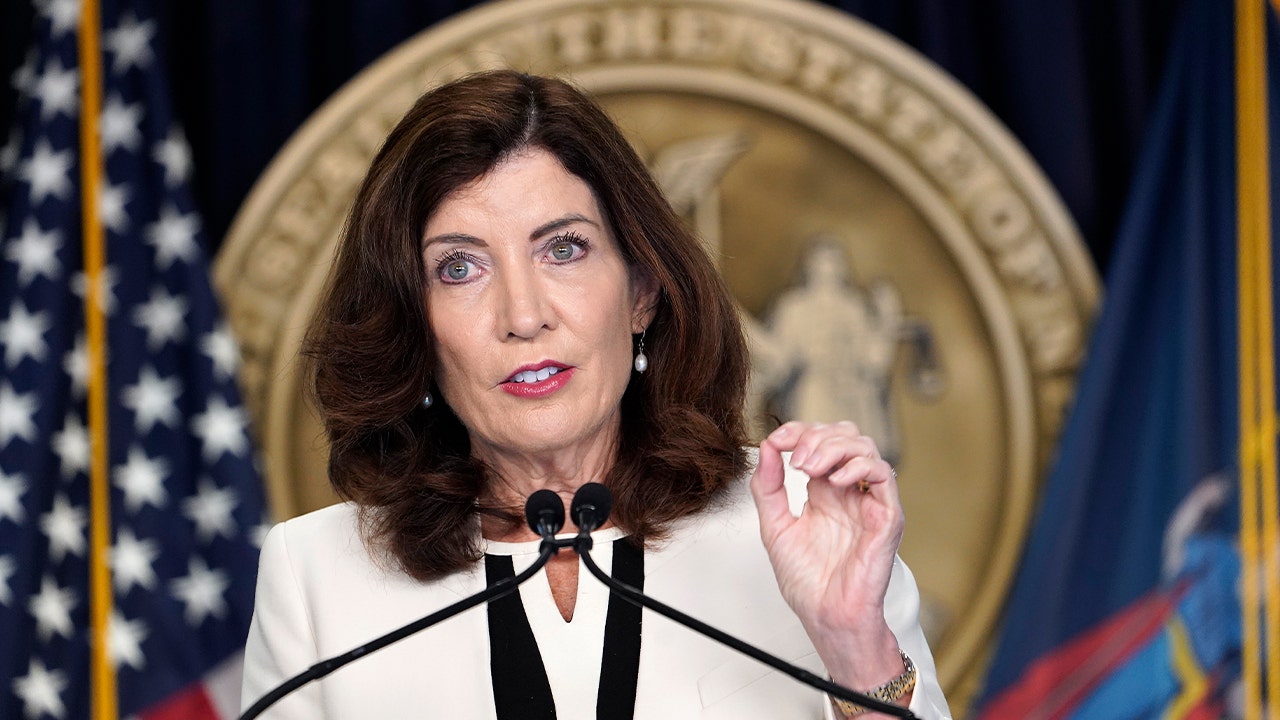
In her State of the State address Tuesday, New York Democratic Gov. Kathy Hochul is expected to lay out her “Cap & Invest” anti-pollution program that critics warn will cause gasoline and utility costs to soar in the already fossil-fuel-averse state.
The plan seeks to reduce emissions by levying companies for their greenhouse gas outputs and investing that money into initiatives like retrofitting buildings to run on green electric power.
A “cap” refers to the limit of greenhouse gas emissions that is imposed by a state. The “cap” is often projected to decrease each year in order to meet climate change prevention goals.
The state then can set up an auction to let energy companies bid on pollution-weight-based “allowances” – the proceeds from which can be invested by the government in “green” initiatives, according to New York Focus.
NY LAWMAKERS DEMAND SUBWAY CHIEF’S OUSTER AFTER COMMENTS DISMISSIVE OF CRIME AMID NEW TOLLS
New York drivers could see more pain at the pump from such a proposal, according to critics like the nonpartisan group Upstate United, which advocates for boosting upstate New York’s economy.
The AAA average gas price in New York sits at $3.14/gallon – comparable to most of the surrounding states except Pennsylvania – which usually remains higher than the rest of the Northeast due to its nationally-third-highest gas tax.
A Hochul spokesman told the New York Post that the governor is “focused on lowering the cost of living, putting money back in New Yorkers’ pockets with refunds, tax credits and more.”
Since Democrats took the executive reins from term-limited GOP Gov. George Pataki in 2007 and have held them without interruption, the Empire State has progressively restricted energy exploration in the state.
The trend began with Gov. David Paterson’s 2010 “timeout” on hydraulic fracturing for natural gas that effectively remains to this day.
The “Marcellus Shale” range is named for a town in New York – but any fracking activity since that time has occurred on the Pennsylvania end of the deposits.
State Sen. Tom O’Mara, R-Elmira, represents a district that sits on part of the Marcellus oil shale formation that remains untouchable under state policy.
Natural gas wells dot the countryside in neighboring Bradford and Tioga counties just to the south in Pennsylvania, but the landscape is clear of any signs of exploration to those traversing NY-17 through New York’s Southern Tier only a few miles away.
HOCHUL CHRISTMASTIME BOAST OF SAFER SUBWAYS CAME AMID STRING OF ALARMING VIOLENT ATTACKS
An oil pumpjack operates in the drive-thru area of a McDonald’s in Bradford, Pennsylvania, on Oct. 6, 2017. (Reuters/Brendan McDermid)
On Monday, O’Mara criticized what he called the latest “radical climate mandate” to be handed down:
“Gov. Hochul and the Albany Democrats are going to keep talking about addressing New York’s affordability crisis. But it’s clear that their actions like Cap and Invest, more aptly called ‘Cap and Tax’… will only keep driving this state into the ground economically,” he said.
In 2014, O’Mara slammed New York’s original decision to ban fracking in his area, saying it “eviscerates the hope of so many Southern Tier farmers, landowners, businesses and potential jobs in the natural gas industry.”
Hochul’s cap-and-tax plan, he said, will only increase the cost of doing business in New York and drive more families and employers out of the state while exacerbating the affordability crisis.
The plan shows the governor is out of touch with New Yorkers, Assembly Minority Leader William Barclay told Fox News Digital.
“The last thing we need is more unworkable environmental policy from Albany that drives costs up and drives residents away. Democrats constantly lecture us about the need for Cap and Invest and other misguided energy policy, but when people are paying more at the pump and can’t afford their heating bills, who benefits?” asked Barclay, R-Oneida.
“It’s our responsibility to make sure New Yorkers have reliable, affordable energy sources – not force consumers to subsidize the green dreams of the liberal environmental lobby.”
Gov. Kathy Hochul (Reuters/Cindy Schultz)
In 2021, then-New York Gov. Andrew Cuomo successfully shuttered the massive 2,000MW Indian Point nuclear power generation plant on the Hudson River opposite Haverstraw.
Cuomo cited safety concerns at the time and said “it does not belong… in close proximity to the most densely-populated area in the country.” Critics responded that that area cited – New York City – relied heavily on the power it generated and complained of increased utility bills.
A 2019 law commits New York to net-zero emissions by 2050, according to The New York Times.
Nationally, “Cap & Trade” first entered the American lexicon during the 2008 presidential campaign, when then-Sen. Barack Obama, D-Ill., wooed environmentalists with the idea of taxing entities that release greenhouse gases and affect the atmosphere.
Read the full article from Here


A broken elevator has left some residents of a Boston apartment building unable to leave, but a new stairlift has brought temporary relief.
When 80-year-old Silke Evans, who lives at the Villa Michelangelo Apartments in the North End, spoke with NBC10 Boston last Wednesday, she had been stuck inside for weeks.
“I feel imprisoned. That’s it,” she said at the time. “I feel like I’m in prison.”
Silke Evans, an 80-year-old woman living at the Villa Michelangelo Apartments in the North End, has been unable to use the elevator at her building for three weeks.
“She was stuck up on the third floor for a total of three-and-a-half weeks,” her daughter, Katharine Clark, said Thursday.
Thursday, Metro Management, which runs the building, installed the stairlift as a temporary solution while waiting for elevator repairs.
It allowed Evans to leave for the first time in nearly a month.
“They had food, and got to eat out, and just feel like a normal person,” Clark said. “She’s been looking kind of sad for weeks, so it’s the first time I saw some pictures where she was genuinely smiling.”
The fix brought major joy to Evans, with hopes of a long-term solution in the future.
“We’re not out of the woods. We still have a broken elevator. Hopefully, it’s not too many months with just a chairlift,” Clark said.
Jeff Buono, director of property management, told NBC10 Boston last week that the process to repair the elevator has been difficult.
“They’re estimating four to five weeks to get the parts and then four to five weeks for the install,” Buono said in a phone interview. “It’s tough to get parts in general. It takes longer to get them than it ever has before. So the systems now just need to be modernized. I mean, it does take a toll on our elderly population — it really does. And we do feel for them. They’re likely family to us.”
NBC10 Boston reached out to the management company for further comment Thursday, but staff had already left for the holiday weekend.
Pittsburg, PA
Pittsburgh is promising its biggest fireworks show ever. Here’s what the setup looks like.

We are just two days away from the Fourth of July, and that means fireworks. The final preparations are underway for the City of Pittsburgh’s show, which is promised to be the largest in history. In all, five barges full of fireworks will be set off for this show.
Under the blistering sun, the true heat is packed on the barges along the Ohio River. Thousands upon thousands of fireworks will go off during the 25-minute show Saturday night, done by Starfire Corporation.
“Being down here, for our family to be able to perform for Pittsburgh is such an honor,” Starfire Corporation vice president Vince Terrizzi Jr. said.
Planning started back in February for this event. The barges will go on the Mon, Allegheny and right near The Point, creating a triangle effect around the Golden Triangle.
“We have one rooftop location that will surprise people and come in and out during the show,” Terrizzi said.
In all, nine truckloads of fireworks were brought in to be part of the show. Inspectors with the Pittsburgh Bureau of Fire inspected and will do a final inspection before the show. For the inspector, it’s her last show as she plans to retire in a few months.
“Going out with literally the biggest bang the city has ever seen,” Lisa Epps-Cuda said with a laugh.
Starfire has done the about a half dozen of the city’s shows over the years, and it never gets old for them.
“Listening to the crowd’s response, boats cheering, those kind of things make it worth its while,” Terrizzi said.
As for the weather, the big concern will be lightning; the fireworks can still be fired off in the rain. The show is set to go off at 9:35 on Saturday night.

In order to get to the truth, it’s important to define your terms.
For example, what precisely do you mean by the word Connecticut? Or is it Quinnehtukqut, in the Algonquin language?
It’s also important how you frame your story.
That is, what do we miss if we only start Connecticut’s story in 1776? What about the long, century-and-a-half colonial/religious run-up beginning in 1638? What about the 10,000 years before that, of indigenous habitation along our state’s long and short rivers? And what of all Long Island Sound?
Depending on where you start, you might have a geography story, a political story, a theological struggle.
You also need to include not only 50 or 60 founding fathers, but a full range of voices — you must try to expand the historical house, and also tell a whole story, not a partial.
For example, even in a copiously told tale of the Elm City Signer-in-Chief Roger Sherman, if you stopped his story at the mere signing of the Declaration of Independence, he’d still be a guy in a homespun suit among many in the founders’ chorus.
Although John Hancock appointed Sherman to the committee — along with Jefferson, Franklin, and Adams, to write the document we are all celebrating this year — it’s clear he wasn’t much of a writer, or editor, or speller. John Adams, when he recollected those days, couldn’t even remember Sherman in the room of the writing of the document that changed the world. Apparently only Franklin and Adams dared to edit the brilliant Jefferson’s prose.
However, continue the story to 1787, and Roger Sherman’s political and personal skills help lead the way to the bicameral compromise — a Congress with one legislative house based on population side by side with another house of equal number of senators from each state.
Without this deal — known as the Connecticut Compromise — there would have been two-and-a-half strikes against the possibility of ever passing a Constitution; and as a consequence, perhaps no United States. That makes Sherman a profound hero of the democratic story, and, of course, earns our sobriquet as the Constitution State.
All this fascinating, perspective-altering stuff was at the heart of a by-turns erudite and entertaining lecture — call it a sermon on history– entitled “Why Connecticut 250 Matters,” delivered by Connecticut State Historian Andy Horowitz.
Receiving it Wednesday night was a standing-room-only crowd of some 200 New Haven history glitterati gathered at the New Haven Museum.
Horowitz’s lecture was the companion piece to a gala evening marking the opening of the New Haven Museum’s new exhibition, “New Haven’s Unfinished Revolutions.”
With opening remarks by City Historian Michael Morand and exhibition director Joanna Steinberg and designers David Jon Walker and John Kudos, attendees also took in the spiffy photo and large, wall-text-festooned new space — the gallery to the left as you enter the museum’s first floor.
The exhibition is designed to include all those voices that Horowitz talked about — the centerpiece being a kind of grand kiosk or large table where you can put “tablets” of, so far, largely 18th century documents into a “cradle,” and then the docs come alive.
You hear, for example, a selection of the deposition by Sarah Townsend of the British invasion of New Haven in 1779. It’s a rare document in the NHM’s collection, but how many have had a chance to read it?
Enter the new exhibition, and the text appears on a screen in front of you — in both the original handwriting and an easy-to-read print version, as her voice speaks in the voice of local actors from New Haven who have done the recordings.
It’s immersive and the whole packed space — 900 square feet, which is not much bigger than a comfortable one-bedroom Elm City apartment — is trying to tell a Big Story, much of it under-told or never-told. It’s also designed for classes and groups and to be a kind of teaching house, said Steinberg.
The “table” is its centerpiece, a kind of hearth — designer John Kudos agreed to this reporter’s characterization — is where an individual, a family, or a group of school kids gather round to warm to the sounds and evocations of long ago and also to not-so-long-ago overlooked voices.
And the design is such that new documents can be added, indeed, are being added from the museum’s collection, along with contemporary documents/voices as they emerge in the living history of the city.
“The soul of New Haven is on display,” said Walker, one of the designers, via video hook up.
By that he meant, in part, under-told stories such as that of the Winchester Repeating Arms Company and those many African American immigrants from a racist South who labored on its factory floors and built new lives and institutions in the Elm City; the Model City era of the late 1960s; May Day of 1970, with the mutual aid groups such as the Hill Parents Association and the local Black Panthers who organized in the run-up; and New Haven’s important labor history as captured in the watershed 1975 teachers strike. The exhibition ends with material from the environmental movement of the 1980s.
In addition to Roger Sherman, the two other “souls” from New Haven’s 1776-era history whom Horowitz summoned and evoked to structure his tale were Hannah Mamanash, an indigenous woman of the Wangunk tribe (related to the Quinnipiacs and Mohegans); and Cuff Wells (also known as Cuffee Saunders), kidnapped as a child from Guiana, in South America, and enslaved in Colchester, Connecticut.
Known mostly through land deeds and an extensive petition for Revolutionary War pensions, Mamanash saw four of her sons enlist in George Washington’s forces. Three, perhaps all four, were killed in the Revolutionary War fighting.
“It’s hard to believe,” said Horowitz, “that anyone made a larger sacrifice to the American Revolution than Hannah Mamanash.”
But Horowitz deepend the story: Mamanash also had a daughter, who married a Samson Occam, a Mohegan who was Christianized, became a minister, and was the first Native American to publish a book. In another document, from 1775, a letter to the Oneida tribe, Mamanash’s son-in-law Occam tried to explain and advise which side that tribe should take in the fast-arriving rupture with Great Britain.
He basically took a neutral position, citing Jesus as a template for being peace-makers, not side-takers, although he did characterize the English as the oppressors and the patriots as the oppressed.
Yet Horowitz’s point is that there was no inherent, clear, obvious reason for Mamanash and her sons to make the choices they made, and the sacrifices they gave. Their history goes back much farther, sometimes siding with the English, sometimes the French, often with no one. You widen the story, and it gets deeper, more complex.
Wells’s enslaver was an apothecary and with that skill, which he learned, Wells enlisted in the Continental Army tending the sick and likely saving lives at the army hospital in Danbury, and later at Valley Forge.
And yet, Horowitz taught, it’s important to know that at the start of the Revolution neither Washington nor the creators of the Declaration wanted Blacks to enlist at all, whether they were apothecaries or not. Like the British they were afraid of what enslaved people might do if given firearms.
In fact, the phrase, among the list of colonists’ grievances in the Declaration itself, is the tell in this context: “Exciting domestic insurrections amongst us” primarily refers to British inducements to enslaved African Americans to flee their American masters and to fight for the king in exchange for offers of freedom.
And still Wells enlisted and deployed his skills, survived the war, received a pension, bought three acres of land in Lebanon, and sired a son, Prince, who went on to graduate from Dartmouth College.
If that isn’t a little-known American story that should be better known, I don’t know what is.
Horowitz was at pains to point out, also, that Wells is known, in the extensive 127-page pension file, the key source of his biography, also as Cuff Saunders.
“He changed his name,” Horowitz surmised, “because he did not want Wells, his enslaver’s name.”
“And such stories are not that unusual,” Horowitz added, “among Black soldiers, who gave themselves names like Caesar, Liberty, Beman. Every description is a form of argument.”
“So what to make of these stories?” Horowtiz drew towards his conclusion and, of course, the relation of the past to the present.
He said the kind of historical research, the poring over documents in archives, that yielded these stories is precisely the kind that is being threatened today, along with, of course, doing the opposite of expanding the historical frame, which is the policy direction of the current administration.
He didn’t mention the name of President Trump, but the narrowing of history, the bee in the bonnet of the current administration, was clearly the elephant in the room, to mix the zoological metaphors.
“When I began, there were three people in the office of state historian. Now I’m the only one. Seventy percent of professors teaching history are un-tenured. History departments are closing down. As a tenured historian I’m like a typewriter repairman, the last of my kind.”
And if there were a single theme to this wide-ranging yet also deep dive into Connecticut’s 1776, it was this: “A narrow sense of history yields a narrow sense of the future.”
Which is why Morand had concluded his remarks, in the new exhibition space of “New Haven’s Unfinished Revolutions,” singing from the same hymnal, with similar congratulatory, if minatory, praise:
“This is a major addition to understanding what New Haven has been and what it has become and to what they and we can do to affect the future. . . Our history is not about the past, it’s made active, it’s story upon story, not punctuated by a period, but an ellipsis. This show is really about America 251, 252, 253 . . . ”
 100vw, 1024px”/><figcaption class=) State Rep. Pat Dillon and local historian Aaron Goode discuss democracy and what to do with the U.S, Supreme Court!
State Rep. Pat Dillon and local historian Aaron Goode discuss democracy and what to do with the U.S, Supreme Court!
 100vw, 1024px”/><figcaption class=) Former teachers union President Frank Carrano, listening to what he said about the 1975 strike.
Former teachers union President Frank Carrano, listening to what he said about the 1975 strike.
Related
-

 Los Angeles, Ca1 hour ago
Boy, 17, with autism accused in murder of 4-month-old girl at Claremont daycare
-

 Detroit, MI2 hours ago
Brief rally not enough for Tigers vs Rangers as win streak ends at 3
-

 San Francisco, CA2 hours ago
Crash on freeway in Millbrae leaves driver dead after reportedly overturning multiple times, CHP says
-

 Dallas, TX2 hours ago
Paige Bueckers, Azzi Fudd do the usual in Hartford, win. This time with Dallas Wings
-

 Miami, FL2 hours ago
World Cup-inspired art exhibit transforms Miami’s Wynwood with interactive soccer experience
-

 Boston, MA2 hours ago
Stairlift brings relief to residents stuck in building with broken elevator
-

 Denver, CO2 hours ago
Free agent point guard Tyus Jones re-signs with the Denver Nuggets – Denver Stiffs
-

 Seattle, WA2 hours ago
Husky Recruit To Move From Seattle to Florida For High School Ball

