

Sign up for the Today newsletter
Get everything you need to know to start your day, delivered right to your inbox every morning.


The aspect of the city’s zoning plan that perhaps most strongly signals a break with the past would strike the rules that gave birth to the Combat Zone in the neighborhood. It would largely be a symbolic move, as the heyday of the notorious den of sleaze — once home to strip clubs, X-rated theaters, peep shows, and adult bookstores in the downtown core of Boston — is decades in the past.
Still, for those who advocate for Chinatown, removing a slice of the zoning that for years allowed for Boston’s only adult entertainment district in their neighborhood matters. It’s a modicum of recompense for a time when city authorities largely ignored the wants and needs of a place that has for generations offered a beachhead for immigrants.
“Chinatown suffered decades of increased crime and negative impacts on the community,” said Lydia Lowe, executive director of Chinatown Community Land Trust. “That issue is very important.”
The rezoning discussion — a comment period for the city’s proposed changes ends in mid-January — comes amid a time of transition for Chinatown, one of Boston’s smallest neighborhoods, an ethnic enclave with a rich history in the city’s urban core. Talk to seemingly anyone in Chinatown and they’ll say that displacement is their largest concern. And demographic data back up the notion that the effects of years-long gentrification continue to alter the fabric of the neighborhood.
The city’s planning department this fall released a draft of new zoning regulations and design guidelines that “seek to promote affordable housing, emphasize the significance of small businesses and cultural spaces, and highlight Chinatown’s unique character,” Brittany Comak, a department spokesperson, said in an email.
The next public meeting, focused on property owners, will be held in January, with final recommendations to come later, Comak said.
The proposal looks to better protect the neighborhood’s historic row houses — symbols of Chinatown’s working class, which now faces displacement — by capping how tall developments can be in part of the district. Residents have fought to preserve the affordability and character of those structures, saying they are integral to the area’s cultural fabric, one of the last untouched pockets of a neighborhood roiled by development.
Under the plan, the maximum height of projects would be 45 feet, down from the current 80 feet. (Chinatown’s row houses tend to be three to four stories in height.) Other restrictions, according to the city, would help ensure new buildings “would be of similar size and scale to the existing row houses” in a certain subdistrict of Chinatown.

“We find that to be a positive change,” said Müge Ündemir, director of real estate for Asian Community Development Corporation, of the city’s zoning approach to the row houses.
Other parts of the rezoning initiative are being met with questions or outright skepticism.
For instance, an affordable housing overlay district would allow developers in parts of Chinatown to build structures up to 350 feet tall, if they meet two thresholds: 60 percent of the gross floor area must be devoted to residential uses, and 60 percent of the residential units must be income-restricted and meet an affordability standard. While advocates support the idea of more affordable housing in Chinatown, 35 stories, they argue, is way too high for the neighborhood.
Karen Chen, executive director of the Chinese Progressive Association, worries that such towering buildings could exacerbate quality-of-life issues in a neighborhood where some blocks are already cast in shadow and wind tunnels are a reality thanks to past development.
“Chinatown is so small and congested already,” said Chen. “Up to 35 stories is just ridiculous.”
Through a spokesperson, the city’s planning department said the overlay “reflects heights of recent projects in the area, how other areas of downtown are being rezoned to increase allowable building height, and acknowledges the clear community priority to deliver affordable housing in Chinatown in an area of limited sites for development.”
Others are critical of the income ceiling for who would qualify for the affordable housing in such projects. Under the city’s plan, households making up to the area median income would qualify. For a one-person household, the cap would be about $114,000.
Advocates want the cap to be much lower, say 60 percent of area median income, which would be about $68,000 for a one-person household. That would more directly help the neighborhood’s working class and working poor, they argue.
“The affordability standard, it needs to match where the neighborhood is at,” said Chen, who also worries that a proposed “transition zone” would contribute to the further encroachment into Chinatown of downtown’s luxury residential towers.
Angie Liou, executive director of the Asian Community Development Corporation, concurs, saying the general idea of incentivizing more affordable housing in the neighborhood is a good one.
“The devil’s really in the details,” she said.

Officially, more than 4,200 residents live within about one-fifth of a square mile that makes up Chinatown. (Advocates have long challenged the population estimate there as severely undercounted.)
According to city figures, about 64 percent of the neighborhood’s population identifies as Asian or Pacific Islander. Half the population is foreign-born, with just under half of all Chinatown residents speaking Mandarin or Cantonese at home. There was a time when those numbers were much higher. An old master plan for the neighborhood estimated that in 1990, 91 percent of residents were Chinese.
Chinatown’s history is one of political marginalization. The Combat Zone, which is now occupied by luxury apartments and trendy restaurants, is a high–profile example of the city treating the neighborhood as an afterthought. Two strip clubs on LaGrange Street still stand in the city’s “adult entertainment district” as a reminder of what once was. They would remain part of an adult entertainment district under the proposed zoning changes, as they are located just outside of what the city considers to be Chinatown.
There is a history of development profoundly changing the neighborhood, which has never produced a Boston city councilor. Construction of the Central Artery and the Massachusetts Turnpike took sizable bites out of Chinatown decades ago, and the steady expansion of Tufts Medical Center also ate away at blocks.

Amid current gentrification and displacement challenges, many first-generation immigrants and working-class Chinese Americans still look to Chinatown for their day-to-day needs, as they have for more than a century. A plaque at Ping On Alley memorializes the city’s first Chinese immigrants, who pitched their tents there starting in 1875.
Advocates say new zoning alone won’t stop gentrification, but some hope it could have a “calming effect” on the neighborhood. Enforcement of the zoning rules also matters. Liou, of the Asian Community Development Corporation, said the city has historically given out variances to Chinatown projects on a regular basis, which has had a cumulative effect of largely rendering the existing zoning moot.
“If it’s on the books and no one follows it,” said Liou, “It’s pointless.”
Danny McDonald can be reached at daniel.mcdonald@globe.com. Follow him @Danny__McDonald.


Amid several reports that said Brown didn’t request a trade and that Boston actually thought Derrick White was the best player on the 2025-26 roster, an already motivated Brown now has an even larger chip on his shoulder after the Celtics dealt him away.
“The message was received,” Brown said. “I wasn’t thrilled with the amount of respect that was shown throughout this process. I think there was a bit of a lack of respect. I think it was fine at one point, then out of nowhere, things just went left. I think Brad [Stevens] is getting a lot of the criticism. I wasn’t thrilled with the way he facilitated some of the conversations.”
After the Celtics fell short in their pursuit of Giannis Antetokounmpo — Brown was the centerpiece of Boston’s trade package — Stevens was noncommittal when asked about Brown’s future in Boston.
“Jaylen Brown is a big part of us,” Stevens said. “I’m never going to predict the future, but every indication, everything that I think about over the past few years has been building around those guys, right? So obviously, you never know. But at the same time, the one thing I want to make very clear is how valued he’s always been.”
“He’s been amazing. He’s been an amazing teammate, a great person to be around. And whether that run ends 10 years from now when he retires, or before, there’s a lot to celebrate. We have a great relationship, an open relationship where we talk about everything. But I don’t want to predict the future. I look at it as, this is our team.”
Stevens traded Brown to the 76ers on Wednesday in exchange for Paul George, two first-round picks, and two second-round picks. The deal was widely criticized.
For Brown, the most puzzling aspect was the lack of an explanation.
“I definitely think there’s more to it,” Brown said. “I just wish that more to it could’ve been explained to me. Because I think if more to it was explained, I would’ve understood. I thought I earned the respect to get that explanation. But hey, obviously, I was wrong. That’s life. You move on.”
Brown will now join a 76ers team that, with Tyrese Maxey, Joel Embiid, and V. J. Edgecombe already in place, could be poised to leapfrog Boston in the Eastern Conference.
“I don’t want [any] special treatment, I don’t need no handouts … I plan on earning my respect one day at a time by putting in the work,” Brown said of playing for Philadelphia. “I’m looking forward to getting in the gym, the whole process.”
“The hard part is, the last 10 years, I’ve been programmed to hate Philadelphia. The history of the rivalry, the playoff battles … I’ve been programmed to think like, ‘[Expletive] The Process’. It’s funny, now I’ve got to reverse-engineer it. But I’ll be ready to go by the time the season starts.”
Conor Ryan can be reached at conor.ryan@globe.com.

A broken elevator has left some residents of a Boston apartment building unable to leave, but a new stairlift has brought temporary relief.
When 80-year-old Silke Evans, who lives at the Villa Michelangelo Apartments in the North End, spoke with NBC10 Boston last Wednesday, she had been stuck inside for weeks.
“I feel imprisoned. That’s it,” she said at the time. “I feel like I’m in prison.”
Silke Evans, an 80-year-old woman living at the Villa Michelangelo Apartments in the North End, has been unable to use the elevator at her building for three weeks.
“She was stuck up on the third floor for a total of three-and-a-half weeks,” her daughter, Katharine Clark, said Thursday.
Thursday, Metro Management, which runs the building, installed the stairlift as a temporary solution while waiting for elevator repairs.
It allowed Evans to leave for the first time in nearly a month.
“They had food, and got to eat out, and just feel like a normal person,” Clark said. “She’s been looking kind of sad for weeks, so it’s the first time I saw some pictures where she was genuinely smiling.”
The fix brought major joy to Evans, with hopes of a long-term solution in the future.
“We’re not out of the woods. We still have a broken elevator. Hopefully, it’s not too many months with just a chairlift,” Clark said.
Jeff Buono, director of property management, told NBC10 Boston last week that the process to repair the elevator has been difficult.
“They’re estimating four to five weeks to get the parts and then four to five weeks for the install,” Buono said in a phone interview. “It’s tough to get parts in general. It takes longer to get them than it ever has before. So the systems now just need to be modernized. I mean, it does take a toll on our elderly population — it really does. And we do feel for them. They’re likely family to us.”
NBC10 Boston reached out to the management company for further comment Thursday, but staff had already left for the holiday weekend.

Concert Reviews
Goose at Leader Bank Pavilion, Boston, July 1, 2026.
I discovered the fan spritzing water at 7:07 p.m., as the “feels like” temp hit 102. It stood near a semicircle of coed porta-potties at the back of Boston’s Leader Bank Pavilion, and we gathered round it like wallowing water buffalo at a flooded rice paddy.
Still, despite the temperature, the weather was not the hottest thing in Boston last night. Goose was on fire.
Night 2 of their “Big Modern!” Boston run saw mostly old favorites. All fat funky jams and spectacle, it veered into the frantic — primal guitar and crowd whoops. You could’ve charged for the light-show alone. They made a case for frontman/Berklee alum Rick Mitarotonda as one of the great lead jam guitarists working today.
Now, sometimes the most selfless gift a band can give fans on a new album tour is to not play much off the new album. I’m thinking of how heartbroken my dad was when Neil Young indulgently played 2003’s “Greendale” in full. With costumed actors. Before most fans had the album (if they bought it).
As for Goose, I’m not a big fan of their slick, heavily produced (overproduced?) “Big Modern!,” released last month. The record gives big “I said we’re not a jam band, Mom!” vibes. Whether it’s a new direction, a lark, something to get out of their system, or a Bob Dylan-esque random venture into new territory, a la “Saved,” only time will tell.
But unlike Neil Young, Goose selflessly delivered the hits. They played just one song off the new album — the title track. For the record, they played only one “Big Modern!” song on night 1 in Boston: “Torero.”
Live, the artists’ DNA remains. Those funky, meaty jams, Mitarotonda’s smooth vocals and raw guitar that feels at all times begging to be let off the leash to run wild, howling — until it inevitably does.
Sorry, Goose. You’re a jam band. You cannot fight animal-nature.
When the powers of lead guitarist/vocalist Mitarotonda, multi-instrumentalist Peter Anspach — both natives of Wilton, Conn. — combine with bassist Trevor Weekz and Bedford, Mass. native drummer Cotter Ellis, jams get electric.
When that electricity combines with the Jedi-level mastery of their brilliant lighting production team, including lighting designer Andrew Goedde — it feels otherworldly. By the end of the night, my camera roll looked like a kaleidoscope.

The Connecticut quartet took stage at 7:39 p.m. Anspach, typically the one to address the crowd, walked on stage with: “Alright, Boston let’s do this. Drink your water tonight, man. It’s f—ing hot.”
They launched into a fiery “Iguana Song” with red and green lights which turned to green and blue, then epic white and red strobes as Mitarotonda’s guitar let out primal screams, and Cotter thwacked. The crowd got on their feet and never sat down.
“Iguana” reached two peaks and ended with all of us cattle-lowing “Goooooooooose” in the way that Springsteen’s fans shout “Bruuuuuuuuuuce.” (We’re not booing.)
The smell of weed poured over me by 7:42. Yes, by God, in the age of ubiquitous vapes and pre-packaged candy edibles, a few old-souls brought skunky old-school pot. The smell immediately took me back to childhood days at Great Woods. (Single tear in eye.)
Next: fan favorite “Royal” as a blue balloon was tossed in the crowd. Things slowed down a bit with “It Burns Within,” before launching into “Wisteria Lane” with Anspach playing both guitar and keys simultaneously, and lights shooting like UFO beams before breaking into greens and purples.
The highlight of the night, though, was an incendiary version of “Electric Avenue” — a 1982 Eddy Grant song that’s become a repertoire staple — that had the whole crowd singing, then shouting as Mitarotonda’s lightning-fast fingerpicking became frantic.
Then Ellis took lead vocals on a funky “Draconian Meter Maid,” a Swimmer song Ellis apparently brought to the band when he joined in ’24. It ended in a cacophony of electric sound, warped beats building into a frenzy before slowing to almost a full halt as bands of orange and green light waved like seaweed in water. As it built back up to the frenzy, the crowd lost it, whooping and screaming, dancing in aisles.
Next came a bluegrassy hoedown “Flodown” to end set 1 around 9:06 p.m., with the “feels-like” temp a balmy 93 degrees.
Intermission saw guys sticking heads under outdoor bathroom sink faucets, wiping faces down with paper towels, holding sweating beer cans to foreheads.
Set 2 kicked off at 9:35 p.m. with the only song they’d play off “Big Modern!” all night: the title track. The set started off spacier, adding to a slow trippy feel. It was now fully dark, and the lights popped even more, hazy light beams illuminating mist and smoke in the air.
“Creatures,” had a sway-in-the-aisle feel, ending with some goosebumps-inducing vocals from Mitarotonda, as lights turned aqua blue. “Jive II” was pure funk that proved they’re a jam-beast at heart. Set 2 ended with “Jive Lee,” but they quickly returned for an encore with “Doobie Song,” a pure reggae tune played for the first time in a year, which Anspach said was dedicated to their crew.
The mellow song was a beautiful way to bring everyone down off the mind-melting jams. It reminded me of how the Grateful Dead capped nights with a lullaby, “We Bid You Goodnight” as a chamomile tea for the mind.
They capped with “Give It Time,” under a hushed aqua light, ending around 11 p.m. Mitarotonda sang, “Go ahead, give it hell.”
They did.

After 13 songs in more than three hours, they delivered something for every type of Goose fan in Boston last night — and every type of Goose fan was there.
There were the “Big Modern!” fans— one dude in a bright yellow and pink jumpsuit, to match the album colors. Young couples in Dead & Co shirts, gray-haired dads with polo shirts, khaki shorts and Keens drinking next to classic wooks. A white-haired grandmother-type in a long floral dress swayed next to a pack of teens with glitter on their faces.
I spotted half a dozen Celtics jerseys with “Walton” on the back, an homage to Boston Biggest Deadhead. Grateful Dead-themed Red Sox jerseys — some with Garcia on the backs — peppered the crowd. A man in Lululemon. A young girl with hand-made patchwork overalls. Bearded hippies with decades-old Neil Young tees.
All of us here to happily dance in the 100-degree heat for hours of fiery jams.
Like it or not Goose, you’re a jam band. It’s coiled in your DNA. Your cells ring with it. You can put out as many bubblegum-slick albums as you want. Blood always tells.
Lauren Daley is a freelance culture writer. She can be reached at [email protected]. She tweets @laurendaley1, and Instagrams at @laurendaley1. Read more stories on Facebook here.

Get everything you need to know to start your day, delivered right to your inbox every morning.

L.A. Affairs: He wanted L.A. I wanted New York. A panic attack changed everything
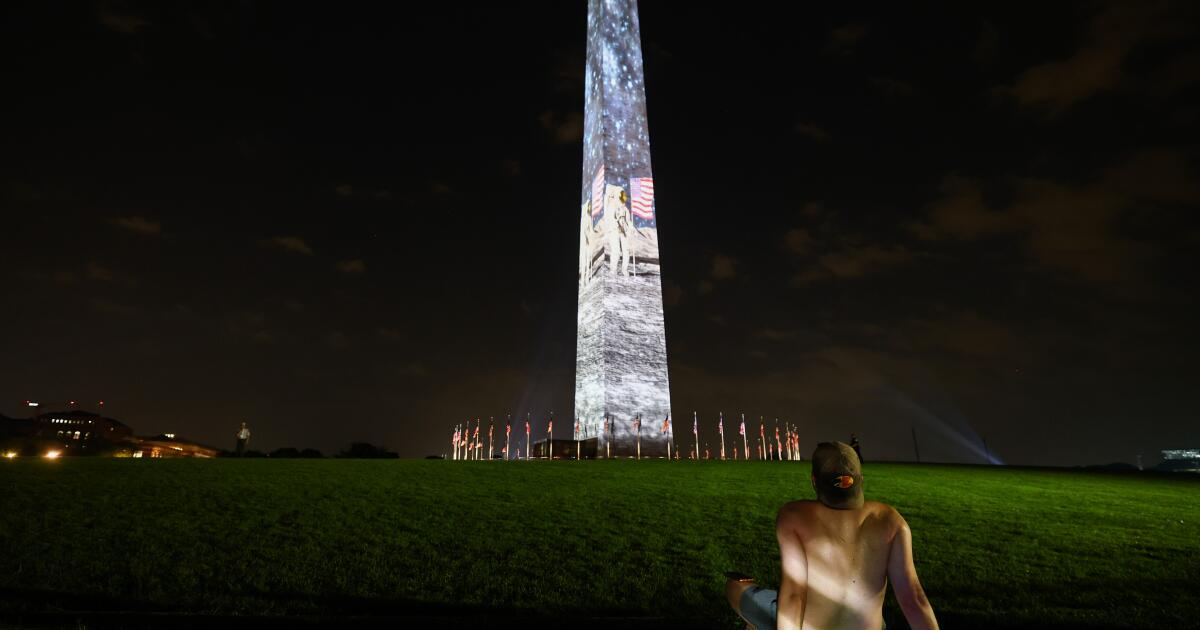
Trump refashions America’s 250th as a celebration of himself

How Dodgers’ Max Muncy, vying for his third All-Star selection, continues to evolve


Germany’s Merz defends NATO spending after Trump calls it ‘ridiculous’

Oregon ER doctors win a ‘David and Goliath’ battle against a national company


Iran gets ready for Khamenei’s funeral • FRANCE 24 English


2 arrested after 3 LASD deputies injured during East L.A. World Cup celebration


Ex-girlfriend in custody after Taylor man found fatally stabbed, police say

