Northeast
Bodycam footage details rough encounter between ex-Trump campaign aide, Smith case agents

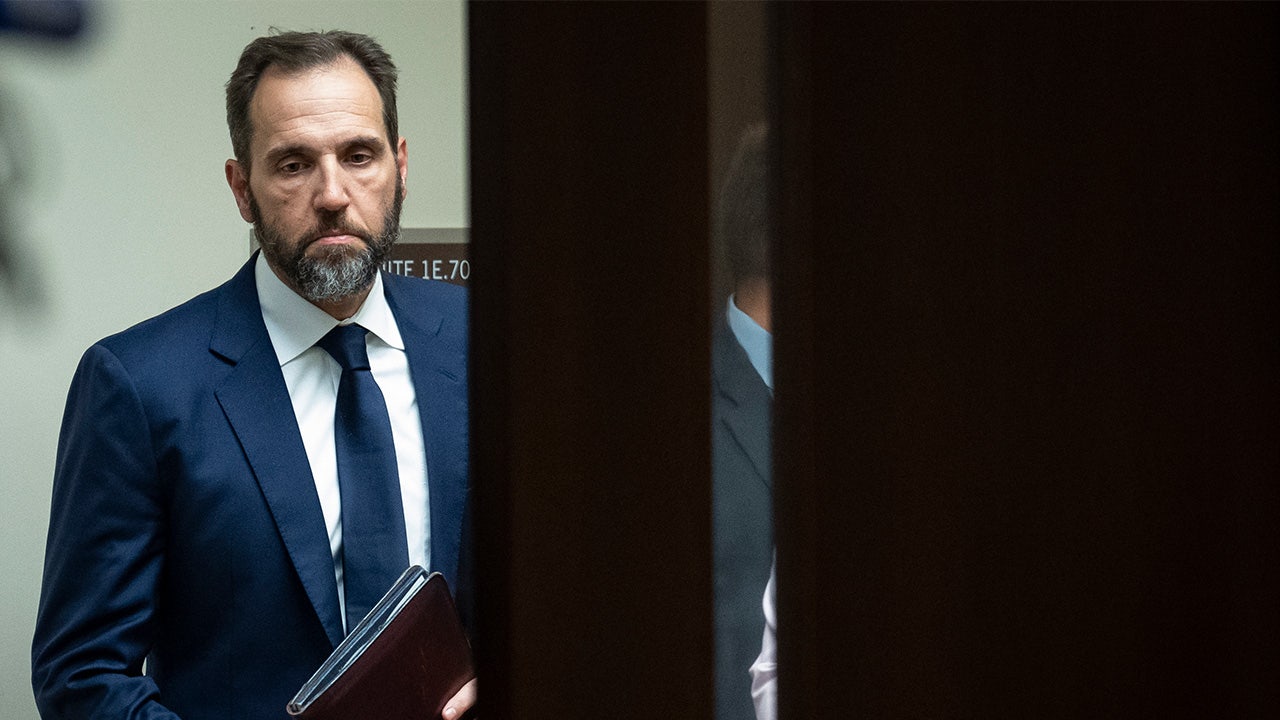
New bodycam video from Maryland police officers obtained by “The Ingraham Angle” depicts a 2020 Trump campaign aide who was indicted in the Georgia election case complaining about allegedly overblown tactics by FBI agents dispatched as part of special counsel Jack Smith’s separate federal probe.
On Friday, substitute host Will Cain reported former Black Voices for Trump Director Harrison Floyd had claimed he was returning home with his daughter when men in suits “out of the show ‘Better Call Saul’” appeared and ran after him.
Floyd can be seen appearing winded while recounting to police in Montgomery County that he yelled back to the men “who the [expletive] do you think you are?” and claiming the men never displayed credentials.
Floyd, who served in Iraq with the Marine Corps and is an MMA expert, also recounted how he considered responding when one of the men brandished a pistol.
‘EXTORTION’: ATTORNEY FLAMES REPORT JACK SMITH DEPUTY TRIED TO ‘FLIP’ TRUMP VALET
Special counsel Jack Smith arrives to give remarks on a recently unsealed indictment including four felony counts against Donald Trump. (Drew Angerer/Getty)
He was later accused of body-slamming one agent, which his attorney, Chris Kachouroff, said was originally a misreported allegation in the press that made its way into the case documentation.
“They should have retracted that, but at the end of the day, if you look at the police report, it’s odd, to say the least,” Kachouroff told “The Ingraham Angle.”
“Remember, these are two FBI agents. They’re law enforcement, and if you look at the state police report, remember, Harrison called the police when these strange people came up to his house and followed him. When you look at the state police report, he is the one who called [police] and he’s the victim. He’s listed as a victim.”
Kachouroff said about 10 hours after he called police, he was himself arrested.
The attorney added that, as a former law enforcement officer himself, it would have been likely that authorities would have responded physically if Floyd had touched them as alleged in that case.
JARRETT: SMITH SHOULD BE ‘INDICTED FOR STUPIDITY’ OVER LATEST TRUMP CHARGES
“If you touch a police officer in his nose — you get that close to him where you’re you’re pointing at his nose… poking his cheek, as they said in the police report… you’re going to get hooked.”
Kachouroff added that Smith’s agents had the responsibility to properly identify themselves if they were not in uniform, saying plainclothes detectives will often wear their badge as a necklace for that reason.
Returning to the bodycam, Floyd can be heard telling police he wants to know the identities and the supervisors of the agents who jumped out at him.
“I want to press [expletive] charges against whoever those two are who are coming after me with my [expletive] daughter… ” Floyd is heard saying on tape.
When he tells police “that’s not the way [serving a subpoena] is done,” one officer replies, “I agree with you.”
“[T]he odd thing is they have the state police arrest him for a state crime, and then just… 10 hours after he made the report, so you can imagine his surprise that he now gets arrested,” Kachouroff said, adding that the case must have looked “embarrassing” to the FBI to see police instead make the arrest.
CLICK TO GET THE FOX NEWS APP
The attorney claimed Maryland officials called him to tell him Floyd’s state-level case was later being dismissed, but that his client could instead be indicted federally.
“Like I said, no police officer worth his salt — even an FBI agent — is going to do this type of shenanigan,” he said.
The subpoena against Floyd stipulates he must turn over his contacts with Trump, the Trump White House and attorneys working for Trump, as well as documents relevant to any potential contact with the election workers who successfully sued former New York Mayor Rudy Giuliani, according to Politico.
Floyd had been charged in Atlanta along with a slew of other Trump-connected figures under the Georgia RICO statute, but reportedly has yet to be indicted by Smith.
The Maryland incident occurred Feb. 23, 2023, according to the Washington Post, which also reported the case affidavit claimed one of the agents held out his bureau credentials at one point, but that Floyd didn’t look at them.
Read the full article from Here


In order to get to the truth, it’s important to define your terms.
For example, what precisely do you mean by the word Connecticut? Or is it Quinnehtukqut, in the Algonquin language?
It’s also important how you frame your story.
That is, what do we miss if we only start Connecticut’s story in 1776? What about the long, century-and-a-half colonial/religious run-up beginning in 1638? What about the 10,000 years before that, of indigenous habitation along our state’s long and short rivers? And what of all Long Island Sound?
Depending on where you start, you might have a geography story, a political story, a theological struggle.
You also need to include not only 50 or 60 founding fathers, but a full range of voices — you must try to expand the historical house, and also tell a whole story, not a partial.
For example, even in a copiously told tale of the Elm City Signer-in-Chief Roger Sherman, if you stopped his story at the mere signing of the Declaration of Independence, he’d still be a guy in a homespun suit among many in the founders’ chorus.
Although John Hancock appointed Sherman to the committee — along with Jefferson, Franklin, and Adams, to write the document we are all celebrating this year — it’s clear he wasn’t much of a writer, or editor, or speller. John Adams, when he recollected those days, couldn’t even remember Sherman in the room of the writing of the document that changed the world. Apparently only Franklin and Adams dared to edit the brilliant Jefferson’s prose.
However, continue the story to 1787, and Roger Sherman’s political and personal skills help lead the way to the bicameral compromise — a Congress with one legislative house based on population side by side with another house of equal number of senators from each state.
Without this deal — known as the Connecticut Compromise — there would have been two-and-a-half strikes against the possibility of ever passing a Constitution; and as a consequence, perhaps no United States. That makes Sherman a profound hero of the democratic story, and, of course, earns our sobriquet as the Constitution State.
All this fascinating, perspective-altering stuff was at the heart of a by-turns erudite and entertaining lecture — call it a sermon on history– entitled “Why Connecticut 250 Matters,” delivered by Connecticut State Historian Andy Horowitz.
Receiving it Wednesday night was a standing-room-only crowd of some 200 New Haven history glitterati gathered at the New Haven Museum.
Horowitz’s lecture was the companion piece to a gala evening marking the opening of the New Haven Museum’s new exhibition, “New Haven’s Unfinished Revolutions.”
With opening remarks by City Historian Michael Morand and exhibition director Joanna Steinberg and designers David Jon Walker and John Kudos, attendees also took in the spiffy photo and large, wall-text-festooned new space — the gallery to the left as you enter the museum’s first floor.
The exhibition is designed to include all those voices that Horowitz talked about — the centerpiece being a kind of grand kiosk or large table where you can put “tablets” of, so far, largely 18th century documents into a “cradle,” and then the docs come alive.
You hear, for example, a selection of the deposition by Sarah Townsend of the British invasion of New Haven in 1779. It’s a rare document in the NHM’s collection, but how many have had a chance to read it?
Enter the new exhibition, and the text appears on a screen in front of you — in both the original handwriting and an easy-to-read print version, as her voice speaks in the voice of local actors from New Haven who have done the recordings.
It’s immersive and the whole packed space — 900 square feet, which is not much bigger than a comfortable one-bedroom Elm City apartment — is trying to tell a Big Story, much of it under-told or never-told. It’s also designed for classes and groups and to be a kind of teaching house, said Steinberg.
The “table” is its centerpiece, a kind of hearth — designer John Kudos agreed to this reporter’s characterization — is where an individual, a family, or a group of school kids gather round to warm to the sounds and evocations of long ago and also to not-so-long-ago overlooked voices.
And the design is such that new documents can be added, indeed, are being added from the museum’s collection, along with contemporary documents/voices as they emerge in the living history of the city.
“The soul of New Haven is on display,” said Walker, one of the designers, via video hook up.
By that he meant, in part, under-told stories such as that of the Winchester Repeating Arms Company and those many African American immigrants from a racist South who labored on its factory floors and built new lives and institutions in the Elm City; the Model City era of the late 1960s; May Day of 1970, with the mutual aid groups such as the Hill Parents Association and the local Black Panthers who organized in the run-up; and New Haven’s important labor history as captured in the watershed 1975 teachers strike. The exhibition ends with material from the environmental movement of the 1980s.
In addition to Roger Sherman, the two other “souls” from New Haven’s 1776-era history whom Horowitz summoned and evoked to structure his tale were Hannah Mamanash, an indigenous woman of the Wangunk tribe (related to the Quinnipiacs and Mohegans); and Cuff Wells (also known as Cuffee Saunders), kidnapped as a child from Guiana, in South America, and enslaved in Colchester, Connecticut.
Known mostly through land deeds and an extensive petition for Revolutionary War pensions, Mamanash saw four of her sons enlist in George Washington’s forces. Three, perhaps all four, were killed in the Revolutionary War fighting.
“It’s hard to believe,” said Horowitz, “that anyone made a larger sacrifice to the American Revolution than Hannah Mamanash.”
But Horowitz deepend the story: Mamanash also had a daughter, who married a Samson Occam, a Mohegan who was Christianized, became a minister, and was the first Native American to publish a book. In another document, from 1775, a letter to the Oneida tribe, Mamanash’s son-in-law Occam tried to explain and advise which side that tribe should take in the fast-arriving rupture with Great Britain.
He basically took a neutral position, citing Jesus as a template for being peace-makers, not side-takers, although he did characterize the English as the oppressors and the patriots as the oppressed.
Yet Horowitz’s point is that there was no inherent, clear, obvious reason for Mamanash and her sons to make the choices they made, and the sacrifices they gave. Their history goes back much farther, sometimes siding with the English, sometimes the French, often with no one. You widen the story, and it gets deeper, more complex.
Wells’s enslaver was an apothecary and with that skill, which he learned, Wells enlisted in the Continental Army tending the sick and likely saving lives at the army hospital in Danbury, and later at Valley Forge.
And yet, Horowitz taught, it’s important to know that at the start of the Revolution neither Washington nor the creators of the Declaration wanted Blacks to enlist at all, whether they were apothecaries or not. Like the British they were afraid of what enslaved people might do if given firearms.
In fact, the phrase, among the list of colonists’ grievances in the Declaration itself, is the tell in this context: “Exciting domestic insurrections amongst us” primarily refers to British inducements to enslaved African Americans to flee their American masters and to fight for the king in exchange for offers of freedom.
And still Wells enlisted and deployed his skills, survived the war, received a pension, bought three acres of land in Lebanon, and sired a son, Prince, who went on to graduate from Dartmouth College.
If that isn’t a little-known American story that should be better known, I don’t know what is.
Horowitz was at pains to point out, also, that Wells is known, in the extensive 127-page pension file, the key source of his biography, also as Cuff Saunders.
“He changed his name,” Horowitz surmised, “because he did not want Wells, his enslaver’s name.”
“And such stories are not that unusual,” Horowitz added, “among Black soldiers, who gave themselves names like Caesar, Liberty, Beman. Every description is a form of argument.”
“So what to make of these stories?” Horowtiz drew towards his conclusion and, of course, the relation of the past to the present.
He said the kind of historical research, the poring over documents in archives, that yielded these stories is precisely the kind that is being threatened today, along with, of course, doing the opposite of expanding the historical frame, which is the policy direction of the current administration.
He didn’t mention the name of President Trump, but the narrowing of history, the bee in the bonnet of the current administration, was clearly the elephant in the room, to mix the zoological metaphors.
“When I began, there were three people in the office of state historian. Now I’m the only one. Seventy percent of professors teaching history are un-tenured. History departments are closing down. As a tenured historian I’m like a typewriter repairman, the last of my kind.”
And if there were a single theme to this wide-ranging yet also deep dive into Connecticut’s 1776, it was this: “A narrow sense of history yields a narrow sense of the future.”
Which is why Morand had concluded his remarks, in the new exhibition space of “New Haven’s Unfinished Revolutions,” singing from the same hymnal, with similar congratulatory, if minatory, praise:
“This is a major addition to understanding what New Haven has been and what it has become and to what they and we can do to affect the future. . . Our history is not about the past, it’s made active, it’s story upon story, not punctuated by a period, but an ellipsis. This show is really about America 251, 252, 253 . . . ”
 100vw, 1024px”/><figcaption class=) State Rep. Pat Dillon and local historian Aaron Goode discuss democracy and what to do with the U.S, Supreme Court!
State Rep. Pat Dillon and local historian Aaron Goode discuss democracy and what to do with the U.S, Supreme Court!
 100vw, 1024px”/><figcaption class=) Former teachers union President Frank Carrano, listening to what he said about the 1975 strike.
Former teachers union President Frank Carrano, listening to what he said about the 1975 strike.
Related

LEWISTON, Maine (WGME) — The Lewiston Fire Department says a family home caught fire on Thursday.
The Lewiston Fire Department says a family home caught fire on Thursday. (Courtesy of Lewiston Fire Department)
At around 11 a.m., the fire department reportedly started getting calls about the blaze on Goffe Street.
When they arrived, the fire was roaring in the rear of the home and had engulfed the attic space, according to authorities.

The Lewiston Fire Department says a family home caught fire on Thursday. (Courtesy of Lewiston Fire Department)
Firefighters attacked the fire “aggressively.”
Lewiston Fire says no one was home at the time, and the cause is still under investigation.

PEABODY, Mass. (WWLP) – A Peabody resident is celebrating a big lottery win after claiming a $500,000 top prize in a Massachusetts State Lottery instant ticket game.
David McHenry won one of the top prizes in the Massachusetts State Lottery’s “$500,000 Frenzy” instant ticket game, lottery officials announced Wednesday.
McHenry chose to receive his winnings as a one-time payment of $500,000 before taxes.
The winning ticket was purchased at E Market Convenience Store & Deli, located at 598 Lowell St. in Peabody. The retailer will receive a $5,000 bonus from the Massachusetts State Lottery for selling the winning ticket.
According to lottery officials, McHenry’s prize marks the seventh $500,000 top prize claimed in the “$500,000 Frenzy” instant ticket game.
Local News Headlines
WWLP-22News, an NBC affiliate, began broadcasting in March 1953 to provide local news, network, syndicated, and local programming to western Massachusetts. Download the 22News Plus app on your TV to watch live-streaming newscasts and video on demand.
-

 Connecticut6 minutes ago
Connecticut 250, 251, 252, 253 . . . – New Haven Independent
-

 Delaware9 minutes ago
Wilmington fire displaces 20, damages 6 homes on Clayton Road; cause under investigation
-

 Florida14 minutes ago
USF Health brings emergency pregnancy training to rural Florida without maternal care
-

 Georgia21 minutes ago
Middle Georgia looks to see a scorcher for the Fourth of July
-

 Hawaii24 minutes ago
Car drives into Sunshine Market in Honolulu
-

 Idaho29 minutes ago
Obituary for Eugene Merland Ricks – East Idaho News
-

 Illinois36 minutes ago
Two charged after severed arm with Packers tattoo found in Illinois lake, police say
-

 Indiana39 minutes ago
Warden resigns from Indiana prison housing hundreds of ICE detainees

