Sign up for the Today newsletter
Get everything you need to know to start your day, delivered right to your inbox every morning.

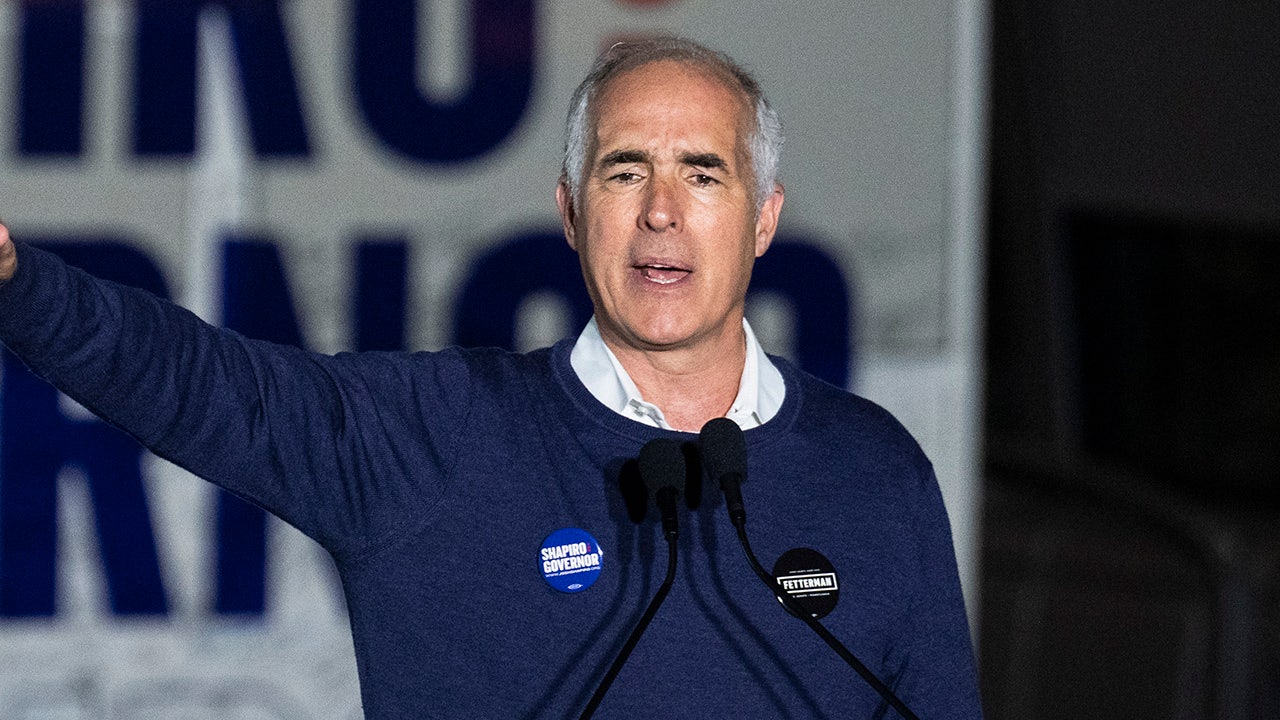
Longtime Pennsylvania Democrat Sen. Bob Casey has distanced himself from the defund the police movement in the run-up to his self-described “tough” election this year, despite recent endorsements from groups advocating that police departments be defunded and promoting a bill that would have overhauled policing practices at the height of 2020’s protests and riots.
“Senator Casey has a long and clear record of working alongside law enforcement and delivering hundreds of millions of dollars to fund bulletproof vests, SWAT gear, police cars, and ballistics shields for officers,” Maddy McDaniel, spokesperson for the Casey campaign, told Fox News Digital this month. “Senator Casey doesn’t support defunding the police, and he’s voted to block federal funding from cities and towns that defund their police departments.”
The campaign’s response comes after the longtime Keystone State senator received endorsements this year from pro-defund advocacy groups Indivisible Philadelphia and the Pennsylvania state chapter of Indivisible.
“Indivisible Philadelphia and the #IndivisiblesOfPA enthusiastically support @Bob_Casey for re-election to the US Senate! #PASen,” Indivisible Philadelphia tweeted last month.
LONGTIME PA DEM SILENT ON SUPPORT FOR FRESHMAN ‘SQUAD’ MEMBER AFTER HIS NAME IS QUIETLY REMOVED FROM SITE
Sen. Bob Casey, D-Pa., speaks during a campaign rally in Newtown, Pennsylvania, on Nov. 6, 2022. (Tom Williams/CQ-Roll Call via Getty Images)
Indivisible Philadelphia describes itself as a “grassroots organization of volunteers determined to advance a progressive agenda by resisting corruption, authoritarianism, and inequality in our governmental institutions.” The group has also repeatedly advocated for police departments to be defunded, most notably in 2020 when defund the police and Black Lives Matter protests and riots unfolded in cities from coast to coast.
“We won’t stop until they #DefundThePolice,” the group’s website reads in a June 25, 2020, post titled “Make Your Demand!”
“When we said #DefundThePolice we meant fewer officers on the street terrorizing Black and Brown residents. We meant moving away from the racist system of criminalization and penal punishment, and moving toward community-led public safety methods and programs,” the post continued, which came after the death of George Floyd at the hands of police in Minneapolis that year.
DEM SEN BOB CASEY SLAMMED BY GOP FOR SHIFTING IMMIGRATION STANCES: ‘COMPLICIT IN THE CRISIS’
The advocacy group’s leader recently told Fox News Digital that police should be funded for “policing work” while other funds should be directed to support social workers and health officials to handle non-policing issues in communities.
“Our position has always been that police should be funded to do policing work, and that for other kinds of problems in the community, adequate funding should be provided for health care professionals, social workers and mental health professionals as appropriate,” Indivisible Philadelphia group leader Vicki Miller said.
Demonstrators in Rochester, New York, hold signs at a Sept. 6, 2020, protest for Daniel Prude, who died after police put a spit hood over his head during his arrest on March 23, 2020. (Reuters/Brendan McDermid)
Casey’s endorsement follows him outlining on his official Senate page that “we must reform” policing systems in the U.S., co-sponsoring the Justice in Policing Act of 2020, and even drawing the ire of law enforcement officials in the state after Indivisible Philadelphia threw its support behind him.
“At a time when there were four shootings in four days on our local public transit system, and law enforcement across the commonwealth is understaffed, Casey’s decision to align himself with these defund the police activists is alarming and extremely dangerous,” said Folcroft Deputy Police Chief Chris Eiserman, who is also the Delaware County FOP Lodge 27 president, during a recent press conference with other law enforcement officials.
Smoke rises from a burning police vehicle on May 30, 2020, in Philadelphia. (AP Photo/Matt Rourke)
Casey joined Democrat New Jersey Sen. Cory Booker and then-California Sen. Kamala Harris in 2020 to promote the Justice in Policing Act of 2020, which was introduced after Floyd’s death. The bill, which did not pass, would have overhauled the qualified immunity doctrine – which protects police from lawsuits alleging that an official violated a plaintiff’s rights – and provided grants to state attorneys general to conduct policing practice investigations and create investigation processes for allegations of police misconduct.
The bill also would have banned choke holds and changed the use of force standard for federal officers; made conspiracy to commit a hate crime a federal crime; mandate officers to receive racial, religious and discriminatory profiling training; and create a federal registry of all federal, state and local law enforcement regarding misconduct complaints or disciplinary records.
COOKIE MONSTER HIDES SEN BOB CASEY’S REPLY ON X AFTER DEM SOUGHT CAMPAIGN DONATION: ‘CAN YOU CHIP IN?’
“We must end police brutality and systematic racism in policing,” Casey said in a press release about the bill in 2020. “It is time for us to create structural change that safeguards every American’s right to safety and equal justice. I am proud to cosponsor the Justice in Policing Act of 2020, which will hold police accountable and improve transparency in policing.”
Police officers in the state railed against the bill at the time, as well as an op-ed Casey penned that argued the legislation would help address “systemic racism in policing.”
“For too long, we have looked to increased training or increased resources as if they alone will solve the systemic issues in our law enforcement. And, too many times, we have witnessed the tragic consequences of our inability to fully implement a comprehensive solution to address the racial injustice and police brutality that permeates our nation’s history,” Casey wrote in the op-ed.
Scott L. Bohn, the executive director of the Pennsylvania Chiefs of Police Association, fired back in his own op-ed shortly after Casey’s opinion piece “seemingly maligned over 1,000 professional and dedicated law enforcement executives in the commonwealth.”
“The senator’s commentary, while politically expedient, lends itself to potentially shortsighted decisions that may have an adverse or unintended consequence,” Bohn wrote. “The opinion he expressed does not inform nor does it reflect the law enforcement environment in Pennsylvania. Pennsylvania’s professional police chiefs are committed to public service and ensuring our communities are safe. Pennsylvanians need to work together and against social injustice and make our Commonwealth equally safe for all its citizens.”
Sen. Bob Casey, D-Pa. (Bill Clark/CQ-Roll Call via Getty Images/File)
Fox News Digital obtained a copy of a letter that Casey reportedly sent to police officers who contacted him with concerns over the bill. In the letter, he doubled down on the legislation that would “put in place the most significant police reforms in our Nation’s history by focusing on officer accountability, data transparency and police practices and training.”
“Pennsylvanians and people across our Nation are angry, sad, tired and desperate for change. The murder of George Floyd by a Minneapolis police officer has reawakened our national attention not only to the significant concerns over the relationship between law enforcement and those they serve, but to the centuries of injustice and systemic oppression that led to this tragedy,” the response letter reads.
REPUBLICAN DAVE MCCORMICK LAUNCHES BID FOR VULNERABLE SENATE SEAT IN BATTLEGROUND STATE
In 2021, Casey did vote for an amendment that would have blocked federal funding to jurisdictions that defunded the police, supported the American Rescue Plan – which provided more than $65 million for Pennsylvania policing funds – and backed legislation last year that provided $1 billion in federal funding for law enforcement agencies across the nation.
Casey, who has served as a senator since 2007, has said that he’s bracing for his “toughest” re-election campaign this year in an anticipated race against Republican Dave McCormick.
“It’ll be a close, tough race,” he recently told NBC. “But look, there’s a lot on the line every time. Every time I’ve run for public office in Pennsylvania, I’ve had to earn the vote and the trust of the people. And I got to do that again.”
Dave McCormick (Jeff Swensen/Getty Images/File)
McCormick is an Army combat veteran who served as the Commerce Department’s undersecretary of Commerce for Industry and Security as well as undersecretary of the Treasury Department’s Office of International Affairs in former President George W. Bush’s administration.
McCormick has received the endorsement of 47 sheriffs in the state, and he took issue with Indivisible Philadelphia’s endorsement of Casey in a comment to Fox News Digital.
DEMOCRAT SEN BOB CASEY CONCEDES THERE’S NO ‘VIDEOTAPE’ THAT’LL DISPROVE BIDEN’S AGE CONCERNS
“Bob Casey headlined an event for Indivisible Philadelphia where he gladly accepted the endorsement of these Defund the Police activists, once again failing to stand up for our men and women in blue. This is a group that said, ‘We won’t stop until they defund the police, called for ‘fewer officers on the street,’ and advocated to ‘end cash bail.’ Pennsylvania deserves better,” McCormick wrote.
Casey has also received endorsements from law enforcement, including from Delaware County Sheriff Jerry L. Sanders Jr.
“Bob Casey has proven he’ll prioritize public safety for Delaware County and has stuck his neck out to give officers the resources and support they need to do the job. His opponent has only proven he’ll prioritize himself,” Sanders said in a comment to Fox News Digital.
The state’s Senate primaries will be held this month. Both Casey and McCormick are running unopposed in their respective primaries.
Read the full article from Here


Health
Massachusetts health officials have confirmed the state’s first two measles cases of the year, a school-aged child and a Greater Boston adult.
The Department of Public Health announced the cases Friday, marking the first report of measles in Massachusetts since 2024.
According to health officials, the adult who was diagnosed returned home recently from abroad and had an “uncertain vaccination history.” While infectious, the person visited several locations where others were likely exposed to the virus, and health officials said they are working to identify and notify anyone affected
The child, meanwhile, is a Massachusetts resident who was exposed to the virus and diagnosed with measles out-of-state, where they remain during the infectious period. Health officials said the child does not appear to have exposed anyone in Massachusetts to measles.
The two Massachusetts cases come as the U.S. battles a large national measles outbreak, which has seen 1,136 confirmed cases nationwide so far in 2026, according to the Centers for Disease Control and Prevention.
“Our first two measles cases in 2026 demonstrate the impact that the measles outbreaks, nationally and internationally, can have here at home,” Massachusetts Public Health Commissioner Robbie Goldstein said Friday. “Fortunately, thanks to high vaccination rates, the risk to most Massachusetts residents remains low.”
Measles is a highly contagious disease that spreads through the air when an infected person sneezes, coughs, or talks. The virus can linger in the air for up to two hours and may even spread through tissues or cups used by someone who has it, according to the DPH.
Early symptoms occur 10 days to two weeks after exposure and may resemble a cold or cough, usually with a fever, health officials warned. A rash develops two to four days after the initial symptoms, appearing first on the head and shifting downward.
According to the DPH, complications occur in about 30% of infected measles patients, ranging from immune suppression to pneumonia, diarrhea, and encephalitis — a potentially life-threatening inflammation of the brain.
“Measles is the most contagious respiratory virus and can cause life-threatening illness,” Goldstein said. “These cases are a reminder of the need for health care providers and local health departments to remain vigilant for cases so that appropriate public health measures can be rapidly employed to prevent spread in the state. This is also a reminder that getting vaccinated is the best way for people to protect themselves from this disease.”
According to the DPH, people who have had measles, or who have been vaccinated against measles, are considered immune. State health officials offer the following guidance for the Measles-Mumps-Rubella (MMR) vaccine:

Get everything you need to know to start your day, delivered right to your inbox every morning.

It’s a scheme made famous by a nearly 30-year-old episode of the sitcom Seinfeld.
Hoping to earn a quick buck, two characters load a mail truck full of soda bottles and beer cans purchased with a redeemable 5-cent deposit in New York, before traveling to Michigan, where they can be recycled for 10 cents apiece. With few thousand cans, they calculate, the trip will earn a decent profit. In the end, the plan fell apart.
But after Connecticut raised the value of its own bottle deposits to 10 cents in 2024, officials say, they were caught off guard by a flood of such fraudulent returns coming in from out of state. Redemption rates have reached 97%, and some beverage distributors have reported millions of dollars in losses as a result of having to pay out for excess returns of their products.
On Thursday, state lawmakers passed an emergency bill to crack down on illegal returns by increasing fines, requiring redemption centers to keep track of bulk drop-offs and allowing local police to go after out-of-state violators.
“I’m heartbroken,” said House Speaker Matt Ritter, D-Hartford, who supported the effort to increase deposits to 10 cents and expand the number of items eligible for redemption. “I spent a lot of political capital to get the bottle bill passed in 2021, and never in a million years did I think that New York, New Jersey and Rhode Island residents would return so many bottles.”
The legislation, Senate Bill 299, would increase fines for violating the bottle bill law from $50 to $500 on a first offense. For third and subsequent offenses, the penalty would increase from $250 to $2,000 and misdemeanor punishable by up to one year in prison.
In addition, it requires redemption centers to be licensed by the state’s Department of Energy and Environmental Protection (previously, those businesses were only required to register with DEEP). As a condition of their license, redemption centers must keep records of anyone seeking to redeem more than 1,000 bottles and cans in a single day.
Anyone not affiliated with a qualified nonprofit would be prohibited from redeeming more than 4,000 bottles a day, down from the previous limit of 5,000.
The bill also seeks to pressure some larger redemption centers into adopting automated scanning technologies, such as reverse vending machines, by temporarily lowering the handling fee that is paid on each beverage container processed by those centers.
The bill easily passed the Senate on Wednesday and the House on Thursday on its way to Gov. Ned Lamont.
While the bill drew bipartisan support, Republicans described it as a temporary fix to a growing problem.
House Minority Leader Vincent Candelora, R-North Branford, called the switch to 10-cent deposits an “unmitigated disaster” and said he believed out-of-state redemption centers were offloading much of their inventory within Connecticut.
“The sheer quantity that is being redeemed in the state of Connecticut, this isn’t two people putting cans into a post office truck,” Candelora said. “This is far more organized than that.”
The impact of those excess returns is felt mostly by the state’s wholesale beverage distributors, who initiate the redemption process by collecting an additional 10 cents on every eligible bottle and can they sell to supermarkets, liquor stores and other retailers within Connecticut. The distributors are required to pay that money back — plus a handling fee — once the containers are returned to the store or a redemption center.
According to the state’s Department of Revenue Services, nearly 12% of wholesalers reported having to pay out more redemptions than they collected in deposits in 2025. Those losses totaled $11.3 million.
Peter Gallo, the vice president of Star Distributors in West Haven, said his company’s losses alone have totaled more than $2 million since the increase on deposits went into effect two years ago. As time goes on, he said, the deficit has only grown.
“We’re hoping we can get something fixed here, because it’s a tough pill to be holding on to debt that we should get paid for,” Gallo said.
Still, officials say they have no way of tracking precisely how many of the roughly 2 billion containers that were redeemed in the state last year were illegally brought in from other states. That’s because most products lack any kind of identifiable marking indicating where they were sold.
“There’s no way to tell right now. That’s one of the core issues here,” said state Rep. John-Michael Parker, D-Madison, who co-chairs the legislature’s Environment Committee.
Parker said the issue could be solved if product labels were printed with a specific barcode or other feature that would be unique to Connecticut. Such a solution, for now, has faced technological challenges and pushback from the beverage industry, he said.
Not everyone involved in the handling, sorting and redemption of bottles is happy about the upcoming changes — or the process by which they were approved.
Francis Bartolomeo, the owner of a Fran’s Cans and Bart’s Bottles in Watertown, said he was only made aware of the legislation on Monday from a fellow redemption center owner. Since then, he said, he’s been contacting his legislators to oppose the bill and was frustrated by the lack of a public hearing.
“I know other people are as flabbergasted as I am because they don’t know where it comes out of,” Bartolomeo said “It’s a one sided affair, really.”
Bartolomeo said one of his biggest concerns with the bill is the $2,500 annual licensing fee that it would place on redemption centers. While he agreed that out-of-state redemptions are a problem, he said it should be up to the state to improve enforcement.
“We’re cleaning up the mess, and we’re going to end up being penalized,” Bartolomeo said. “Get rid of it and go back to 5 cents if it’s that big of a hindrance, but don’t penalize the redemption centers for what you imposed.”
Lynn Little of New Milford Redemption Center supports the increased penalties but believes the solution ultimately lies with better labeling by the distributors. She is also frustrated by the volume caps after the state initially gave grants to residents looking to open their own bottle redemption businesses.
“They’re taking a volume business, because any business where you make 3 cents per unit (the average handling fee) is a volume business, and limiting the volume we can take in, you’re crushing small businesses,” Little said.
Ritter said that he opposed a move back to the 5-cent deposit, which he noted was increased to encourage recycling. However, he said the current situation has become politically untenable and puts the state at risk of a lawsuit from distributors.
“We’re getting to a point where we’re going to lose the bottle bill,” Ritter said. “If we got sued in court, I think we’d lose.”





Exclusive: DeepSeek withholds latest AI model from US chipmakers including Nvidia, sources say


Mother and daughter injured in Taunton house explosion


2026 MHSA Montana Wrestling State Championship Brackets And Results – FloWrestling


Wildfires rage in Oklahoma as thousands urged to evacuate a small city


Wildfire near Gum Swamp Road in Livingston Parish now under control; more than 200 acres burned


10 acres charred, 5 injured in Thornton grass fire, evacuation orders lifted


YouTube TV billing scam emails are hitting inboxes


Stellantis is in a crisis of its own making
