Sign up for the Today newsletter
Get everything you need to know to start your day, delivered right to your inbox every morning.

An armed, off-duty Maryland police officer sent two suspected carjackers fleeing when he fired his weapon as they forced his family out of a vehicle near a large shopping mall outside of Washington, D.C., police say.
“Continue to remain diligent. Be aware of your surroundings,” Prince George Assistant Chief Vernon Hale III said during a press conference last week. “As you can see, if this can happen to an off-duty officer, it can certainly happen to a family. So, we want to make sure that everybody remains diligent, take care of one another, and keep your eyes open.”
Hale said an unidentified off-duty police officer with the department was assisting two of his family members as they got into their personal vehicle at about 5 p.m. Thursday in Oxon Hill when they were approached by at least two suspects, Fox 5 DC reported. The family was in a parking lot that serves office buildings, including dental and medical offices, and is located across the street from the Tanger Outlets National Harbor shopping center.
The off-duty cop and his family were forced from the vehicle, Hale said, calling the incident an “apparent carjacking.”
LICENSED GUN OWNER TURNS TABLES ON WOULD-BE CARJACKERS AMID SOARING CHICAGO VIOLENCE
Prince George Assistant Chief Vernon Hale III during a press conference. (Prince George’s County Police Department )
The off-duty officer fired his weapon, causing the suspects to flee in the vehicle. The family members were not injured during the incident and police do not believe any shots hit the suspected carjackers.
“The officer was able to get his family safely out of the vehicle, discharge his weapon and the suspects escaped including his personal vehicle,” Hale said.
DC MAYOR REFUSES TO WATCH VIRAL VIDEO OF KIDS DEBATING WHICH CRIMES THEY’D ‘RATHER’ COMMIT: ‘WASTING MY TIME’
The officer used his department-issued firearm during the incident, police later said.
The Tanger Outlets National Harbor shopping center in Maryland, near Washington, D.C. (Google Maps )
Police issued a “be on the lookout” for a black GMC Acadia shortly after the incident, according to NBC Washington.
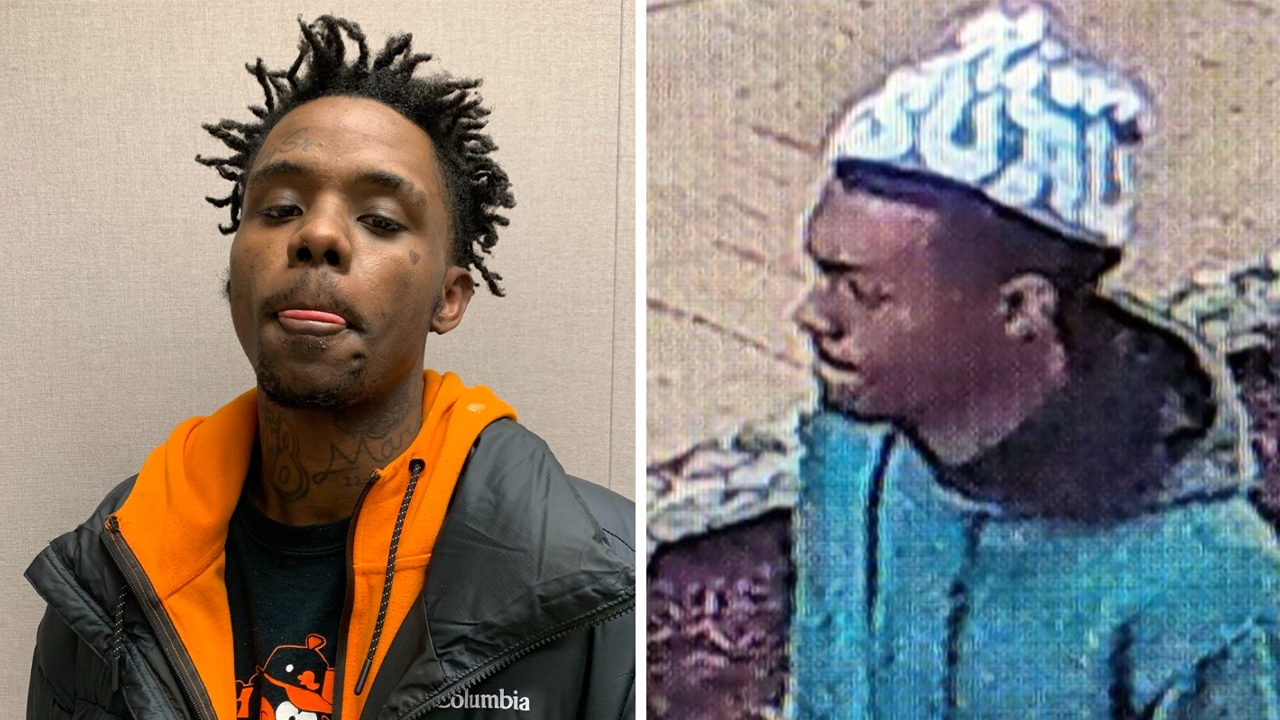
Police on Friday located one of the suspects, who was identified as Washington, D.C., resident Anthony Stewart, 19. He was found in D.C., arrested and will be extradited to Maryland. He is facing charges of carjacking, robbery, theft, and additional charges, police said.
Anthony Stewart, 19, of Washington, D.C., is accused of carjacking an off-duty cop. (Prince George’s County Police Department )
The second suspect is still at large, according to police.
DC PRE-TEEN ALLEGEDLY ATTEMPTS TO CARJACK ARMED, OFF-DUTY-FEDERAL OFFICER, 13-YEAR-OLD KILLED IN GUNFIRE
Prince George’s County Police Department are asking for any tips on the identity of a second suspected carjacker. (Prince George’s County Police Department )
The carjacking is just one of hundreds this year that have plagued areas of Maryland, as well as Washington, D.C. There have been 500 carjackings as of last week in jurisdictions overseen by Prince George’s County Police, which is an 18% spike over data from last year, WJLA reported.
CONSERVATIVES SOUND ALARM ON DC CRIME CRISIS AFTER HOUSE DEM CARJACKED: ‘SOFT ON CRIME POLICIES’
In nearby D.C., which is located roughly 11 miles from the site of Thursday’s carjacking incident, such crimes have more than doubled over figures from last year. The outlet found there were 952 carjackings in the city as of last week, compared to 475 during the same time period in 2022.
CLICK HERE FOR MORE US NEWS
Crime in the city has even affected political leaders and their families, including in October when Texas Democratic Rep. Henry Cuellar was carjacked by three armed attackers near the U.S. Capitol.
The Prince George’s County Police Department was still investigating the carjacking Thursday and calling on members of the public to come forward with any tips on the second suspect’s identity The off-duty officer was placed on administrative leave until the investigation is concluded.
Read the full article from Here


Local News
A Boston man is facing charges after he allegedly lunged at a Burger King employee, punched a customer, and then resisted arrest at a nearby MBTA station in East Boston, authorities announced Monday afternoon.
Patrick Donovan, 59, was charged July 1 with one count of assault and battery causing injury on an over 60 or disabled person, assault and battery, disorderly conduct, resisting arrest, assault, and vandalism, Suffolk District Attorney Kevin Hayden’s office said in a press release.
The charges stem from an incident shortly before 10 p.m. on June 30, when Boston police responded to a disturbance call from Burger King at 1 Maverick Square, Hayden’s office said.
A Burger King employee told officers that, after ordering his food and receiving it, Donovan yelled that he no longer wanted it and smacked a napkin holder off the counter. He then allegedly lunged at an employee and grabbed her by the arm, prosecutors said.
Donovan subsequently shoved a customer from behind and allegedly punched him in the face three times while calling him racial slurs, the DA’s office said.
Emergency medical services evaluated the customer for “visible lacerations to the forehead,” but the victim declined additional treatment, authorities said.
Donovan fled the restaurant following the assaults, and officers tracked him to the nearby MBTA Maverick Station, prosecutors said.
“While officers tried to detain Donovan inside the station, he swung at them with a closed fist but did not make contact,” Hayden’s office said, noting that Donovan made racial slurs towards the officers. “Donovan was placed into custody after a brief struggle.”
During his arraignment in the East Boston division of the Boston Municipal Court, Donovan pleaded not guilty and was released on personal recognizance. Court records show he was also ordered to stay away from Maverick Square and Burger King.
He is scheduled to return to court Aug. 7 for a pre-trial hearing, prosecutors said.
Officers obtained security footage of both assaults. Authorities said the incident remains under investigation and could result in further charges.
“Our workers deserve to be safe in their workplaces and our consumers deserve to be safe in their shopping or dining places, without exception,” Hayden said in a statement. “Beyond that, none of our citizens or first responders should be subjected to racial slurs. These appalling words have no place in Suffolk County or anywhere else in our society.”
Attorney information for Donovan was not immediately available Monday afternoon.
Get everything you need to know to start your day, delivered right to your inbox every morning.


A hit HBO documentary series is looking to Connecticut for stories to feature in its second season.
The show “Neighbors” follows on-going neighbor disputes across the country. The goal of the show is to help neighbors reach a resolution, according to the show’s casting director and executive producer Harleigh Shaw.
“Each story we explore, we spend extensive time with neighbors on both sides to really understand the full context beyond the disputes,” Shaw said.
Producers wanted to share stories in the second season that were based in states that weren’t featured earlier this year in the first season, including Connecticut, Shaw said.
“A lot of the things that we’re most interested in are things that may seem small, but become a bigger issue between the neighbors,” Shaw said. “Anything from disagreements over gardening practices to property lines to noise to dock issues, if it’s a waterfront property. A whole myriad of things. We’re really open to anything.”
However, the show does avoid situations that are violent or dangerous.
Residents from Connecticut looking to participate should be open to third party conflict resolution, according to Shaw.
“Some of the ways that we did that were through mediation,” Shaw said. “That’s a huge one. But there are other things in terms of resources we’d be open to help the neighbors to like help work through the issues.”
Filming will take place throughout the summer and is expected to be completed by the end of September.
The show’s production team is located in New York City and Los Angeles.
“Connecticut has always been really interesting because it’s just a short trip away, and we’re just curious to explore the types of neighbor dynamics that are going on there,” Shaw said.
Connecticut residents who are interested in being on “Neighbors,” can apply at helloneighbortv.com and are encouraged to submit information about themselves as well as their neighbor dispute.
“The neighbor disputes are the entry point for this show, but we’re always also just very interested in inspiring amazing people doing cool stuff,” Shaw said.
“Neighbors” premiered in February and was quickly renewed. The show averages about 3 million viewers per episode.
The show features stories that make viewers laugh and cringe, according to HBO Programming’s Executive Vice President Nina Rosenstein.
“At a time when even the smallest disagreements can spiral out of control, ‘Neighbors’ feels both hilariously absurd and surprisingly relatable,” Rosenstein said. “What makes the show special isn’t just the stories and people they find, but the empathy and humanity they bring to each episode.”


Ritzy Pasadena hotel settles lawsuit for allegedly price gouging wildfire victims


Brother Nature at Night: Jack’s backyard & kayaking the Huron River


Hardin Fire in Napa County burns 55 acres near Pope Valley


Former Dallas ISD Superintendent Michael Hinojosa runs for Dallas Mayor


South Florida mother arrested for leaving daughter chained to fence, police say


Boston man charged after allegedly assaulting Burger King employee, punching customer

Denver Country Club caddie earns full-ride Evans Scholarship, becomes first in family to attend college


Seattle very much in running for another World Cup

