Sign up for the Today newsletter
Get everything you need to know to start your day, delivered right to your inbox every morning.

The former Democratic lawmaker Anthony Weiner and the FOX News host debate a wide-range of issues, from Democrats’ handling crime, to the border and trans athletes on ‘Jesse Watters Primetime.’
Disgraced former Rep. Anthony Weiner, D-N.Y., responded to rumors regarding his potential return to the public scene, years after he resigned from Congress amid the first of several sexting scandals.
The one-time nom de guerre “Carlos Danger” last served on New York City Council in the 1990s representing Sheepshead Bay and Brighton Beach. Responding to calls from reporters and listeners to his 77WABC radio program, Weiner said Monday he loves his hometown very much, as talk of a new bid in Manhattan surfaced.
He pointed to fellow 77WABC host and Guardian Angels founder Curtis Sliwa, who mounted an unsuccessful Republican bid against Eric Adams in 2021, suggesting he too is not done with public service.
“The way I always unpack these things is ‘what does it mean for me and my neighbors?’ The city has always been the way that I have looked at service. And, you know, we are Democrats. We stand up… for each other… we don’t like people being victimized by bullies,” Weiner said.
NJ GOV SAYS HE’LL ‘FIGHT TO THE DEATH’ AGAINST TRUMP POLICIES ‘CONTRARY TO VALUES’
Anthony Weiner and estranged wife Huma Abedin. (Reuters)
Weiner said New York City should always be the “shining laboratory” of Democratic Party ideals and said that “for years we had Republicans running this town.”
From 1994 to 2002, Republican Rudy Giuliani served as mayor. He was succeeded by Democrat-turned-Republican-turned-Independent Michael Bloomberg until 2013. The City Council, however, has historically been a supermajority of Democrats.
“I would always say, if we can’t come up with solutions for this city, and we can’t show that they can work, we don’t deserve to win… I love my city. This is a city that is proudly governed by Democrats.”
Weiner said that, in contrast, there are issues with New York that seem “intractable” – citing the years-to-decades it takes to build infrastructure, sky-high taxation and the fact that when he rides the bus, “I’d be surprised if half the people paid.”
Weiner blamed part of the homeless and migrant problem on a 1979 class action suit brought against then-Gov. Hugh L. Carey and Mayor Ed Koch that resulted in the “Callahan Decree” – which instituted a right-to-shelter for homeless men.
However, Weiner continued through a litany of things he would like to see improved about the city, such as being able to walk into a Duane Reade with his son and not find most of the store’s goods locked up.
GOP WINS FIRST BLUE-CITY SENATE SEAT IN THREE DECADES

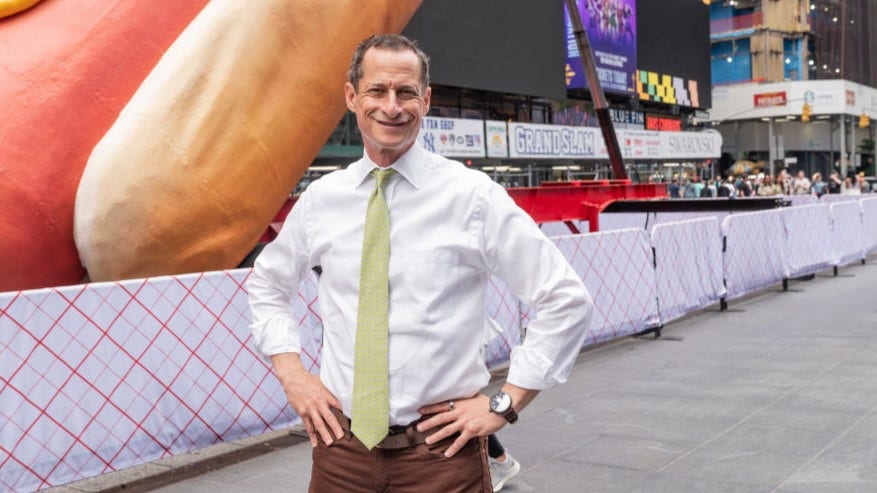
Anthony Weiner seen on Times Sqaure promoting public art. (Getty) (Lev Radin/Pacific Press/LightRocket via Getty Images)
“And as someone who has struggled with addiction, someone who lost his brother, I mean, I don’t know if we are running headlong into these things because they seem like the right thing to do without thinking.”
Weiner said people in his neighborhood have approached him about a return as well.
He noted Councilwoman Carlina Rivera of Kips Bay is term-limited, which would place Weiner’s home in an open district.
“People said: ‘Anthony, why don’t you run?’”
He addressed the elephant in the room, remarking that there are “all kinds of reasons not to – least of which are the things in my past and the things about my addiction.”
Weiner was once seen as then-Rep. Chuck Schumer’s protégé and had a close relationship with his fellow Brooklynite. When Schumer gave up his House seat and successfully won the Senate seat of retiring Republican Al D’Amato, Weiner replaced him.
However, Weiner resigned from Congress in 2011 after admitting to sending women explicit photos.
After his resignation, Weiner continued sexting under the pseudonym “Carlos Danger.” The main recipient, Sydney Leathers, claimed the former lawmaker referred to himself as “an argumentative, perpetually horny middle-aged man.”
A few years later, he was embroiled in another sexting scandal during which he separated from his wife, longtime Hillary Clinton confidante Huma Abedin.
After claims surfaced again, this time that Weiner had sexted a teenager in North Carolina, his laptop was seized. Investigators found emails pertinent to Clinton’s classified documents scandal that preceded her upset loss to President-elect Donald Trump.
Weiner later checked himself into rehab for sex addiction, and in 2017 was sentenced in his federal sexting case – which imploded his then-bid for mayor. He remains a registered sex offender.
Weiner remained upbeat in speaking out about his potential opportunity to help New York.
“We’re at a moment that we Democrats, seem like we come into knife fights carrying library books all the time,” he said.
“I’m thinking about it. I’m wrestling with it. I’m trying to figure out. I don’t know. I mean, I love doing this job on the radio, but I want to be of service. I think everyone should think that way.”
“We’re Democrats, we solve problems.”
The City Council currently sits at a 45-6 Democratic majority, but Republicans doubled their ranks recently and now have at least one member from every borough except Manhattan.
Read the full article from Here


Health
Massachusetts health officials have confirmed the state’s first two measles cases of the year, a school-aged child and a Greater Boston adult.
The Department of Public Health announced the cases Friday, marking the first report of measles in Massachusetts since 2024.
According to health officials, the adult who was diagnosed returned home recently from abroad and had an “uncertain vaccination history.” While infectious, the person visited several locations where others were likely exposed to the virus, and health officials said they are working to identify and notify anyone affected
The child, meanwhile, is a Massachusetts resident who was exposed to the virus and diagnosed with measles out-of-state, where they remain during the infectious period. Health officials said the child does not appear to have exposed anyone in Massachusetts to measles.
The two Massachusetts cases come as the U.S. battles a large national measles outbreak, which has seen 1,136 confirmed cases nationwide so far in 2026, according to the Centers for Disease Control and Prevention.
“Our first two measles cases in 2026 demonstrate the impact that the measles outbreaks, nationally and internationally, can have here at home,” Massachusetts Public Health Commissioner Robbie Goldstein said Friday. “Fortunately, thanks to high vaccination rates, the risk to most Massachusetts residents remains low.”
Measles is a highly contagious disease that spreads through the air when an infected person sneezes, coughs, or talks. The virus can linger in the air for up to two hours and may even spread through tissues or cups used by someone who has it, according to the DPH.
Early symptoms occur 10 days to two weeks after exposure and may resemble a cold or cough, usually with a fever, health officials warned. A rash develops two to four days after the initial symptoms, appearing first on the head and shifting downward.
According to the DPH, complications occur in about 30% of infected measles patients, ranging from immune suppression to pneumonia, diarrhea, and encephalitis — a potentially life-threatening inflammation of the brain.
“Measles is the most contagious respiratory virus and can cause life-threatening illness,” Goldstein said. “These cases are a reminder of the need for health care providers and local health departments to remain vigilant for cases so that appropriate public health measures can be rapidly employed to prevent spread in the state. This is also a reminder that getting vaccinated is the best way for people to protect themselves from this disease.”
According to the DPH, people who have had measles, or who have been vaccinated against measles, are considered immune. State health officials offer the following guidance for the Measles-Mumps-Rubella (MMR) vaccine:
Get everything you need to know to start your day, delivered right to your inbox every morning.

It’s a scheme made famous by a nearly 30-year-old episode of the sitcom Seinfeld.
Hoping to earn a quick buck, two characters load a mail truck full of soda bottles and beer cans purchased with a redeemable 5-cent deposit in New York, before traveling to Michigan, where they can be recycled for 10 cents apiece. With few thousand cans, they calculate, the trip will earn a decent profit. In the end, the plan fell apart.
But after Connecticut raised the value of its own bottle deposits to 10 cents in 2024, officials say, they were caught off guard by a flood of such fraudulent returns coming in from out of state. Redemption rates have reached 97%, and some beverage distributors have reported millions of dollars in losses as a result of having to pay out for excess returns of their products.
On Thursday, state lawmakers passed an emergency bill to crack down on illegal returns by increasing fines, requiring redemption centers to keep track of bulk drop-offs and allowing local police to go after out-of-state violators.
“I’m heartbroken,” said House Speaker Matt Ritter, D-Hartford, who supported the effort to increase deposits to 10 cents and expand the number of items eligible for redemption. “I spent a lot of political capital to get the bottle bill passed in 2021, and never in a million years did I think that New York, New Jersey and Rhode Island residents would return so many bottles.”
The legislation, Senate Bill 299, would increase fines for violating the bottle bill law from $50 to $500 on a first offense. For third and subsequent offenses, the penalty would increase from $250 to $2,000 and misdemeanor punishable by up to one year in prison.
In addition, it requires redemption centers to be licensed by the state’s Department of Energy and Environmental Protection (previously, those businesses were only required to register with DEEP). As a condition of their license, redemption centers must keep records of anyone seeking to redeem more than 1,000 bottles and cans in a single day.
Anyone not affiliated with a qualified nonprofit would be prohibited from redeeming more than 4,000 bottles a day, down from the previous limit of 5,000.
The bill also seeks to pressure some larger redemption centers into adopting automated scanning technologies, such as reverse vending machines, by temporarily lowering the handling fee that is paid on each beverage container processed by those centers.
The bill easily passed the Senate on Wednesday and the House on Thursday on its way to Gov. Ned Lamont.
While the bill drew bipartisan support, Republicans described it as a temporary fix to a growing problem.
House Minority Leader Vincent Candelora, R-North Branford, called the switch to 10-cent deposits an “unmitigated disaster” and said he believed out-of-state redemption centers were offloading much of their inventory within Connecticut.
“The sheer quantity that is being redeemed in the state of Connecticut, this isn’t two people putting cans into a post office truck,” Candelora said. “This is far more organized than that.”
The impact of those excess returns is felt mostly by the state’s wholesale beverage distributors, who initiate the redemption process by collecting an additional 10 cents on every eligible bottle and can they sell to supermarkets, liquor stores and other retailers within Connecticut. The distributors are required to pay that money back — plus a handling fee — once the containers are returned to the store or a redemption center.
According to the state’s Department of Revenue Services, nearly 12% of wholesalers reported having to pay out more redemptions than they collected in deposits in 2025. Those losses totaled $11.3 million.
Peter Gallo, the vice president of Star Distributors in West Haven, said his company’s losses alone have totaled more than $2 million since the increase on deposits went into effect two years ago. As time goes on, he said, the deficit has only grown.
“We’re hoping we can get something fixed here, because it’s a tough pill to be holding on to debt that we should get paid for,” Gallo said.
Still, officials say they have no way of tracking precisely how many of the roughly 2 billion containers that were redeemed in the state last year were illegally brought in from other states. That’s because most products lack any kind of identifiable marking indicating where they were sold.
“There’s no way to tell right now. That’s one of the core issues here,” said state Rep. John-Michael Parker, D-Madison, who co-chairs the legislature’s Environment Committee.
Parker said the issue could be solved if product labels were printed with a specific barcode or other feature that would be unique to Connecticut. Such a solution, for now, has faced technological challenges and pushback from the beverage industry, he said.
Not everyone involved in the handling, sorting and redemption of bottles is happy about the upcoming changes — or the process by which they were approved.
Francis Bartolomeo, the owner of a Fran’s Cans and Bart’s Bottles in Watertown, said he was only made aware of the legislation on Monday from a fellow redemption center owner. Since then, he said, he’s been contacting his legislators to oppose the bill and was frustrated by the lack of a public hearing.
“I know other people are as flabbergasted as I am because they don’t know where it comes out of,” Bartolomeo said “It’s a one sided affair, really.”
Bartolomeo said one of his biggest concerns with the bill is the $2,500 annual licensing fee that it would place on redemption centers. While he agreed that out-of-state redemptions are a problem, he said it should be up to the state to improve enforcement.
“We’re cleaning up the mess, and we’re going to end up being penalized,” Bartolomeo said. “Get rid of it and go back to 5 cents if it’s that big of a hindrance, but don’t penalize the redemption centers for what you imposed.”
Lynn Little of New Milford Redemption Center supports the increased penalties but believes the solution ultimately lies with better labeling by the distributors. She is also frustrated by the volume caps after the state initially gave grants to residents looking to open their own bottle redemption businesses.
“They’re taking a volume business, because any business where you make 3 cents per unit (the average handling fee) is a volume business, and limiting the volume we can take in, you’re crushing small businesses,” Little said.
Ritter said that he opposed a move back to the 5-cent deposit, which he noted was increased to encourage recycling. However, he said the current situation has become politically untenable and puts the state at risk of a lawsuit from distributors.
“We’re getting to a point where we’re going to lose the bottle bill,” Ritter said. “If we got sued in court, I think we’d lose.”





Exclusive: DeepSeek withholds latest AI model from US chipmakers including Nvidia, sources say


Mother and daughter injured in Taunton house explosion


2026 MHSA Montana Wrestling State Championship Brackets And Results – FloWrestling


Wildfires rage in Oklahoma as thousands urged to evacuate a small city


Wildfire near Gum Swamp Road in Livingston Parish now under control; more than 200 acres burned


10 acres charred, 5 injured in Thornton grass fire, evacuation orders lifted


YouTube TV billing scam emails are hitting inboxes


Stellantis is in a crisis of its own making
