
News
What we know about the fatal police shooting of a 13-year-old boy in Utica, N.Y
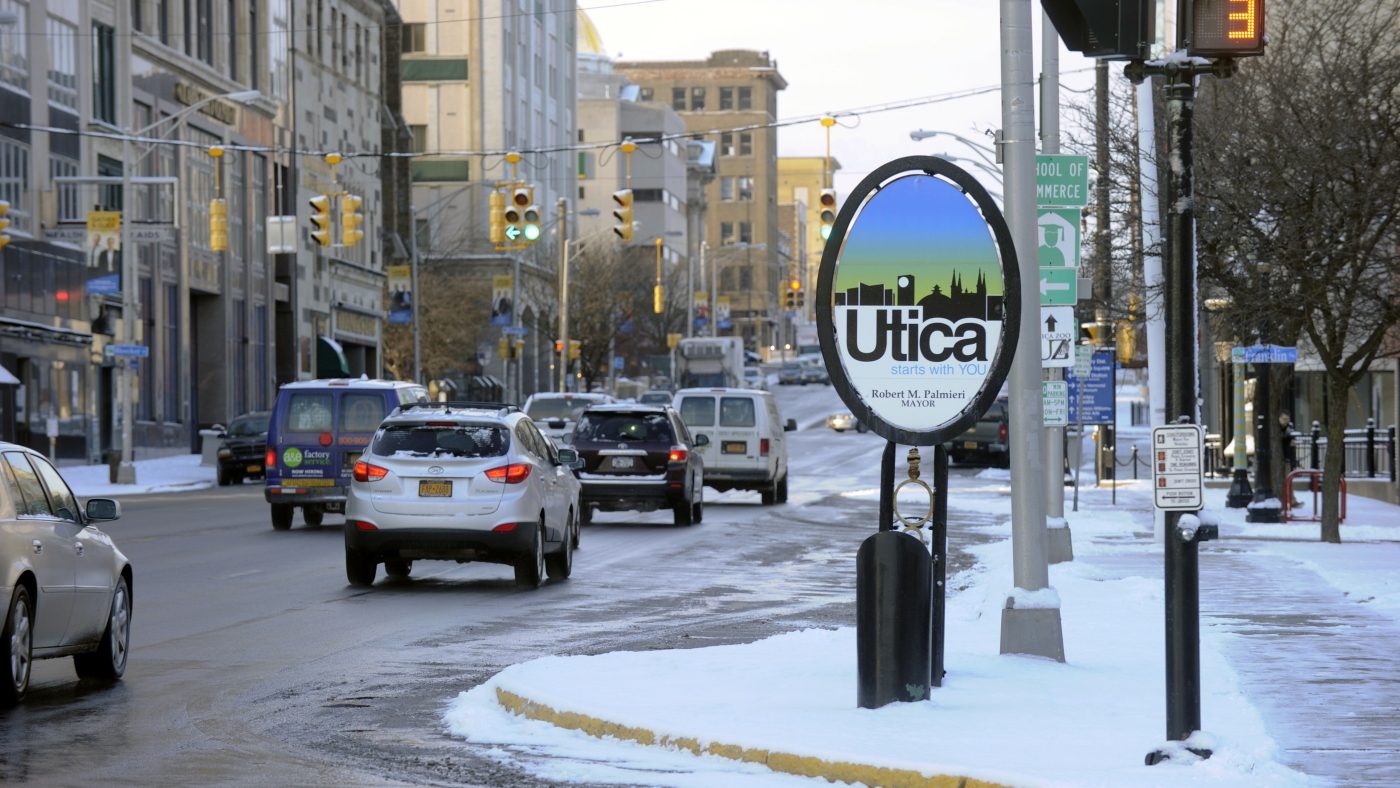
Police in Utica, N.Y., say an officer fatally shot a 13-year-old boy after a foot chase on Friday evening. Police say officers believed the boy brandished a handgun. Above, vehicles move along Genesee Street after a fresh snowfall, in Utica, N.Y., on Jan. 31, 2017.
Hans Pennink/AP
hide caption
toggle caption
Hans Pennink/AP
Grief and anger engulfed the city of Utica, N.Y. after a police officer shot and killed Nyah Mway, a 13-year-old boy, on Friday night.
The Utica Police Department said the fatal shooting occurred amid a foot chase between Mway and three officers. The officers saw what they believed to be a handgun on Mway, according to a statement released by the department on Facebook. Mway, who graduated from middle school just two days earlier, was then tackled to the ground before an officer, later identified by police as Patrick Husnay, discharged his firearm. The weapon on Mway was later determined to be a pellet gun.
Efforts to contact relatives of Mway were unsuccessful, but on a GoFundMe page set up by his family he was remembered as “an outgoing kid who loved to be outside biking and playing.” The family said he was “a good kid” who “has never gotten in trouble with law enforcement before.”
Mway and his family came to the U.S. from Myanmar, also known as Burma, as Karen refugees over eight years ago, according to the GoFundMe page. Over the years, thousands of Karen refugees have settled in Utica to flee ethnic and religious persecution by the Myanmar government.
How the shooting unfolded
On Friday night, police officers patrolled the streets of West Utica to investigate a string of armed robberies in the area. The suspects were described as Asian males who carried a black firearm, police said.
Around 10 p.m., three officers stopped Mway and another 13-year-old boy outside on a street, believing the two boys fit the description of the robbery suspects, police said.
In body-camera footage released by law-enforcement, an officer asks to pat down Mway in search of a possible weapon, and Mway tries to run away. The officers followed.
In a statement, the police said the officers believed Mway was holding and pointing a firearm at the officers. In the body-camera footage, an officer yelled out “Gun!” and tackled Mway to the ground. Soon, all three officers appeared hovering over Mway. Roughly 15 seconds after the chase began, a shot was fired by police.
Screams from onlookers followed. One officer attempted to do chest compressions on Mway. He was later transported to Wynn Hospital where he died from his wounds.
Police said they recovered a replica of a Glock 17 Gen5 handgun with a detachable magazine on scene. It was later determined to be a pellet gun.
Police officers are put on administrative leave with pay
Utica Police identified the officers involved as Husnay, a six-year veteran of the Utica Police Department; Bryce Patterson, a four-year veteran; and Andrew Citriniti, who has been on the force for two-and-a-half years.
Police Chief Mark Williams said all three officers were put on administrative leave with pay.
Utica Police said an internal investigation has been launched. The New York State’s Attorney General’s Office of Special Investigations will also investigate if the shooting violated any state laws.
On Saturday, the Utica police department said in a statement, “Our thoughts are with our officers involved, and the family of the deceased juvenile.”
In a later statement on Saturday night, the department added, “It is our sincerest desire that at the conclusion of these investigations an impartial, fair, and thorough investigation will have been completed, giving answers to any remaining lingering questions.”
Response from the community
At a news conference on Saturday, Utica mayor Michael P. Galime said transparency will be a priority.
“What happened yesterday evening in our community is an event that has become all too familiar and routine, over and over and over again,” he said.
Troves of family, friends and community members attended the conference, expressing their anger, grief and disbelief to the situation.
On Saturday, hundreds also gathered for a vigil in honor of Mway, bringing flowers, balloons and candles.
“We won’t be satisfied until the murderers are put in jail,” said Mway’s older brother, The Daily Sentinel reported.
News
Despite a competitive market, finding a summer job is highly beneficial for teens
A lifeguard overlooks an outdoor swimming pool.
Etienne Laurent/Getty Images
hide caption
toggle caption
Etienne Laurent/Getty Images
Teenagers hoping to hold the whistle as a lifeguard or camp counselor, or just work any job this summer are having a hard time getting hired.
“They now have more competition. There may be fewer jobs available,” says Brad Hershbein, an economist at the W.E. Upjohn Institute for Employment Research. “They kind of get stuck with the short straw.”
Many factors are contributing to the competition for entry-level jobs: AI, inflation, tariffs, even those oil tankers stuck in the Persian Gulf. But all signs are pointing to 2026 being the worst job market for teens in decades.
“So many people are increasingly desperate to find a job, any job, especially if they have college loans,” Hershbein says. “That makes it that much harder for someone younger to be able to compete.”
The Bureau of Labor Statistics counted 219,000 fewer teens working this May compared to last May. Their participation in the labor force has been sliding since a peak of nearly 58% in the 1970s. Today, about a third of teens are in the labor force, either working or looking for summer work.
Mariella Silva, 19, had to hustle before finding a summer job as a barista at Zeke’s Coffee, a roastery and coffee shop in Washington, D.C.
She says now that she’s working, she feels more grown up. She is learning from her older coworkers and starting to understand and appreciate the value of money. She says, “Every time I spend something, I’m like, oh, this is like two hours of work.” She says she really feels the pinch of inflation when she considers whether to buy a meal out in the world, “I’m like, hmm. . . there’s food at home.”
Her boss, Jesse Lauritsen, doesn’t actually hire many teens. For starters, their schedules are hard to accommodate. Teens often have school or sports commitments and are new to the idea of carving out big chunks of time for work shifts.
“If they can only work one day a month, there’s no point in really hiring them,” Lauritsen says.
Economist Brad Herschbein notes that hiring managers may view teens as an investment that won’t pay off right away. “It’s almost a community service, rather than getting that productivity right away,” he says.
The dwindling job opportunities for teenagers means that plenty of them won’t get their first workforce experience while they’re still young, he adds. “A growing share of 18- to 19-year-olds are neither employed nor in school. They’re not really engaged in child care either.”
Economists call such people “idle.” It’s a strong term, but might be accurate, according to time-use surveys.
“They do seem to be engaging in a lot of leisure,” says Hershbein “The quintessential stereotype is, you know, someone’s playing video games all day.”
That pattern doesn’t just worry their parents. Many cities and school districts are trying hard to line up job opportunities for young people.
At a community pool in Ann Arbor, Michigan, Gayle Hurn hires over a hundred lifeguards and swim instructors every summer: She says she’s got a roster full of teenagers from around the city. “I think we need to start viewing teens as a really important part of the infrastructure of the workplace.”
Hurn says everyone who visits the pool feels the joy that her young workers bring to their job, even if she admits that teenagers can be hard to manage. “It’s my job to help them not just get a paycheck, but really build them so that when they move on from me, they can be super successful and really great contributors to whatever other work environment they join.”
Hurn makes them put away their phones, she works around their vacation schedules and she helps them through difficult conversations.
Happily, she adds, her teen employees are totally worth it.
News
Park Ranger Dies After Falling Into a Crevasse on Mt. McKinley
A ranger who was assigned to a climbing patrol on Mount McKinley in Alaska, North America’s tallest peak, died after falling into a crevasse on Thursday, the National Park Service said.
Officials identified the ranger as Robin Pendery, 33, of Enumclaw, Wash., a seasonal employee for the park service, and said she had been near a camp that sits at about 14,000 feet up the mountain when she fell. Parks Service workers responded immediately, the agency said, but Ms. Pendery did not survive. It did not release further details about the incident.
Ms. Pendery’s death came just over a week after three members of a Latvian climbing expedition died in an accident on the same mountain in Denali National Park and Preserve.
The Park Service said that Ms. Pendery had joined the mountaineering staff at the park in 2024.
“We are heartbroken by the loss of a member of our Denali family,” Brooke Merrell, the park’s superintendent, said in a statement. “Our mountaineering rangers dedicate themselves to serving visitors and helping others in one of the most challenging environments in the world. Today, we mourn the loss of a valued colleague, friend and teammate.”
Ms. Pendery was a nursing student at the University of Washington, according to her LinkedIn profile, and then became a registered nurse. She had nearly a decade of experience as a seasonal mountain guide, including for Alpine Ascents International, an expedition company based in Seattle.
A biography page for Ms. Pendery on the Alpine Ascents website said that, along with Mount McKinley, she had climbed Mount Rainier, Mount Baker and Mount St. Helens in Washington State and Mount Hood in Oregon.
“She was a serious and compassionate professional,” Gordon Janow, the director of programs for Alpine Ascents, wrote in an email on Friday. “Highly respected by peers, thorough, competent and an absolute pleasure to spend time with. We guided together in India, and her level of care for clients and passion for the mountains were unsurpassed. We’re devastated and her companionship will be sorely missed.”
Mount McKinley, which soars to 20,310 feet above sea level, was renamed as Mount Denali, the name long used by Alaska Native tribes, by President Barack Obama in 2015, but last year, President Trump reinstated the name that honored the former U.S. president William McKinley.
The recent stretch of the climbing season in the national park, which typically runs from late April through mid-July, has been particularly deadly.
Last week, three members of the Latvian Mountaineering Association died and a fourth was critically injured in what officials described as an accident at about 18,000 feet on the mountain.
The recent death toll is above average for the mountain, where more than 130 people have died since the park started keeping records more than a century ago. Three people died in Denali National Park in 2025, according to Park Service data, and there was one death in the park in both 2024 and 2023.
News
See Where the L.A. Mayoral Candidates Have Done Best So Far
The final matchup for the Los Angeles mayoral runoff remains unsettled, but precinct-level returns show the contours of the race. The incumbent mayor, Karen Bass, secured one of the two spots in the November election, but Spencer Pratt and Nithya Raman are battling for second.
The results on the map reflect the nearly 500,000 votes that were tabulated on election night, which include early and mail-in votes that were returned early and ballots cast in-person on Election Day. Election officials are still in the process of counting hundreds of thousands of ballots in the race, and high-level updates will continue to be reported each day through at least June 12. But updated precinct-level data is not expected to be released until the end of June.
That means these results reflect voters who participated earlier in the process. On Wednesday, Thursday and Friday, as ballots that arrived later began being processed, the updated results were notably more favorable to the Democrats than they were to Mr. Pratt. The lead Mr. Pratt had over Ms. Raman as of the end of election night had been cut in half as of Friday.
Even so, the incomplete results highlight the socioeconomic fault lines that have divided the city in this election and the coalitions that each candidate has built:
Karen Bass
Ms. Bass leads handily in the Black, Latino and white liberal strongholds that underpinned her 2022 election.
Three areas of support in particular stand out for her: South Los Angeles, where she got her start as a grass-roots activist during the crack cocaine epidemic; East Los Angeles and the East Valley, where organized labor routinely turns out Latino voters; and bastions of older white Democrats, like Mar Vista, which were part of her district when she served in Congress.
Wealthy precincts like Pacific Palisades, which was ravaged by wildfire last year, spurned her, but the Palisades also overwhelmingly opposed her in 2022.
Spencer Pratt
Mr. Pratt has done well so far in the most affluent parts of the city, including Pacific Palisades, where he grew up and where his family’s home burned down in the fires last year.
As a registered Republican, he also did well in pockets of MAGA conservatism like the Sunland-Tujunga area in the far northeast San Fernando Valley.
He won over some Jewish communities on the city’s Westside with direct appeals to pro-Israel voters and also did well in expatriate Iranian-American hubs like Tehrangeles in Westwood.
Nithya Raman
Ms. Raman, who was elected to the City Council in 2020 with the support of the Democratic Socialists of America, has maintained her urban progressive base in places like Echo Park and Silver Lake, where she lives.
Her focus on affordability and her public policy expertise yielded support in dense neighborhoods with lots of cash-strapped, educated renters, like Los Feliz.
She has also done well in precincts around college campuses like Occidental College and the University of Southern California.
Of course, these results will change as the rest of the ballots are tallied over the next few weeks. Election officials have not provided an estimate of how many ballots remain uncounted specifically in the Los Angeles mayoral race, but countywide figures suggest that a substantial share of the vote is still outstanding.
As of Friday night, Los Angeles County had reported 1.6 million ballots counted and estimated that roughly 540,000 ballots remained countywide, with more still arriving. Late mail-in ballots have been more favorable to the Democrats this cycle, so the final results may move toward Ms. Bass and Ms. Raman at even higher rates than they did for Ms. Bass in the 2022 primary.
Rick Caruso, a centrist Democrat and former Republican, led on election night in 2022, but Ms. Bass steadily gained ground over the following weeks. She ultimately overtook him, winning the primary with 43 percent of the vote to Mr. Caruso’s 36 percent.
-
Entertainment4 minutes agoReview: A family braces for the worst, unsentimentally and with nuanced charm, in ‘Renoir’
-
Lifestyle7 minutes agoAt 100, Route 66 still beckons as a cross-country caravan takes off from Santa Monica
-
Politics12 minutes agoJudge pauses USDA plan to tie SNAP benefits to Trump’s gender, immigration ideology
-
Science19 minutes agoA flesh-eating worm from the 1960s is re-invading the U.S. Are CA cattle at risk?
-
Sports22 minutes agoNorth Carolina’s Jason DeCaro shuts out USC baseball to force decisive Game 3
-
World34 minutes agoD-Day 82nd anniversary honoured in France
-
News57 minutes agoDespite a competitive market, finding a summer job is highly beneficial for teens
-
Los Angeles, Ca2 hours agoPasadena motorist knocked unconscious in unprovoked assault after other driver flashes high beams at him


