News
What the data tells us about kidnapped people — and how Nancy Guthrie is an outlier

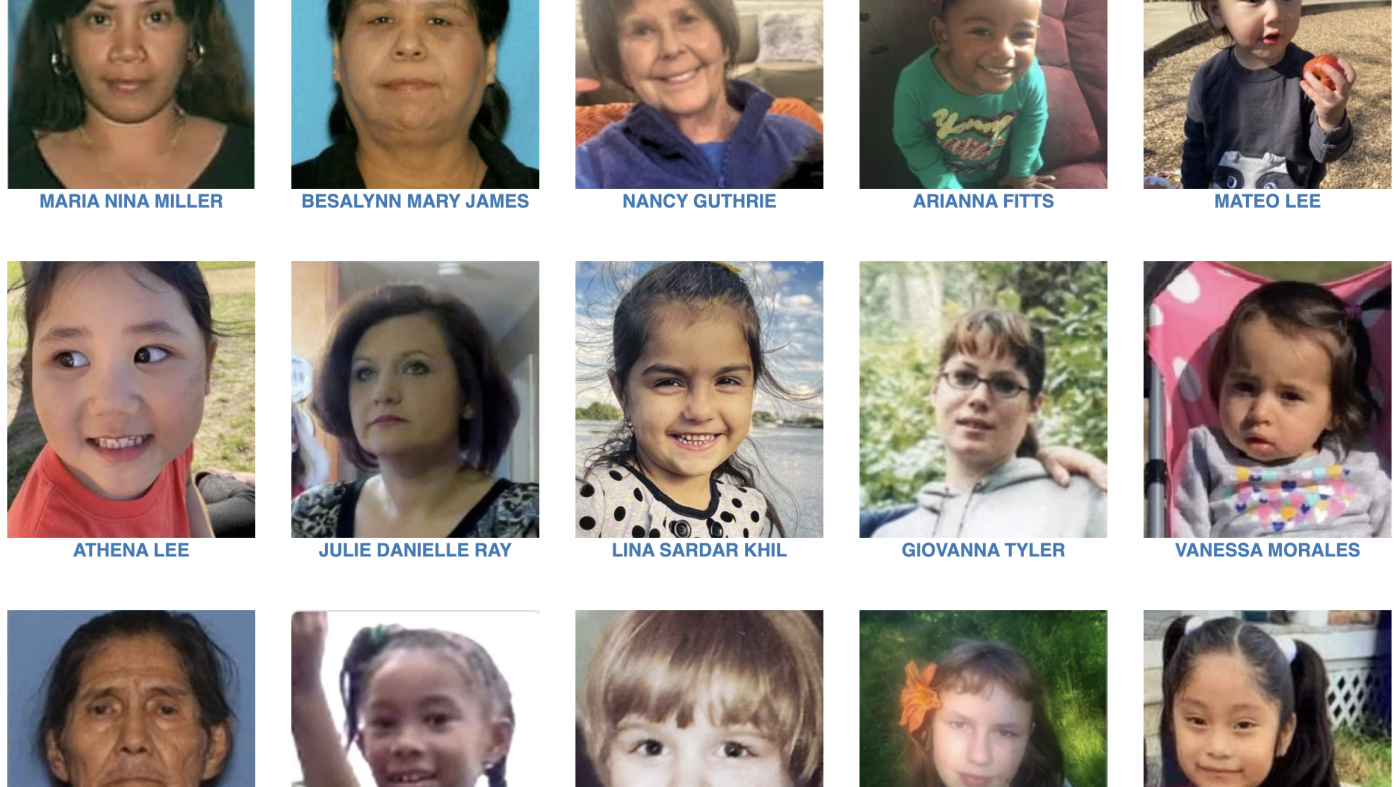
Nancy Guthrie’s case has drawn wide attention, in part because of the unique circumstances of her disappearance. She’s seen here alongside other people who are listed on the FBI’s Kidnappings and Missing Persons page as of Thursday morning./FBI/ Screenshot by NPR
The abduction of Nancy Guthrie is putting a spotlight on the excruciating uncertainty endured by thousands of families whose loved ones go missing each year. Experts see parallels with those cases, even as many details in Guthrie’s case are unique, from the victim’s age to her celebrity daughter, Today show co-host Savannah Guthrie.

The circumstances of Guthrie’s disappearance are “quite shocking,” says Jesse Goliath, a forensic anthropologist at Mississippi State University.
“Usually you hear about smaller children, juveniles that go missing” and attracting national press, Goliath says. “But having an older woman who’s gone missing and having [a daughter] that you’ve seen on TV every day” is extraordinary, he adds.
More than 500,000 people were reported missing in the U.S. last year, according to the Justice Department. But Tara Kennedy, media representative for the Doe Network, a volunteer group working to identify missing and unidentified persons, says high-profile kidnappings are rare.
“I can’t remember the last time I heard about a ransom case besides Guthrie,” says Kennedy, who has worked with the Doe Network since 2014. “I always associate them with different periods in American history, like the Lindbergh kidnapping, not someone’s mother from the Today show.”
Both Kennedy and Goliath describe the Guthrie case as “strange.” Here’s a rundown of things it has in common with other missing-persons cases, and why it’s unusual:
Key details that are “unheard of”
From June 2020 to June 2025, women comprised more than 75% of the victims in the some 240,000 cases of kidnappings or abductions that were reported in the U.S., according to FBI crime data. But of those, only 646 women were in their 80s like Nancy Guthrie, who is 84, or less than .2% of all victims. Compare that to the age group that accounted for the largest number of victims that year: people 20-29, who made up just shy of 30% of victims.
Other highly unusual revelations have emerged as her disappearance has persisted: from purported ransom notes sent to media outlets demanding millions of dollars to unsettling images of a masked gunman approaching Guthrie’s front door on the night she disappeared.
Taken together, it’s like something out of a true crime novel, Goliath says: “That’s something unheard of.”
In missing-person cases, a quick response is crucial
TV shows have helped perpetuate a myth that families have to wait 24 hours before reporting a loved one as missing. But some shows and movies do get one thing right: The first 24 to 48 hours are critical to locating someone who has disappeared.
“Usually a lot of them are going to be [found] within 24 hours, especially the juvenile and young adult cases,” Goliath says.

In that early timeframe, eyewitness reports might be more useful; sniffer dogs will have a fresher scent to follow; and surveillance video and other electronic data is more likely to be intact and helpful.
“The longer the person is missing, the more difficult it becomes” to find them, Kennedy says, citing decades-old unresolved cases.
Then there’s the victim’s health. Whether the subject of a search operation wandered off and got lost, or was abducted or trafficked, Goliath notes that after 48 hours, their well-being could be compromised — by the elements, or by health issues such as Nancy Guthrie’s pacemaker and her need for daily medication.
“Sadly, if that person is not found within that first two days, their chances of survival drop exponentially,” Goliath says.
Who are the people who go missing in the U.S.?
At any given moment, about 100,000 people are considered missing in the U.S., according to Goliath and Kennedy. At the end of 2024, for instance, the National Crime Information Center — listed more than 93,000 active missing-persons cases in the U.S., while a total of 533,936 cases were entered into the federal tracking system that year.
Of those cases, more than 60% — or roughly 330,000 — involved juveniles, according to the NCIC database, which law enforcement agencies use to share criminal warrants, missing-person alerts, and other records.
Among people who are reported missing, Goliath says there is an “overrepresentation of Black and Indigenous populations who go missing, especially females, across the United States.”
In Mississippi, he adds, “Our highest demographic of missing [persons] is young Black females.”
Black Americans are also overrepresented in abductions. While members of the group make up less than 15% of the U.S. population, they account for more than 25% of the victims in reported abductions or kidnappings, according to the FBI’s data.
But a large number of missing-persons cases also go unreported, because some communities, such as people of color or those who don’t have documented status in the U.S., are less likely to engage with authorities. And Goliath notes that Indigenous people living on reservations might have limited access to law enforcement.
Another dynamic that skews public perception, Kennedy says, is “missing white woman syndrome,” when national media become fixated on a white woman who has disappeared.
“As someone who researches cold cases in terms of looking for information, the disparity of information out there, of cases for people of color is ridiculous,” she says.
Calling for action, easier ways to share data
Goliath says every missing-person case, not just Guthrie’s, needs to be widely broadcast and shared, to increase the chance of bringing someone home.
“We call this a silent crisis,” he says, “that there are people missing in the United States, throughout the country that really don’t have that same social media representation or a nationwide media representation for their cases.”
It’s also difficult to find standardized data for missing persons, due to a patchwork of rules and resources. It’s only mandatory for law enforcement agencies across the country to report missing persons cases to the federal government if they involve minors, for instance.
In addition to NCIC, missing persons data is collected by NamUs (the National Missing and Unidentified Persons System), which offers public access. But as of now, only 16 states require mandatory reporting to the NamUs clearinghouse for missing persons cases.
Goliath says he’d like to see a nationwide push for more states to adopt NamUs requirements. As NPR reported last year, a large portion of U.S. police agencies weren’t listed in the system.
“That’d be a help, because it’s already a system that exists,” Goliath says. “Law enforcement already is doing it. So, let’s just have all the states be able to use NamUs.”



Note: Map shows the area with a shake intensity of 3 or greater, which U.S.G.S. defines as “weak,” though the earthquake may be felt outside the areas shown. The New York Times
A minor earthquake with a preliminary magnitude of 3.5 struck in Central California on Monday, according to the United States Geological Survey.
The temblor happened at 7:17 a.m. Pacific time about 6 miles northwest of Pinnacles, Calif., data from the agency shows.
As seismologists review available data, they may revise the earthquake’s reported magnitude. Additional information collected about the earthquake may also prompt U.S.G.S. scientists to update the shake-severity map.
Source: United States Geological Survey | Notes: Shaking categories are based on the Modified Mercalli Intensity scale. When aftershock data is available, the corresponding maps and charts include earthquakes within 100 miles and seven days of the initial quake. All times above are Pacific time. Shake data is as of Monday, March 2 at 10:20 a.m. Eastern. Aftershocks data is as of Monday, March 2 at 11:18 a.m. Eastern.

The U.S. and Israel have been conducting strikes against targets in Iran since Saturday morning, with the aim of toppling Tehran’s clerical regime. Iran has fired back, with retaliatory assaults featuring missiles and drones targeting several Gulf countries and American bases in the Middle East.
“All six aircrew ejected safely, have been safely recovered, and are in stable condition. Kuwait has acknowledged this incident, and we are grateful for the efforts of the Kuwaiti defense forces and their support in this ongoing operation,” Central Command said.
“The cause of the incident is under investigation. Additional information will be released as it becomes available,” it added.
In a separate statement later Monday, Central Command said that American forces had been killed during combat since the strikes began.
“As of 7:30 am ET, March 2, four U.S. service members have been killed in action. The fourth service member, who was seriously wounded during Iran’s initial attacks, eventually succumbed to their injuries,” it said.
Major combat operations continue and our response effort is ongoing. The identities of the fallen are being withheld until 24 hours after next of kin notification,” Central Command added.
This story has been updated.

Smoke rises over Konarak naval base in southern Iran on Sunday. The base was one of hundreds of targets of U.S. and Israeli forces throughout the country.
Planet Labs PBC
hide caption
toggle caption
Planet Labs PBC
Commercial satellite images are providing a unique look at the extent of damage being done to Iran’s military facilities across the country.
The U.S. and Israeli military campaign opened with a daytime attack that struck Iranian leadership in central Tehran. Smoke was still visible rising from Ayatollah Ali Khamenei’s compound following the attack that killed the supreme leader.

An image by the company Airbus taken on Saturday shows the aftermath of an Israeli strike on Iran’s Leadership House in central Tehran. Iran’s Supreme Leader Ayatollah Ali Khamenei was killed in the opening wave of attacks.
Pléiades Neo (c) Airbus DS 2026
hide caption
toggle caption
Pléiades Neo (c) Airbus DS 2026
Israel and the U.S. have gone on to strike targets across the country. Reports on social media indicate that there have been numerous military bases and compounds attacked all over Iran, and Iran has responded with attacks throughout the Middle East.
U.S. forces have also been striking at Iran’s navy. In a post on his social media platform, President Trump said that he had been briefed that U.S. forces had sunk nine Iranian naval vessels. U.S. Central Command did not immediately confirm that number but it did say it had struck an Iranian warship in port.

An image captured on Saturday shows a ship burning at Iran’s naval base at Konarak.
Satellite image ©2026 Vantor
hide caption
toggle caption
Satellite image ©2026 Vantor
Numerous satellite images show burning vessels at Konarak naval base in southern Iran. Images also show damage to a nearby airbase where hardened hangers were struck by precision munitions.

Hardened aircraft shelters at Konarak airbase were struck with precision munitions.
Satellite image ©2026 Vantor
hide caption
toggle caption
Satellite image ©2026 Vantor
And there was extensive damage at a drone base in the same area. Iran has launched numerous drones and missiles toward Israel and U.S. military installations in Bahrain, Kuwait and Qatar. Many drones have been intercepted but videos on social media show that some have evaded air defenses and caused damage in nearby Gulf countries. In Dubai, debris from an Iranian drone damaged the iconic Burj Al Arab, according to a statement from Dubai’s government.

Buildings at an Iranian drone base at Konarak were destroyed in the strikes.
Satellite image ©2026 Vantor
hide caption
toggle caption
Satellite image ©2026 Vantor
Iran’s most powerful weapons are its long-range missiles. The Iranian Revolutionary Guards have hidden the missiles deep inside mountain tunnels. Images taken Sunday in the mountains of northern Iran indicate that some of those tunnels were hit in a wave of strikes.
Following Khamenei’s death, Iran declared 40 days of mourning. Satellite images showed mourners gathering in Tehran’s Enghelab square on Sunday.
Iranian Foreign Ministry Spokesperson Esmail Baghaei told NPR on Sunday that Iran will continue to fight “foreign aggression, foreign domination.”
A White House official told NPR that Trump plans to talk to Iran’s interim leadership “eventually,” but that for now, U.S. operations continue in the region “unabated.”

A large crowd of mourners fill Enghelab Square in Tehran on Sunday, following the death of Iran’s Supreme Leader Ayatollah Ali Khamenei, who was killed in an Israeli airstrike.
Satellite image ©2026 Vantor
hide caption
toggle caption
Satellite image ©2026 Vantor

Alaska Air National Guard rescues injured snowmachiner near Cooper Landing

Arizona NAACP responds to ‘Simon Says’ case, calls for police accountability

Arkansas Division of Higher Education on continuing your education after high school

Rep. Kevin Kiley announces run in California’s redrawn 6th Congressional District

How the Colorado Rockies Are Actually Building Its Opening Day Roster

Florida High School Football Rankings: Top 25 teams – Oct. 21

Cleary's 21 help Le Moyne down Central Connecticut State 69-64 in OT

How old is Bo Nix? What to know about Oregon quarterback ahead of 2024 NFL Draft

99th annual Pony Swim held in Virginia

Indiana Members Credit Union announced as new anchor tenant at Bottleworks District

Map: Earthquake Shakes Central California

Gas prices could jump as Middle East tensions threaten global oil supply

Pakistan calls troops, orders 3-day curfew as 24 killed in pro-Iran rallies

US says Kuwait accidentally shot down 3 American jets

House Republicans push Johnson to go to war with Senate over SAVE Act
-

 World5 days ago
Exclusive: DeepSeek withholds latest AI model from US chipmakers including Nvidia, sources say
-

 Massachusetts5 days ago
Mother and daughter injured in Taunton house explosion
-

 Denver, CO5 days ago
10 acres charred, 5 injured in Thornton grass fire, evacuation orders lifted
-

 Louisiana1 week ago
Wildfire near Gum Swamp Road in Livingston Parish now under control; more than 200 acres burned
-

 Technology1 week ago
YouTube TV billing scam emails are hitting inboxes
-

 Politics1 week ago
OpenAI didn’t contact police despite employees flagging mass shooter’s concerning chatbot interactions: REPORT
-

 Technology1 week ago
Stellantis is in a crisis of its own making
-

 News1 week ago
World reacts as US top court limits Trump’s tariff powers