Connect with us

News

US to ‘aggressively’ revoke visas of Chinese students

Published

on

US to ‘aggressively’ revoke visas of Chinese students

Unlock the White House Watch newsletter for free

US secretary of state Marco Rubio has said the Trump administration would “aggressively” revoke the visas of Chinese students, in its latest move to crack down on foreigners hoping to study in the US.

The move came a day after Rubio ordered US embassies across the world to stop scheduling interviews for new student visas, as the administration tightens the screening of applicants’ social media activities.

Rubio said in a statement that the state department would work with the Department of Homeland Security to “aggressively revoke visas for Chinese students, including those with connections to the Chinese Communist party or studying in critical fields”.

Advertisement

He said the US would also revise visa criteria to enhance scrutiny of all future visa applications from China and Hong Kong.

In the 2023-24 school year, nearly 280,000 international students were from China, making up more than a quarter of all foreign students in the US, according to the Institute of International Education. It was the second leading country of origin after India.

The new measures are part of a wide-ranging crackdown on international students that has sent a chill through American campuses and caused anguish for thousands already studying in the US who fear they will not be able to renew their visas.

The moves to restrict student visas are part of President Donald Trump’s broader assault on the US’s elite universities, which he accuses of failing to tackle antisemitism during large-scale pro-Palestinian protests after the start of Israel’s war in Gaza. The president’s critics have accused him of attacking free speech and academic freedom.

Yet the immigration curbs go far beyond students. Rubio also said on Wednesday that the Trump administration would also place new visa restrictions on foreign officials who he said had acted against US citizens over their posts on social media.

Advertisement

“Foreigners who work to undermine the rights of Americans should not enjoy the privilege of travelling to our country,” Rubio said in a statement posted to X. “Whether in Latin America, Europe, or elsewhere, the days of passive treatment for those who work to undermine the rights of Americans are over.”

It was not immediately clear which officials would be affected by the visa restrictions or how the policy changes would be implemented.

But Rubio said in a separate statement that in “some instances, foreign officials have taken flagrant censorship actions against US tech companies and US citizens and residents when they have no authority to do so”.

He added it was “unacceptable” for foreign officials to threaten to arrest US citizens or residents for their social media posts and for foreign officials to “demand that American tech platforms adopt global content moderation policies or engage in censorship activity that reaches beyond their authority and into the United States”.

“We will not tolerate encroachments upon American sovereignty, especially when such encroachments undermine the exercise of our fundamental right to free speech,” the secretary of state said.

Advertisement

Trump, vice-president JD Vance and Rubio have all criticised overseas leaders for what the administration sees as infringements of free speech, including online.

Republican lawmakers, including Jim Jordan, chair of the House judiciary committee, have also attacked foreign lawmakers for their regulation of social media platforms and online content, including the EU’s Digital Services Act and the UK’s Online Safety Act.

Vance stunned attendees at February’s Munich Security Conference when he accused European and UK leaders of suppressing speech and said the continent’s “threat from within” was graver than that posed by Russia and China.

More recently, Rubio said there was a “great possibility” of sanctions against Brazilian supreme court justice Alexandre de Moraes, who has led a crackdown against online disinformation in the country and made headlines last year after clashing with Trump ally Elon Musk.

The billionaire called Moraes a “dictator” but ultimately backed down and complied with his rulings that blocked users found to be spreading election disinformation after X, his social media platform, was banned for a month in Brazil.

Advertisement

Musk has also hit out at the UK government for its policing of offensive speech in the wake of far-right riots across the country last August, comparing the country to the Soviet Union.

Europe has taken a tougher approach to regulating digital platforms than the US. The Digital Services Act compels large social media companies and web platforms operating in the region to make efforts to combat misinformation and hate speech.

The UK’s Online Safety Act creates similar sweeping powers for media regulator Ofcom to punish tech giants for failing to police illegal content, such as hate speech and incitement to violence.

Advertisement

News

Trump administration sends letter wiping out addiction, mental health grants

Published

on

Trump administration sends letter wiping out addiction, mental health grants

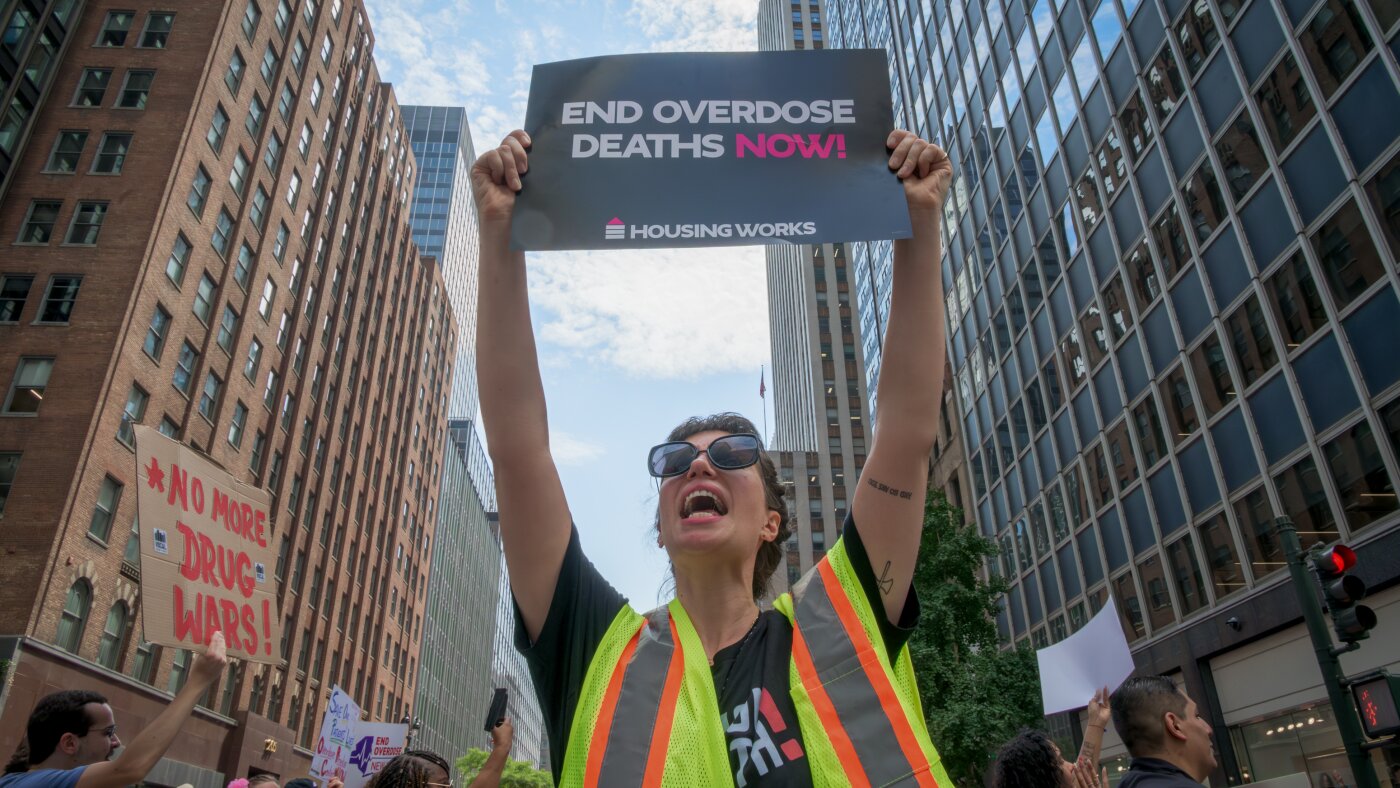
A demonstrator holds a sign during International Overdose Awareness Day on Aug. 28, 2024 in New York City.

Erik McGregor/LightRocket via Getty Images


hide caption

toggle caption

Advertisement

Erik McGregor/LightRocket via Getty Images

The Trump administration sent shockwaves through the U.S. mental health and drug addiction system late Tuesday, sending hundreds of termination letters, effective immediately, for federal grants supporting health services.

Three sources said they believe total cuts to nonprofit groups, many providing street-level care to people experiencing addiction, homelessness and mental illness, could reach roughly $2 billion. NPR wasn’t able to independently confirm the scale of the grant cancellation. The U.S. Substance Abuse and Mental Health Services Administration (SAMSHA) didn’t respond to a request for clarification.

“We are definitely looking at severe loss of front-line capacity,” said Andrew Kessler, head of Slingshot Solutions, a consultancy firm that works with mental health and addiction groups nationwide. “[Programs] may have to shut their doors tomorrow.”

Advertisement

Kessler said he has reviewed numerous grant termination letters from “Salt Lake City to El Paso to Detroit, all over the country.”

Ryan Hampton, the founder of Mobilize Recovery, a national advocacy nonprofit for people in and seeking recovery, told NPR his group lost roughly $500,000 “overnight.”

“Waking up to nearly $2 billion in grant cancellations means front-line providers are forced to cease overdose prevention, naloxone distribution, and peer recovery services immediately, leaving our communities defenseless against a raging crisis,” Hampton said. “This cruelty will be measured in lives lost, as recovery centers shutter and the safety net we built is slashed overnight. We are witnessing the dismantling of our recovery infrastructure in real-time, and the administration will have blood on its hands for every preventable death that follows.”

Copies of the letter sent to two different organizations and reviewed by NPR signal that SAMHSA officials no longer believe the defunded programs align with the Trump administration’s priorities.

The letter points to efforts to reshape the national health system in part by restructuring SAMHSA’s grant program, which “includes terminating some of its … awards.”

Advertisement

According to the letter, grants are terminated as of Jan.13, adding that “costs resulting from financial obligations incurred after termination are not allowable.”

The National Association of County Behavioral Health and Developmental Disability Directors sent a letter to members saying it believes “over 2,000 grants [nationwide] with a total of more than $2 billion” are affected. The group said it’s still working to understand the “full scope” of the cuts.

This move comes on top of deep Medicaid cuts, passed last year by the Republican-controlled Congress, which affect numerous mental health and addiction care providers.

Kessler told NPR he’s hearing alarm from care providers nationwide that the safety net for people experiencing an addiction or mental health crisis could unravel.

“In the short term, there’s going to be severe damage. We’re going to have to scramble,” he said.

Advertisement

Regina LaBelle, a Georgetown University professor who served as acting head of the Office of National Drug Control Policy during the Biden administration, said the SAMHSA grants pay for lifesaving services.

“From first responders to drug courts, continued federal funding quite literally save lives,” LaBelle said. “The overdose epidemic has been declared a public health emergency and overdose deaths are decreasing. This is no time to pull critical funding.”

Requests for comment from SAMHSA and the Department of Health and Human Services were not immediately returned.

This is a developing story.

Advertisement
Continue Reading

News

Video: Clashes With Federal Agents in Minneapolis Escalate

Published

on

Video: Clashes With Federal Agents in Minneapolis Escalate

new video loaded: Clashes With Federal Agents in Minneapolis Escalate

transcript

transcript

Clashes With Federal Agents in Minneapolis Escalate

Fear and frustration among residents in Minneapolis have mounted as ICE and Border Patrol agents have deployed aggressive tactics and conducted arrests after the killing of Renee Good by an immigration officer last week.

“Open it. Last warning.” “Do you have an ID on you, ma’am?” “I don’t need an ID to walk around in — In my city. This is my city.” “OK. Do you have some ID then, please?” “I don’t need it.” “If not, we’re going to put you in the vehicle and we’re going to ID you.” “I am a U.S. citizen.” “All right. Can we see an ID, please?” “I am a U.S. citizen.”

Advertisement
Fear and frustration among residents in Minneapolis have mounted as ICE and Border Patrol agents have deployed aggressive tactics and conducted arrests after the killing of Renee Good by an immigration officer last week.

By Jamie Leventhal and Jiawei Wang

January 13, 2026

Continue Reading

News

Lindsey Halligan argues she should still be U.S. attorney, accuses judge of abuse of power

Published

on

Lindsey Halligan argues she should still be U.S. attorney, accuses judge of abuse of power

Top Justice Department officials defended Lindsey Halligan’s attempts to remain in her position as a U.S. attorney in court filings Tuesday, responding to a federal judge who demanded to know why she was continuing to do so after another judge had found that her appointment was invalid.

The filing, signed by Halligan, Attorney General Pam Bondi and Deputy Attorney General Todd Blanche, accused a Trump-appointed judge of “gross abuse of power,” and attempting to “coerce the Executive Branch into conformity.”

Last week, U.S. District Judge David Novak, who sits on the federal bench in Richmond, ordered Halligan to provide the basis for her repeated use of the title of U.S. attorney and explain why it “does not constitute a false or misleading statement.” 

Novak gave Halligan seven days to respond to his order and brief on why he “should not strike Ms. Halligan’s identification as United States attorney” after she listed herself on an indictment returned in the Eastern District of Virginia in December as a “United States attorney and special attorney.”

U.S. District Judge Cameron Currie had ruled in November that Halligan’s appointment as interim U.S. attorney was invalid and violated the Constitution’s Appointments Clause, and she dismissed the cases Halligan had brought against former FBI Director James Comey and New York Attorney General Letitia James. 

Advertisement

The statute invoked by the Trump administration to appoint Halligan allows an interim U.S. attorney to serve for 120 days. After that, the interim U.S. attorney may be extended by the U.S. district court judges for the region. 

Currie found that the 120-day clock began when Halligan’s predecessor, Erik Siebert was initially appointed in January 2025. Currie concluded that when that timeframe expired, Bondi’s authority to appoint an interim U.S. attorney expired along with it. 

The judge ruled that Halligan had been serving unlawfully since Sept. 22 and concluded that “all actions flowing from Ms. Halligan’s defective appointment” had to be set aside. That included the Comey and James indictments.

In their response, Bondi, Blanche and Halligan called Novak’s move an “inquisition,” “insult,” and a “cudgel” against the executive branch. The Justice Department argued that Currie’s ruling in November applied only to the Comey and James cases and did not bar Halligan from calling herself U.S. attorney in other cases that she oversees. 

“Adding insult to error, [Novak’s order] posits that the United States’ continued assertion of its legal position that Ms. Halligan properly serves as the United States Attorney amounts to a factual misrepresentation that could trigger attorney discipline. The Court’s thinly veiled threat to use attorney discipline to cudgel the Executive Branch into conforming its legal position in all criminal prosecutions to the views of a single district judge is a gross abuse of power and an affront to the separation of powers,” the Justice Department wrote.

Advertisement

In his earlier order, Novak said that Currie’s decision “remains binding precedent in this district and is not subject to being ignored.”

The Justice Department called Currie’s ruling “erroneous”: and said that Halligan is entitled to maintain her position “notwithstanding a single district judge’s contrary view.”

On Monday, the second-highest ranking federal prosecutor in the Eastern District of Virginia, Robert McBride, was fired after he refused to help lead the Justice Department’s prosecution of Comey, a source familiar with the matter told CBS News. McBride is a former longtime federal prosecutor in Kentucky’s Eastern District and had only been on the job as first assistant U.S. attorney for a few months after joining the office in the fall. 

Halligan is a former insurance lawyer who was a member of President Trump’s legal team, and joined Mr. Trump’s White House staff after he won a second term in 2024. In September, Halligan was selected to serve as interim U.S. attorney for the Eastern District of Virginia after her predecessor abruptly left the post amid concerns he would be forced out for failing to prosecute James.

Just days after she was appointed, Halligan sought and secured a two-count indictment against Comey alleging he lied to Congress during testimony in September 2020. James, the New York attorney general, was indicted on bank fraud charges in early October. Both pleaded not guilty and pursued several arguments to have their respective indictments dismissed, including the validity of Halligan’s appointment, and claims of vindictive prosecution.

Advertisement

Continue Reading
Advertisement

Trending