Connect with us

News

Trump says Kari Lake will lead Voice of America. He attacked it during his first term

Published

on

Trump says Kari Lake will lead Voice of America. He attacked it during his first term

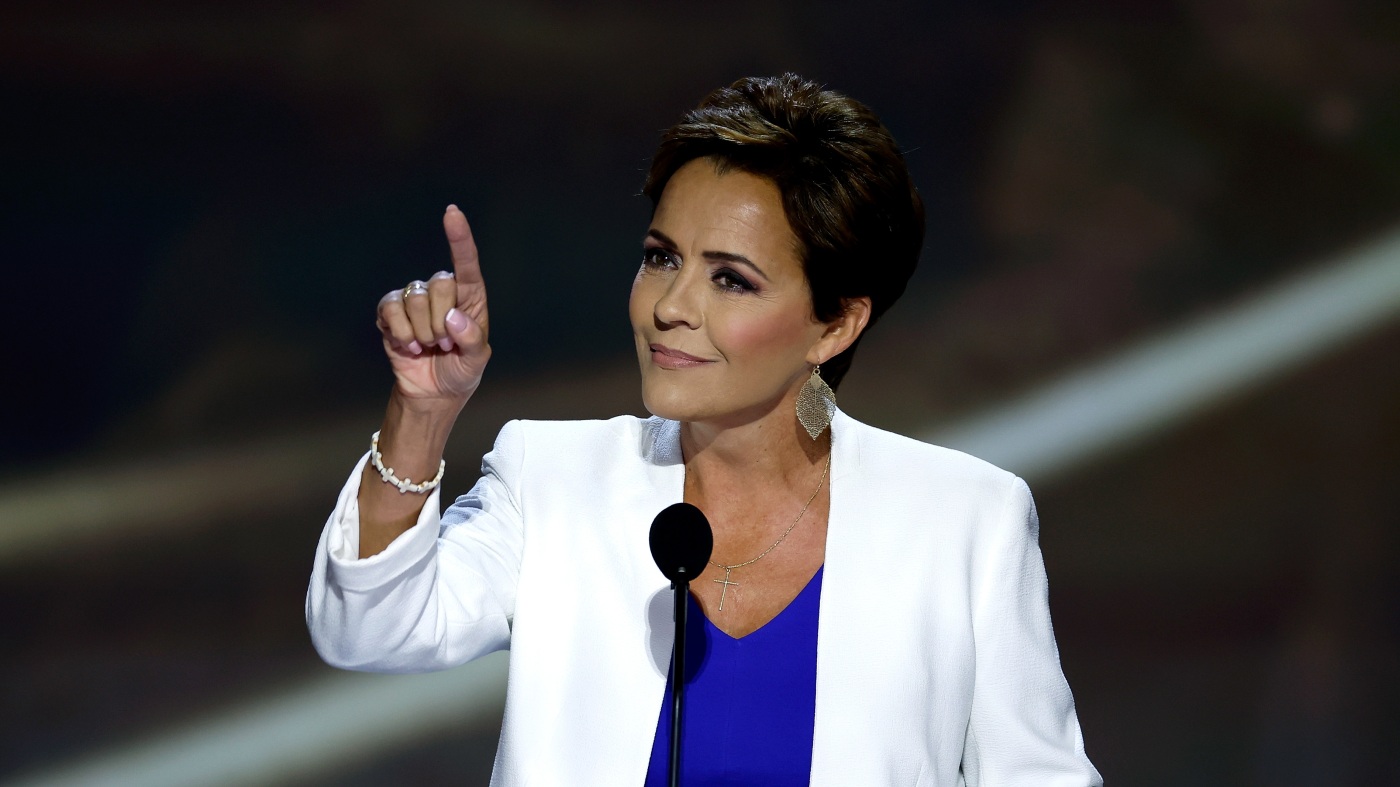
Kari Lake, pictured at the Republican National Convention in July, is President-elect Donald Trump’s pick to head the Voice of America.

Chip Somodevilla/Getty Images


hide caption

toggle caption

Advertisement

Chip Somodevilla/Getty Images

President-elect Donald Trump says Kari Lake, a local television news anchor-turned-MAGA politician, will lead the federally funded broadcaster Voice of America.

If successful, the move would put a loyalist at the helm of a news outlet that Trump sought to bring to heel under his appointee during the final year of his first term. Trump officials sought to strip the network and its parent agency of their independence during his first term, including actions later found to be illegal and in one case, unconstitutional.

But Trump doesn’t have the authority to unilaterally install Lake; the hire is dependent on a bipartisan board beneath the chief executive of its parent agency.

Advertisement

Voice of America (VOA), which is funded by Congress, operates in nearly 50 languages and reaches an estimated 354 million people weekly across the globe. It is part of the U.S. Agency for Global Media, the government agency that oversees all non-military, U.S. international broadcasting.

Trump said Wednesday on Truth Social that Lake will be appointed by and work closely with the incoming head of that agency, “who I will announce soon.”

A free press is central to VOA’s mission: It aims to bring unfettered reporting to places that do not have it, and show political debate and dissent in the U.S. even when that reflects critically on the administration in power.

Trump’s White House took the unprecedented step in spring 2020 of openly attacking VOA in public statements over its perceived failures to explicitly blame the Chinese government for the pandemic.

On Wednesday, Trump wrote that Lake and his as-yet-unnamed agency leader will “ensure that the American values of Freedom and Liberty are broadcast around the World FAIRLY and ACCURATELY, unlike the lies spread by the Fake News Media.”

Advertisement

Lake, who ran unsuccessfully for an Arizona U.S. Senate seat this year and for governor in 2022, has made a political name for herself in part by denying election losses (both hers and Trump’s in 2020) and railing against the mainstream media, of which she was once a part.

She left her job at the Phoenix Fox affiliate in 2021 after over two decades and a series of controversies, including sharing COVID-19 misinformation during the pandemic.

In her speech at the Republican National Convention this summer, Lake accused the “fake news” of spending “the last eight years lying about President Donald Trump and his amazing, patriotic supporters,” and said they had “worn out your welcome.”

On Wednesday, Lake said she looks forward to starting at VOA, which she described as a “vital international media outlet dedicated to advancing the interests of the United States by engaging directly with people across the globe and promoting democracy and truth.”

“Under my leadership, the VOA will excel in its mission: chronicling America’s achievements worldwide,” Lake tweeted.

Advertisement

That’s not exactly the organization’s stated mission, however. On its website, it says it is “committed to providing comprehensive coverage of the news and telling audiences the truth.”

What is Voice of America?

VOA was founded in 1942 to counter Nazi propaganda in Germany.

“We bring you Voices from America,” said announcer William Harlan Hale in the first German-language program. “Today, and daily from now on, we shall speak to you about America and the war. The news may be good for us. The news may be bad. But we shall tell you the truth.”

By the end of World War II, it was broadcasting 3,200 programs in 40 languages every week, presenting America — and modeling a free press — to the world.

VOA was able to continue and even expand its operations during the Cold War. And when the United States Information Agency was established in 1953, VOA became its largest element.

Advertisement

Today, its over 2,000 employees produce radio, digital and television content, distributed by a network of satellite, cable, FM and MW and some 3,500 affiliate stations.

VOA calls itself the largest U.S. international broadcaster; others include Radio Free Europe/Radio Liberty, Radio Free Asia, and Radio Martí.

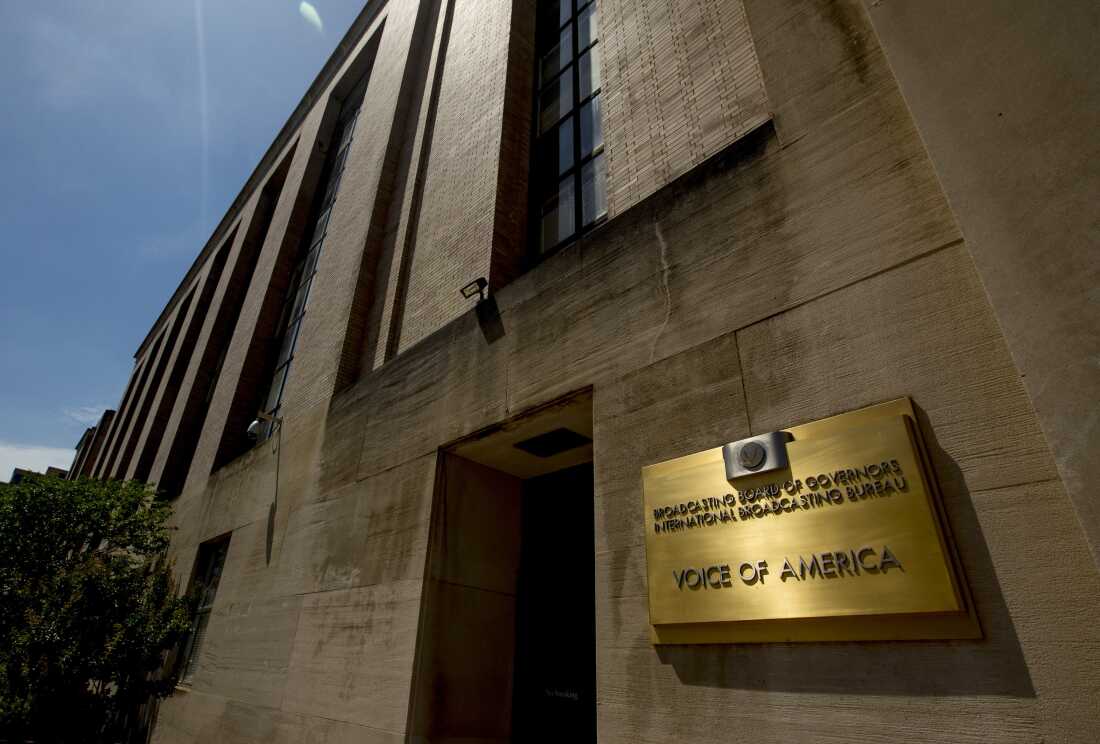
The Voice of America building stands in Washington, D.C.

The Voice of America building stands in Washington, D.C.

Andrew Harnik/AP


hide caption

Advertisement

toggle caption

Andrew Harnik/AP

Is VOA editorially independent?

From its beginning, government officials debated the balance VOA should strike between reporting the news and furthering U.S. foreign policy. Over the years, the broadcaster has taken several steps to safeguard its editorial independence, in practice and in policy.

In the late 1950s, VOA employees drafted a formal statement of principles to protect the editorial integrity of their broadcasts, which became the official VOA Charter in 1960. President Gerald Ford signed it into law in 1976 .

Advertisement

There are three main guidelines: VOA news will be “accurate, objective and comprehensive;” “represent America, not any single segment of American society” and cover not only U.S. policies but “responsible discussions and opinion” about them.

Taking a step further, the 1994 U.S. International Broadcasting Act enshrined in U.S. code a “firewall” that prohibits any U.S. government official from interfering in the objective, independent reporting of news.

“The firewall ensures that VOA can make the final decisions on what stories to cover, and how they are covered,” the broadcaster says.

That firewall came under threat during the first Trump administration, as NPR has reported.

Advertisement

What happened to VOA during Trump’s first term?

Despite the VOA being owned by the federal government, the White House singled it out for attack during the first Trump administration, particularly during the early days of the COVID-19 pandemic in spring 2020.

The White House accused the broadcaster of amplifying Chinese government propaganda about the country’s efforts to contain the virus, which it denied.

It was in that context that the Republican-led Senate finally confirmed conservative filmmaker Michael Pack to lead the U.S. Agency for Global Media, two years after Trump first nominated him.

Pack’s arrival rattled VOA even before he got there: Two top officials resigned as soon as he was confirmed.

Further fueling fears of political interference, Pack quickly stripped most of the agency’s senior leadership of their authority and fired the chiefs of the government-sponsored broadcast networks for foreign audiences, including Radio Free Europe/Radio Liberty and Radio Free Asia.

Advertisement

“My job really is to drain the swamp, to root out corruption and to deal with these issues of bias, not to tell journalists what to report,” Pack told the pro-Trump website The Federalist at the time.

Throughout his seven-month tenure at VOA’s parent agency, Pack faced multiple accusations of meddling in its process — from making personnel moves like reassigning VOA leaders and refusing to extend foreign employees’ work visas, to editorial decisions like removing several controversial stories from its website after publication.

Under Pack’s leadership, the agency also investigated one of its own VOA White House reporters for perceived anti-Trump bias and rescinded the firewall meant to ensure editorial independence from partisan interference.

A formal federal investigation also said Pack engaged in “waste or gross waste of government resources” in paying a private firm $1.6 million to investigate agency executives he considered insufficiently loyal (they were ultimately exonerated). Such work is ordinarily done by government attorneys.

The Biden administration swiftly removed several Trump loyalists from the U.S. Agency for Global Media and VOA itself after taking office in 2021. A federal inquiry released in 2023 found that Pack repeatedly engaged in abuses of power and gross mismanagement — including, but not limited to, violating journalists’ independence. A federal judge found that Pack had violated constitutional free speech protections of the network’s journalists.

Advertisement

Is Lake’s leadership a sure thing?

The chaos of the Pack era led to congressional reform — most notably, the creation of the International Broadcasting Advisory Board (IBAB).

The IBAB is an independent federal entity made up of seven people: six experts in mass communications and international affairs, appointed by the president and confirmed by the U.S. Senate, and a seat for the secretary of state. No more than three of the president’s appointees can be from the same political party.

The Senate confirmed its six new members last December.

The board’s stated mission is to ensure the editorial independence and enhance the impact of the work carried out by the U.S Agency for Global Media. It also plays a role in the appointment and removal of heads of the agency’s entities.

The heads of VOA and others “may only be appointed or removed if such action has been approved by the Board,” according to its bylaws.

Advertisement

Notably, VOA welcomed a new director — former Freedom House president and longtime Washington Post reporter and editor Michael
Abramowitz — in June.

It’s not clear when or whether the board would meet to decide to replace Abramowitz. Trump has not yet said whom he intends to appoint to lead the parent U.S. Agency for Global Media, a position that requires Senate confirmation.

The board has not yet responded to NPR’s request for comment.

News

Map: 2.3-Magnitude Earthquake Reported North of New York City

Published

on

Map: 2.3-Magnitude Earthquake Reported North of New York City

Note: Map shows the area with a shake intensity of 3 or greater, which U.S.G.S. defines as “weak,” though the earthquake may be felt outside the areas shown.  All times on the map are Eastern. The New York Times

A minor, 2.3-magnitude earthquake struck about 12 miles north of New York City on Tuesday, according to the United States Geological Survey.

The temblor happened at 10:17 a.m. Eastern in Sleepy Hollow, N.Y., data from the agency shows.

The Westchester County emergency services department said in a statement that it had not received any reports of damage.

As seismologists review available data, they may revise the earthquake’s reported magnitude. Additional information collected about the earthquake may also prompt U.S.G.S. scientists to update the shake-severity map.

Advertisement

Source: United States Geological Survey | Notes: Shaking categories are based on the Modified Mercalli Intensity scale. When aftershock data is available, the corresponding maps and charts include earthquakes within 100 miles and seven days of the initial quake. All times above are Eastern. Shake data is as of Tuesday, March 10 at 10:30 a.m. Eastern. Aftershocks data is as of Tuesday, March 10 at 2:18 p.m. Eastern.

Continue Reading

News

Ed Martin, outspoken Justice Department lawyer, is formally accused of ethical violations | CNN Politics

Published

on

Ed Martin, outspoken Justice Department lawyer, is formally accused of ethical violations | CNN Politics

Ed Martin, an outspoken Trump administration official, is facing attorney discipline proceedings in Washington, DC, for a letter he sent to Georgetown Law about its diversity programs, the district’s professional conduct investigator announced on Tuesday.

Martin is formally accused of violating his ethical codes as an attorney for telling Georgetown Law’s dean last year that his Justice Department office wouldn’t hire students because of the school’s diversity, inclusion and equity initiatives programs, according to the filing from Hamilton Fox, the disciplinary counsel for DC who acts as a quasi-prosecutor on attorney discipline matters.

Unlike unsolicited complaints, Fox’s formal disciplinary complaint kicks off professional conduct proceedings for Martin in which he will need to respond and could be sanctioned or ultimately lose his law license.

Fox’s announcement on Tuesday marks the first major bar discipline proceeding against a high-profile administration official or attorney supporting President Donald Trump during Trump’s second term. Several Trump lawyers faced disciplinary proceedings after the efforts to overturn Joe Biden’s victory in the 2020 presidential election, including Rudy Giuliani, who lost his law license.

“Acting in his official capacity and speaking on behalf of the government, he used coercion to punish or suppress a disfavored viewpoint, the teaching and promotion of ‘DEI,’” Fox wrote in the complaint. “He demanded that Georgetown Law relinquish its free speech and religious rights in order to continue to obtain a benefit, employment opportunities for its students.”

Advertisement

Martin was removed from the top prosecutor job in DC after senators made clear he would not be confirmed to the role, but has remained at the Justice Department in several roles, including as pardon attorney.

“Mr. Martin knew or should have known that, as a government official, his conduct violated the First and Fifth Amendments to the Constitution of the United States,” Fox wrote.

Martin is being represented by a Justice Department attorney, a source told CNN.

A spokesperson for DOJ attacked Fox’s complaint. “The DC bar’s attempt to target and punish those serving President Trump while refusing to investigate or act against actual ethical violations that were committed by Biden and Obama administration attorneys is a clear indication of this partisan organization’s agenda,” DOJ said.

Martin had sent the letter to Georgetown Law while serving temporarily as US attorney for DC, a prominent Justice Department position, and told the school his federal prosecutors’ office wouldn’t hire Georgetown’s law school students. It came at a time when the Trump administration was beginning to crack down on universities for their DEI efforts.

Advertisement

In his letter, Martin claimed a whistleblower told him that the school was teaching and promoting DEI.

Martin also violated attorney ethics rules by contacting judges of the DC court directly, Fox alleged, rather than going through official channels, once he was informed he was under investigation for his professional conduct. The DC Court of Appeals ultimately signs off on attorney discipline findings.

Early last year, Fox’s office had formally asked Martin to respond to a complaint it received by a retired judge regarding the Georgetown letter.

Martin instead wrote to the judges on the DC court complaining about Fox.

“In that letter, he stated that he would not be responding to Disciplinary Counsel’s inquiry, complained about Disciplinary Counsel’s ‘uneven behavior,’ and requested a ‘face-to-face meeting with all of you to discuss this matter and find a way forward,’” Fox wrote.

Advertisement

“He copied the White House Counsel ‘for informational purposes because of the importance of getting this issue addressed,’” Fox said.

The top judge in the DC courts told Martin the court wouldn’t meet with him about the disciplinary matter and that he would need to follow procedure.

With Fox’s complaint, there will now be several steps ahead of bar discipline authorities looking at Martin’s action, and Fox didn’t specify how Martin should be reprimanded or punished if the discipline boards and the court ultimately determine he violated his ethical codes.

Spokespeople for the Justice Department didn’t immediately respond to requests for comment on Tuesday morning.

In recent days, Attorney General Pam Bondi announced her office would have a more powerful role in reviewing attorney discipline complaints against Justice Department attorneys, potentially setting up an approach that could keep the department at odds with the bar on behalf of DOJ attorneys facing their own individual disciplinary proceedings.

Advertisement

CNN’s Paula Reid contributed to this report.

Continue Reading

News

Europe and Asia battle for LNG as Iran war chokes supply

Published

on

Europe and Asia battle for LNG as Iran war chokes supply

Unlock the Editor’s Digest for free

Asian and European buyers are battling to source liquefied natural gas after the war in the Middle East choked off shipments through the Strait of Hormuz, blocking a fifth of global supplies.

In an indication of the intensifying contest for LNG since the US and Israel launched strikes on Iran, a handful of gas carriers have abruptly changed course while sailing to Europe and swung towards Asia instead, according to ship monitoring data analysed by the FT.

Countries across Asia are highly dependent on oil and gas sent through the Strait of Hormuz, a critical waterway where shipping has slowed to a near standstill.

Advertisement

Most of the LNG produced in Qatar and the United Arab Emirates is ordinarily shipped through the strait to Asia, and Asian LNG prices surged almost immediately after war broke out, creating an incentive to divert US gas to the region.

Some content could not load. Check your internet connection or browser settings.

Taiwan, South Korea and Japan are among the countries that need to source LNG to make up for supplies they will not receive from the Gulf, said Massimo Di Odoardo, head of gas and LNG analysis at consultancy Wood Mackenzie.

Taiwan relied on Qatar for more than 30 per cent of its gas consumption in 2025, according to Citigroup, while for South Korea and Japan the figures were 15 per cent and 5 per cent respectively. Asia typically uses more gas than Europe in the hotter summer months because of more air-conditioning use, creating urgency for Asian utilities to secure cargoes.

The vast majority of LNG is sold under long-term contracts rather than on the spot market, but some buyers are able to change the final destination of their purchases and some sellers are willing to break contracts if prices rise high enough.

Advertisement

By Thursday, surging European gas prices and rocketing shipping rates had swung the balance back against diversion of US LNG to Asia, according to data company Spark Commodities.

The decision on where to send gas carriers can depend on the relative levels of the European gas price, Asia’s JKM benchmark for LNG and shipping rates.

Some content could not load. Check your internet connection or browser settings.

For European buyers, the battle with Asia for LNG supplies is eerily familiar to the situation four years ago after Russia slashed pipeline natural gas flows to the continent following Moscow’s full-scale invasion of Ukraine. Competition for spare cargoes then pushed prices to record levels.

On Monday, European gas prices reached as high as €69.50 per megawatt hour, more than double their level before the Iran conflict began. Even so, prices are still far from the €342 per megawatt hour reached in 2022.

JKM gas prices also more than doubled since the start of the war to $24.80 per 1mn British thermal units by Monday, equivalent to €73.10/MWh.

Advertisement

European buyers have learnt from their experience in 2022. “Europe has more weapons at its disposal in this extreme price scenario to try and fight,” said Alex Kerr, a partner at law firm Baker Botts.

Buyers had started putting clauses in contracts to say that suppliers would face much higher penalties if they diverted cargoes for commercial gain, Kerr said.

There is also much more LNG on the market now that is not committed to set destinations, largely because of new projects starting in the US.

While producers such as Qatar impose strict rules on where its LNG can be sent, almost all US exports are allowed to sail wherever buyers want. Several analysts said there had also been an increase in the willingness of some producers to break contracts for financial advantage.

This makes diversions more likely, while the reluctance of some European buyers to sign long-term supply contracts before the outbreak of war this month could prove costly.

Advertisement

Expectations of a global supply glut convinced some European buyers that it would be cheaper to wait until later in the year to sign supply deals.

Wood Mackenzie’s Di Odoardo said the buyers had also held off on LNG purchases because new EU legislation on methane emissions made it unclear whether they could incur penalties in the future.

The risk of prices rising as Europe and Asia fight for available cargoes is increasing every day the Strait of Hormuz stays almost closed.

Gas is more difficult to store and to carry in tankers than oil, making its markets more vulnerable to shortages and price shocks.

“The longer the Strait remains shut, the greater the risk that the shipping disruption turns into a genuine gas shortage, as tankers cannot load and facilities have limited storage,” said consultancy Oxford Economics in a research note.

Advertisement

Additional reporting by Harry Dempsey in Tokyo. Data visualisation by Jana Tauschinski

Continue Reading
Advertisement

Trending