The United States carried out large-scale military strikes on Saturday against dozens of targets in Yemen controlled by the Iranian-backed Houthi militia, President Trump announced.
It was the opening salvo in what senior American officials said was a new offensive against the militants and a strong message to Iran, as Mr. Trump seeks a nuclear deal with its government.
Air and naval strikes ordered by Mr. Trump hit radars, air defenses, and missile and drone systems in an effort to open international shipping lanes in the Red Sea that the Houthis have disrupted for months with their own attacks. At least one senior Houthi commander was targeted. The Biden administration conducted several strikes against the Houthis but largely failed to restore stability to the region.
U.S. officials said the bombardment, the most significant military action of Mr. Trump’s second term so far, was also meant to send a warning signal to Iran. Mr. Trump wants to broker a deal with Iran to prevent it from acquiring a nuclear weapon, but has left open the possibility of military action if the Iranians rebuff negotiations.
“Today, I have ordered the United States Military to launch decisive and powerful Military action against the Houthi terrorists in Yemen,” Mr. Trump said in a message on Truth Social. “They have waged an unrelenting campaign of piracy, violence, and terrorism against American, and other, ships, aircraft, and drones.”
Advertisement
Mr. Trump then pivoted to Iran’s rulers in Tehran: “To Iran: Support for the Houthi terrorists must end IMMEDIATELY! Do NOT threaten the American People, their President, who has received one of the largest mandates in Presidential History, or Worldwide shipping lanes. If you do, BEWARE, because America will hold you fully accountable.”
U.S. officials said that airstrikes against the Houthis’ arsenal, much of which is buried deep underground, could last for several weeks, intensifying in scope and scale depending on the militants’ reaction. U.S. intelligence agencies have struggled in the past to identify and locate the Houthi weapons systems, which the rebels produce in subterranean factories and smuggle in from Iran.
Some national security aides want to pursue an even more aggressive campaign that could lead the Houthis to essentially lose control of large parts of the country’s north, U.S. officials said. But Mr. Trump has not yet authorized that strategy, wary of entangling the United States in a Middle East conflict he pledged to avoid during his campaign.
Prime Minister Benjamin Netanyahu of Israel has been pushing Mr. Trump to authorize a joint U.S.-Israel operation to destroy Iran’s nuclear weapons facilities, taking advantage of a moment when Iran’s air defenses are exposed, after a bombing campaign from Israel in October dismantled critical military infrastructure. Mr. Trump, reluctant to be drawn into a major war, has so far held off against pressure from both Israeli and U.S. hawks to seize the opening to strike Iran’s nuclear sites.
Since the Hamas-led assault on Israel in October 2023, Houthi rebels have attacked more than 100 merchant vessels and warships in the Red Sea with hundreds of missiles, drones and speedboats loaded with explosives, disrupting global trade through one of the world’s busiest shipping lanes.
Advertisement
The Houthis, who are backed by Iran and act as the de facto government in much of northern Yemen, largely discontinued their attacks when Israel and Hamas reached a cease-fire in Gaza in January. But Israel instituted a blockade on aid to Gaza this month, and the Houthis have said they will step up attacks in response.
The group’s assaults in recent weeks have angered Mr. Trump. They fired a surface-to-air missile at an Air Force F-16 flying over the Red Sea, missing the jet. A U.S. military MQ-9 Reaper drone disappeared over the Red Sea the same day Houthi militants claimed to have shot one down.
“To all Houthi terrorists, YOUR TIME IS UP, AND YOUR ATTACKS MUST STOP, STARTING TODAY.” Mr. Trump said in Truth Social message.
The initial airstrikes hit buildings in neighborhoods in and around Sana, Yemen’s capital, that were known Houthi leadership strongholds, residents said. According to the Houthi-run television news channel Al Masirah, the Yemeni health ministry said that nine people had been killed and nine others injured in airstrikes. The casualties could not be independently verified.
U.S. officials said the strikes on Saturday resulted from a series of high-level White House meetings this week between Mr. Trump and top national security aides, including Vice President JD Vance; Secretary of State Marco Rubio; Michael Waltz, the president’s national security adviser; Defense Secretary Pete Hegseth; and Gen. Michael E. Kurilla, the head of the military’s Central Command. Mr. Trump approved the plan on Friday.
Advertisement
The strikes were carried out by fighter jets from the aircraft carrier Harry S. Truman, now in the northern Red Sea, as well as by Air Force attack planes and armed drones launched from bases in the region, U.S. officials said.
During the Biden administration, the attacks on commercial shipping were met with several counterstrikes by U.S. and British military forces. Between last January and May, for instance, the two countries’ militaries conducted at least five major joint strikes against the Houthis in response to the attacks on shipping.
United States Central Command, which carried out the strikes on Saturday without any other nation’s assistance, has regularly announced military actions against the Houthis.
But the U.S.-led strikes have failed to deter them from attacking shipping lanes connecting to the Suez Canal that are critical for global trade. Hundreds of ships have been forced to take a lengthy detour around southern Africa, driving up costs. Despite the cease-fire in Gaza, some of the biggest container shipping lines show their vessels still going around the Cape of Good Hope and avoiding the Red Sea on their websites.
The Biden administration tried to chip away at the ability of the Houthis to menace merchant ships and military vessels without killing large numbers of Houthi fighters and commanders, which could unleash even more mayhem into a widening regional war that officials feared would drag in Iran.
Advertisement
Fears of that broader regional conflict have greatly subsided in the months since Israel decimated Hezbollah and Hamas, two main armed proxies for Iran in the region, and destroyed much of Iran’s air defenses with a series of punishing airstrikes last fall that left the country vulnerable to an even larger Israeli counterattack should it retaliate.
That has given Mr. Trump more leeway to undertake the large-scale bombing offensive against the Houthis and use it as a warning to Iranian leaders if they balked at talks centered on Tehran’s nuclear program.
But it is unclear how a renewed bombing campaign against the Houthis would succeed where previous American-led military efforts largely failed. Military officials said these strikes would hit a broader set of Houthi targets and would be carried out over weeks. Mr. Trump did not elaborate in his message on social media.
“Joe Biden’s response was pathetically weak, so the unrestrained Houthis just kept going,” Mr. Trump said, adding: “The Houthi attack on American vessels will not be tolerated. We will use overwhelming lethal force until we have achieved our objective.”
The Houthis, whose military capabilities were honed by more than eight years of fighting against a Saudi-led coalition, have greeted the prospect of war with the United States with open delight.
Advertisement
The Houthis, a tribal group, have taken over much of northern Yemen since they stormed the nation’s capital, Sana, in 2014, effectively winning a war against the Saudi-led coalition that spent years trying to rout them. They have built their ideology around opposition to Israel and the United States, and often draw parallels between the American-made bombs that were used to pummel Yemen and those sent to Israel and used in Gaza.
In late January, Mr. Trump issued an executive order to redesignate Yemen’s Houthi rebels as a “foreign terrorist organization,” calling the group a threat to regional security, the White House said. Critics argued the move will worsen an already dire humanitarian crisis in the country.
The order restored a designation given to the group, formally known as Ansar Allah, late in the first Trump administration. The Biden administration lifted the designation shortly after taking office, partly to facilitate peace talks in Yemen’s civil war.
Last year, however, the Biden team reversed course, labeling the Houthis a “specially designated global terrorist” organization — a less severe category — in response to attacks against U.S. warships in the Red Sea.
Officials in Washington and the Middle East were bracing on Saturday for a Houthi counterattack.
Advertisement
The Houthis’ spokesman, Mohammed Abdulsalam, said on social media on Jan. 22 that supporting the Palestinian cause would remain a top priority even after the cease-fire in Gaza. The Houthis have said they would stop targeting all ships “upon the full implementation of all phases” of the cease-fire agreement.
But at the same time, the Houthis warned that if the United States or Britain directly attacked Yemen, they would resume their assaults on vessels associated with those countries. Evidence recently examined by weapons researchers shows that the rebels may have acquired new advanced technology that makes their drones more difficult to detect and helps them fly even farther.
Peter Eavis contributed reporting from New York, and Saeed Al-Batati from Al Mukalla, Yemen.
This much is undisputed: On Nov. 2, 2023, a guard and a prisoner at a federal penitentiary in California got into it over a straw sunhat that the officer had confiscated. The man — identified in court records by his initials, J.M. — walked out of the office, as Officer Sandra Munagay followed him. When he stopped and turned around, Munagay “cocked back … and punched me in my face,” he said in an interview. That is on camera. Munagay admitted to the assault and pleaded guilty this January to falsifying records about it.
But the more severe harm came after, J.M. said, in a hallway without security cameras. As Munagay kicked and hit him, she shouted to other officers that J.M.had attacked her. According to a lawsuit, at least three other guards then rushed in, forced him into a blind spot, and pinned him face-first to a wall. With J.M.’s hands cuffed, he says an officer then sexually assaulted him with an unknown object.
Advertisement
That night, J.M. was transferred to another prison, where a nurse noted bleeding and tenderness in his rectum, medical records show. That gave J.M. more proof than most people behind bars in his situation.
But guards still had near-total control over whether he could file a complaint, or someday sue over what happened to him. J.M. knew they could destroy his paperwork, claim it got lost, or simply deny him the forms he needed. And like he had experienced in other federal prisons, he says, they might punish him for even trying to speak out.
It’s the same dilemma presented to anyone who faces violence in federal prison: Try to file an administrative grievance and risk opening yourself up to retaliation — or stay quiet, endure the abuse, and forgo your chance to someday bring your case to court.
Under federal law, people in prison must go through the facility’s own grievance process before they can attempt to sue. That gives prison staff a “chokehold over access to the courts,” said Colin Prince, a civil rights attorney and former federal defender who is representing J.M. in his lawsuit.
Advertisement
“The guards functionally have power over whether a prisoner can sue them for their own misconduct,” he said. “The entire system is layer upon layer of bureaucratic insulation against accountability. It simply prevents prisoners from getting access to the courts.”
An attorney for Munagay said he and his client declined to comment. A spokesperson for the Bureau of Prisons, Randilee Giamusso, said she could not discuss individual cases or ongoing litigation.
An investigation by The Marshall Project and NPR found that less than 2% of grievances filed in federal prison in 2023 were granted. A majority were rejected for procedural errors or “administratively closed” for other reasons. The findings were based on a federal database, published by the Data Liberation Project, containing nearly 1 million federal prison grievance cases dating back to 2000.
But that data only includes instances where incarcerated people were able to file a complaint at all. An unknown number of cases, especially those involving physical and sexual violence, go unreported, as the same officers accused of abuse can silence those trying to seek help, according to court records, lawsuits, and interviews with attorneys, incarcerated people, advocates and former bureau officials. A recent report by the Government Accountability Office found that fear of retaliation was a major impediment to reducing and reporting sexual abuse in federal prisons.
Advertisement
Prison officials said bureau policy prohibits retaliation of any kind, and that they review and investigate allegations of abuse. In an email, Giamusso wrote that the remedy system is “a safeguard intended to foster resolution within the system, not a barrier to court access.” She noted that remedies related to sexual abuse can be submitted in other ways, such as “third-party reporting and [Prison Rape Elimination Act]-specific channels.”
But many prisoners disagree. “The grievance system is a joke,” said Jimmy Hodge, who was released from federal prison in early 2025. Hodge says he was abused in multiple federal penitentiaries, but was frequently blocked from filing complaints about it. “If you’re grieving over abuse, they’re going to harass you, they’re going to assault you, but you’re never going to get relief.”
Since the passage of the Prison Litigation Reform Act 30 years ago, which required incarcerated people to file grievances before attempting to sue, the rate of civil rights cases filed from prison has dropped significantly.
Lawmakers at the time were concerned about “frivolous” lawsuits from prisons overwhelming federal courts. Politicians pointed to one case where a person had allegedly sued over whether he received chunky or creamy peanut butter. (The case was actually about not getting a $2.50 refund for peanut butter returned to the commissary, which is the equivalent of hours of prison labor.)
“People talk a lot about prisoners filing frivolous lawsuits,” said professor Margo Schlanger of the University of Michigan Law School, who has studied prison litigation across the U.S. “But a huge number of prisoner cases are about really, really serious matters. They’re about abysmal medical care and awful conditions and failures to protect them from harm by staff or by other prisoners. They’re about sexual violations.”
Advertisement
Attempts to significantly reform the law have gone nowhere, Schlanger said. “Having a system that stands in the way and says, ‘You know what, because you filed that grievance after three days instead of after two, you are out of luck and out of court’ — that is a shocking betrayal of justice.”
People who are blocked from filing grievances can sometimes convince a court that the remedy system was unavailable and their lawsuit should proceed. But that is a high bar that may require documentation and the help of an attorney, which many people filing from prison don’t have.
As is, the law fails to account for all the ways prison staff can thwart someone’s attempts to follow the remedy process, attorneys say.
To submit a complaint, someone must obtain a form from their counselor or another prison employee and then return the completed form to staff. According to bureau rules, an incarcerated person must file on their own behalf, unless it is regarding sexual abuse — whether they are in the infirmary or solitary confinement or have a disability. They can receive assistance with their filing from “trained inmate aides,” someone on the outside or a staff member, Giamusso wrote.
For people in isolation, filing a complaint is even harder. “You can’t just walk over to a box on the wall that says grievances and put it in the slot,” said attorney John Boston, co-author of the “Prisoners’ Self-Help Litigation Manual.” “You’ve got to hand it to the correctional officer. And that right there is a prescription for mischief.”
Advertisement
Multiple people in federal prison said officers refused to provide the forms they needed. “I have had difficulty in obtaining the initial grievance form because the unit counselor who issues the forms was friends with the officer whom the complaint was about,” wrote Erick Hobbs, now incarcerated in federal prison in North Carolina. According to Giamusso, if someone can’t get a form, they can ask for help from any staffer, “proceed to the next step in the remedy process, or report concerns through alternative channels.”
Even if you can get a form, there’s no guarantee the paperwork will be filed. “I have had officers doing a ‘random shakedown’ of a cell, and remedy papers go missing,” wrote William Batton, from a federal prison in Massachusetts. Many said prisoners were often transferred to a new facility and lost their paperwork in the process. That halts a case, as any appeal requires copies of every previous response and filing.
People in federal prison have just 20 days after an incident to file a complaint. Those regarding sexual abuse are supposed to be exempt from deadlines, under the federal Prison Rape Elimination Act. There is no such exemption for physical violence.
“People who are the most hurt are often the least equipped to describe it and file a grievance promptly,” Schlanger said. “Requiring them to very speedily figure out exactly what they’re complaining about can be a very, very high hurdle.”
By the time J.M. was assaulted in California, he had served time in some of the country’s most notorious federal prisons. In 2020, he was held at Big Sandy penitentiary in Kentucky, where officers had an unofficial policy: If someone requested protective custody because they feared other prisoners, guards would beat the person asking for help. Then the guards worked together to cover up the attacks, according to court records. Six staff members at Big Sandy were convicted for their role in the abuse.
Advertisement
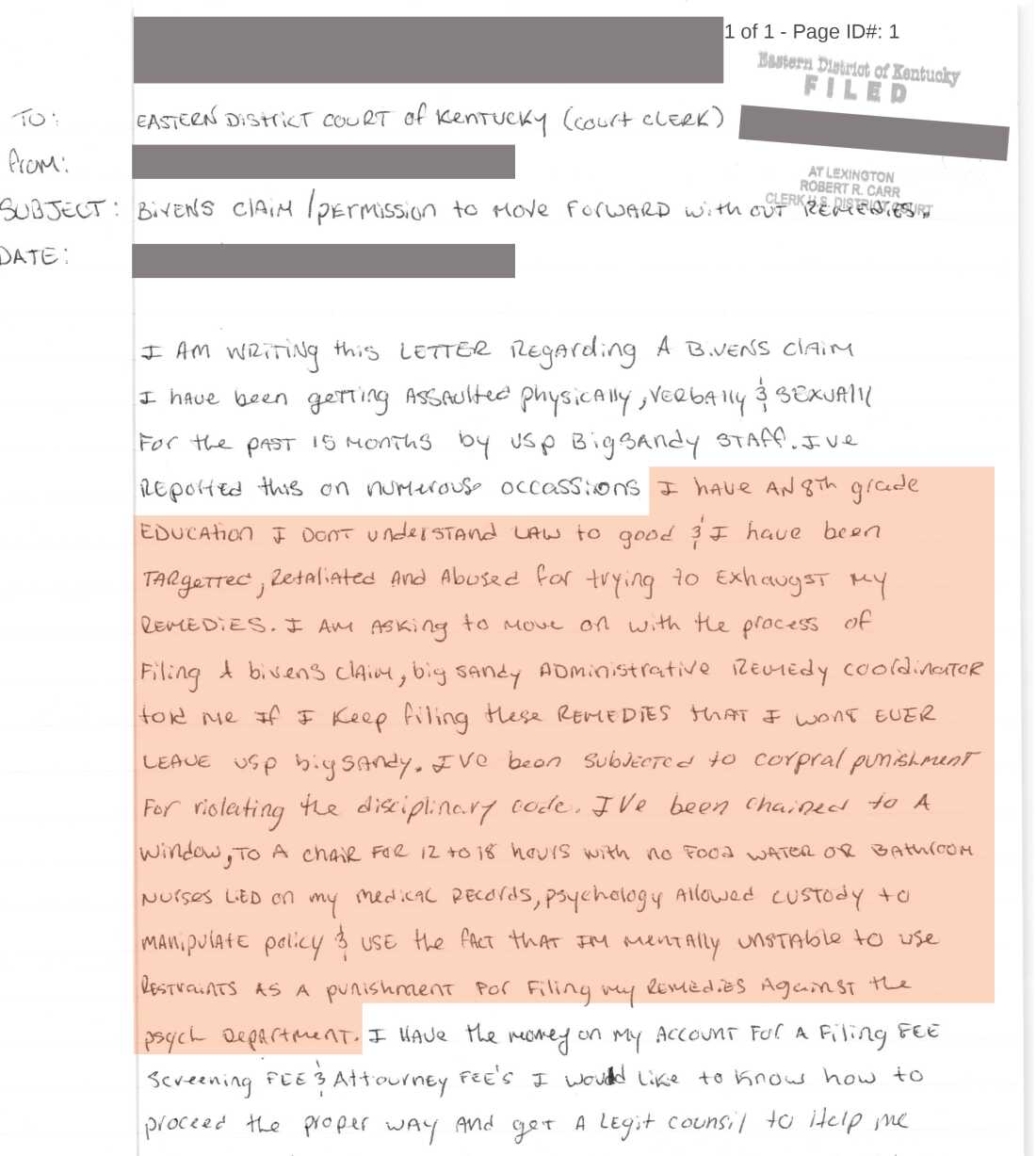
J.M. tried to report the abuse he received at Big Sandy penitentiary in 2020 to the Eastern District Court of Kentucky. The highlighting and redactions were done by The Marshall Project.
PACER
hide caption
toggle caption
PACER
Advertisement
When J.M. tried to report the abuse he said he suffered at the hands of Big Sandy staff, it only brought more mistreatment. “I have an 8th-grade education, I don’t understand law,” he wrote to a federal court in 2020. “I have been targeted, retaliated and abused for trying to exhaust my remedies. Big Sandy [staff] told me if I keep filing these remedies that I won’t ever leave.” In his letter, J.M. described being chained to a chair for 12 to 18 hours at a time with no “food water or bathroom.”
“Nobody should get chained to no bed for … hours for filing a piece of paper, no matter what,” J.M. said in a recent interview.
His plea to the court, like several others filed from Big Sandy at that time, went nowhere.
In one case reviewed by The Marshall Project, an incarcerated man reported being pepper-sprayed, choked, beaten with a baton and repeatedly called racial slurs by Kentucky officers who were later convicted. He tried multiple times to file grievances about the attacks but received no response before he was transferred to another prison, according to a legal complaint. When he sued in court, his case was thrown out: He hadn’t completed the final two levels of the bureau’s remedy process.
Advertisement
By 2021, J.M. was transferred from Big Sandy to Thomson penitentiary in Illinois, then one of the most violent federal prisons in the country. Bureau officials closed the high-security Special Management Unit there in 2023, after an investigation by The Marshall Project and NPR exposed a culture of abuse and multiple homicides.
In his legal complaint, J.M. said officers at Thomson also refused to provide him with grievance forms. In a survey of over 120 people who had been held at Thomson, conducted by legal advocacy group The Washington Lawyers’ Committee, many reported the same interference. “I’m gonna break your fucking hands since you like to write us up,” one man said he was told, after an officer confiscated his stamps and legal documents.
There are supposed to be other avenues for incarcerated people to report their abuse. But in a setting where no communication is truly anonymous, and the fear of retaliation is prevalent, even reaching out to the Inspector General felt risky, J.M. said. And it was hard to trust another government agency. “It’s like being in a house, and your mother or father is abusing you,” he explained. “And then you go and try and tell your mother or father, ‘Y’all abusing me.’ It didn’t make sense.”
In the U.S. Government Accountability Office report, published in May, investigators found that most surveyed prisoners said they could experience retaliation from staff if they reported sexual abuse. Less than half said they would feel comfortable reporting to the warden or a corrections officer. And many of the surveyed people didn’t know they had other options to report a sexual assault, like calling a rape crisis center or asking a family member to report on their behalf. The bureau agreed with the recommendations laid out in the report.
Advertisement
Fear of being targeted can hide systemic problems. At FCI Dublin in California, which closed in 2024 over widespread sexual abuse, officers frequently punished people for trying to file complaints, said Aron Laureano, who spent two years at the facility.
“They made it literally impossible for anybody to say anything,” she said. The first time Laureano filed a grievance, an officer came to her cell and quoted from her written complaint in front of everyone. “And that’s why they got away with it for so long.”
According to a federal lawsuit, officers retaliated against Laureano by placing her in solitary confinement, taking away her visits and phone calls, and confiscating her property. In one bizarre form of punishment, Laureano said, an officer made her walk around the prison yard, gather the eggs and baby hatchlings of geese who were roosting on the grounds, and stuff them in a trash bag.
Laureano came home from prison in 2024. “You went from one monster to another,” she said of navigating her time at Dublin. “You didn’t have anywhere to go. And I think that’s the worst feeling in the world. I told myself I would never put myself in a predicament like that again, ever.”
After the 2023 assault at Atwater penitentiary in California, J.M. was transferred to a different federal facility and locked in solitary confinement for making threats, insolence, and refusing to obey an order. In her official retelling of the incident, Officer Munagay had claimed that J.M. “walked toward me in an aggressive way” and that she “feared for [her] life.”
Advertisement
What happened with Munagay and the other officers followed J.M. to the new facility. “Everybody knew about the situation, it was funny to them,” he said of the guards there. “I had officers come and tell me, ‘Hey, drop the case, she’s got three kids.’” Staff also began threatening him, according to J.M.’s complaint. They told other prisoners he was a snitch, he said, and locked him in four-point restraints for hours, where each limb was chained to a concrete slab.
It wasn’t just the guards he was worried about. J.M. had seen employees turn prisoners against each other, he said, as payback for writing someone up. “If I file a remedy … my unit team is going to come … take everybody’s stuff, trash everybody’s cells, and say, ‘We’re doing this because [J.M.] complained,’” he said. “Now the other inmates are mad, ‘Oh, it’s your fault.’ Your life is in danger.”
Federal prison policy required J.M. to file his complaint at the institution level first, unless it was regarding a “sensitive” issue. Then he could mail a claim directly to the regional director. J.M. didn’t have enough postage, so he fashioned a fishing line out of plastic wrappers, and used it to trade food for stamps with other men on the tier.
His grievance was rejected. The bureau did not consider his issue “sensitive,” according to a federal database, and required him to file again at the prison level. When J.M. went to file an appeal, prison staff seized and destroyed his paperwork, his lawsuit says.
“He had been assaulted, isolated, trapped, and could not tell anyone who would listen,” his complaint states. “By mid-January 2024 … JM was expressing ‘suicidality’ to the mental-health department because he could not ‘participate’ in the ‘Administrative Remedy Process.’”
Advertisement
Nearly six months after his attack, prison staff dropped the disciplinary charges against J.M., as video footage showed Munagay had punched him. Federal prosecutors filed criminal charges against Munagay six months later. In June, she was sentenced to four months in prison. J.M.’s lawsuit is ongoing.
No charges have been filed regarding the sexual assault J.M. says he experienced. In 2024, there were 32 allegations of sexual abuse by staff reported at Atwater penitentiary.
J.M. has since been moved to another federal penitentiary out of state. His struggles with the grievance system continue. He’s trying to appeal a grievance he filed about not receiving his allotment of postage stamps, but he doesn’t have enough stamps to mail the paperwork.
“I’m resilient. I’m not going to give up just because other people failed,” he said about his commitment to keep trying to use the system. “I’m going to keep filing no matter how small or big the situation is, and hopefully something will change. These are the rules I gotta follow. This is the only way I got to fight.”
A person was killed Monday in an ICE-involved shooting in Biddeford, Maine, according to the state’s speaker of the house — just days after a federal agent fatally shot a Mexican immigrant during a traffic stop in Houston, sparking mass protests and demands for transparency and accountability.
“A person was killed. ICE was involved. State Police and the Department of Public Safety are now on scene to gather details and would expect the FBI to investigate as well,” Maine House Speaker Ryan Fecteau said in a statement on Facebook. “These are the details that I have at this time. I will provide further updates, as they are relayed to me.”
CNN has reached out to Immigration and Customs Enforcement and the Department of Homeland Security for comment.
Biddeford police told CNN there was a “police incident” in the area, about 18 miles south of Portland, and said there is no threat to the public at this time, but declined to provide additional details.
Maine Democratic US Rep. Chellie Pingree said she was “disturbed and angry” upon hearing the news of the shooting. She called for an investigation into the incident, adding a question directed at ICE officers: “Why are you in Maine?”
Advertisement
The incident comes less than a week after a man on his way to work in Houston was shot and killed by an ICE agent. Lorenzo Salgado Araujo was killed during a traffic stop in what ICE initially described as a targeted enforcement operation, though a source later said Salgado Araujo was not the target of the operation.
The shooting has reignited calls for accountability among ICE agents, which reached a fever pitch earlier this year after 37-year-old mother Renee Good and 37-year-old ICU nurse Alex Pretti were killed by federal immigration agents during the Trump administration’s operation in Minneapolis.
The administration dubbed a similar surge in immigration enforcement across Maine in January “Operation Catch of the Day.” The ACLU and other advocates filed a lawsuit against federal immigration agents for “abducting a lawful immigrant” during the surge.
Some community groups and advocates that rallied against the surge earlier this year have already started to organize in response to Monday’s shooting. The group “Maine Resists” has planned an emergency community rally in the city at noon. The racial justice and immigrant rights group Project Relief said it is in touch with the victim’s family.
“Gus,” a Tyrannosaurus rex skeleton, is pictured during a press preview at Sotheby’s in New York City on July 1.
Timothy A. Clary/AFP via Getty Images
hide caption
toggle caption
Advertisement
Timothy A. Clary/AFP via Getty Images
If you ever wanted to own an actual T. rex and not just a toy, you now have a chance. But it’s going to cost you some bones. Millions of them.
The Tyrannosaurus rex fossil known as “Gus” will go up for auction Tuesday morning at Sotheby’s New York City office. The starting bid for the dinosaur is $19 million and the auction house estimates it could sell for $20 to $30 million.
Gus was found in Harding County, S.D., on private land in 2021, according to Sotheby’s. The T. rex skeleton, which is 38 feet long and 12 and half feet tall, is believed to be from the late Cretaceous period from about 67 million years ago.
Advertisement
“Judging from the overall size and degree of bone development it can be determined that Gus’ skeleton belonged to a very large, robust, adult individual,” the auction house said in the listing.
Thomas Heitkamp, president of Theropoda Expeditions, the company that excavated the site, said in a Sotheby’s video about the discovery that nearly a thousand pieces were collected.
The creature is named after the owner of the ranch where it was discovered, Gary “Gus” Licking. He died during the excavation process, which ran through 2023, and was not able to see Gus fully assembled, according to Cassandra Hatton of Sotheby’s.
“Gary had for years roamed around his 6,500 acre property and seeing T. rex teeth and little bits of fossils and such, and he realized that there was probably something really important under the ground,” Hatton said in the video.
Gus is one of the largest and most complete T. rex specimens ever found, according to Sotheby’s.
Advertisement
It’s not the first time dinosaur bones have been for sale to the highest bidder.
The first auction for a dinosaur was held by Sotheby’s in 1997. The creature, a T. rex named Sue, was purchased by a few large companies for the Field Museum in Chicago. It went for $8.4 million.
In 2024, Apex the stegosaurus sold for $44.6 million, the most ever for a dinosaur fossil. It was purchased by billionaire investor Ken Griffin, who loaned it to the American Natural History Museum in New York for four years.
Paleontologist Scott Persons, who is the curator of natural history at the South Carolina State Museum, says dinosaurs fetching tens of millions of dollars reflects an “increase in market demand.”
Advertisement
“More and more dinosaurs are being sold this way and at ridiculous prices,” he says in an email to NPR.
He says people who can afford to spend this much on an auction could do more to support further research.
“A sum like that could endow a research program at a public museum of your choosing,” he says. “That would pay for a career’s worth of fieldwork, the discovery of whole new species, and the public exhibition of the findings.”