News
The debut of new pandas in D.C. marks the latest chapter in China's 'panda diplomacy'


The National Zoo’s first giant pandas, Ling-Ling and Hsing-Hsing, play in their yard in 1974 as onlookers watch.
File/AP
hide caption
toggle caption
File/AP
What’s black, white and back in the nation’s capital? Giant pandas, at last.
Bao Li and Qing Bao, both three years old, are making their public debut at the Smithsonian National Zoological Park (aka the National Zoo) on Friday after months of anticipation and fanfare — including panda-themed pop-up bars, hotel packages and special-edition transit cards.
The pair arrived in D.C. — aboard the fittingly nicknamed “Panda Express” — from China back in October. Since then, they could only be glimpsed occasionally on the zoo’s social media feed (including rolling around in the flurries during a snowstorm earlier this month).

Now, after a requisite quarantine and brief preview period for zoo members, the panda exhibit and its accompanying Giant Panda Cam are back on full display.
“Bao Li and Qing Bao have already won the hearts of our staff and volunteers, and we are excited to welcome panda fans back to the Zoo — the only place in the nation where you can see giant pandas for free — and celebrate the newest chapter of our giant panda breeding and conservation program,” said Brandie Smith, director of the Smithsonian’s National Zoo and Conservation Biology Institute.
🐼🎁🐼 Our gift to you: have yourself a merry little moment with giant pandas Bao Li and Qing Bao. Happy holidays from our wild family to yours!
. . .
🐾 Follow #DCPandas for updates, and meet our pandas when they make their giant debut Jan. 24, 2025. LEARN MORE:… pic.twitter.com/UprwrFyozs— National Zoo (@NationalZoo) December 25, 2024
Scientists estimate there are fewer than 2,000 giant pandas living in the wild, scattered throughout half a dozen mountainous regions in China. About 420 pandas live in captivity in zoos and reserves, mostly but not exclusively in China.
That’s because, over the last half a century, China has either gifted or loaned its beloved bears to zoos around the world, a practice that’s become known as “panda diplomacy.” In exchange, zoos pay a hefty fee to support panda conservation programs in China.
Under the National Zoo’s agreement, Bao Li and Qing Bao will stay in D.C. until 2034, and any cubs they birth will move to China by age four. The zoo is paying $1 million annually to contribute to projects including restoring giant panda habitat, monitoring wildlife diseases and assessing the impacts of climate change.
In addition to D.C., the San Diego Zoo welcomed two pandas in 2024, while the San Francisco Zoo is anticipating the arrival of a pair this year.
Panda diplomacy is seen as a way for China to not only conserve wildlife but promote goodwill and strengthen diplomatic ties with other countries — bringing a whole new meaning to soft power.

“Many people don’t realize it, but there are actually two Chinese ambassadors in Washington: me and the panda cub at the National Zoo,” Cui Tiankai, China’s then-ambassador to the U.S., wrote in a 2013 Washington Post op-ed.
Here’s a look at the current state of panda diplomacy — and how we got here.
The early years: Panda-monium starts to spread

Ruth Harkness holds Su Lin at her hotel room in New York City. Su Lin was never intended to be a pet, and ended up at a Chicago zoo.
Getty Images
hide caption
toggle caption
Getty Images
The first living giant panda exhibited in the U.S. was named Su Lin. The three-month-old cub was captured and brought over from China in 1936 by American fashion designer and socialite Ruth Harkness, who was inspired to carry out her late husband’s dream.
Su Lin, who was named after Harkness’ Chinese guide’s sister-in-law — he was believed to be female until after his death — ended up at Chicago’s Brookfield Zoo, where he became a star attraction, winning over celebrity admirers including Shirley Temple. He died of pneumonia in 1938, just weeks after Harkness brought back another panda from China — Mei Mei — to join him. Su Lin’s body is still on display at Chicago’s Field Museum.
Foreigners captured and took over a dozen pandas from China over the next decade, according to the World Wildlife Foundation (WWF), whose logo happens to be a panda. By the 1940s, China sought to end the exploitation of its pandas by foreigners, but recognized it had something special to offer its friends.
E. Elena Songster, a history professor at St. Mary’s College of California who authored Panda Nation: The Construction and Conservation of China’s Modern Icon, told WBUR in 2024 that the first time pandas were used “as diplomatic expression” was in 1941.
“Chiang Kai-shek’s wife, Soong Mei-ling, offered a pair of pandas to the United States as an expression of gratitude for our assistance with them in their war of resistance against Japan,” she explained.
The People’s Republic of China continued that practice in the years after it took over in 1949. The U.S. initially didn’t recognize and tried to weaken the communist government, forbade American citizens from visiting the country and encouraged its allies not to have diplomatic relations with China.
China began gifting pandas to its allies, including the Soviet Union and North Korea. It sent its first panda ambassadors, Ping Ping and Qi Qi, to the Soviet Union in 1957 to celebrate the 40th anniversary of the October Revolution, writes Yu Tao, a professor of Chinese Studies at the University of Western Australia.
Between 1957 and 1983, the country sent 24 pandas to foreign countries, including the U.S.
Mid-20th century: Panda diplomacy reaches the U.S.

First lady Patricia Nixon welcomes China’s giant pandas to Washington’s National Zoo on April 20, 1972. The tradition of China sending pandas to U.S. zoos has continued ever since.
File/AP
hide caption
toggle caption
File/AP
The U.S. and China began to warm to each other throughout the 1970s, with President Richard Nixon’s landmark 1972 visit signaling the beginning of a policy of engagement.
A pivotal moment came when China gave its first pair of pandas to the U.S., just months after Nixon’s trip.
At a dinner in Beijing, while seated next to Chinese Premier Zhou Enlai, First Lady Patricia Nixon commented on a box of cigarettes decorated with pandas: “Aren’t they cute? I love them.”
“I’ll give you some,” he replied, according to the Richard Nixon Foundation.
Zhou gifted two giant pandas to the U.S., and the Nixons chose the National Zoo as their home.

Ling-Ling and Hsing-Hsing arrived in April 1972 and lived at the zoo for the next two decades. They drew millions of visitors until their deaths in 1992 and 1999, and set a new tradition in motion.
“[The gift] made a huge splash because the U.S. was a former enemy state, and so it was a giant gesture of diplomatic friendship,” Songster explains. “And from that moment, [China] saw how warmly welcomed the pandas were and how popular they were and how useful they were for putting a friendly face on China.”
By 1979, the U.S. and China had established full diplomatic relations.
As other countries — including West Germany and Japan — recognized Beijing in the early 1970s, they received pandas of their own. Soon, however, the practice began to look unsustainable.
Turn of the millennium: Gifts turn into loans

National Zoo visitors welcome Tian Tian and Mei Xiang to their new home in December 2000. They returned to China with their cub in late 2023.
Getty Images/Hulton Archive
hide caption
toggle caption
Getty Images/Hulton Archive
In the mid-1980s, China stopped giving pandas as gifts over concerns about its ability to maintain the wild population.
“And also at that time, there was a panda starvation scare, because there was a huge bamboo die-off in the pandas’ range,” Songster explained. “And so from that point forward, they started loaning them.”

That shift also embodied “China’s market-orientated economic reforms,” Tao wrote, with bears bringing in some $500,000 to $1 million per year.
While loan periods were initially relatively short, by the 1990s they had grown to at least 10 years, Songster said, proving less stressful for the animals and more conducive to reproduction.
In 1998, the U.S. shifted its acceptance policy to only allow a panda to reside stateside if China devoted more than half of its annual fee to conservation efforts, according to the History Channel.
Today: What pandas can tell us about politics

Wang Wang the panda chews on a box as South Australian Premier Peter Malinauskas and China’s Premier Li Qiang listen to a ranger at Adelaide Zoo in Australia in June 2024 — the first high-level diplomatic outreach by a Chinese leader to Australia since 2017.
Asanka Ratnayake/Getty Images AsiaPac
hide caption
toggle caption
Asanka Ratnayake/Getty Images AsiaPac
Scholars have noted that China’s panda strategy has evolved over the decades from strategic gift-giving to a financial transaction to, as of recent years, a symbol of trade relationships.
Indeed, many of China’s panda loans have coincided with trade deals. Shortly after the Edinburgh Zoo received two pandas in 2011, Scotland and China signed trade agreements involving salmon and renewable energy technology. The loan of two pandas to Germany in 2017 overlapped with Chinese leader Xi Jinping’s visit to Berlin.
The timing of panda loans has also seemed to reflect the level of tension between China and other nations.
The arrival of two pandas to Malaysia in 2014 — to mark the 40th anniversary of its diplomatic ties with Beijing — was delayed by several months because of disagreements over Malaysia’s handling of the disappearance of Flight MH370 (many of its passengers were Chinese).

In November 2023, the National Zoo sent its three pandas — Tian Tian and Mei Xiang, who had lived there since 2000, and their cub Xiao Qi Ji — back to China, in advance of the expiration of their loan agreement and amidst rising tensions between the two countries.
There was no agreement in place at the time for a new set of pandas to head to D.C., and Atlanta was left as the only zoo in the country housing any pandas.
A week later, however, Xi signaled openness to sending more pandas to the U.S., specifically California. And in May 2024, the official announcement came down: A pair of pandas — Bao Li and Qing Bao — would arrive in the States by the end of the year.



“So, my daughter, Robin, was born Jan. 5, 2025.” “Hi, baby. That’s you.” “When I first saw her, I was like, ‘Oh my God, she’s here.’” “She was crying and immediately when she was up on my face, she stopped crying.” “I got the room with the view.” “But it wasn’t until way later, I saw a fire near the Pasadena Mountains.” “We’re watching the news on the TV, hoping that it’s just not going to reach our house.” “The Eaton fire has scorched over 13,000 acres.” “Sixteen people confirmed dead.” “More than 1,000 structures have been destroyed.” “And then that’s when we got the call. Liz’s mom crying, saying the house is on fire.” “Oh, please. No, Dios mio. Go back. Don’t go that way. It’s closed. Go, turn. Turn back.” “Our house is burning, Veli.” “Oh my God.” “It was just surreal. Like, I couldn’t believe it.” “There’s nothing left.” “Not only our house is gone, the neighbors’ houses are gone, her grandma’s house is gone. All you could see was ash.” “My family has lived in Altadena for about 40 years. It was so quiet. There’s no freeways. My grandmother was across the street from us. All our family would have Christmas there, Thanksgivings. She had her nopales in the back. She would always just go out and cut them down and make salads out of them. My grandmother is definitely the matriarch of our family. My parents, our house was across the street. And then me and Javi got married right after high school.” “My husband’s getting me a cookie.” “Me and Javi had talked a lot about having kids in the future. Finally, after 15 years of being married, we were in a good place. It was so exciting to find out that we were pregnant. We remodeled our whole house. We were really preparing. My grandmother and my mom, they were like, crying, and they were like, so excited.” “Liz!” “I had this vision for her, of how she would grow up, the experiences maybe she would have experiencing my grandmother’s house as it was. We wanted her to have her childhood here. But all of our preparation went out the window in the matter of a few hours.” “And we’re like, ‘What do we do?’ And then we get a phone call. And it was Liz’s uncle. He was like, ‘Hey, come to my house. We have a room ready for you.’” “In my more immediate family, nine people lost their homes, so it was about 13 people in the house at any given point for the first three months of the fire. It was a really hard time. We had to figure out insurance claim forms, finding a new place to live, the cost of rebuilding — will we be able to afford it? Oh my gosh, we must have looked at 10 rentals. The experience of motherhood that I was hoping to have was completely different. Survival mode is not how I wanted to start. “Hi, Robin.” “Robin — she was really stressed out. “She’s over it.” “Our stress was radiating towards Robin. I feel like she could feel that.” “There was just no place to lay her safely, where she could be free and not stepped over by a dog or something. So she was having issues gaining strength. So she did have to go to physical therapy for a few months to be able to lift her head.” “One more, one more — you can do it.” “All the stress and the pain, it was just too much.” “Then Liz got really sick.” “I didn’t stop throwing up for five hours. Javi immediately took me to the E.R. They did a bunch of tests and figured out it was vertigo, likely stress-induced. It felt like, OK, something has to slow down. I can’t just handle all of it myself all the time. My mom is so amazing and my grandmother, they really took care of us in a really wonderful way. So — yeah.” “We’ve been able to get back on our feet. “Good high-five.” “I think it has changed how I parent. I’m trying to shed what I thought it would be like, and be open to what’s new. Robin is doing much better. She’s like standing now and trying to talk. She says like five words already. Even if it’s not exactly home for Robin, I wanted to have those smells around. You walk in and it smells like home. For us, it’s definitely tamales. My grandmother’s house is not being rebuilt. I can tell she’s so sad. “Let me just grab a piece of this.” “So right now, where Javi’s standing is the front. One bedroom there, here in the middle, and Robin’s bedroom in the corner. My grandma will live with us versus across the street, which is silver linings. Yeah, and we did make space for a garden for her.” “What are you seeing? What do you think? What do you think, Robin?” “The roots of Altadena — even though they’re charred — they’re going to be stronger than before.” “How strong you can be when something like this happens, I think is something that’s really important for her to take on. And that I hope Altadena also takes on.”

People participate in a protest and noise demonstration calling for an end to federal immigration enforcement operations in the city, Friday, Jan. 9, 2026, in Minneapolis.
John Locher/AP
hide caption
toggle caption
John Locher/AP
MINNEAPOLIS — A Minnesota prosecutor on Friday called on the public to share with investigators any recordings and evidence connected to the fatal shooting of Renee Good as a new video emerged showing the final moments of her encounter with an immigration officer.

The Minneapolis killing and a separate shooting in Portland, Oregon, a day later by the Border Patrol have set off protests in multiple cities and denunciations of immigration enforcement tactics by the U.S. government. The Trump administration has defended the officer who shot Good in her car, saying he was protecting himself and fellow agents.
The reaction to the shooting has largely been focused on witness cellphone video of the encounter. A new, 47-second video that was published online by a Minnesota-based conservative news site, Alpha News, and later reposted on social media by the Department of Homeland Security shows the shooting from the perspective of ICE officer Jonathan Ross, who fired the shots.
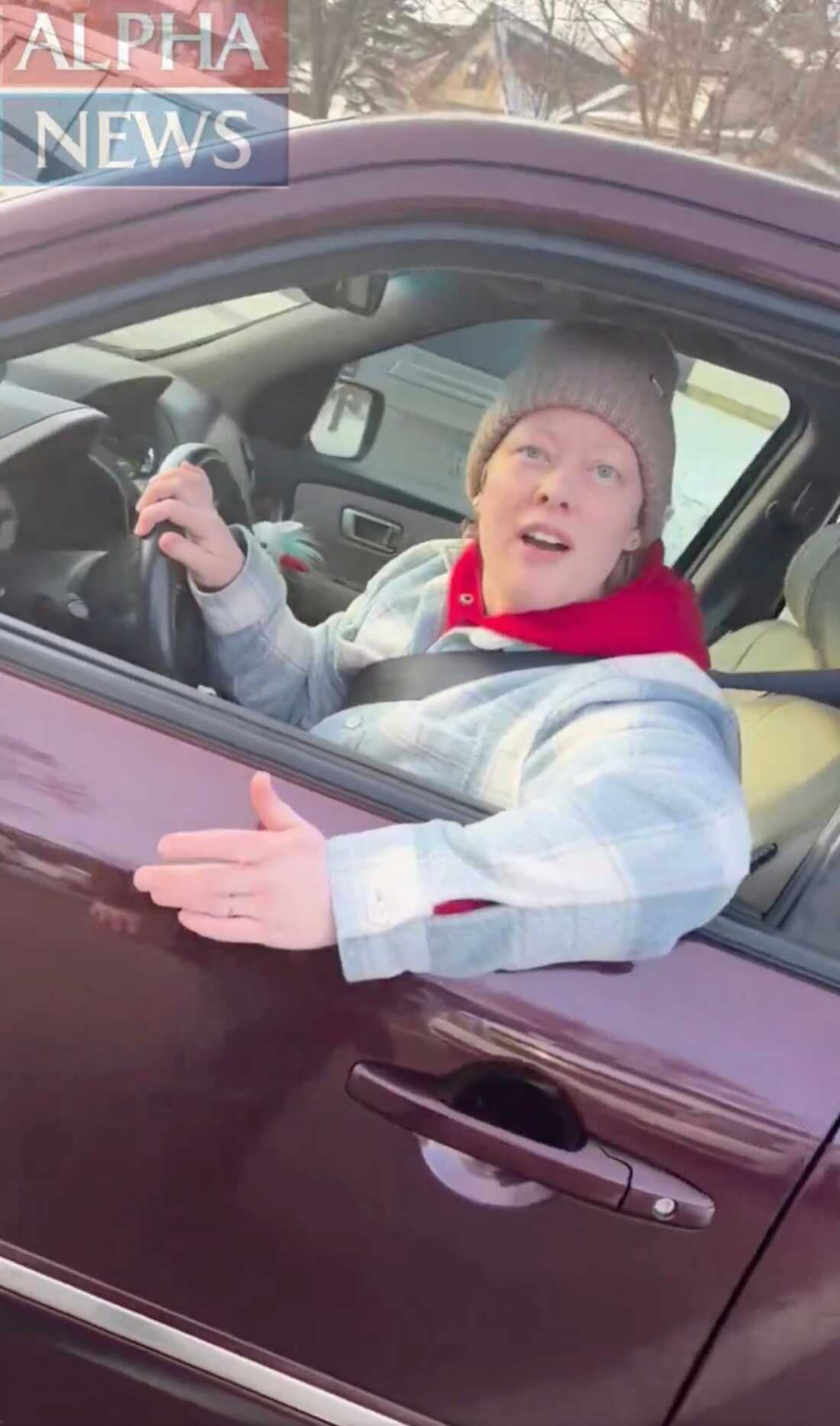
This image from video made by Immigration and Customs Enforcement officer Jonathan Ross via Alpha News shows Renee Good in her vehicle in Minneapolis on Wednesday, Jan. 7, 2026.
Jonathan Ross/AP/ICE
hide caption
toggle caption
Jonathan Ross/AP/ICE
Sirens blaring in the background, he approaches and circles Good’s vehicle in the middle of the road while apparently filming on his cellphone. At the same time, Good’s wife also was recording the encounter and can be seen walking around the vehicle and approaching the officer. A series of exchanges occurred:
“That’s fine, I’m not mad at you,” Good says as the officer passes by her door. She has one hand on the steering wheel and the other outside the open driver side window.
“U.S. citizen, former f—ing veteran,” says her wife, standing outside the passenger side of the SUV holding up her phone. “You wanna come at us, you wanna come at us, I say go get yourself some lunch big boy.”
Other officers are approaching the driver’s side of the car at about the same time and one says: “Get out of the car, get out of the f—ing car.” Ross is now at the front driver side of the vehicle. Good reverses briefly, then turns the steering wheel toward the passenger side as she drives ahead and Ross opens fire.
The camera becomes unsteady and points toward the sky and then returns to the street view showing Good’s SUV careening away.
“F—ing b—,” someone at the scene says.
A crashing sound is heard as Good’s vehicle smashes into others parked on the street.
Federal agencies have encouraged officers to document encounters in which people may attempt to interfere with enforcement actions, but policing experts have cautioned that recording on a handheld device can complicate already volatile situations by occupying an officer’s hands and narrowing focus at moments when rapid decision-making is required.
Under an ICE policy directive, officers and agents are expected to activate body-worn cameras at the start of enforcement activities and to record throughout interactions, and footage must be kept for review in serious incidents such as deaths or use-of-force cases. The Department of Homeland Security has not responded to questions about whether the officer who opened fire or any of the others who were on the scene were wearing body cameras.
Homeland Security says video shows self-defense
Vice President JD Vance and Homeland Security spokesperson Tricia McLaughlin said in posts on X that the new video backs their contention that the officer fired in self-defense.
“Many of you have been told this law enforcement officer wasn’t hit by a car, wasn’t being harassed, and murdered an innocent woman,” Vance said. “The reality is that his life was endangered and he fired in self defense.”
Minneapolis Mayor Jacob Frey has said any self-defense argument is “garbage.”
Policing experts said the video didn’t change their thoughts on the use-of-force but did raise additional questions about the officer’s training.
“Now that we can see he’s holding a gun in one hand and a cellphone in the other filming, I want to see the officer training that permits that,” said Geoff Alpert, a criminology professor at the University of South Carolina.
The video demonstrates that the officers didn’t perceive Good to be a threat, said John P. Gross, a professor at the University of Wisconsin Law School who has written extensively about officers shooting at moving vehicles.
“If you are an officer who views this woman as a threat, you don’t have one hand on a cellphone. You don’t walk around this supposed weapon, casually filming,” Gross said.
Ross, 43, is an Iraq War veteran who has served in the Border Patrol and ICE for nearly two decades. He was injured last year when he was dragged by a driver fleeing an immigration arrest.
Attempts to reach Ross at phone numbers and email addresses associated with him were not successful.
Prosecutor asks for video and evidence
Meanwhile, Hennepin County Attorney Mary Moriarty said that although her office has collaborated effectively with the FBI in past cases, she is concerned by the Trump administration’s decision to bar state and local agencies from playing any role in the investigation into Good’s killing.
She also said the officer who shot Good in the head does not have complete legal immunity, as Vance declared.
“We do have jurisdiction to make this decision with what happened in this case,” Moriarty said at a news conference. “It does not matter that it was a federal law enforcement agent.”
Moriarty said her office would post a link for the public to submit footage of the shooting, even though she acknowledged that she wasn’t sure what legal outcome submissions might produce.
Good’s wife, Becca Good, released a statement to Minnesota Public Radio on Friday saying, “kindness radiated out of her.”
“On Wednesday, January 7th, we stopped to support our neighbors. We had whistles. They had guns,” Becca Good said.
“I am now left to raise our son and to continue teaching him, as Renee believed, that there are people building a better world for him,” she wrote.
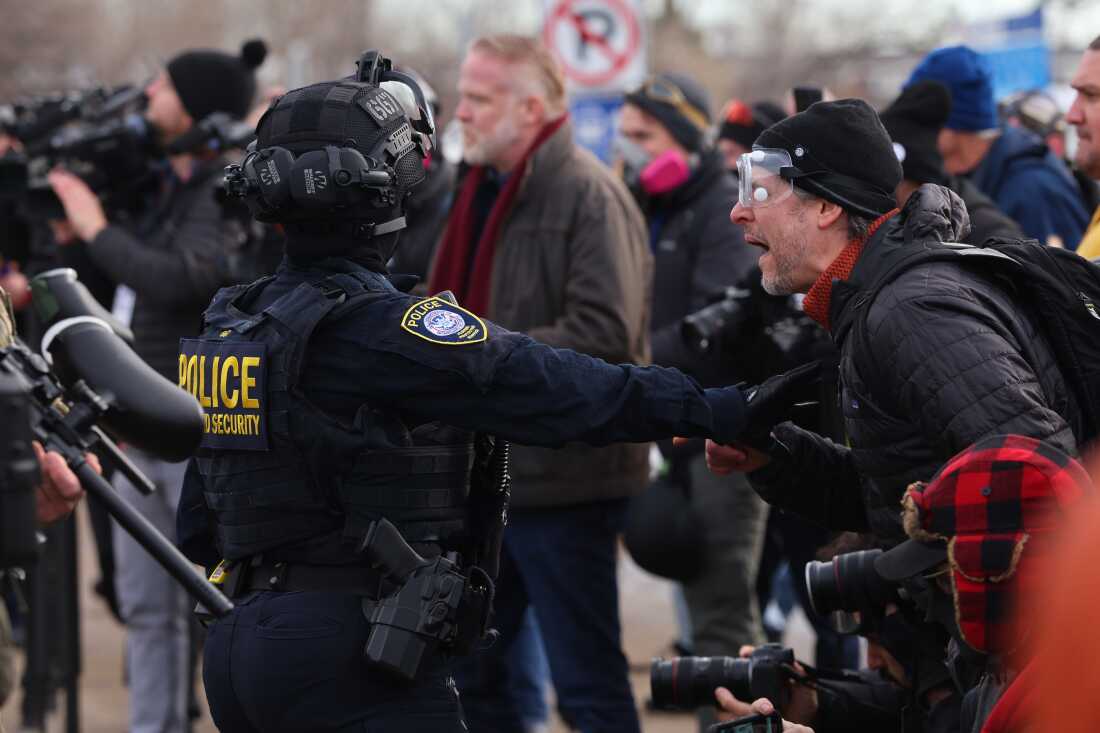
Protesters confront law enforcement outside the Bishop Henry Whipple Federal Building in Minneapolis, Friday, Jan. 9, 2026.
Adam Bettcher/AP
hide caption
toggle caption
Adam Bettcher/AP
The reaction to Good’s shooting was immediate in the city where police killed George Floyd in 2020, with hundreds of protesters converging on the shooting scene and the school district canceling classes for the rest of the week as a precaution and offering an online option through Feb. 12.
On Friday, protesters were outside a federal facility serving as a hub for the immigration crackdown that began Tuesday in Minneapolis and St. Paul. That evening, hundreds protested and marched outside two hotels in downtown Minneapolis where immigration enforcement agents were supposed to be staying. Some people were seen breaking or spray painting windows and state law enforcement officers wearing helmets and holding batons ordered the remaining group of fewer than 100 people to leave late Friday.
Shooting in Portland
The Portland shooting happened outside a hospital Thursday. A federal border officer shot and wounded a man and woman in a vehicle, identified by the Department of Homeland Security as Venezuela nationals Luis David Nico Moncada and Yorlenys Betzabeth Zambrano-Contreras. Police said they were in stable condition Friday after surgery, with DHS saying Nico Moncada was taken into FBI custody
DHS defended the actions of its officers in Portland, saying the shooting occurred after the driver with alleged gang ties tried to “weaponize” his vehicle to hit them. It said no officers were injured.
Portland Police Chief Bob Day confirmed that the two people shot had “some nexus” to Tren de Aragua, a Venezuelan gang. Day said they came to the attention of police during an investigation of a July shooting believed to have been carried out by gang members, but they were not identified as suspects.
The chief said any gang affiliation did not necessarily justify the shooting by U.S. Border Patrol. The Oregon Department of Justice said it would investigate.
On Friday evening, hundreds of protesters marched to the ICE building in Portland.
The biggest crackdown yet
The Minneapolis shooting happened on the second day of the immigration crackdown in the Twin Cities, which Homeland Security said is the biggest immigration enforcement operation ever. More than 2,000 officers are taking part and Homeland Security Secretary Kristi Noem said they have made more than 1,500 arrests.
The government is also shifting immigration officers to Minneapolis from sweeps in Louisiana, according to documents obtained by The Associated Press. This represents a pivot, as the Louisiana crackdown that began in December had been expected to last into February.
Good’s death — at least the fifth tied to immigration sweeps since President Donald Trump took office — has resonated far beyond Minneapolis. More protests are planned for this weekend, according to Indivisible, a group formed to resist the Trump administration.

A federal judge ruled Friday that President Donald Trump’s administration cannot block federal money for child care subsidies and other programs aimed at supporting needy children and their families from flowing to five Democratic-led states for now.
The states of California, Colorado, Illinois, Minnesota and New York argued that a policy announced Tuesday to freeze funds for three grant programs is having an immediate impact on them and creating “operational chaos.” In court filings and a hearing earlier Friday, the states contended that the government did not have a legal reason for holding back the money from those states.
The U.S. Department of Health and Human Services said it was pausing the funding because it had “reason to believe” the states were granting benefits to people in the country illegally, though it did not provide evidence or explain why it was targeting those states and not others.
The programs are the Child Care and Development Fund, which subsidizes child care for children from low-income families; the Temporary Assistance for Needy Families program, which provides cash assistance and job training; and the Social Services Block Grant, a smaller fund that provides money for a variety of programs.
The five states say they receive a total of more than $10 billion a year from the programs.
U.S. District Judge Arun Subramanian, who was nominated to the bench by former President Joe Biden, did not rule on the legality of the funding freeze, but he said the five states had met a legal threshold “to protect the status quo” for at least 14 days while arguments are made in court.
The government had requested reams of data from the five states, including the names and Social Security numbers of everyone who received benefits from some of the programs since 2022.
The states argue that the effort is unconstitutional and is intended to go after Trump’s political adversaries rather than to stamp out fraud in government programs — something the states say they already do.
Jessica Ranucci, a lawyer in the New York Attorney General’s office, said in the Friday hearing, which was conducted by telephone, that at least four of the states had already had money delayed after requesting it. She said that if the states can’t get child care funds, there will be immediate uncertainty for providers and families who rely on the programs.
A lawyer for the federal government, Kamika Shaw, said it was her understanding that the money had not stopped flowing to states.

1986 Movie Reviews – Black Moon Rising | The Nerdy

Video: Owner of Swiss Bar Detained in Fire Investigation

Video: Raising a Baby in Altadena’s Ashes

The Best Time To Take Turmeric for Weight Loss and How To Maximize Results

Washington National Opera leaves Kennedy Center, joining slew of artist exits

Florida High School Football Rankings: Top 25 teams – Oct. 21

Cleary's 21 help Le Moyne down Central Connecticut State 69-64 in OT

How old is Bo Nix? What to know about Oregon quarterback ahead of 2024 NFL Draft

99th annual Pony Swim held in Virginia

Video: ‘It Didn’t Have to Happen This Way:’ U.Va. Faculty Call for Review of Police Response to Protests
Video: Raising a Baby in Altadena’s Ashes

Trump signs order to protect Venezuela oil revenue held in US accounts
What Canada, accustomed to extreme winters, can teach Europe
New video shows fatal Minnesota ICE shooting from officer’s perspective

Federal judge blocks Trump from cutting childcare funds to Democratic states over fraud concerns
-

 Detroit, MI7 days ago
2 hospitalized after shooting on Lodge Freeway in Detroit
-

 Technology4 days ago
Power bank feature creep is out of control
-

 Dallas, TX5 days ago
Defensive coordinator candidates who could improve Cowboys’ brutal secondary in 2026
-

 Iowa4 days ago
Pat McAfee praises Audi Crooks, plays hype song for Iowa State star
-

 Dallas, TX2 days ago
Anti-ICE protest outside Dallas City Hall follows deadly shooting in Minneapolis
-

 Health6 days ago
Viral New Year reset routine is helping people adopt healthier habits
-

 Delaware1 day ago
MERR responds to dead humpback whale washed up near Bethany Beach
-

 Nebraska3 days ago
Oregon State LB transfer Dexter Foster commits to Nebraska