News
Senators take first step to end US government shutdown

The US Senate took the first step to end the longest shutdown in history on Sunday night, after a group of Democratic lawmakers crossed party lines and endorsed a compromise plan to reopen the government.
Eight Democrats voted along with all but one Republican senator to advance a deal, which was negotiated behind closed doors by rank-and-file Democrats, Republican senators and the White House. The final vote was 60-40 in favour of advancing the agreement.
A deal would reopen the federal government and keep it funded until the end of January. It would also reverse the lay-offs initiated by the White House during the shutdown and guarantee that furloughed workers receive back pay, while including a concession by Democrats on healthcare tax credits that have been a key sticking point in the funding stand-off.
After Sunday’s procedural vote, the deal will now need to be debated and passed by the Senate and signed off by the Republican-controlled House of Representatives before the shutdown can end.
US President Donald Trump appeared confident late on Sunday, the 40th day of the shutdown. “It looks like we are getting close to the shutdown ending,” he told reporters. “You’ll know very soon.”
The Senate vote was a breakthrough in a shutdown that has dragged on for nearly six weeks, rattling the federal workforce, bringing many public services to a halt and jeopardising welfare benefits for tens of millions of Americans.
Tim Kaine, Democratic senator for Virginia and one of the eight to side with Republicans, said a possible deal would “protect federal workers from baseless firings, reinstate those who have been wrongfully terminated during the shutdown, and ensure federal workers receive back pay”.
However, the vote exposed deep divisions among Democrats as many lawmakers accused fellow party members of caving in to Republican demands.
Chuck Schumer, the Democratic minority leader in the Senate, voted against the deal, while Hakeem Jeffries, his counterpart in the House, said he would also oppose it.
The agreement included a concession by Democrats on healthcare tax credits, which are due to expire at the end of the year and which the Democratic party has insisted should be extended. Trump on Saturday poured cold water on the idea of an extension.
The deal struck on Sunday gives no guarantees on the future of the tax credits but only offers an assurance that a vote will be held on the issue no later than mid-December.
“We will fight the GOP bill in the House of Representatives,” Jeffries said. “As a result of the Republican refusal to address the healthcare crisis that they have created, tens of millions of everyday Americans are going to see their costs skyrocket.”
Sunday’s vote came after top Trump administration officials warned that US air travel would slow to a “trickle” and economic growth could turn negative if the stalemate continued for much longer.
US Treasury secretary Scott Bessent said the economic impact of the shutdown would only get “worse and worse”.
US futures tracking the S&P 500 and Nasdaq 100 rose 0.7 per cent and 1.2 per cent respectively on Monday.
Yields on 10-year US Treasuries rose 0.04 percentage points to 4.14 per cent. Bond yields move inversely to prices.
The government shut down on October 1, after Republican and Democratic lawmakers failed to agree on a plan to fund the government for the new federal fiscal year.
Funds for the Supplemental Nutrition Assistance Program (Snap) lapsed on November 1 for the first time in more than 60 years, affecting 40mn-plus poorer Americans who rely on the benefits.
On Friday the Federal Aviation Administration, which regulates air travel in the US, ordered airlines to begin reducing flight numbers. More than 2,700 flights were cancelled in the US on Sunday, according to tracking website FlightAware, while more than 10,000 others were delayed.
Richard Yetsenga, chief economist and head of research at ANZ, said the shutdown had contributed to falling bond yields and a correction in gold prices. “If the shutdown’s over I would expect a reversion of some of those shifts.”
Additional reporting by William Sandlund in Hong Kong



Donald Trump expects to have “the honour of taking Cuba”, he declared, after a US-imposed oil blockade plunged the country into darkness under a total power blackout.
The US president claimed on Monday that he could do “anything I want” with Cuba, amid US negotiations with Havana over the country’s future.
“You know, all my life I’ve been hearing about the United States and Cuba. When will the United States do it?” Trump told reporters at the White House on Monday.
“I do believe I’ll be … having the honour of taking Cuba,” Trump added. “Whether I free it, take it – think I could do anything I want with it. You want to know the truth. They’re a very weakened nation right now.”
Shortly after he spoke, the New York Times reported that US officials told Cuba to remove its president, Miguel Díaz-Canel, from power during recent talks, citing four unnamed sources familiar with the discussions.
The US has sought to intensify pressure on Cuba, its longtime foe, since seizing the Venezuelan president, Nicolás Maduro – Cuba’s most important foreign benefactor – in January. Trump cut off Venezuelan oil shipments to Cuba and threatened to put tariffs on any country that sold oil to Cuba, strangling its antiquated power grid.
Toppling Díaz-Canel from power would take out a key figurehead, while leaving in place the repressive Communist regime which has run Cuba for almost seven decades.
Cuba has traditionally rejected any interference in its internal affairs and has considered any proposals on that front to be a dealbreaker for any agreement.
Marco Rubio, the US secretary of state and son of Cuban immigrants, has long made it clear he wants regime change in Havana. Trump has also called for a “friendly takeover”, but recently told reporters: “It may not be a friendly takeover.”
Since removing Maduro from power in January and joining Israel in attacking Iran, Trump has openly mused that Cuba would be “next”.
Díaz-Canel, 65, who succeeded the late Fidel Castro and his brother Raúl Castro as president in 2018, said on Friday that he expected talks with the US to take place “under the principles of equality and respect for the political systems of both countries, sovereignty and self-determination”.
with AFP and Reuters

new video loaded: Michael B. Jordan Celebrates Oscar Win at In-N-Out
transcript
transcript
Michael B. Jordan Celebrates Oscar Win at In-N-Out
Michael B. Jordan, who won his first Oscar for best actor on Sunday for his role in “Sinners,” celebrated his win at In-N-Out Burger.
-
Thank you, everybody in this room and everybody at home for supporting me over my career. I feel it. I know you guys want me to do well, and I — and I want to do that because you guys bet on me. So thank you for keeping — for keep betting on me. And I’m going to keep stepping up, and I’m going to keep being the best version of myself I could be.

By Cynthia Silva
March 16, 2026

The U.S. men’s sled hockey team celebrates after winning its fifth straight Paralympics gold medal on Sunday.
Stefano Rellandini/AFP via Getty Images
hide caption
toggle caption
Stefano Rellandini/AFP via Getty Images
Team USA finished second in the overall Paralympics medal count, after 10 days of competition in which American athletes made dazzling debuts, defended titles and cemented legacies.
One of the many made-for-TV moments came just hours before the closing ceremony on Sunday, when the U.S. sled hockey team defeated rival Canada to claim its record fifth gold medal in a row.
“You don’t ever start out and try to be the only five-time gold medalist in the sport,” said captain Josh Pauls after personally achieving that very feat. “But to be with these guys, to lead them and kind of pass on that tradition, it’s the ultimate honor.”

The day — and the Games — ended with the closing ceremony in Cortina d’Ampezzo, featuring performances, speeches and the extinguishing of the Paralympic flame. American skiers Kendall Gretsch and Andrew Kurka, who are both leaving Italy with new medals, carried the flag for Team USA.
“I’ve been involved in four Games and have only been able to go to two closing ceremonies: in PyeongChang, where I won my gold and silver, and this year, where I won my bronze,” said Kurka, who medaled in men’s super-G. “It’s been a career filled with ups and downs, but even the small victories count for me.”
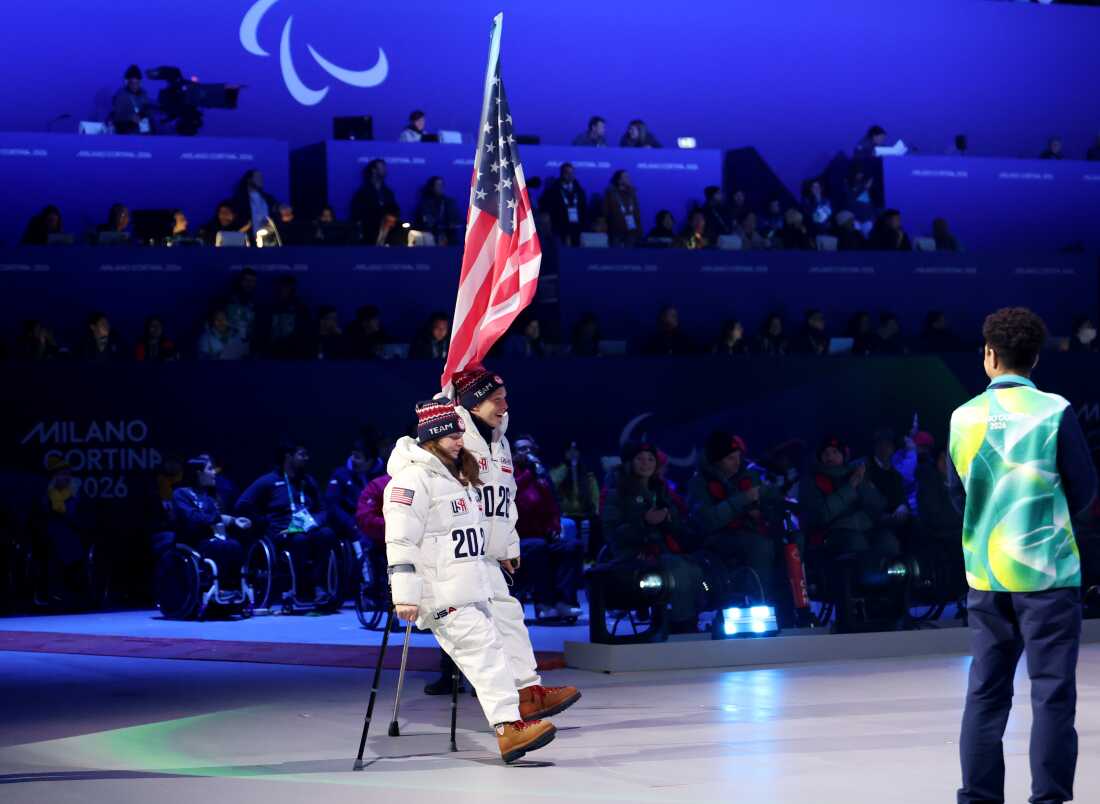
Andrew Kurka and Kendall Gretsch carry the U.S. flag during the Milano Cortina 2026 Winter Paralympic Games closing ceremony in Cortina on Sunday.
Mattia Ozbot/Getty Images
hide caption
toggle caption
Mattia Ozbot/Getty Images
At the ceremony, International Paralympic Committee (IPC) President Andrew Parsons declared the Games — the 50th anniversary of the Winter Paralympics — officially over, and a success: “The biggest and most beautiful Winter Paralympics with more athletes, more nations, more women and more global broadcast and digital coverage than ever before.”
A record 611 athletes from 55 countries competed in 79 medal events across six sports.
China topped the medal count for the second Winter Games in a row, with 44 total medals (15 gold), followed by the U.S. with 24 total medals, including 13 gold. The U.S. improved on its fifth-place standing from 2022. This is the same number of gold medals it won in 2018, in what officials are calling its “strongest gold-medal showing in the last 20 years.”
A total of 28 American Paralympians and two guides reached the podium this year. Six of them won medals for the first time, and six of them earned multiple medals, according to the U.S. Olympic and Paralympic Committee (USOPC).
In third place — both overall and in gold medals — was Russia, which was allowed to participate under its own flag for the first time since 2014 despite its ongoing war in Ukraine. Ukrainian athletes boycotted both the opening and closing ceremonies in protest.
But even in a moment of intense geopolitical upheaval, amid conflicts in Europe and the Middle East, the IPC’s Parsons said the Paralympics offered “proof that sport can unite us through respect, fairness and human achievement.”
“Paralympians, you rose above pressure, expectation and global tension to keep the focus where it belongs: on you and your sport,” he said. “You expanded the imagination of the world. You have shown that excellence is universal and that determination knows no boundaries.”
Parsons passed the proverbial torch to the next Winter Paralympics host: the French Alps for 2030. Those will follow the 2028 Summer Olympics and Paralympics in Los Angeles.
Team USA highlights
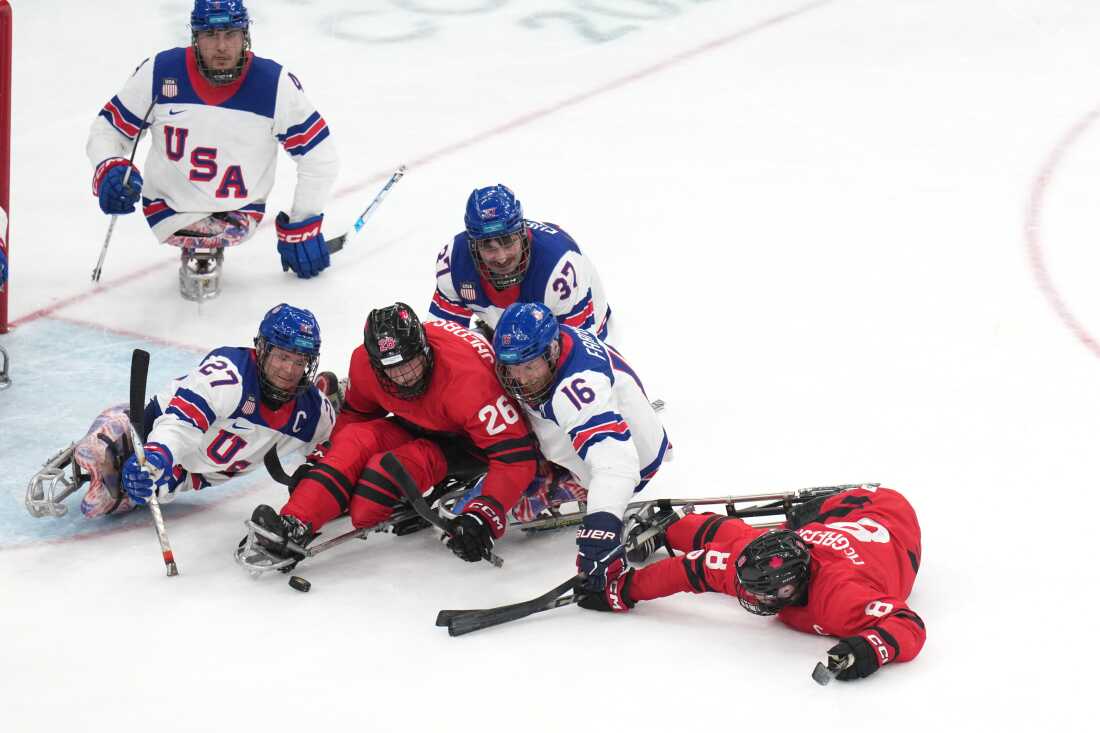
Team USA’s Declan Farmer, center, fights for the puck during the gold-medal match against Canada.
Antonio Calanni/AP
hide caption
toggle caption
Antonio Calanni/AP
On the ice:
The U.S. sled hockey team got off to a strong start in an early-round match against Italy, when it beat the host nation 14-1 — the largest margin of victory in the sport’s U.S. history.
It stayed dominant, outscoring opponents 46-6 throughout the tournament before becoming the first Paralympic or Olympic team to win five consecutive winter gold medals.
“You are going to enjoy something like this, for sure,” Coach David Hoff said afterward. “But I don’t know if it’s just the wins. It’s so much more than that. They just love playing together.”
Team USA beat Canada 6-2 on Sunday, thanks to a hat trick from Jack Wallace — who was named “best defender” of the tournament — and goals by Kayden Beasley, Brody Roybal and four-time Paralympian Declan Farmer.
Farmer, the top scorer and official MVP of these Games, scored 15 goals and 26 points throughout the tournament to become the all-time leading scorer in Paralympic sled hockey history at just 28 years old. But he was quick to share the credit with his teammates.
“A lot of the guys stepped up and had their best games of the tournament, and we just carried each other,” said Farmer. “I’m just so happy for the guys, we earned it together.”

You’re forgiven if you have deja vu from last month: This win makes the U.S. the first country to sweep all three Olympic and Paralympic hockey tournaments in one year.
Team USA also made history in wheelchair curling, with Steve Emt and Laura Dwyer finishing fourth in the brand-new mixed doubles event. That’s the United States’ best-ever Paralympic finish in the sport.
“In the two years we’ve been together, we’ve shown the world what we’re capable of doing and we’re going to go home, take some time off, relax, re-group and come back even better next year,” said Emt, the most decorated Paralympic curler in U.S. history.
In Para Nordic Skiing (cross country and biathlon):

Oksana Masters competes in the para cross-country skiing 20km in Tesero, Italy, on Sunday.
Luke Hales/Getty Images
hide caption
toggle caption
Luke Hales/Getty Images
Eight-time, dual-season Paralympian Oksana Masters, the most decorated Winter Paralympian in U.S. history, is leaving Italy with four new gold medals and a bronze in biathlon and cross-country skiing events, bringing her career total to 24 medals.
That’s despite a concussion, infection and injury that almost kept her from competing in the first place.
“I think that is what makes it so special, because nothing is guaranteed,” Masters told NPR on Saturday. “A win’s not guaranteed, and the podium’s not guaranteed, and so that’s been a really great motivator for this whole … year so far.”
Four-time Paralympian Jake Adicoff, with guides Reid Goble and Peter Wolter, won four gold medals in four visually impaired skiing events to set a new record for the most Para cross-country golds won by a Team USA athlete in a single Games.

Joshua Sweeney, Oksana Masters, Sydney Peterson, Jake Adicoff and his guide Reid Goble of Team USA participate in the medal ceremony after the para cross-country skiing mixed 4×2.5km relay.
Luke Hales/Getty Images Europe
hide caption
toggle caption
Luke Hales/Getty Images Europe
“It’s incredibly scary to put a high goal out to the public,” the 30-year-old said. “I was doubting it so much this week, I didn’t know what was going to happen, but the races came together and I’m just overjoyed.”
One of those was the mixed 4×2.5km relay, where the all-star team of Adicoff, Masters, Josh Sweeney and Sydney Peterson came from behind in the final leg to defend the U.S. title.

Peterson, competing in her second Paralympics, won four medals — three of them gold — this time around.
And Kendall Gretsch, closing ceremony flag-bearer, won four medals at her third Winter Paralympics (and fifth total): one gold, one silver and two bronze. That brings her total medal count to 11 across Summer and Winter Games.
In Alpine skiing:

Andrew Kurka competes in the super-G leg of the para Alpine skiing men’s combined.
Maja Hitij/Getty Images
hide caption
toggle caption
Maja Hitij/Getty Images
Andrew Kurka won bronze in the men’s super-G sitting, adding to his silver and gold from 2018.
“I’m happy to be here. I’m happy to have a great career. Gold, silver, and bronze, happy to be done,” said Kurka, who wrote on Instagram after the closing ceremony that he is stepping back from ski racing to deal with injuries.
In 2022, he competed with a broken nose, thumb and humerus bone, finishing fourth in the sitting downhill event before withdrawing from the rest of competition. Kurka said in Italy that he’s broken over 20 bones in his career.
“When it comes to it, losing is nothing compared to the pain of failure,” he said after winning bronze. “And when it comes down to today, I was just happy to get across that finish line without any injuries and in a relatively quick time. Usually, if I cross the finish line, it’s pretty fast.”
Meanwhile, Patrick Halgren won silver in the men’s super-G standing event — the first for Team USA since 1998.
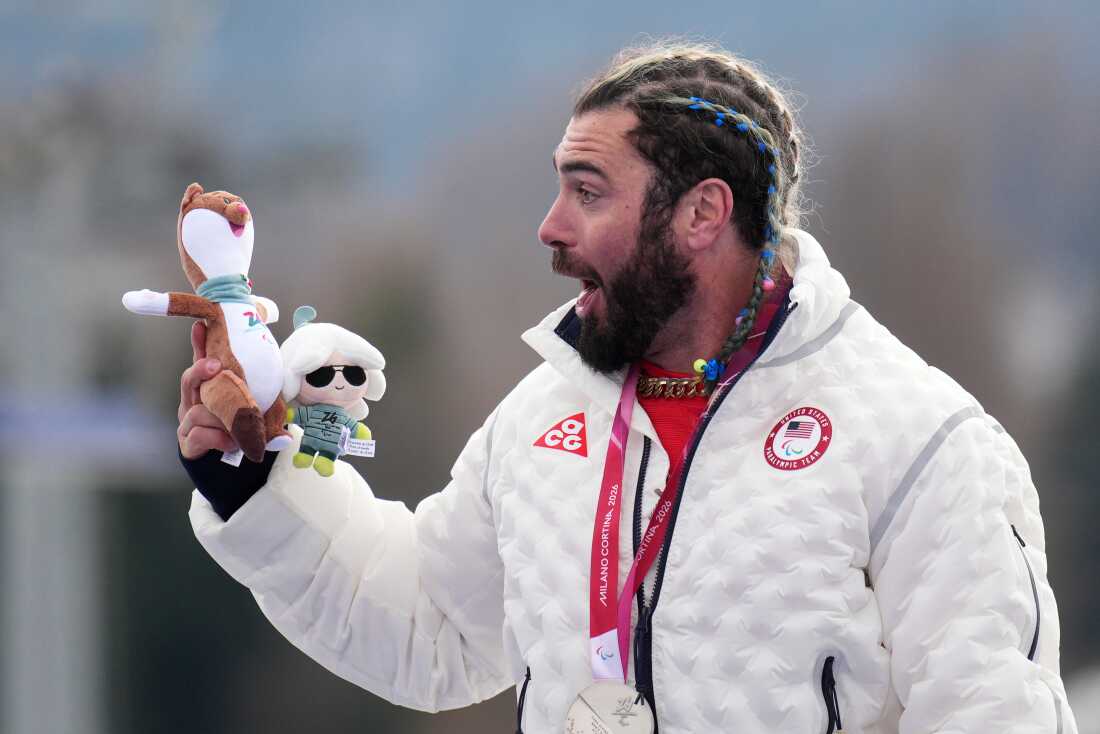
Patrick Halgren celebrates after winning a silver medal in the alpine skiing men’s super-G standing on Monday.
Emilio Morenatti/AP
hide caption
toggle caption
Emilio Morenatti/AP
The 33-year-old wasn’t necessarily a favorite for the podium, having placed 26th and 24th at his events in the Beijing Paralympics. But Halgren said he felt the presence of his late twin brother Sven — his source of encouragement to try para Alpine skiing — who died in a motorcycle accident in 2016. Halgren himself lost most of his left leg, and nearly his life, in a motorcycle accident three years earlier.
Halgren, who wowed the internet with his winning performance and rock-star persona, dedicated his win to Sven and called it the “best day of my life until tomorrow.”
“You celebrate the victories the same as the defeats,” he added. “I’ve been blessed to have to develop my character over the last 11 years, losing my leg, and could either roll over and die, or I could become the greatest Patrick Halgren on Earth, and that’s what you’re seeing.”
In snowboarding:

Kate Delson, center, and Brenna Huckaby, right, of Team U.S. pose for a photo on the podium during the medal ceremony for the para snowboard banked slalom.
Maja Hitij/Getty Images
hide caption
toggle caption
Maja Hitij/Getty Images
Three-time Paralympian Brenna Huckaby leaves Italy as the most decorated Paralympic snowboarder in history.
She won bronze in the women’s banked slalom event — which she dominated in 2022 — to bring her career total to five medals. That came days after she finished sixth in the snowboard cross event, which she still saw as a win.
“I’m here representing a very small portion of people who want to see themselves represented,” Huckaby said. “They want to know that if they lose their leg above the knee, life does not end. I accomplished that here simply by being. So I’m happy.”

First-time Paralympian Kate Delson medaled in both of those events, winning gold in the banked slalom and silver in snowboard cross.
“I was just stoked to be here, I think it’s such a fun course,” Delson said after. “I got to get a medal with my teammate, [Huckaby], one of my best friends in the world, that’s unreal.”
On the men’s side, Noah Elliott won gold in the banked slalom, a repeat of 2018, and silver in snowboard cross to double his career medal count.
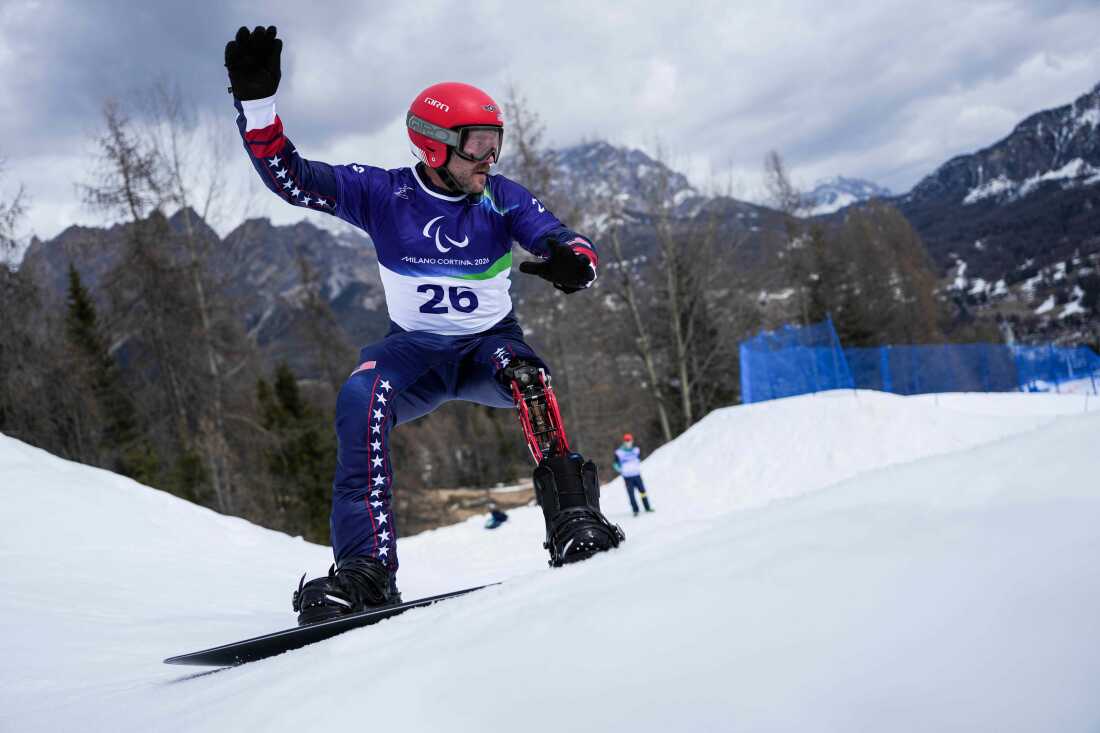
Mike Schultz brought home a bronze medal in his final Paralympics, for which he outfitted many athletes with their prosthetics.
Evgeniy Maloletka/AP
hide caption
toggle caption
Evgeniy Maloletka/AP
And Mike Schultz earned his fourth career medal — bronze in banked slalom — at the last race of his third and final Paralympics.
“To finish my last run and bring home a bronze medal, that’s storybook stuff there,” Schultz said in an emotional Instagram video after watching a compilation of congratulatory messages from his U.S. snowboarding teammates, whom he called his family.
All the while, the 44-year-old outfitted many para athletes — including some who beat him — with high-performance prosthetics, a business he has run for over a decade, which he plans to pursue in retirement.

Haverhill Considers Ban on Cryptocurrency ATMs as Consumer Protection Measure

The Geopolitics of Gold: A New Arena for U.S.–China Financial Coexistence

I’m 76 and joined a fitness group in my 60s. I still train every day and can do 5 muscle-ups.

‘Forbidden Fruits’ Review: The Salesgirls Are Witches in a Depraved Satirical Thriller That’s Like ‘Mean Girls’ Meets ‘The Craft’ Touched with Something Darker

U.S. Court Rules Against RFK Jr.’s Vaccine Policies

Florida High School Football Rankings: Top 25 teams – Oct. 21

How old is Bo Nix? What to know about Oregon quarterback ahead of 2024 NFL Draft

Cleary's 21 help Le Moyne down Central Connecticut State 69-64 in OT

99th annual Pony Swim held in Virginia

Indiana Members Credit Union announced as new anchor tenant at Bottleworks District

Minnesota bill would ban warrants allowing police to collect data from devices near a crime scene

Kallas says ‘no appetite’ to shift mandate of EU Hormuz naval mission

Trump predicts US will have ‘honour of taking Cuba’ amid power blackout

MTG on Trump’s Iran war: ‘Why would an American president do that?’

Video: Michael B. Jordan Celebrates Oscar Win at In-N-Out
-

 Oklahoma1 week ago
OSSAA unveils Class 6A-2A basketball state tournament brackets, schedule
-

 Oklahoma2 days ago
Family rallies around Oklahoma father after head-on crash
-

 Michigan1 week ago
Operation BBQ Relief helping with Southwest Michigan tornado recovery
-

 Southeast1 week ago
‘90 Day Fiancé’ alum’s boyfriend on trial for attempted murder over wild ‘Boca Bash’ accusations
-

 Nebraska4 days ago
Wildfire forces immediate evacuation order for Farnam residents
-

 Health1 week ago
Ancient herb known as ‘nature’s Valium’ touted for improving sleep and anxiety
-
 Business1 week ago
Commentary: In two new court cases, judges find that AI does not have human intelligence
-

 Technology1 week ago
Time’s running out to get a free gift card when you preorder a new MacBook