News
Rare earths: Federal backing and tech advances aim to help the U.S. catch up to China

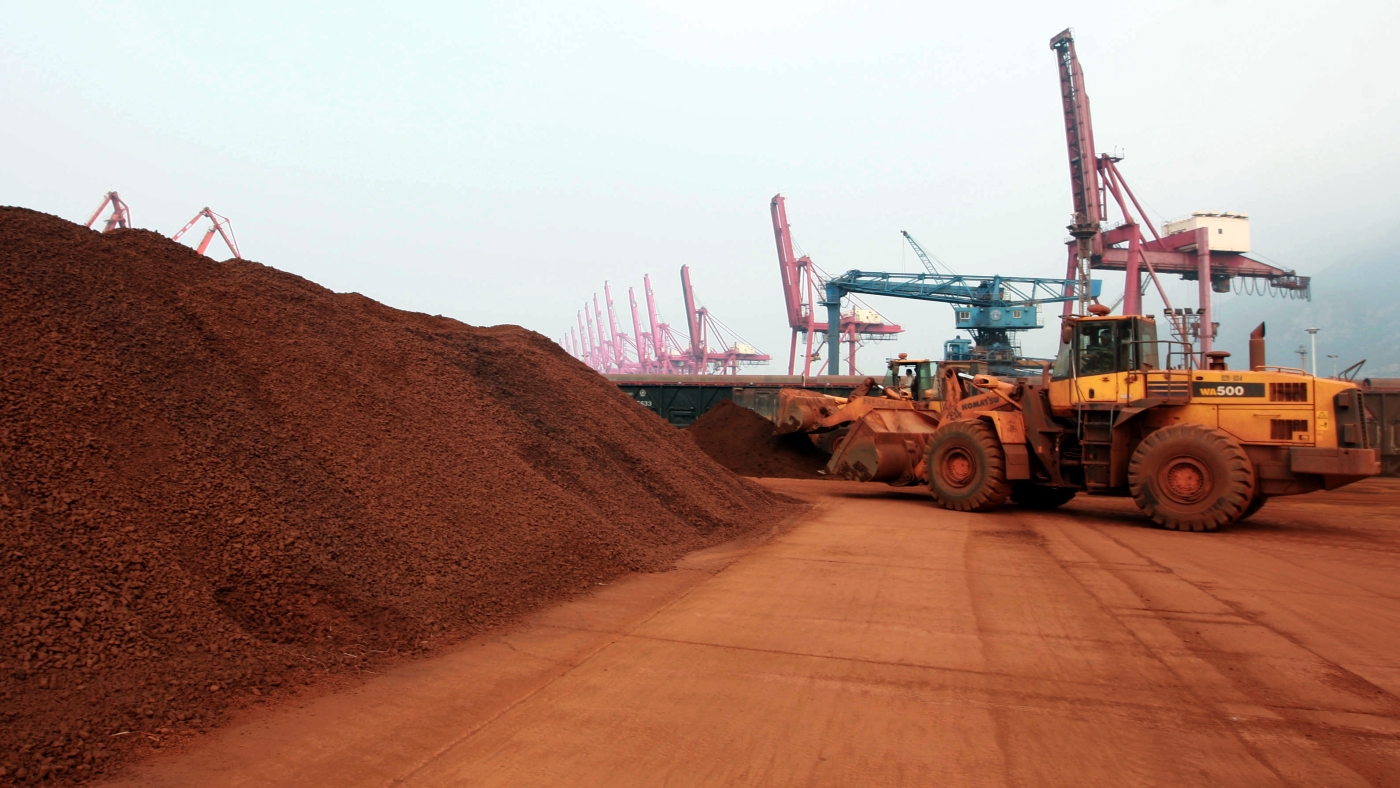
A rare earth minerals mine in China’s Jiangsu province, photographed in 2010.
/AFP via Getty Images
hide caption
toggle caption
/AFP via Getty Images
With names like neodymium and dysprosium, rare-earth elements sound exotic — and their perceived scarcity has only added to the mystique.
In reality, rare earths aren’t that rare, but just difficult to extract and refine. Yet they’ve become indispensable to modern life, embedded in everything from our smartphones and electric-vehicle motors to wind turbines and medical imaging machines.
And demand is climbing.
The real choke point is processing and refining — a complex and environmentally sensitive step that the U.S. has lagged behind in and that China now dominates, controlling nearly 90% of global output.
The need for high-torque, compact EV motors — which use rare-earth magnets that are three to four times stronger than conventional magnets — is helping drive demand. Production of these motors is soaring by roughly a third each year. Military aircraft also rely heavily on these elements; one RAND estimate suggests an F-35 contains over 900 pounds of rare-earth materials in its engines and electronics.
Taking a private-public approach
To reduce reliance on foreign supply, the White House is pursuing U.S. self-sufficiency in rare-earth production. The federal government under President Trump has supported the sector in ways that depart from traditional free-market principles. Rather than relying solely on private industry, the federal government has followed a strategy similar to China’s, providing hundreds of millions in loans and even taking stakes in key mines and startups.
Indiana-based ReElement Technologies is among the beneficiaries of this government backing. Earlier this month, the Trump administration announced a partnership between the Pentagon, via its Office of Strategic Capital (OSC), ReElement and Vulcan Elements, a North Carolina based firm that produces rare-earth magnets for military applications.
ReElement says it has developed a more efficient, environmentally friendly method of rare-earth processing and recycling that involves chromatography. The company operates a commercialization facility in Noblesville, Ind., with a larger production site in Marion, Ind., slated to come online next year.

Stacks separate rare earths at ReElement’s Noblesville, Ind., plant.
ReElement Technologies Corp.
hide caption
toggle caption
ReElement Technologies Corp.
ReElement Technologies CEO Mark Jensen says confidently that by the end of 2026, “we’ll be the largest producer of rare earth oxides in the United States.”

Because China’s dominance in refining is so great, the U.S. benchmark for success is modest, according to Bert Donnes, a research analyst at investment banking firm William Blair.
ReElement, in partnership with Vulcan Elements, aims in the next few years to produce 10,000 metric tons of neodymium-iron-boron magnets used not only in EVs, but also wind-turbine generators, hard-disk drives and MRI machines. Even that ambitious target is a fraction of the approximately 230,000 tons produced globally in 2024, according to the Institute of Electrical and Electronics Engineers, or IEEE.
“I would say if you see those numbers, you think this is going to be a massive facility,” says Donnes of ReElement’s current operation. “It isn’t.”
Compared to a traditional processing facility, ReElement’s operation is compact, he says, helping avoid any “not-in-my-backyard” (NIMBY) backlash. “So it’s not like people are scared of this process. Maybe they don’t know about it as much because you can keep the process so small,” he says.
How the U.S. lost its lead
Starting in the 1980s, China began surging ahead of the U.S. and the rest of the world in rare earth production. Around the same time, environmental concerns mounted at the only major U.S. rare earth mine, Mountain Pass in California, where spills of radioactive and toxic wastewater — byproducts of refining — raised alarms.
Mountain Pass is an open-cut mine where they “drill and blast, blend their types and locations in the pit” before grinding the solid materials into smaller particles, according to Kelton Smith, a lead process engineer for mining at Tetra Tech, a global consulting and engineering services firm. A flotation process then concentrates the rare earths that are in turn leached with hydrochloric acid.
The California mine had to halt production multiple times over the years due to environmental concerns. During that time, it changed ownership and ultimately filed for bankruptcy protection before being acquired by MP Materials in 2017, which reopened the mine.
The troubles at Mountain Pass helped China to gain a foothold and eventually overtake the U.S. in rare earths — just as demand for them was rising. Beijing now produces about 60% of the world’s supply of these substances, according to the International Energy Agency. China also holds a substantial amount of the world’s proven reserves of the ores that contain these elements — roughly 34%, according to the U.S. Geological Survey, but several other countries — including the U.S. — have substantial reserves as well.
Trump’s trade war with China has made the squeeze in rare earths even more acute. Because the U.S. lacks the ability to process rare earths on a large scale, MP Materials has had to send its ore from Mountain Pass to China for refining. But no more. Instead, the company is having to ramp up its limited capability to process the ore on-site.
Further complicating the issue are expanded export controls that Beijing announced last month that require foreign companies to obtain a license in order to sell products overseas that contain Chinese-sourced rare earths.
Aaron Mintzes is deputy policy director and counsel at Earthworks, a national group focused on preventing the adverse impacts of mineral and energy development. “What we’re urging … is to do that processing in ways that reduce energy and water intensity and toxicity,” he says.

Brent Elliott, a research associate professor of geology at the University of Texas, estimates the U.S. has sufficient resources to meet demand. “It’s about the extraction potential and the logistics of getting it out of the ground in a way that is environmentally sensitive but also socially responsible,” he says.
Partly because it is environmentally messy, with toxic byproducts, Beijing has gained an advantage by ignoring those consequences. “China can do it faster and better because they don’t have the environmental concerns that we have,” Elliott says.

Many experts agree that the U.S. has enough reserves but lacks the processing capability to go along with it. Simon Jowitt, a geologist and the director of the Nevada Bureau of Mines and Geology, says there are a number of rare earth deposits in the U.S. that have potential, but it’s rarely a straightforward proposition.
“You need a source of the rare earths, some way of transporting the rare earths, some way of concentrating the rare earths, and some way of putting those rare earths into a form that they can then be extracted,” Jowitt says. “If you don’t have one of those, then you end up with something that isn’t a mineral deposit and you’ll never get anything out of it.”
Last year, China decreed new regulations for rare earth processing that include strict environmental and safety regulations, but it remains to be seen how stringent enforcement will be.
Meanwhile, it not only processes its own ore, but it imports raw ore from places like Southeast Asia and Africa. It’s part of a broader strategy by China to set itself up as a global hub for rare earths, according to Gracelin Baskaran, director of the Critical Minerals Security Program at the Center for Strategic and International Studies.
“They put a lot of state resources behind building processing capabilities, such that the minerals come from different places and then they get sent to China for refining,” Baskaran says. “What China has been extraordinarily good at is connecting their foreign policy to secure rare earths from around the world.”
A new process and federal investments
Refining is where ReElement comes in. The company uses large columns in a specialized filtration process developed at Purdue University to extract and purify valuable metals from raw ore, but also recycled rare earths from old magnets. The process is more efficient and less environmentally damaging than older methods, such as those used by China.
Jensen, the ReElement CEO, says that method, known as solvent extraction, is “ecologically challenging” and difficult to scale. “It’s a dead technology,” he says, adding that his company’s ultimate goal isn’t necessarily to achieve U.S. dominance, but to produce enough rare earths domestically to break China’s monopoly.
The One Big Beautiful Bill passed in July appropriated $7.5 billion toward securing critical minerals. Days later, the Pentagon’s Office of Strategic Capital announced a $400 million investment in MP Materials, making the U.S. government the company’s largest shareholder. The Pentagon agency plans further investments in “[c]ritical components, raw materials, and rare earth elements utilized in microelectronic manufacturing.”
As part of the deal with ReElement, Vulcan Elements will get a $620 million loan from the Pentagon’s OSC with an additional $50 million provided by the Department of Commerce under the CHIPS and Science Act signed by former President Joe Biden. ReElement Technologies will receive an $80 million loan to support the expansion of its recycling and processing operations.
“I think we’re making big strides now because of all the grants and all the critical-mineral-focused grants coming out,” says Elliott, the University of Texas geology professor. “I think it really can set us up for success.”





The Supreme Court
Win McNamee/Getty Images
hide caption
toggle caption
Win McNamee/Getty Images
The Supreme Court on Monday intervened in New York’s redistricting process, blocking a lower court decision that would likely have flipped a Republican congressional district into a Democratic district.
At issue is the midterm redrawing of New York’s 11th congressional district, including Staten Island and a small part of Brooklyn. The district is currently held by a Republican, but on Jan. 21, a state Supreme Court judge ruled that the current district dilutes the power of Black and Latino voters in violation of the state constitution.
GOP Rep. Nicole Malliotakis, who represents the district, and the Republican co-chair of the state Board of Elections promptly appealed to the U.S. Supreme Court, asking the justices to block the redrawing as an unconstitutional “racial gerrymander.” New York’s congressional election cycle was set to officially begin Feb. 24, the opening day for candidates to seek placement on the ballot.
As in this year’s prior mid-decade redistricting fights — in Texas and California — the Trump administration backed the Republicans.
Voters and the State of New York contended it’s too soon for the Supreme Court to wade into this dispute. New York’s highest state court has not issued a final judgment, so the voters asserted that if the Supreme Court grants relief now “future stay applicants will see little purpose in waiting for state court rulings before coming to this Court” and “be rewarded for such gamesmanship.” The state argues this is an issue for “New York courts, not federal courts” to resolve, and there is sufficient time for the dispute to be resolved on the merits.
The court majority explained the decision to intervene in 101 words, which the three dissenting liberal justices summarized as “Rules for thee, but not for me.”
The unsigned majority order does not explain the Court’s rationale. It says only how long the stay will last, until the case moves through the New York State appeals courts. If, however, the losing party petitions and the court agrees to hear the challenge, the stay extends until the final opinion is announced.
Dissenting from the decision were Justices Sonia Sotomayor, Elena Kagan, and Ketanji Brown Jackson. Writing for the three, Sotomayor said that if nonfinal decisions of a state trial court can be brought to highest court, “then every decision from any court is now fair game.” More immediately, she noted, “By granting these applications, the Court thrusts itself into the middle of every election-law dispute around the country, even as many States redraw their congressional maps ahead of the 2026 election.”
Monday’s Supreme Court action deviates from the court’s hands-off pattern in these mid-term redistricting fights this year. In two previous cases — from Texas and California — the court refused to intervene, allowing newly drawn maps to stay in effect.
Requests for Supreme Court intervention on redistricting issues has been a recurring theme this term, a trend that is likely to grow. Earlier last month the high court allowed California to use a voter-approved, Democratic-friendly map. California’s redistricting came in response to a GOP-friendly redistricting plan in Texas that the Supreme Court also permitted to move forward. These redistricting efforts are expected to offset one another.
But the high court itself has yet to rule on a challenge to Louisiana’s voting map, which was drawn by the state legislature after the decennial census in order to create a second majority-Black district. Since the drawing of that second majority-black district, the state has backed away from that map, hoping to return to a plan that provides for only one majority-minority district.
The Supreme Court’s consideration of the Louisiana case has stretched across two terms. The justices failed to resolve the case last term and chose to order a second round of arguments this term adding a new question: Does the state’s intentional creation of a second majority-minority district violate the constitution’s Fourteenth and Fifteenth Amendments’ guarantee of the right to vote and the authority of Congress to enforce that mandate?
Following the addition of the new question, the state of Louisiana flipped positions to oppose the map it had just drawn and defended in court. Whether the Supreme Court follows suit remains to be seen. But the tone of the October argument suggested that the court’s conservative supermajority is likely to continue undercutting the 1965 Voting Rights Act.

Note: Map shows the area with a shake intensity of 3 or greater, which U.S.G.S. defines as “weak,” though the earthquake may be felt outside the areas shown. The New York Times
A minor earthquake with a preliminary magnitude of 3.5 struck in Central California on Monday, according to the United States Geological Survey.
The temblor happened at 7:17 a.m. Pacific time about 6 miles northwest of Pinnacles, Calif., data from the agency shows.
As seismologists review available data, they may revise the earthquake’s reported magnitude. Additional information collected about the earthquake may also prompt U.S.G.S. scientists to update the shake-severity map.
Source: United States Geological Survey | Notes: Shaking categories are based on the Modified Mercalli Intensity scale. When aftershock data is available, the corresponding maps and charts include earthquakes within 100 miles and seven days of the initial quake. All times above are Pacific time. Shake data is as of Monday, March 2 at 10:20 a.m. Eastern. Aftershocks data is as of Monday, March 2 at 11:18 a.m. Eastern.

The U.S. and Israel have been conducting strikes against targets in Iran since Saturday morning, with the aim of toppling Tehran’s clerical regime. Iran has fired back, with retaliatory assaults featuring missiles and drones targeting several Gulf countries and American bases in the Middle East.
“All six aircrew ejected safely, have been safely recovered, and are in stable condition. Kuwait has acknowledged this incident, and we are grateful for the efforts of the Kuwaiti defense forces and their support in this ongoing operation,” Central Command said.
“The cause of the incident is under investigation. Additional information will be released as it becomes available,” it added.
In a separate statement later Monday, Central Command said that American forces had been killed during combat since the strikes began.
“As of 7:30 am ET, March 2, four U.S. service members have been killed in action. The fourth service member, who was seriously wounded during Iran’s initial attacks, eventually succumbed to their injuries,” it said.
Major combat operations continue and our response effort is ongoing. The identities of the fallen are being withheld until 24 hours after next of kin notification,” Central Command added.
This story has been updated.

Home Gym Supplies Squat Rack Cage Package Released to Market for Exercise Lovers by Strongway Gym Supplies

‘Hoppers’ review: Who can argue with hilarious talking animals?

‘God of War’ Creator Says TV First Look Is ‘So Dumb’ and ‘Terrible’: Looks Like He’s ‘S—ing in the Woods’

How President Trump’s Image Permeates the White House and Beyond

The Latest on Natural Ozempic Alternatives: How To Lose Weight Without GLP-1s

Florida High School Football Rankings: Top 25 teams – Oct. 21

Cleary's 21 help Le Moyne down Central Connecticut State 69-64 in OT

How old is Bo Nix? What to know about Oregon quarterback ahead of 2024 NFL Draft

99th annual Pony Swim held in Virginia

Indiana Members Credit Union announced as new anchor tenant at Bottleworks District

Trump sends official notification to Congress on strikes against Iran

Unexpected birth brings hope to near-extinct Amazon tribe
Supreme Court blocks redrawing of New York congressional map, dealing a win for GOP

Map: Earthquake Shakes Central California

Gas prices could jump as Middle East tensions threaten global oil supply
-

 World5 days ago
Exclusive: DeepSeek withholds latest AI model from US chipmakers including Nvidia, sources say
-

 Massachusetts5 days ago
Mother and daughter injured in Taunton house explosion
-

 Denver, CO5 days ago
10 acres charred, 5 injured in Thornton grass fire, evacuation orders lifted
-

 Louisiana1 week ago
Wildfire near Gum Swamp Road in Livingston Parish now under control; more than 200 acres burned
-

 Technology1 week ago
YouTube TV billing scam emails are hitting inboxes
-

 Politics1 week ago
OpenAI didn’t contact police despite employees flagging mass shooter’s concerning chatbot interactions: REPORT
-

 Technology1 week ago
Stellantis is in a crisis of its own making
-

 News1 week ago
World reacts as US top court limits Trump’s tariff powers